शास्त्र विंग · वाद्य-पट्टिका · Instrument Plate
क्लैरिनेट
Clarinet
आर. डी. बर्मन के सपनों का वाद्य — बॉलीवुड के स्वर्ण काल का गुप्त नायक
अन्य नामक्लारिनेट · शहनाई का पश्चिमी रूप · Klarinette · Clarinette
एक पंक्तिक्लैरिनेट एक सिंगल-रीड लकड़ी का वाद्य यंत्र है जो अपनी गर्म, मखमली ध्वनि से हिंदी फ़िल्म संगीत में शहनाई-जैसी अभिव्यक्ति और पश्चिमी जैज़ की खुलापन दोनों लाया।
परिचय
Overviewक्लैरिनेट — वह वाद्य जिसके बिना हिंदी सिनेमा का स्वर्ण काल अधूरा होता। जब आप 'दम मारो दम' सुनते हैं और उस गीत में जो सपनीली, आह-जैसी ध्वनि है — वह है मनोहारी सिंह की क्लैरिनेट। जब 'रैना बीती जाए' में रात की खामोशी बोलती है — वह है क्लैरिनेट का मखमली स्वर। पंचम दा (आर. डी. बर्मन) के सर्वोत्तम गीतों में क्लैरिनेट वह रंग है जो हर चीज़ को अलग बनाता है। जर्मनी में जन्मे इस यंत्र को भारत में एक अनोखी पहचान मिली। पश्चिम में क्लैरिनेट जैज़ और शास्त्रीय संगीत का प्रतीक है — बेनी गुडमैन और मोज़ार्ट ने इसे अमर किया। लेकिन भारत में, मनोहारी सिंह जैसे वादकों ने इसे कुछ और बना दिया — एक ऐसा वाद्य जो शहनाई की तरह भारतीय भावनाओं को और पश्चिमी जैज़ की खुलेपन को एकसाथ बोल सके। भारत में क्लैरिनेट का आगमन ब्रिटिश सेना के साथ हुआ और फिर गोवा के ईसाई संगीतकारों के माध्यम से मुंबई पहुँचा। यह समुदाय — गोअन, ब्राह्मण, और उत्तर भारतीय संगीतकारों का एक अनूठा संयोजन — वह था जिसने बॉलीवुड के रेकॉर्डिंग स्टूडियो को जीवंत रखा। इनमें से अनेक नाम इतिहास में नहीं हैं, लेकिन उनकी ध्वनि करोड़ों भारतीयों के दिलों में अमर है। आज, जब डिजिटल संगीत का दौर है, क्लैरिनेट की लाइव ध्वनि की जगह सॉफ्टवेयर प्लग-इन ने ली है। लेकिन मनोहारी सिंह के रिकॉर्डिंग सुनकर जो अनुभव होता है — वह किसी डिजिटल प्लग-इन से संभव नहीं। वह ध्वनि एक इंसान की साँस, एक कलाकार की आत्मा से उत्पन्न थी।
अंग्रेज़ी में पढ़ें · Read in English
Clarinet — the instrument without which Hindi cinema's golden era would have been incomplete. When you listen to 'Dum Maro Dum' and hear that dreamy, sigh-like sound — that is Manohari Singh's clarinet. When in 'Raina Beeti Jaye' the silence of night speaks — that is clarinet's velvety voice. In Pancham da's (R. D. Burman's) best songs, clarinet is the color that makes everything different.
Born in Germany, this instrument found a unique identity in India. In the West, clarinet symbolizes jazz and classical music — Benny Goodman and Mozart immortalized it. But in India, players like Manohari Singh made it something else — an instrument that could simultaneously speak the Indian emotions of shehnai and the openness of Western jazz.
Clarinet's arrival in India came with the British army and then reached Mumbai through Goan Christian musicians. This community — a unique blend of Goan, Brahmin, and North Indian musicians — was what kept Bollywood recording studios alive. Many of their names are not in history books, but their sound is immortal in the hearts of hundreds of millions of Indians.
Today, in the era of digital music, software plugins have replaced live clarinet. But the experience of listening to Manohari Singh's recordings cannot be replicated by any digital plugin. That sound was born from a human breath, an artist's soul.
काव्य-पंक्ति · The Verse
काव्य-पंक्ति
क्लैरिनेट की आवाज़ में रात का वो रंग है, जो दिल में उतर जाए और जाए ना।
— अज्ञात In clarinet's voice is that shade of night, Which descends into the heart and does not leave.
वर्गीकरण
ClassificationNatya Shastra
सुषिर — वायु वाद्य यंत्र, एकल रीड सहित
Sushira — Wind Instrument with Single Reed
नाट्यशास्त्र में क्लैरिनेट का उल्लेख नहीं है। आधुनिक भारतीय वर्गीकरण में इसे 'सुषिर' वर्ग में रखा जाता है। अपनी मखमली ध्वनि के कारण इसे शहनाई और बाँसुरी के पश्चिमी समकक्ष के रूप में देखा जाता है।
Clarinet is not mentioned in the Natya Shastra. In modern Indian classification it belongs to the 'Sushira' category. Its velvety sound is seen as a Western equivalent of shehnai and bansuri.
Western
Woodwind Instrument
Single Reed Aerophone
पश्चिमी वर्गीकरण में क्लैरिनेट लकड़ी वाद्य परिवार (Woodwind) का सदस्य है — एकल-रीड एरोफोन। बाँसुरी (Flute), ओबो (Oboe), और बेसून (Bassoon) इसके परिवार के साथी हैं।
In Western classification, clarinet is a member of the woodwind family — single-reed aerophone. Flute, oboe, and bassoon are its family companions.
Hornbostel Sachs
422.212
Single-reed aerophone — cylindrical bore instrument
सिनेमा में
In Cinemaहिंदी सिनेमा में क्लैरिनेट का सबसे महत्वपूर्ण नाम है — मनोहारी सिंह। वे आर. डी. बर्मन के प्राथमिक वाद्य वादक थे और क्लैरिनेट, सैक्सोफोन, और तुरही तीनों में असाधारण प्रतिभा रखते थे। 'दम मारो दम' में जो आइकॉनिक आह-जैसी ध्वनि है, 'रैना बीती जाए' में जो सपनीली धुन है, 'जय जय शिव शंकर' में जो जोशीला मध्य-भाग है — इन सबमें मनोहारी जी का योगदान अपार है। नौशाद के संगीत में भी क्लैरिनेट ने शहनाई-समान भूमिका निभाई। मदन मोहन के ग़ज़ल-प्रधान संगीत में क्लैरिनेट का उपयोग विशेष काव्यात्मक प्रभाव देता था। ओ. पी. नैयर के उत्साही गीतों में क्लैरिनेट तुरही के साथ मिलकर एक विशेष 'बिगबैंड' जैसी ध्वनि बनाती थी। एस. डी. बर्मन के शांत, गहरे गीतों में क्लैरिनेट की मखमली ध्वनि भावनात्मक गहराई जोड़ती थी।
अंग्रेज़ी में पढ़ें · Read in English
In Hindi cinema, the most important name for clarinet is Manohari Singh. He was R. D. Burman's primary instrumentalist with extraordinary talent in clarinet, saxophone, and trumpet. The iconic sigh-like sound in 'Dum Maro Dum', the dreamy melody in 'Raina Beeti Jaye', the energetic middle section in 'Jai Jai Shiv Shankar' — all carry Manohari ji's immense contribution. In Naushad's music too, clarinet played a shehnai-equivalent role. In Madan Mohan's ghazal-centered music, clarinet use gave a special poetic effect. In O. P. Nayyar's energetic songs, clarinet combined with trumpet to create a special 'big band' sound. In S. D. Burman's calm, deep songs, clarinet's velvety sound added emotional depth.
वर्तमान स्थिति
Modern Statusविवरण
भारत में क्लैरिनेट की स्थिति बदल रही है। बॉलीवुड में डिजिटल वुडविंड साउंड के आगमन ने लाइव क्लैरिनेट की माँग कम की है। लेकिन कुछ बड़े संगीतकार और स्टूडियो अभी भी लाइव क्लैरिनेट की मखमली ध्वनि को पसंद करते हैं। जैज़ और फ्यूज़न संगीत में क्लैरिनेट को नई पहचान मिल रही है। युवा भारतीय संगीतकारों में जैज़ के प्रति बढ़ती रुचि से क्लैरिनेट वादकों की माँग बढ़ रही है।
अंग्रेज़ी में पढ़ें · Read in English
Clarinet's situation in India is changing. Digital woodwind sounds in Bollywood have reduced demand for live clarinet. But some major composers and studios still prefer live clarinet's velvety sound. Clarinet is gaining new recognition in jazz and fusion music. Growing youth interest in jazz is increasing demand for clarinet players.
Estimated Players
2,000-3,000 active clarinet players in India
Revival Efforts
जैज़ दृश्य में नई रुचि और NCPA जैसी संस्थाओं में पश्चिमी वाद्य प्रशिक्षण।
अंग्रेज़ी में पढ़ें · Read in English
New interest in jazz scene and Western instrument training at institutions like NCPA.
बनावट
Physicalविवरण
क्लैरिनेट की संरचना अत्यंत परिष्कृत है। यह मुख्यतः अफ्रीकन ब्लैकवुड (Grenadilla) या हार्ड रबर (Ebonite) से बनी एक बेलनाकार (Cylindrical) नली होती है जिस पर एक जटिल कुंजी-तंत्र लगा होता है। मुखपीस (Mouthpiece) पर एक पतली रीड (Reed) धातु की लिगेचर (Ligature) से जुड़ी होती है। जब वादक मुखपीस में फूँकता है, तो रीड कंपित होकर ध्वनि उत्पन्न करती है। कुंजियाँ दबाने से विभिन्न टोन-होल (Tone Holes) बंद या खुले होते हैं जिससे सुर बदलता है। बोएम प्रणाली (Boehm System) के आधुनिक क्लैरिनेट में १७ कुंजियाँ और ६ रिंग होती हैं। भारतीय संगीत के लिए क्लैरिनेट में कोई विशेष बदलाव नहीं किया जाता — वादक अपने भाव-प्रदर्शन से और उँगलियों की विशेष तकनीकों से भारतीय अलंकार निकालते हैं।
अंग्रेज़ी में पढ़ें · Read in English
Clarinet's construction is highly refined. It is primarily a cylindrical tube of African blackwood (grenadilla) or hard rubber (ebonite) fitted with a complex key mechanism. On the mouthpiece, a thin reed is attached with a metal ligature. When the player blows into the mouthpiece, the reed vibrates to produce sound. Pressing keys opens or closes various tone holes, changing pitch. Modern Boehm system clarinets have 17 keys and 6 rings. No special modifications are made to clarinet for Indian music — players use their expressive breath control and special finger techniques to produce Indian ornamentations.
Dimensions
66-69 cm (Bb soprano clarinet)
3-4 cm (barrel diameter)
700-850 grams
Strings Or Keys
क्लैरिनेट में कोई तार नहीं होता। ध्वनि रीड के कंपन से उत्पन्न होती है। बोएम प्रणाली में १७ कुंजियाँ और ६ रिंग हैं।
Clarinet has no strings. Sound is produced by reed vibration. Boehm system has 17 keys and 6 rings.
17 keys + 6 rings (Boehm system)
Cane reed, silver or nickel keys
Tuning
Bb (बी-फ्लैट) ट्यूनिंग — पश्चिमी मानक; भारतीय संगीत के लिए एम्बुशर और साँस से समायोजन
Bb (B-flat) tuning — Western standard; adjustment via embouchure and breath for Indian music
Bb = concert pitch standard (transposing instrument)
D3 से Bb6 तक — लगभग साढ़े तीन सप्तक
Construction
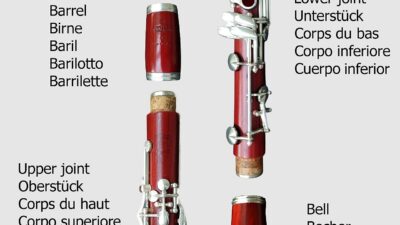
मुखपीस एक कप-आकार का टुकड़ा है जिस पर एक पतली रीड लगाई जाती है। रीड का कंपन क्लैरिनेट की ध्वनि उत्पन्न करता है।
Mouthpiece is a cup-shaped piece on which a thin reed is attached. Reed's vibration produces clarinet's sound.
मुखपीस और मुख्य नली के बीच की छोटी ट्यूब जिसे खींच-धकेलकर ट्यूनिंग समायोजित की जाती है।
Short tube between mouthpiece and main body for tuning adjustment by pushing or pulling.
मुख्य नली के दो भाग जिन पर अधिकांश कुंजियाँ लगी होती हैं। यहाँ उंगलियों के विभिन्न संयोजनों से सुर बजाए जाते हैं।
Two sections of the main tube on which most keys are mounted. Different finger combinations here produce different pitches.
नीचे का विस्तृत खुला सिरा जहाँ से ध्वनि बाहर निकलती है। क्लैरिनेट का घंटा वायलिन के f-छेद जैसा काम करता है।
Lower flared open end from which sound emerges. Clarinet's bell functions similarly to violin's f-holes.
बोएम प्रणाली की जटिल कुंजियाँ और रिंग जो टोन-होल को खोलती-बंद करती हैं। यह तंत्र क्लैरिनेट को पूर्ण क्रोमेटिक स्केल बजाने में सक्षम बनाता है।
Complex Boehm system keys and rings that open and close tone holes. This mechanism enables clarinet to play a full chromatic scale.
ध्वनि-चरित्र
SoundTonal Character
क्लैरिनेट की ध्वनि अत्यंत विविध है — इसमें तीन अलग-अलग 'रजिस्टर' हैं जिनकी ध्वनि एकदम भिन्न है। निचला रजिस्टर ('चालुमो' — Chalumeau) गहरी, गर्म, और मखमली होती है — जैसे किसी गहरे कंठ वाले गायक की धीमी आवाज़। मध्य रजिस्टर ('थ्रोट टोन्स') थोड़ी खुली और पारदर्शी होती है। ऊपरी रजिस्टर ('क्लैरिनो') उज्ज्वल, चमकदार, और शहनाई-जैसी होती है। यही कारण है कि हिंदी फ़िल्म संगीत में क्लैरिनेट शहनाई की ध्वनि के करीब है — और इसीलिए मनोहारी सिंह जैसे वादकों ने इसका इतना प्रभावशाली उपयोग किया। क्लैरिनेट की ध्वनि में एक ऐसी उदासीनता है जो भारतीय भावनाओं को बयान करती है।
अंग्रेज़ी में पढ़ें · Read in English
Clarinet's sound is extremely varied — it has three distinct 'registers' with completely different sounds. The lower register ('chalumeau') is deep, warm, and velvety — like the quiet voice of a deep-throated singer. The middle register ('throat tones') is slightly open and transparent. The upper register ('clarino') is bright, luminous, and shehnai-like. This is why clarinet resembles shehnai in Hindi film music — and why players like Manohari Singh used it so effectively. Clarinet's sound has a wistfulness that expresses Indian emotions.
Timbre
मखमली, गर्म, और बहु-रंगी — निचले सुर में गहरा, ऊपरी सुर में शहनाई-जैसा उज्ज्वल
अंग्रेज़ी में पढ़ें · Read in English
Velvety, warm, multi-tonal — deep in low register, luminous like shehnai in upper register
Dynamic Range
विस्तृत — बहुत धीमे से तीव्र तक, विशेषकर पियानिसिमो में अत्यंत कोमल
अंग्रेज़ी में पढ़ें · Read in English
Wide — from very soft to intense, especially extraordinarily gentle in pianissimo
Comparison
शहनाई की मिठास, बाँसुरी की सादगी, और मानव कंठ की भावनात्मकता का संयोजन
अंग्रेज़ी में पढ़ें · Read in English
A blend of shehnai's sweetness, bansuri's simplicity, and human voice's emotionality
वादन-तकनीक
Playing Techniqueविवरण
क्लैरिनेट बजाना सीखना अपेक्षाकृत जल्दी शुरू होता है — पहले कुछ सुर दो-तीन हफ़्ते में निकलने लगते हैं। लेकिन महारत के लिए वर्षों की साधना चाहिए। मुखपीस को नीचे के होंठ और दाँतों के बीच रखकर फूँका जाता है। एम्बुशर (Embouchure) — होंठों की मांसपेशियाँ और उनका नियंत्रण — ध्वनि-गुणवत्ता निर्धारित करती है। भारतीय संगीत के लिए क्लैरिनेट बजाने में उंगलियों की विशेष तकनीक का उपयोग होता है — 'हाफ-होलिंग' (Half-holing) यानी किसी टोन-होल को आधा दबाकर मींड जैसा प्रभाव निकालना। गमक के लिए तेज़ साँस के झटके दिए जाते हैं। मनोहारी सिंह ने इन तकनीकों को इस कदर सिद्ध किया था कि उनकी क्लैरिनेट में शहनाई और मानव कंठ दोनों की गूँज मिलती थी।
अंग्रेज़ी में पढ़ें · Read in English
Learning clarinet starts relatively quickly — the first few notes emerge in two-three weeks. But mastery requires years of practice. The mouthpiece is held between the lower lip and teeth to blow. Embouchure — lip muscles and their control — determines sound quality. Indian music clarinet playing uses special finger techniques — 'half-holing' means partially covering a tone hole to produce meend-like effects. For gamak, sharp breath impulses are used. Manohari Singh perfected these techniques to such an extent that his clarinet resonated with both shehnai and human voice.
Posture
खड़े होकर या बैठकर, क्लैरिनेट को ४५ डिग्री के कोण पर सामने की ओर झुकाकर, दोनों हाथों से — बायाँ ऊपरी जोड़ पर, दायाँ निचले जोड़ पर
अंग्रेज़ी में पढ़ें · Read in English
Standing or sitting, clarinet held at approximately 45-degree angle forward — left hand on upper joint, right hand on lower joint
Techniques
किसी टोन-होल को आधा दबाकर दो सुरों के बीच की पिच पर ध्वनि उत्पन्न करना। यह भारतीय संगीत की मींड का आभास देता है। मनोहारी सिंह इस तकनीक के माहिर थे।
Partially covering a tone hole to produce a pitch between two notes, creating a meend-like effect. Manohari Singh was a master of this technique.
साँस या जबड़े की गति से सुर में एक नियमित कंपन उत्पन्न करना। भारतीय गमक का पश्चिमी समकक्ष — हिंदी फ़िल्म संगीत में भावपूर्ण धुनों के लिए उपयोग।
Producing regular pitch oscillation through breath or jaw movement. Western equivalent of Indian gamak — used for expressive melodies in Hindi film music.
अधिक साँस दबाव से क्लैरिनेट ऑक्टेव की जगह बारहवें सुर (Twelfth) पर जाती है — यह इसकी अनूठी भौतिकी है।
With increased breath pressure, clarinet jumps to the twelfth instead of an octave — this is its unique physics.
उंगलियों को धीरे-धीरे टोन-होल से उठाते हुए एक सुर से दूसरे पर सरकना। बेनी गुडमैन के 'राइसॉडी इन ब्लू' ओपनिंग जैसी तकनीक।
Sliding from one note to another by gradually lifting fingers from tone holes. The technique like Benny Goodman's 'Rhapsody in Blue' opening glissando.
जीभ के स्पर्श से सुरों को अलग-अलग (Staccato) या जुड़ा हुआ (Legato) बनाना। भारतीय फ़िल्म संगीत के अलग-अलग मूड के लिए।
Using tongue contact to make notes detached (staccato) or connected (legato). For different moods in Indian film music.
निर्माण-प्रक्रिया
Making Processविवरण
उत्तम क्लैरिनेट का निर्माण बहुत कुशल और सटीक प्रक्रिया है। नली के लिए आफ्रीकन ब्लैकवुड (Dalbergia melanoxylon) सर्वश्रेष्ठ माना जाता है — यह अत्यंत कठोर, घनत्व वाली लकड़ी है जो ध्वनि को बेहतरीन तरीके से प्रसारित करती है। सस्ते क्लैरिनेट में प्लास्टिक (ABS) या हार्ड रबर का उपयोग होता है। कुंजी-तंत्र के निर्माण में उच्च-स्तरीय मशीन-कार्य की आवश्यकता है — एक भी कुंजी का गलत स्थान टोन-होल को ठीक से बंद नहीं करेगी। रीड को अर्ज़ेंटिनाई बाँस (Arundo Donax) से बनाया जाता है और यह नाज़ुक तत्व है जो नियमित रूप से बदला जाता है। भारत में क्लैरिनेट का निर्माण लगभग नहीं होता — अधिकांश यंत्र फ्रांस (Buffet, Selmer) या जर्मनी से आयात किए जाते हैं।
अंग्रेज़ी में पढ़ें · Read in English
Making a quality clarinet is a highly skilled and precise process. African blackwood (Dalbergia melanoxylon) is considered best for the body — it is extremely hard, dense wood that transmits sound superbly. Inexpensive clarinets use plastic (ABS) or hard rubber. Key mechanism manufacturing requires high-level machine work — even a slightly misaligned key will not properly seal a tone hole. Reeds are made from Argentine cane (Arundo Donax) and are delicate elements changed regularly. Clarinet manufacturing in India is nearly non-existent — most instruments are imported from France (Buffet, Selmer) or Germany.
Materials
मुख्य नली के लिए — अत्यंत घनत्व और कठोरता से ध्वनि की सर्वोत्तम गुणवत्ता।
For main tube — extreme density and hardness provides best sound quality.
छात्र-स्तर के यंत्रों के लिए — सस्ता, मज़बूत, लेकिन ध्वनि गुणवत्ता कम।
For student-level instruments — affordable, durable, but lower sound quality.
अर्ज़ेंटिनाई Arundo Donax बाँस से बनी रीड — ध्वनि उत्पन्न करने वाला सबसे महत्वपूर्ण तत्व, नियमित रूप से बदला जाता है।
Reed made from Arundo Donax cane — the most critical sound-producing element, changed regularly.
कुंजी-तंत्र के लिए — संक्षारण-रोध और स्मूथ संचालन के लिए।
For key mechanism — for corrosion resistance and smooth operation.
Artisan Centers
विश्व के सर्वश्रेष्ठ क्लैरिनेट निर्माताओं में से एक — भारत के पेशेवर संगीतकार इनके यंत्र पसंद करते हैं।
One of world's finest clarinet makers — Indian professional musicians prefer their instruments.
उच्च-गुणवत्ता क्लैरिनेट और सैक्सोफोन के लिए प्रसिद्ध।
Renowned for high-quality clarinets and saxophones.
भारत में सर्वाधिक बिकने वाले क्लैरिनेट — छात्र और मध्यम स्तर के लिए।
Most widely sold clarinets in India — for student and intermediate level.
Time To Craft
3-4 weeks (professional handcrafted instrument)
Price Range
₹8,000–3,00,000 (student to professional)
संगीत-समूह में भूमिका
Role In EnsemblePrimary Role
बॉलीवुड ऑर्केस्ट्रा में रंगीन, भावपूर्ण लाइन — शहनाई और बाँसुरी के बीच का सेतु
अंग्रेज़ी में पढ़ें · Read in English
Colorful, expressive melodic line in Bollywood orchestra — bridge between shehnai and bansuri
Solo Capability
पूर्ण एकल वाद्य — जैज़, पश्चिमी शास्त्रीय, और कुछ भारतीय फ्यूज़न में एकल वादन।
अंग्रेज़ी में पढ़ें · Read in English
Complete solo instrument — performed as solo in jazz, Western classical, and some Indian fusion.
Accompaniment For
हिंदी फ़िल्मों के रोमांटिक गीतों में क्लैरिनेट गायक के साथ एक उदास, मखमली लाइन बनाती है।
In romantic Hindi film songs, clarinet creates a wistful, velvety line alongside the vocalist.
पूरे ऑर्केस्ट्रा में क्लैरिनेट अलग-अलग भावनात्मक रंग जोड़ती है — कभी हल्की, कभी गंभीर।
Clarinet adds different emotional colors throughout orchestra — sometimes light, sometimes grave.
लोक संगीत में
In Folk Musicक्लैरिनेट का भारतीय लोक संगीत में प्रत्यक्ष स्थान नहीं है, लेकिन इसके दो प्रमुख संपर्क-बिंदु हैं। पहला — भारतीय विवाह बैंड में, जहाँ कुछ बैंड में क्लैरिनेट वादक होते हैं जो शहनाई की जगह या उसके साथ बजाते हैं। दूसरा — गोवा और केरल की ईसाई संगीत परंपराओं में, जहाँ क्लैरिनेट चर्च बैंड का हिस्सा है। राजस्थान और पंजाब के लोक बैंड में भी क्लैरिनेट धीरे-धीरे प्रवेश कर रही है। भारतीय जैज़ दृश्य में क्लैरिनेट को एक नई पहचान मिली है। कुछ प्रयोगधर्मी संगीतकारों ने क्लैरिनेट पर हिंदुस्तानी और कर्नाटक राग बजाए हैं।
अंग्रेज़ी में पढ़ें · Read in English
Clarinet has no direct place in Indian folk music, but has two main contact points. First — in Indian wedding bands, where some bands have clarinet players playing instead of or alongside shehnai. Second — in Goan and Kerala Christian music traditions, where clarinet is part of church bands. Clarinet is also gradually entering folk bands of Rajasthan and Punjab. Clarinet has found a new identity in the Indian jazz scene. Some experimental musicians have played Hindustani and Carnatic ragas on clarinet.
क्षेत्रीय रूप
Regional VariantsBb क्लैरिनेट से एक ऑक्टेव नीचे, बड़ा और गहरे सुर वाला। भारतीय बड़े ऑर्केस्ट्रा में सीमित उपस्थिति।
One octave below Bb clarinet, larger and deeper-voiced. Limited presence in Indian large orchestras.
Bb से छोटा, ऊँचे सुर वाला — भारतीय सैन्य बैंड में प्रयुक्त।
Smaller than Bb, higher-pitched — used in Indian military bands.
प्रसिद्ध वादक
Famous Playersहिंदी फ़िल्म संगीत के सबसे महत्वपूर्ण वाद्य वादकों में से एक। आर. डी. बर्मन (पंचम दा) के सर्वोच्च विश्वस्त वाद्य-सहयोगी। क्लैरिनेट, सैक्सोफोन, और तुरही में अप्रतिम। 'दम मारो दम', 'रैना बीती जाए', 'जय जय शिव शंकर', 'शोले', 'आप की कसम' — ये सभी उनकी विरासत हैं। उनकी क्लैरिनेट की भावपूर्ण, मखमली ध्वनि ने बॉलीवुड के स्वर्ण काल को एक अलग पहचान दी।
One of Hindi film music's most important instrumentalists. R. D. Burman's (Pancham da's) supreme trusted musical collaborator. Unparalleled in clarinet, saxophone, and trumpet. 'Dum Maro Dum', 'Raina Beeti Jaye', 'Jai Jai Shiv Shankar', 'Sholay', 'Aap Ki Kasam' — all are his legacy. His clarinet's expressive, velvety sound gave Bollywood's golden era a distinct identity.
मुंबई के गोअन समुदाय के प्रतिभाशाली क्लैरिनेट और सैक्सोफोन वादक जिन्होंने बॉलीवुड के प्रारंभिक काल में महत्वपूर्ण योगदान दिया।
Talented clarinet and saxophone player from Mumbai's Goan community who made important contributions in Bollywood's early era.
अमेरिकी जैज़ के 'किंग ऑफ़ स्विंग' बेनी गुडमैन की क्लैरिनेट शैली का मुंबई के संगीतकारों पर गहरा प्रभाव था। उनके रेकॉर्ड मुंबई के संगीत जगत में बहुत पसंद किए जाते थे।
American jazz 'King of Swing' Benny Goodman's clarinet style had a deep influence on Mumbai musicians. His records were very popular in Mumbai's music world.
मुंबई के एक वरिष्ठ सेशन क्लैरिनेट वादक जिन्होंने अनेक हिंदी और मराठी फ़िल्मों में योगदान दिया।
A senior session clarinet player from Mumbai who contributed to numerous Hindi and Marathi films.
भारत में जैज़ और फ्यूज़न संगीत में युवा क्लैरिनेट वादकों की एक नई पीढ़ी उभर रही है जो भारतीय और पश्चिमी तत्वों को मिलाकर नए प्रयोग कर रही है।
A new generation of young clarinet players in Indian jazz and fusion music is emerging, making new experiments by combining Indian and Western elements.
राग-उपयुक्तता
Raag Suitabilityक्लैरिनेट की मखमली, उदास ध्वनि भैरवी के कोमल स्वरों और विदाई के भाव को बड़ी खूबसूरती से व्यक्त कर सकती है।
Clarinet's velvety, wistful sound can beautifully express Bhairavi's flat notes and farewell character.
पीलू की चंचल, हल्की-फुल्की प्रकृति क्लैरिनेट के मध्य और ऊपरी रजिस्टर में बहुत स्वाभाविक लगती है।
Pilu's playful, light character sounds very natural in clarinet's middle and upper register.
खमाज का मधुर, अर्ध-गंभीर भाव क्लैरिनेट की गर्म ध्वनि के साथ अत्यंत उपयुक्त है।
Khamaj's sweet, semi-serious character is highly suited to clarinet's warm sound.
घराना-संबंध
Gharana Connectionsमुंबई के गोअन ईसाई समुदाय की पश्चिमी वाद्य परंपरा ने बॉलीवुड को कुशल क्लैरिनेट वादक दिए।
The Western instrument tradition of Mumbai's Goan Christian community gave Bollywood skilled clarinet players.
मनोहारी सिंह, बासु चक्रवर्ती, और अन्य वाद्य वादकों का वह समूह जिसने पंचम दा के साथ मिलकर बॉलीवुड की एक पूरी संगीत-भाषा बनाई।
The group of Manohari Singh, Basu Chakravorty, and other instrumentalists who together with Pancham da created an entire musical language for Bollywood.
सीखने का मार्ग
Learning Pathविवरण
क्लैरिनेट सीखने की शुरुआत अपेक्षाकृत त्वरित है — पहले हफ्ते में ही कुछ सुर निकलने लगते हैं। लेकिन सुंदर, नियंत्रित ध्वनि के लिए महीनों की साधना चाहिए। भारत में क्लैरिनेट सीखना दुर्लभ है — अधिकांश शिक्षक बड़े शहरों में हैं। मुंबई में NCPA और KM संगीत अकादमी में क्लैरिनेट प्रशिक्षण उपलब्ध है। कुछ छात्र यूट्यूब और ऑनलाइन पाठ्यक्रमों के माध्यम से भी सीखते हैं। रीड की देखभाल — सही रीड चुनना, उसे गीला करना, और बदलना — सीखना भी आवश्यक है।
अंग्रेज़ी में पढ़ें · Read in English
Learning clarinet starts relatively quickly — some notes emerge in the first week. But beautiful, controlled sound requires months of practice. Learning clarinet is rare in India — most teachers are in large cities. Clarinet training is available at NCPA Mumbai and KM Music Conservatory. Some students also learn via YouTube and online courses. Learning reed care — selecting the right reed, moistening it, and replacing it — is also necessary.
Beginner Steps
रीड को पानी में भिगोकर, मुखपीस पर लगाकर पहली ध्वनि उत्पन्न करना — एम्बुशर का परिचय।
Soaking reed in water, attaching to mouthpiece, producing first sound — introduction to embouchure.
G, A, B, C, D (निचले रजिस्टर में) — बिना कुंजी-जटिलता के सरल सुर।
G, A, B, C, D (in lower register) — simple notes without key complexity.
Bb मेजर और G माइनर स्केल, फिर ऊपरी रजिस्टर में जाना सीखना।
Bb major and G minor scales, then learning to transition to the upper register.
सामान्य अवधि
4-6 years for basic proficiency; 10+ years for concert level
संस्थान
भारत का प्रमुख पश्चिमी संगीत केंद्र — क्लैरिनेट प्रशिक्षण यहाँ उपलब्ध है।
India's premier Western music center — clarinet training available here.
ए. आर. रहमान की संगीत अकादमी में पश्चिमी वाद्य प्रशिक्षण उपलब्ध है।
Western instrument training available at A. R. Rahman's music conservatory.
सांस्कृतिक महत्व
Cultural Significanceक्लैरिनेट भारतीय संगीत में उस खामोश योगदानकर्ता का प्रतीक है जिसे श्रेय कम मिलता है लेकिन जिसके बिना संगीत अधूरा होता। हिंदी फ़िल्म संगीत के स्वर्ण काल में गायक और संगीतकार को सारी प्रशंसा मिलती थी, लेकिन वे वाद्य वादक — जिनमें मनोहारी सिंह सर्वोच्च थे — अनजाने ही उस संगीत की आत्मा थे। क्लैरिनेट की मखमली ध्वनि उस काल की सांस्कृतिक स्मृति है — जो सुनाई दे तो तुरंत उस स्वर्णिम दौर की याद आती है।
अंग्रेज़ी में पढ़ें · Read in English
Clarinet in Indian music symbolizes the silent contributor who receives little credit but without whom music is incomplete. In Hindi film music's golden era, singers and composers received all praise, but those instrumentalists — among whom Manohari Singh was supreme — were unknowingly the soul of that music. Clarinet's velvety sound is the cultural memory of that era — when heard, it immediately evokes the golden period.
सुनने का मार्गदर्शन
The Listening Guideक्लैरिनेट को ध्यान से पहचानने के लिए, 'दम मारो दम' को सुनें — शुरू से अंत तक उस सपनीली, मखमली वुडविंड ध्वनि को ट्रैक करें। फिर 'रैना बीती जाए' सुनें — वहाँ क्लैरिनेट की उदास, रात्रिकालीन ध्वनि को महसूस करें। फिर बेनी गुडमैन का 'राइसॉडी इन ब्लू' सुनें — और समझें कि यही यंत्र जैज़ में कितना उत्साही और खुला हो सकता है।
अंग्रेज़ी में पढ़ें · Read in English
To identify clarinet attentively, listen to 'Dum Maro Dum' — track that dreamy, velvety woodwind sound from start to finish. Then listen to 'Raina Beeti Jaye' — feel clarinet's wistful, nocturnal sound there. Then listen to Benny Goodman's 'Rhapsody in Blue' — and understand how vibrant and open this same instrument can be in jazz.
श्रवण-कक्ष · The Listening Room
देखें-सुनें
दम मारो दम — मनोहारी सिंह की क्लैरिनेट · मनोहारी सिंह / आर. डी. बर्मन · varies
बेनी गुडमैन — राइसॉडी इन ब्लू · बेनी गुडमैन · varies
परिचय
Identity- Year Of Origin
- 1700
वर्गीकरण
Classification- Code
- 422.212
- Description
- Single-reed aerophone — cylindrical bore instrument
- Category
- सुषिर — वायु वाद्य यंत्र, एकल रीड सहित
- Category En
- Sushira — Wind Instrument with Single Reed
- Description
- नाट्यशास्त्र में क्लैरिनेट का उल्लेख नहीं है। आधुनिक भारतीय वर्गीकरण में इसे 'सुषिर' वर्ग में रखा जाता है। अपनी मखमली ध्वनि के कारण इसे शहनाई और बाँसुरी के पश्चिमी समकक्ष के रूप में देखा जाता है।
- Description En
- Clarinet is not mentioned in the Natya Shastra. In modern Indian classification it belongs to the 'Sushira' category. Its velvety sound is seen as a Western equivalent of shehnai and bansuri.
Hornbostel Sachs
Natya Shastra
अन्य विवरण
More Details- मुखपीस और रीड (Mouthpiece & Reed) — मुखपीस एक कप-आकार का टुकड़ा है जिस पर एक पतली रीड लगाई जाती है। रीड का कंपन क्लैरिनेट की ध्वनि उत्पन्न करता है। · Mouthpiece and Reed
- बैरल (Barrel) — मुखपीस और मुख्य नली के बीच की छोटी ट्यूब जिसे खींच-धकेलकर ट्यूनिंग समायोजित की जाती है। · Barrel
- ऊपरी जोड़ और निचला जोड़ (Upper & Lower Joint) — मुख्य नली के दो भाग जिन पर अधिकांश कुंजियाँ लगी होती हैं। यहाँ उंगलियों के विभिन्न संयोजनों से सुर बजाए जाते हैं। · Upper and Lower Joint
- बेल (Bell — घंटा) — नीचे का विस्तृत खुला सिरा जहाँ से ध्वनि बाहर निकलती है। क्लैरिनेट का घंटा वायलिन के f-छेद जैसा काम करता है। · Bell
- कुंजी-तंत्र (Key Mechanism) — बोएम प्रणाली की जटिल कुंजियाँ और रिंग जो टोन-होल को खोलती-बंद करती हैं। यह तंत्र क्लैरिनेट को पूर्ण क्रोमेटिक स्केल बजाने में सक्षम बनाता है। · Key Mechanism
- System
- Bb (बी-फ्लैट) ट्यूनिंग — पश्चिमी मानक; भारतीय संगीत के लिए एम्बुशर और साँस से समायोजन
- System En
- Bb (B-flat) tuning — Western standard; adjustment via embouchure and breath for Indian music
- Standard Tuning
- Bb = concert pitch standard (transposing instrument)
- Range
- D3 से Bb6 तक — लगभग साढ़े तीन सप्तक
Construction
Tuning
Timbre
मखमली, गर्म, और बहु-रंगी — निचले सुर में गहरा, ऊपरी सुर में शहनाई-जैसा उज्ज्वल
रोचक तथ्य
Margin Notesमनोहारी सिंह के बारे में कहा जाता है कि वे आर. डी. बर्मन के लिए न केवल वाद्य वादक थे, बल्कि एक सांगीतिक सलाहकार भी थे। कई गीतों के इंट्रो और इंटरल्यूड की संरचना उनके सुझावों पर बनी।
It is said about Manohari Singh that he was not merely an instrumentalist for R. D. Burman but also a musical advisor. The structure of intros and interludes of many songs was built on his suggestions.
क्लैरिनेट एकमात्र वाद्य यंत्र है जो ओवर-ब्लो करने पर ऑक्टेव (Octave) की जगह ट्वेल्थ (Twelfth — बारहवाँ सुर) पर जाता है। यह इसकी बेलनाकार (Cylindrical) नली के कारण है।
Clarinet is the only wind instrument that when overblown produces a 'twelfth' (twelfth note) instead of an octave. This is due to its cylindrical bore.
बेनी गुडमैन का 'राइसॉडी इन ब्लू' (Rhapsody in Blue) का उद्घाटन ग्लिसांडो हिंदी फ़िल्म संगीत के संगीतकारों पर गहरा प्रभाव डाला। ओ. पी. नैयर और आर. डी. बर्मन के कई गीतों में इसी तरह का क्लैरिनेट का ग्लिसांडो सुनाई देता है।
Benny Goodman's opening glissando in 'Rhapsody in Blue' deeply influenced Hindi film music composers. Similar clarinet glissandos can be heard in many songs by O. P. Nayyar and R. D. Burman.
क्लैरिनेट की रीड (Reed) का जीवन बहुत कम होता है — एक पेशेवर वादक हर सत्र से पहले नई रीड लगाता है। एक रीड की कीमत ₹१००-५०० होती है और एक महीने में दस-बीस रीड का उपयोग हो सकता है।
Clarinet reed's lifespan is very short — a professional player inserts a new reed before each session. A reed costs ₹100-500 and ten to twenty reeds may be used in a month.
क्लैरिनेट का सबसे प्रसिद्ध शास्त्रीय टुकड़ा मोज़ार्ट का 'क्लैरिनेट कंचेर्तो इन A मेजर' (K. 622) है, जिसे मोज़ार्ट ने अपने निधन से कुछ महीने पहले रचा था। इसे अक्सर मोज़ार्ट की सबसे सुंदर और भावपूर्ण रचना माना जाता है।
Clarinet's most famous classical piece is Mozart's 'Clarinet Concerto in A major' (K. 622), composed a few months before his death. It is often considered Mozart's most beautiful and expressive composition.
हिंदी फ़िल्म संगीत में क्लैरिनेट और सैक्सोफोन को अक्सर एक दूसरे के बदले उपयोग किया जाता था। मनोहारी सिंह दोनों में कुशल थे और कभी-कभी एक ही रेकॉर्डिंग सेशन में दोनों बजाते थे।
In Hindi film music, clarinet and saxophone were often used interchangeably. Manohari Singh was skilled in both and sometimes played both in the same recording session.
क्या आप जानते हैं?
Did You Knowमनोहारी सिंह ने अपनी आत्मकथा में लिखा था कि पंचम दा (आर. डी. बर्मन) अक्सर रात तीन बजे फ़ोन करके कहते थे: 'मनोहारी, एक नई धुन बनी है — अभी रेकॉर्डिंग करनी है।' और मनोहारी जी तुरंत स्टूडियो पहुँच जाते थे।
Manohari Singh wrote in his autobiography that Pancham da (R. D. Burman) would often call at 3 AM saying: 'Manohari, a new melody has come — recording must happen now.' And Manohari ji would reach the studio immediately.
भारत में क्लैरिनेट वादकों की संख्या वायलिन वादकों से बहुत कम है — मुख्यतः इसलिए कि इसकी शिक्षा की सुविधाएँ कम हैं और यंत्र अपेक्षाकृत महँगा है।
The number of clarinet players in India is much lower than violin players — mainly because educational facilities are fewer and the instrument is relatively expensive.
क्लैरिनेट में नई रीड की ध्वनि और पुरानी रीड की ध्वनि में काफ़ी फ़र्क होता है। एक अनुभवी वादक केवल ध्वनि सुनकर बता सकता है कि रीड कितनी पुरानी है।
The sound of a new reed in clarinet differs significantly from an old reed. An experienced player can tell just by listening how old the reed is.
सूक्तियाँ
Words of the Masters“मनोहारी भाई की क्लैरिनेट बजती थी तो लगता था कोई अंदर से रो रहा है — लेकिन वह रोना सुंदर था।”
— — आर. डी. बर्मन (पंचम दा)“When Manohari bhai's clarinet played, it felt like someone was crying from within — but that crying was beautiful.”
“क्लैरिनेट का स्वर सुनकर मुझे हमेशा वो बारिश की रात याद आती है जब पंचम के स्टूडियो में हम नई धुन बना रहे थे।”
— — गुलज़ार, कवि-गीतकार“Hearing clarinet's voice always reminds me of that rainy night when we were creating a new melody in Pancham's studio.”
“क्लैरिनेट की आवाज़ में एक ऐसी खिन्नता है जो मोज़ार्ट से माइल्स डेविस तक, और मनोहारी सिंह से आज तक — सबको छूती है।”
— — अज्ञात संगीतज्ञ“In clarinet's voice there is a wistfulness that touches everyone — from Mozart to Miles Davis, and from Manohari Singh to today.”
सवाल-जवाब
Questions & Answersहिंदी फ़िल्म संगीत में क्लैरिनेट का सबसे प्रसिद्ध वादक कौन थे?
हिंदी फ़िल्म संगीत में क्लैरिनेट का सबसे प्रसिद्ध वादक निस्संदेह मनोहारी सिंह थे। वे आर. डी. बर्मन (पंचम दा) के प्राथमिक वाद्य-सहयोगी थे और क्लैरिनेट, सैक्सोफोन, और तुरही तीनों में असाधारण प्रतिभाशाली थे। 'दम मारो दम', 'रैना बीती जाए', 'जय जय शिव शंकर' जैसे अमर गीतों में उनका योगदान अतुलनीय है।
क्लैरिनेट और शहनाई में क्या समानता है?
क्लैरिनेट और शहनाई दोनों वायु वाद्य यंत्र हैं जिनमें रीड के माध्यम से ध्वनि उत्पन्न होती है। दोनों की ध्वनि में एक ऐसी मिठास और भावनात्मकता है जो भारतीय उत्सवों और भावपूर्ण गीतों के लिए उपयुक्त है। हिंदी फ़िल्मों में कभी-कभी क्लैरिनेट को शहनाई की जगह या उसकी तर्ज़ पर बजाया जाता है। लेकिन शहनाई में दोहरी रीड है जबकि क्लैरिनेट में एकल रीड है।
'दम मारो दम' में क्या मनोहारी सिंह ने क्लैरिनेट बजाई थी?
हाँ, 'दम मारो दम' (हरे राम हरे कृष्ण, १९७१) में मनोहारी सिंह ने मुख्यतः सैक्सोफोन बजाई — वह आह-जैसी, सपनीली ध्वनि उनकी सैक्सोफोन थी। लेकिन मनोहारी जी सैक्सोफोन और क्लैरिनेट दोनों बजाते थे और दोनों की ध्वनि एक जैसी मखमली होती है। वे अक्सर एक ही सेशन में दोनों उपयोग करते थे।
भारत में क्लैरिनेट कहाँ सीख सकते हैं?
भारत में क्लैरिनेट सीखने के मुख्य स्थान हैं: नेशनल सेंटर फॉर परफॉर्मिंग आर्ट्स (NCPA) मुंबई, KM संगीत अकादमी चेन्नई (ए. आर. रहमान), और कुछ निजी शिक्षक दिल्ली और बेंगलुरु में। ऑनलाइन प्लेटफॉर्म पर भी क्लैरिनेट शिक्षण उपलब्ध है। गोवा में ईसाई संगीत परंपरा के भीतर भी क्लैरिनेट सीखने के अवसर हैं।
इतिहास
The Historyउत्पत्ति — लगभग १७०० ई. — न्यूरेम्बर्ग, जर्मनी Origin
क्लैरिनेट का आविष्कार जोहान क्रिस्टोफ़ डेनर (Johann Christoph Denner) ने लगभग १७०० में किया। उन्होंने पुरानी 'शॉल्मेई' (Chalumeau) नली में एक रजिस्टर कुंजी (Register Key) जोड़ी जिससे ऊपरी रजिस्टर में भी बजाना संभव हुआ। यह एक क्रांतिकारी परिवर्तन था। धीरे-धीरे बोएम प्रणाली (Boehm System) विकसित हुई जिसने आधुनिक क्लैरिनेट को जन्म दिया। थियोबाल्ड बोएम ने १८३०-४० के दशक में यह प्रणाली बाँसुरी के लिए विकसित की, बाद में हयाकिंठे किलोस ने क्लैरिनेट पर लागू की।
अंग्रेज़ी में पढ़ें · Read in English
Clarinet was invented by Johann Christoph Denner around 1700. He added a register key to the older 'chalumeau' tube, enabling playing in the upper register too. This was a revolutionary change. Gradually the Boehm system developed, giving birth to the modern clarinet. Theobald Boehm developed this system for flute in the 1830s-40s, later applied to clarinet by Hyacinthe Klosé.
विकास-यात्रा · Evolution
- लगभग १७०० — आविष्कार और प्रारंभिक विकास डेनर द्वारा आविष्कार। दो कुंजियों वाला प्रारंभिक रूप। यूरोप में धीरे-धीरे प्रसिद्ध हुआ।
- १७५०-१८४० — बोएम प्रणाली का विकास मोज़ार्ट ने क्लैरिनेट के लिए महान कंचेर्तो लिखा। बोएम प्रणाली ने आधुनिक क्लैरिनेट को परिपूर्ण किया।
- १८५०-१९३० — भारत में प्रवेश ब्रिटिश सेना और गोवा के पुर्तगाली ईसाई समुदाय के साथ भारत आया।
- १९३०-१९७५ — बॉलीवुड स्वर्ण काल मनोहारी सिंह जैसे वादकों ने क्लैरिनेट को हिंदी फ़िल्म संगीत का अनिवार्य अंग बनाया।
- १९७५-वर्तमान — डिजिटल युग डिजिटल संगीत ने लाइव क्लैरिनेट की माँग कम की लेकिन जैज़ और फ्यूज़न में नई संभावनाएँ खुलीं।
प्रमुख पड़ाव · Key Milestones
- 1700 जोहान क्रिस्टोफ़ डेनर द्वारा न्यूरेम्बर्ग में क्लैरिनेट का आविष्कार
- 1791 मोज़ार्ट का 'क्लैरिनेट कंचेर्तो' — क्लैरिनेट की शास्त्रीय परंपरा की उच्चतम रचना
- 1844 बोएम प्रणाली क्लैरिनेट पर लागू — आधुनिक क्लैरिनेट का जन्म
- 1870 ब्रिटिश सैन्य बैंड के साथ भारत में क्लैरिनेट का प्रवेश
- 1938 बेनी गुडमैन — 'राइसॉडी इन ब्लू' में क्लैरिनेट ग्लिसांडो — मुंबई के संगीतकारों पर गहरा प्रभाव
- 1965 मनोहारी सिंह का आर. डी. बर्मन के साथ सहयोग शुरू — हिंदी सिनेमा में क्लैरिनेट का स्वर्ण काल
- 1971 'दम मारो दम' — हिंदी सिनेमा में क्लैरिनेट का सबसे प्रसिद्ध क्षण
नमूना-पट्टी
The Specimen Table| नाम | क्लैरिनेट · Clarinet |
|---|---|
| अन्य नाम | क्लारिनेट · शहनाई का पश्चिमी रूप · Klarinette · Clarinette |
| उद्गम | 1700 |
| काल | लगभग १७०० ई. — न्यूरेम्बर्ग, जर्मनी |
| प्रकार | वाद्य · Instruments |
जुड़े हुए पन्ने
Connected Plates · The Graph Made Visibleअटलस में कोई पन्ना अकेला नहीं — इस वाद्य से जुड़े गीत, कलाकार, शास्त्र और कहानियाँ, सब यहाँ से खुलते हैं।
इस वाद्य के गीत
Songs of this Instruments





साझा कीजिए · Share this Plate