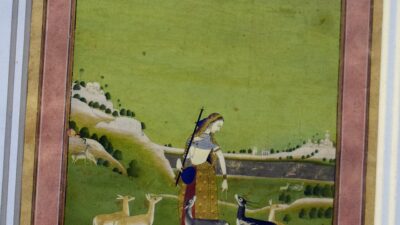
शास्त्र विंग · राग-पट्टिका · Raag Plate
धेनुक
Dhenuka
एक शांत Carnatic राग · A Peace Carnatic Raag
भावशांतिपूर्ण · ध्यानपूर्ण · प्रशांत · शांत
ऊर्जाधीमी
स्वर-चित्र · The Swara Panel
आरोह — अवरोह · The Ascent and the Descent
आरोह · Aroha चढ़ती हुई सीढ़ी
अवरोह · Avaroha उतरती हुई सीढ़ी
सˊ = तार सप्तक का षड्ज
पकड़ · पहचान वाक्यांश
रे॒ ग॒ म प ध॒ नि सा' — सा' नि ध॒ प म ग॒ रे॒ सा
Re♭ Ga♭ Ma Pa Dha♭ Ni Sa' — Sa' Ni Dha♭ Pa Ma Ga♭ Re♭ Sa
Dhenuka has no established Hindustani pakad. This ascending phrase through komal Re, komal Ga, shuddha Ma, komal Dha, and shuddha Ni—with the striking contrast of komal Dha resolving up to shuddha Ni—is the characteristic movement used in Carnatic alapana. The descent returns through the same komal swaras, giving the raga a subtle pastoral pathos.
वादी–संवादी टिप्पणी · Vadi–Samvadi note
Vadi — In the Carnatic tradition, Raag Dhenuka emphasizes Pancham (Pa) as a key resting note.
Samvadi — Sa (Shadj) serves as the complementary note.
समय और भाव
Time Theory & Moodसमय-सिद्धांत · Time Theory
प्रातः काल
परंपरागत रूप से सुबह के समय (6:00 AM - 10:00 AM) गाया जाता है, जब दिन ताज़ा होता है।
Traditionally performed during the morning hours (6:00 AM - 10:00 AM), when the day is fresh and the atmosphere is calm.
भाव और गति · Mood & Tempo
शांत · Peace/Tranquility
आंतरिक शांति, सुकून और आध्यात्मिक वैराग्य का रस। शांति, ध्यान और अध्यात्म को जगाता है।
ऊर्जा · Energyधीमी
स्तर · Leveladvanced — राग Dhenuka के लिए कर्नाटक संगीत सिद्धांत की मजबूत नींव आवश्यक है।
पट्टिका-लेख
The Monographपरिचय Introduction
राग Dhenuka कर्नाटक शास्त्रीय संगीत परंपरा का एक राग है। इसका प्रमुख रस शांत (Peace/Tranquility) है। यह परंपरागत रूप से सुबह के समय (6:00 AM - 10:00 AM) गाया जाता है गाया जाता है।
अंग्रेज़ी में पढ़ें · Read in English
Raag Dhenuka is a complete scale with all 7 notes in both ascent and descent raga in the Carnatic classical music tradition. It is derived from the Dhenuka melakarta (#9). With its Sampurna-Sampurna jati structure, this raag creates a distinctive tonal landscape. The predominant rasa is Peace/Tranquility (शांत), making it suitable for compositions that evoke peaceful, meditative emotions. It is traditionally performed during morning hours, and its melodic contour offers rich possibilities for alapana, kalpanaswaram, and creative improvisation.
सांस्कृतिक महत्व Cultural Significance
भारतीय शास्त्रीय संगीत की समृद्ध परंपरा के अंग के रूप में, राग Dhenuka Carnatic परंपरा को परिभाषित करने वाले स्वर संरचना और भावनात्मक अभिव्यक्ति के बीच गहरे संबंध का प्रतिनिधित्व करता है।
अंग्रेज़ी में पढ़ें · Read in English
As part of the rich tapestry of Indian classical music, Raag Dhenuka represents the deep connection between melodic structure and emotional expression that defines the Carnatic tradition.
ऐतिहासिक महत्व Historical Significance
धेनुका कर्नाटक संगीत की 72-मेलकर्ता प्रणाली में 9वाँ मेलकर्ता है और नेत्र चक्र (मेलकर्ता 7–12), अर्थात् 2वें चक्र, का तीसरा सदस्य है। नेत्र चक्र में कोमल ऋषभ और साधारण गंधार का प्रयोग होता है; तीसरे स्थान (धेनुका) में शुद्ध धैवत और काकली निषाद आते हैं। कोमल ऋषभ, कोमल गंधार, शुद्ध मध्यम, कोमल धैवत और शुद्ध निषाद का संयोग एक अनूठा भाव उत्पन्न करता है — निचले चतुष्टक में 'लघु-स्वर' की उदासी और ऊपरी चतुष्टक में शुद्ध निषाद की चमक। वेंकटमखिन ने इसे चतुर्दंडिप्रकाशिका (लगभग 1620 ई.) में वर्गीकृत किया। 'धेनुका' का अर्थ है 'गाय' — संस्कृत साहित्य और भक्ति कविता में पशुचारण-प्रतीक। यह राग कर्नाटक संगीत में विशेष रूप से प्रसिद्ध नहीं है, किन्तु इससे कुछ रोचक जन्य राग व्युत्पन्न होते हैं।
अंग्रेज़ी में पढ़ें · Read in English
Dhenuka is the 9th melakarta in the Carnatic 72-raga system, the third member of the Netra chakra (melakartas 7–12), the 2nd of the 12 chakras. The Netra chakra uses komal Rishabha (R1, 1 semitone) paired with sadharana Gandhara (G2, 3 semitones); the third position within this chakra employs shuddha Dhaivata (D1, 8 semitones) and kakali Nishada (N3, 11 semitones). The resulting scale—komal Re, komal Ga, shuddha Ma, komal Dha, shuddha Ni—has a characteristic contrast between the 'minor' lower tetrachord and the shuddha upper resolving swara that gives Dhenuka a subtly pastoral, bittersweet quality. Venkatamakhin classified it in the Caturdandiprakasika (c. 1620 CE). The name 'Dhenuka' means 'cow,' evoking pastoral symbolism deeply embedded in Sanskrit literature and devotional poetry. The raga is not among the frequently performed melakartas, but its scale pattern has generated some interesting janya ragas in the Carnatic tradition.
शिक्षा
Teaching & LearningBegin with slow aalapana to internalize the raag's swaroopa (melodic form)
Practice the arohana and avarohana patterns with a tanpura drone
Listen to recordings by master performers to understand the raag's gamakas (ornamentations)
Work on kalpanaswaram (improvisation) within the raag's framework
Using incorrect gamakas that belong to a different raag
Not maintaining proper swar sthana (note placement)
Rushing through phrases without allowing the raag bhava to develop
तुलना
A Specimen Comparisonहनुमतोडी (#8 — प्रसिद्ध 'तोड़ी' मेलकर्त) से: दोनों रागों में केवल निषाद का अंतर है — धेनुक में शुद्ध निषाद, हनुमतोडी में कोमल निषाद। हनुमतोडी का कोमल निषाद अवरोह (Ni♭ → Dha♭ → Pa...) कर्नाटक संगीत की सबसे भावपूर्ण स्वर-गतियों में से एक है, जो गहरी विरह-वेदना जगाती है। धेनुक का शुद्ध निषाद उस दर्द को हटाकर एक खुला, शांत समापन देता है।
| तुलनाSpecimen | धेनुक | हनुमतोडी |
|---|---|---|
| स्वर-अंतर | Identical in every note except Nishada: Dhenuka has shuddha Ni (natural seventh), Hanumatodi has komal Ni (flat seventh) | |
| भाव-अंतर | Hanumatodi evokes deep longing and pathos through its komal Ni descent; Dhenuka's shuddha Ni gives a more open, less grief-stricken resolution | |
कोकिलप्रिया (#11) नेत्र चक्र का वह राग है जिसमें धेनुक जैसा कोमल ऋषभ और कोमल गांधार है, पर शुद्ध धैवत है — इससे उसका ऊपरी स्वर-क्षेत्र अधिक उज्जवल हो जाता है।
| तुलनाSpecimen | धेनुक | कोकिलप्रिया |
|---|---|---|
| स्वर-अंतर | Both share komal Re and komal Ga; Kokilapriya uses shuddha Dha while Dhenuka uses komal Dha | |
| भाव-अंतर | Kokilapriya's upper register is considerably brighter and more open | |
सेनावती (#7) इस चक्र का सबसे गहरा राग है, जिसमें Ga♭♭ और Ni♭♭ दोनों हैं — उसकी तुलना में धेनुक का शुद्ध निषाद प्रशांत लगता है।
| तुलनाSpecimen | धेनुक | सेनावती |
|---|---|---|
| स्वर-अंतर | Senavati uses Ga♭♭ (double-flat Ga) and Ni♭♭ (double-flat Ni); Dhenuka has komal Ga and shuddha Ni | |
प्रस्तुति
Performance- Description
- परंपरागत रूप से सुबह के समय (6:00 AM - 10:00 AM) गाया जाता है, जब दिन ताज़ा होता है। Traditionally performed during the morning hours (6:00 AM - 10:00 AM), when the day is fresh and the atmosphere is calm.
- Prahar Number
- 1
- Prahar Name
- प्रातः काल Pratah Kaal
- Time Start
- 06:00
- Time End
- 10:00
- Time Flexibility
- flexible
Time
और जानें
More to Know- raag-hanumatodi — Hanumatodi — हनुमतोडी — Hanumatodi (#8, the famous 'Todi' melakarta): the two ragas are completely identical in every note except nishada — Dhenuka has shuddha Ni (natural seventh) while Hanumatodi has komal Ni (flat seventh). Hanumatodi's komal Ni descent (Ni♭ → Dha♭ → Pa → Ma...) is one of the most emotionally potent melodic movements in all of Carnatic music, evoking deep longing and pathos; Dhenuka's shuddha Ni replaces that ache with a more open, less grief-stricken resolution, fundamentally changing the raga's emotional landscape. — हनुमतोडी (#8 — प्रसिद्ध 'तोड़ी' मेलकर्त) से: दोनों रागों में केवल निषाद का अंतर है — धेनुक में शुद्ध निषाद, हनुमतोडी में कोमल निषाद। हनुमतोडी का कोमल निषाद अवरोह (Ni♭ → Dha♭ → Pa...) कर्नाटक संगीत की सबसे भावपूर्ण स्वर-गतियों में से एक है, जो गहरी विरह-वेदना जगाती है। धेनुक का शुद्ध निषाद उस दर्द को हटाकर एक खुला, शांत समापन देता है। — Identical in every note except Nishada: Dhenuka has shuddha Ni (natural seventh), Hanumatodi has komal Ni (flat seventh) — Hanumatodi evokes deep longing and pathos through its komal Ni descent; Dhenuka's shuddha Ni gives a more open, less grief-stricken resolution
- raag-kokilapriya — Kokilapriya — कोकिलप्रिया — Kokilapriya (#11) is another Netra chakra sibling that shares Dhenuka's komal Re and komal Ga but uses shuddha Dha instead of Dhenuka's komal Dha — making Kokilapriya's upper register considerably brighter and more open. — कोकिलप्रिया (#11) नेत्र चक्र का वह राग है जिसमें धेनुक जैसा कोमल ऋषभ और कोमल गांधार है, पर शुद्ध धैवत है — इससे उसका ऊपरी स्वर-क्षेत्र अधिक उज्जवल हो जाता है। — Both share komal Re and komal Ga; Kokilapriya uses shuddha Dha while Dhenuka uses komal Dha — Kokilapriya's upper register is considerably brighter and more open
- raag-senavati — Senavati — सेनावती — Senavati (#7), at the darkest extreme of the Netra chakra, uses double-flat Ga (Ga♭♭) and double-flat Ni (Ni♭♭), making Dhenuka's relatively shuddha Ni feel serene by comparison. — सेनावती (#7) इस चक्र का सबसे गहरा राग है, जिसमें Ga♭♭ और Ni♭♭ दोनों हैं — उसकी तुलना में धेनुक का शुद्ध निषाद प्रशांत लगता है। — Senavati uses Ga♭♭ (double-flat Ga) and Ni♭♭ (double-flat Ni); Dhenuka has komal Ga and shuddha Ni
In Film Music
Dhenuka is a Carnatic melakarta with no direct representation in Hindi film music. It is most easily understood in relation to its famous Carnatic neighbour Hanumatodi (#8 — the Carnatic equivalent of Hindustani Todi), from which Dhenuka differs only in nishada: Dhenuka uses shuddha Ni while Hanumatodi uses komal Ni. The Hindustani Todi and Bhairavi scales have inspired many celebrated Hindi film songs — Bhairavi's warmth gave us songs like 'Babul Mora' (film: Street Singer, 1938, music director K.C. Dey) and Todi's aching komal Ni phrase is heard in semi-classical songs across decades — but those songs are rooted in Hindustani scales, not in the Carnatic Dhenuka. Dhenuka itself lives on the Carnatic concert stage as a morning raga of meditative calm, its shuddha Ni denying the dramatic emotional resolution associated with Todi's komal Ni descent.
Comparisons
सीखने के लिए
For Learners- Difficulty Level
- advanced
अन्य विवरण
More Details- Indian_Music_Raga_Encyclopedia_v2.xlsx
- Carnatic 72 melakarta system — Netra chakra (7-12)
- S. Bhagyalekshmy — Ragas in Carnatic Music (1990)
- P. Sambamurthy — South Indian Music (4 vols)
- Comparison with Hindustani Todi and Bhairavi — P. Basu, Raga Nidhi
- Carnatic 72-melakarta system: melakarta 9 in the Netra chakra (Venkatamakhin, Caturdandiprakasika, c. 1620 CE)
- Govindacharya, Samgraha-Chudamani, c. 1800 CE
References
नमूना-पट्टी
The Specimen Table| नाम | धेनुक · Dhenuka |
|---|---|
| थाट | — |
| आरोह | Sa Re♭ Ga♭ Ma Pa Dha♭ Ni Sa' Sa' |
| अवरोह | Sa' Sa' Ni Dha♭ Pa Ma Ga♭ Re♭ Sa |
| पकड़ | रे॒ ग॒ म प ध॒ नि सा' — सा' नि ध॒ प म ग॒ रे॒ सा |
| जाति | संपूर्ण-संपूर्ण · Sampurna-Sampurna |
| समय | प्रातः काल |
| ऊर्जा | धीमी |
| परिवार | Dhenuka |
| स्तर | advanced |
| लोकप्रियता | Obscure |
| कर्नाटक समतुल्य | Dhenuka · Melakarta 9 |
जुड़े हुए पन्ने
Connected Plates · The Graph Made Visibleअटलस में कोई पन्ना अकेला नहीं — इस राग से गीत, प्रस्तुतियाँ, कलाकार, ताल, घराने और मिलते-जुलते राग, सब यहाँ से खुलते हैं।
ताल-साथी · Taal Pairings
श्रवण-कक्ष · The Listening Room
सुनिए — धेनुक · Hear the Raag
Raag Dhenuka — Classical Performance
प्रश्नोत्तर
Questions & Answersराग Dhenuka किस संगीत पद्धति का राग है?
राग Dhenuka कर्नाटक (दक्षिण भारतीय) शास्त्रीय संगीत पद्धति का राग है।
अंग्रेज़ी में पढ़ें · Read in English
Which music system does Raga Dhenuka belong to? — Raga Dhenuka belongs to the Carnatic (South Indian) classical music system.
साझा कीजिए · Share this Plate