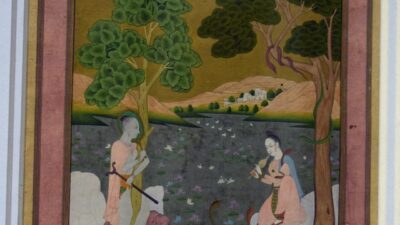
शास्त्र विंग · राग-पट्टिका · Raag Plate
वगधीस्वरि
Vagadheeswari
एक शांत Carnatic राग · A Peace Carnatic Raag
भावशांतिपूर्ण · ध्यानपूर्ण · प्रशांत · शांत
ऊर्जाधीमी
स्वर-चित्र · The Swara Panel
आरोह — अवरोह · The Ascent and the Descent
आरोह · Aroha चढ़ती हुई सीढ़ी
अवरोह · Avaroha उतरती हुई सीढ़ी
सˊ = तार सप्तक का षड्ज
पकड़ · पहचान वाक्यांश
स रे॑ ग म प ध नि॒ स'
Sa R♯ Ga Ma Pa Dha Ni♭ Sa'
Vagadheeswari's characteristic Shatsruti Rishabha (R♯ in file notation = R₃ in Carnatic, a pitch functionally equivalent to komal Ga in Hindustani) followed by Antara Gandhara (shuddha Ga pitch) creates two consecutive Ga-level pitches — an impossible interval in Hindustani music — that immediately identifies this raag.
वादी–संवादी टिप्पणी · Vadi–Samvadi note
Vadi — In the Carnatic tradition, Raag Vagadheeswari emphasizes Pancham (Pa) as a key resting note.
Samvadi — Sa (Shadj) serves as the complementary note.
समय और भाव
Time Theory & Moodसमय-सिद्धांत · Time Theory
अपराह्न
परंपरागत रूप से दोपहर (12:00 PM - 4:00 PM) में गाया जाता है।
Traditionally performed during afternoon hours (12:00 PM - 4:00 PM), suited for the warmth and energy of midday.
भाव और गति · Mood & Tempo
शांत · Peace/Tranquility
आंतरिक शांति, सुकून और आध्यात्मिक वैराग्य का रस। शांति, ध्यान और अध्यात्म को जगाता है।
ऊर्जा · Energyधीमी
स्तर · Leveladvanced — राग Vagadheeswari के लिए कर्नाटक संगीत सिद्धांत की मजबूत नींव आवश्यक है।
पट्टिका-लेख
The Monographपरिचय Introduction
राग Vagadheeswari कर्नाटक शास्त्रीय संगीत परंपरा का एक राग है। इसका प्रमुख रस शांत (Peace/Tranquility) है। यह परंपरागत रूप से दोपहर (12:00 PM - 4:00 PM) में गाया जाता है। गाया जाता है।
अंग्रेज़ी में पढ़ें · Read in English
Raag Vagadheeswari is a complete scale with all 7 notes in both ascent and descent raga in the Carnatic classical music tradition. It is derived from the Vagadheeswari melakarta (#34). With its Sampurna-Sampurna jati structure, this raag creates a distinctive tonal landscape. The predominant rasa is Peace/Tranquility (शांत), making it suitable for compositions that evoke peaceful, meditative emotions. It is traditionally performed during afternoon hours, and its melodic contour offers rich possibilities for alapana, kalpanaswaram, and creative improvisation.
सांस्कृतिक महत्व Cultural Significance
भारतीय शास्त्रीय संगीत की समृद्ध परंपरा के अंग के रूप में, राग Vagadheeswari Carnatic परंपरा को परिभाषित करने वाले स्वर संरचना और भावनात्मक अभिव्यक्ति के बीच गहरे संबंध का प्रतिनिधित्व करता है।
अंग्रेज़ी में पढ़ें · Read in English
As part of the rich tapestry of Indian classical music, Raag Vagadheeswari represents the deep connection between melodic structure and emotional expression that defines the Carnatic tradition.
ऐतिहासिक महत्व Historical Significance
वगधीश्वरि (अर्थ: वाक् की देवी) कर्नाटक शास्त्रीय संगीत के 72 मेलकर्ता चक्र का 34वाँ मेलकर्ता राग है। यह ऋतु चक्र (षष्ठ समूह, मेलकर्ता 31–36) का अंतिम और शुद्ध मध्यम वर्ग का अंतिम राग है। वेंकटमखिन (लगभग 1620 ईस्वी) द्वारा संहिताबद्ध इस राग में षट्श्रुति ऋषभ (R₃) का उपयोग होता है, जो श्रुति की दृष्टि से हिंदुस्तानी कोमल गंधार की स्थिति में है। इसके साथ अंतर गंधार (G₃ = शुद्ध ग की स्थिति) भी है, जिससे निचले चतुष्टय में दो लगभग सटे हुए स्वर बनते हैं। यह स्वर-संयोजन हिंदुस्तानी ठाट पद्धति में बिल्कुल नहीं पाया जाता। इस राग की यही विशेषता कर्नाटक संगीत के कलाकारों को आकर्षित करती है।
अंग्रेज़ी में पढ़ें · Read in English
Vagadheeswari (वगधीश्वरि, 'goddess of speech' or 'mistress of words') is the 34th melakarta in the 72-melakarta system, the last mela of the Rutu chakra (6th group, melakartas 31–36) and the final raag in the Shuddha Madhyama half. Codified by Venkatamakhin (c. 1620 CE), it uses Shatsruti Rishabha (R₃) — a pitch enharmonic to G₁ (the lowest Ga), placing it at what Hindustani musicians would recognise as the komal Ga pitch — alongside Antara Gandhara (G₃, equivalent to shuddha Ga in pitch). This produces two consecutive notes in the Re–Ga area separated by only one semitone, a scale feature that has no parallel in any of the ten Hindustani thaats. The raag's upper tetrachord uses Shuddha Dha (D₂) and Chatussruti Ni (N₂ ≈ komal Ni). Vagadheeswari sees modest concert activity in Carnatic music, where performers prize its unusual opening movement.
शिक्षा
Teaching & LearningBegin with slow aalapana to internalize the raag's swaroopa (melodic form)
Practice the arohana and avarohana patterns with a tanpura drone
Listen to recordings by master performers to understand the raag's gamakas (ornamentations)
Work on kalpanaswaram (improvisation) within the raag's framework
Using incorrect gamakas that belong to a different raag
Not maintaining proper swar sthana (note placement)
Rushing through phrases without allowing the raag bhava to develop
प्रस्तुति
Performance- Description
- परंपरागत रूप से दोपहर (12:00 PM - 4:00 PM) में गाया जाता है। Traditionally performed during afternoon hours (12:00 PM - 4:00 PM), suited for the warmth and energy of midday.
- Prahar Number
- 3
- Prahar Name
- अपराह्न Aparahna
- Time Start
- 12:00
- Time End
- 16:00
- Time Flexibility
- flexible
Time
और जानें
More to KnowIn Film Music
Vagadheeswari has no confirmed presence in Hindi film music. Its unusual consecutive Re–Ga pitch proximity — a Carnatic-specific melodic feature with no Hindustani equivalent — makes it inaccessible to most Hindi film composers trained in the thaat framework. South Indian films have occasionally employed Vagadheeswari-influenced passages in instrumental background scores.
सीखने के लिए
For Learners- Difficulty Level
- advanced
अन्य विवरण
More Details- Indian_Music_Raga_Encyclopedia_v2.xlsx
- Venkatamakhin, Chaturdandiprakasika (c. 1620 CE)
- S. Bhagyalekshmy, Ragas in Carnatic Music (1990)
References
नमूना-पट्टी
The Specimen Table| नाम | वगधीस्वरि · Vagadheeswari |
|---|---|
| थाट | — |
| आरोह | Sa Re♯ Ga Ma Pa Dha Ni♭ Sa' Sa' |
| अवरोह | Sa' Sa' Ni♭ Dha Pa Ma Ga Re♯ Sa |
| पकड़ | स रे॑ ग म प ध नि॒ स' |
| जाति | संपूर्ण-संपूर्ण · Sampurna-Sampurna |
| समय | अपराह्न |
| ऊर्जा | धीमी |
| परिवार | Vagadheeswari |
| स्तर | advanced |
| लोकप्रियता | Obscure |
| कर्नाटक समतुल्य | Vagadheeswari · Melakarta 34 |
जुड़े हुए पन्ने
Connected Plates · The Graph Made Visibleअटलस में कोई पन्ना अकेला नहीं — इस राग से गीत, प्रस्तुतियाँ, कलाकार, ताल, घराने और मिलते-जुलते राग, सब यहाँ से खुलते हैं।
ताल-साथी · Taal Pairings
श्रवण-कक्ष · The Listening Room
सुनिए — वगधीस्वरि · Hear the Raag
Raga Vagadeeshwari | Shashank Subramanyam | Ragam Tanam Pallavi | Music of India
प्रश्नोत्तर
Questions & Answersराग Vagadheeswari किस संगीत पद्धति का राग है?
राग Vagadheeswari कर्नाटक (दक्षिण भारतीय) शास्त्रीय संगीत पद्धति का राग है।
अंग्रेज़ी में पढ़ें · Read in English
Which music system does Raga Vagadheeswari belong to? — Raga Vagadheeswari belongs to the Carnatic (South Indian) classical music system.
साझा कीजिए · Share this Plate