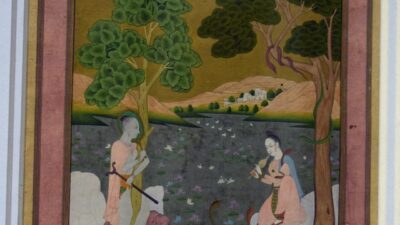
शास्त्र विंग · राग-पट्टिका · Raag Plate
धीरसंकरबरनम्
Dheerasankarabaranam
एक शांत Carnatic राग · A Peace Carnatic Raag
भावशांतिपूर्ण · ध्यानपूर्ण · प्रशांत · शांत
ऊर्जाधीमी
स्वर-चित्र · The Swara Panel
आरोह — अवरोह · The Ascent and the Descent
आरोह · Aroha
सा रे₂ ग₃ म₁ प ध₂ नि₃ सˊ
Sa Re₂ Ga₃ Ma₁ Pa Dha₂ Ni₃ Sa'
अवरोह · Avaroha
सˊ नि₃ ध₂ प म₁ ग₃ रे₂ स
Sa' Ni₃ Dha₂ Pa Ma₁ Ga₃ Re₂ Sa
वादी–संवादी टिप्पणी · Vadi–Samvadi note
Vadi — In the Carnatic tradition, Raag Dheerasankarabaranam emphasizes Pancham (Pa) as a key resting note.
Samvadi — Sa (Shadj) serves as the complementary note.
समय और भाव
Time Theory & Moodसमय-सिद्धांत · Time Theory
संध्या काल
परंपरागत रूप से संध्या काल (4:00 PM - 7:00 PM) में गाया जाता है।
Traditionally performed during evening/twilight hours (4:00 PM - 7:00 PM), when day transitions to night.
भाव और गति · Mood & Tempo
शांत · Peace/Tranquility
आंतरिक शांति, सुकून और आध्यात्मिक वैराग्य का रस। शांति, ध्यान और अध्यात्म को जगाता है।
ऊर्जा · Energyधीमी
स्तर · Leveladvanced — राग Dheerasankarabaranam के लिए कर्नाटक संगीत सिद्धांत की मजबूत नींव आवश्यक है।
पट्टिका-लेख
The Monographपरिचय Introduction
धीरसंकरबरनम् कर्नाटक शास्त्रीय संगीत का 29वां मेलकर्ता है, जिसमें सभी शुद्ध स्वर हैं। यह एक शांत और ध्यानमय राग है जो आध्यात्मिक और भक्तिपूर्ण प्रदर्शन के लिए उपयुक्त है।
अंग्रेज़ी में पढ़ें · Read in English
Dheerasankarabaranam is the 29th melakarta in the Carnatic classical music system, featuring all shuddha (natural) swaras with no komal (flat) or tivra (sharp) notes. Known for its serene and meditative quality, this raag creates a peaceful, transcendent atmosphere suitable for spiritual and devotional performances. The complete scale in both ascent and descent provides flexibility for intricate melodic exploration while maintaining its characteristic tranquility. Dheerasankarabaranam is traditionally performed during morning and evening hours and is a staple of Carnatic concert repertoire.
सांस्कृतिक महत्व Cultural Significance
प्राथमिक मेलकर्ता राग के रूप में, धीरसंकरबरनम् कर्नाटक शास्त्रीय परंपरा में एक केंद्रीय स्थान रखता है।
अंग्रेज़ी में पढ़ें · Read in English
As one of the primary melakarta raags, Dheerasankarabaranam holds a central position in the Carnatic classical tradition, serving as both a concert piece and a fundamental teaching tool for understanding the melakarta system.
ऐतिहासिक महत्व Historical Significance
धीरसंकरबरनम् अपने नाम को संस्कृत मूलों से प्राप्त करता है जिसका अर्थ 'स्थिर' है।
अंग्रेज़ी में पढ़ें · Read in English
Dheerasankarabaranam derives its name from Sanskrit roots meaning 'steady' (Dhira) and carries historical significance as an ancient melakarta in the systematic Carnatic classification. Its comprehensive scale and peaceful character have made it a foundational raag for both learning and artistic exploration across centuries of South Indian musical practice.
शिक्षा
Teaching & LearningBegin with slow aalapana to internalize the raag's swaroopa (melodic form)
Practice the arohana and avarohana patterns with a tanpura drone
Listen to recordings by master performers to understand the raag's gamakas (ornamentations)
Work on kalpanaswaram (improvisation) within the raag's framework
Using incorrect gamakas that belong to a different raag
Not maintaining proper swar sthana (note placement)
Rushing through phrases without allowing the raag bhava to develop
तुलना
A Specimen Comparisonदोनों में सातों शुद्ध स्वर समान हैं — अंतर केवल प्रदर्शन-परंपरा में है: बिलावल हिंदुस्तानी ख़याल में अपने विशिष्ट वाक्यों, वादी (सा और प) और अलंकारिक स्वतंत्रता के साथ प्रस्तुत होता है, जबकि धीरसंकरबरनम् कर्नाटक लक्षण और गमक-परंपरा में चलता है।
| तुलनाSpecimen | धीरसंकरबरनम् | बिलावल |
|---|---|---|
| स्वर-अंतर | Both contain all seven natural swaras; the difference is entirely in performance tradition, gamakas, and compositional framework | |
शंकराभरणम् इसी मेलकर्ता का लोकप्रिय नाम है — दोनों में कोई स्वर-भेद नहीं।
| तुलनाSpecimen | धीरसंकरबरनम् | शंकराभरणम् |
|---|---|---|
| स्वर-अंतर | No swara difference; Shankarabharanam is the popular/concert name while Dheerasankarabaranam is the systematic melakarta name | |
केवल एक अंतर — मेचाकल्याणी में तीव्र मध्यम (तेज़ चतुर्थ) है, जो उसे यमन (हिंदुस्तानी कल्याण) जैसी उत्थित, रोमांटिक और विस्तृत अनुभूति देता है, जबकि धीरसंकरबरनम् का शुद्ध मध्यम उसे ज़मीन से जुड़ी, प्राकृतिक शांति देता है।
| तुलनाSpecimen | धीरसंकरबरनम् | मेचाकल्याणी |
|---|---|---|
| स्वर-अंतर | Mechakalyani uses tivra Madhyam (sharp 4th); Dheerasankarabaranam uses shuddha Madhyam — one note difference | |
| भाव-अंतर | Mechakalyani has an elevated, romantic, expansive quality (like Yaman/Kalyani); Dheerasankarabaranam has grounded, natural serenity | |
प्रस्तुति
Performance- Description
- परंपरागत रूप से संध्या काल (4:00 PM - 7:00 PM) में गाया जाता है। Traditionally performed during evening/twilight hours (4:00 PM - 7:00 PM), when day transitions to night.
- Prahar Number
- 5
- Prahar Name
- संध्या काल Sandhya Kaal
- Time Start
- 16:00
- Time End
- 19:00
- Time Flexibility
- flexible
Time
और जानें
More to Know- raag-bilawal — Bilawal — बिलावल — Both Dheerasankarabaranam and Bilawal (Hindustani) share all seven natural swaras, making them theoretically identical in note content. The difference lies entirely in the performance tradition: Bilawal is rendered in the Hindustani khayal tradition with specific characteristic phrases, vadi (Sa and Pa), and ornamental freedom, while Dheerasankarabaranam follows Carnatic lakshana with its own gamakas, kriti compositions, and concert norms. — दोनों में सातों शुद्ध स्वर समान हैं — अंतर केवल प्रदर्शन-परंपरा में है: बिलावल हिंदुस्तानी ख़याल में अपने विशिष्ट वाक्यों, वादी (सा और प) और अलंकारिक स्वतंत्रता के साथ प्रस्तुत होता है, जबकि धीरसंकरबरनम् कर्नाटक लक्षण और गमक-परंपरा में चलता है। — Both contain all seven natural swaras; the difference is entirely in performance tradition, gamakas, and compositional framework
- raag-shankarabharanam — Shankarabharanam — शंकराभरणम् — Shankarabharanam is the more commonly known name for the same raga (or close janya thereof) in popular and concert Carnatic usage; Dheerasankarabaranam is the systematic melakarta name within the 72-melakarta classification scheme. There is no swara difference between the two names. — शंकराभरणम् इसी मेलकर्ता का लोकप्रिय नाम है — दोनों में कोई स्वर-भेद नहीं। — No swara difference; Shankarabharanam is the popular/concert name while Dheerasankarabaranam is the systematic melakarta name
- raag-mechakalyani — Mechakalyani — मेचाकल्याणी — The only difference between Dheerasankarabaranam and Mechakalyani (65th melakarta) is that Mechakalyani uses tivra Madhyam (sharp 4th) instead of shuddha Madhyam. This single note change gives Mechakalyani (Carnatic Kalyani / Hindustani Yaman) a distinctly more elevated, romantic, and expansive quality compared to Dheerasankarabaranam's grounded, natural serenity. — केवल एक अंतर — मेचाकल्याणी में तीव्र मध्यम (तेज़ चतुर्थ) है, जो उसे यमन (हिंदुस्तानी कल्याण) जैसी उत्थित, रोमांटिक और विस्तृत अनुभूति देता है, जबकि धीरसंकरबरनम् का शुद्ध मध्यम उसे ज़मीन से जुड़ी, प्राकृतिक शांति देता है। — Mechakalyani uses tivra Madhyam (sharp 4th); Dheerasankarabaranam uses shuddha Madhyam — one note difference — Mechakalyani has an elevated, romantic, expansive quality (like Yaman/Kalyani); Dheerasankarabaranam has grounded, natural serenity
In Film Music
Dheerasankarabaranam's note set — all seven natural swaras (Sa Re Ga Ma Pa Dha Ni, equivalent to the Western C major scale) — is the most ubiquitous tonal foundation in Indian music. In the Hindustani tradition, this same scale is called Bilawal, and countless Hindi film songs across every decade draw upon it. However, film composers working in the Hindustani tradition would identify their songs as being in Bilawal, Bihag, Alhaiya Bilawal, or Shankara — not in Dheerasankarabaranam, which is the Carnatic systematic name for the 29th melakarta. The Carnatic tradition's most spectacular film celebration of this raga's parent came in the landmark Telugu film Shankarabharanam (1980, music director K. V. Mahadevan), which was built entirely around this melakarta and became a milestone in South Indian cinema. In Hindi film music, songs in this natural-note scale are so prevalent that singling out specific examples as 'Dheerasankarabaranam' would be misleading — the more accurate statement is that the Bilawal family of songs in Hindi film music draws on the same tonal universe that Dheerasankarabaranam represents in the Carnatic system.
Comparisons
सीखने के लिए
For Learners- Difficulty Level
- advanced
अन्य विवरण
More Details- Indian_Music_Raga_Encyclopedia_v2.xlsx
- Shankarabharanam (Telugu film, 1980), director K. Viswanath, music K. V. Mahadevan
- 72-melakarta system: Dheerasankarabaranam as the 29th melakarta with all shuddha swaras
- Bilawal thaat (Hindustani) equivalence to Dheerasankarabaranam scale
References
नमूना-पट्टी
The Specimen Table| नाम | धीरसंकरबरनम् · Dheerasankarabaranam |
|---|---|
| आरोह | सा रे₂ ग₃ म₁ प ध₂ नि₃ सˊ |
| अवरोह | सˊ नि₃ ध₂ प म₁ ग₃ रे₂ स |
| जाति | संपूर्ण-संपूर्ण · Sampurna-Sampurna |
| समय | संध्या काल |
| ऊर्जा | धीमी |
| परिवार | Dheerasankarabaranam |
| स्तर | advanced |
| लोकप्रियता | Obscure |
| कर्नाटक समतुल्य | Dheerasankarabaranam · Melakarta 29 |
जुड़े हुए पन्ने
Connected Plates · The Graph Made Visibleअटलस में कोई पन्ना अकेला नहीं — इस राग से गीत, प्रस्तुतियाँ, कलाकार, ताल, घराने और मिलते-जुलते राग, सब यहाँ से खुलते हैं।
ताल-साथी · Taal Pairings
श्रवण-कक्ष · The Listening Room
सुनिए — धीरसंकरबरनम् · Hear the Raag
Raag Dheerasankarabaranam — Classical Performance
प्रश्नोत्तर
Questions & Answersराग Dheerasankarabaranam किस संगीत पद्धति का राग है?
राग Dheerasankarabaranam कर्नाटक (दक्षिण भारतीय) शास्त्रीय संगीत पद्धति का राग है।
अंग्रेज़ी में पढ़ें · Read in English
Which music system does Raga Dheerasankarabaranam belong to? — Raga Dheerasankarabaranam belongs to the Carnatic (South Indian) classical music system.
साझा कीजिए · Share this Plate