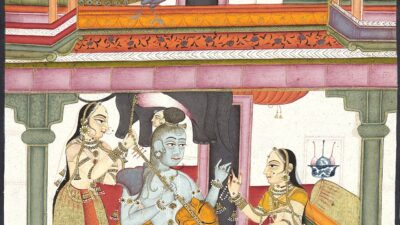
शास्त्र विंग · राग-पट्टिका · Raag Plate
चक्रवकम्
Chakravakam
एक श्रृंगार Carnatic राग · A Romance Carnatic Raag
भावरोमांटिक · सुंदर · कोमल · प्रेमपूर्ण
ऊर्जामध्यम
स्वर-चित्र · The Swara Panel
आरोह — अवरोह · The Ascent and the Descent
आरोह · Aroha चढ़ती हुई सीढ़ी
अवरोह · Avaroha उतरती हुई सीढ़ी
सˊ = तार सप्तक का षड्ज
पकड़ · पहचान वाक्यांश
रे॒ ग म प ध नि॒ सा' — सा' नि॒ ध प म ग रे॒ सा
Re♭ Ga Ma Pa Dha Ni♭ Sa' — Sa' Ni♭ Dha Pa Ma Ga Re♭ Sa
No classical Hindustani pakad exists for Chakravakam. This characteristic phrase emphasises the raga's defining quality: the pairing of komal Rishabha with shuddha Gandhara, which creates a subtly wistful warmth unlike any of the 10 Hindustani thaats. The descent through Ni♭, Dha, Pa, Ga, Re♭, Sa is the signature cadential movement used in Carnatic alapana.
वादी–संवादी टिप्पणी · Vadi–Samvadi note
Vadi — In the Carnatic tradition, Raag Chakravakam emphasizes Pancham (Pa) as a key resting note.
Samvadi — Sa (Shadj) serves as the complementary note.
समय और भाव
Time Theory & Moodसमय-सिद्धांत · Time Theory
अपराह्न
परंपरागत रूप से दोपहर (12:00 PM - 4:00 PM) में गाया जाता है।
Traditionally performed during afternoon hours (12:00 PM - 4:00 PM), suited for the warmth and energy of midday.
भाव और गति · Mood & Tempo
श्रृंगार · Romance/Beauty
प्रेम, सौंदर्य और भक्ति का रस। रोमांटिक तड़प, सौंदर्यपरक आनंद और गहरे भावनात्मक जुड़ाव को जगाता है।
ऊर्जा · Energyमध्यम
स्तर · Leveladvanced — राग Chakravakam के लिए कर्नाटक संगीत सिद्धांत की मजबूत नींव आवश्यक है।
पट्टिका-लेख
The Monographपरिचय Introduction
राग Chakravakam कर्नाटक शास्त्रीय संगीत परंपरा का एक राग है। इसका प्रमुख रस श्रृंगार (Romance/Beauty) है। यह परंपरागत रूप से दोपहर (12:00 PM - 4:00 PM) में गाया जाता है। गाया जाता है।
अंग्रेज़ी में पढ़ें · Read in English
Raag Chakravakam is a complete scale with all 7 notes in both ascent and descent raga in the Carnatic classical music tradition. It is derived from the Chakravakam melakarta (#16). With its Sampurna-Sampurna jati structure, this raag creates a distinctive tonal landscape. The predominant rasa is Romance/Beauty (श्रृंगार), making it suitable for compositions that evoke romantic, beautiful emotions. It is traditionally performed during afternoon hours, and its melodic contour offers rich possibilities for alapana, kalpanaswaram, and creative improvisation.
सांस्कृतिक महत्व Cultural Significance
भारतीय शास्त्रीय संगीत की समृद्ध परंपरा के अंग के रूप में, राग Chakravakam Carnatic परंपरा को परिभाषित करने वाले स्वर संरचना और भावनात्मक अभिव्यक्ति के बीच गहरे संबंध का प्रतिनिधित्व करता है।
अंग्रेज़ी में पढ़ें · Read in English
As part of the rich tapestry of Indian classical music, Raag Chakravakam represents the deep connection between melodic structure and emotional expression that defines the Carnatic tradition.
ऐतिहासिक महत्व Historical Significance
चक्रवाकम् कर्नाटक संगीत की 72-मेलकर्ता प्रणाली में 16वाँ मेलकर्ता है। यह अग्नि चक्र (मेलकर्ता 13–18) का चौथा सदस्य है। इसमें कोमल ऋषभ, अंतर गंधार, शुद्ध मध्यम, शुद्ध पंचम, चतुःश्रुति धैवत और कैशिक निषाद का समावेश है। वेंकटमखिन ने इसे चतुर्दंडिप्रकाशिका (लगभग 1620 ई.) में वर्गीकृत किया, और गोविंदाचार्य ने संग्रह-चूड़ामणि (लगभग 1800 ई.) में इसकी स्थिति को पुष्ट किया। 'चक्रवाक' संस्कृत साहित्य में उस चकवा पक्षी का नाम है जिसकी विरह-पुकार प्रेम-वियोग की काव्यिक प्रतीक रही है। इस राग का सबसे बड़ा महत्व यह है कि यह सहना का जनक मेलकर्ता है — सहना, कर्नाटक शास्त्रीय संगीत और दक्षिण भारतीय फ़िल्म संगीत दोनों में अत्यंत लोकप्रिय और भावपूर्ण राग है। चक्रवाकम् की विशिष्ट कोमल ऋषभ + शुद्ध गंधार की जुगलबंदी सहना में जीवित है।
अंग्रेज़ी में पढ़ें · Read in English
Chakravakam is the 16th melakarta in the Carnatic 72-raga system, placed in the Agni chakra (melakartas 13–18), the 3rd chakra of the first set of 36 (shuddha-madhyama melakartas). Within the Agni chakra, it occupies the fourth position, combining komal Rishabha, antara Gandhara, shuddha Madhyama, shuddha Panchama, chatusshruti Dhaivata, and kaisika Nishada. Venkatamakhin classified it in the Caturdandiprakasika (c. 1620 CE); Govindacharya later confirmed and elaborated its position in the Samgraha-Chudamani (c. 1800 CE). The name 'Chakravaka' refers to the ruddy shelduck, a bird whose mournful separation-call (viraha) is a classical metaphor in Sanskrit literature. Chakravakam's greatest significance lies in being the parent melakarta of Sahana, one of the most emotionally powerful and widely performed ragas in Carnatic classical and South Indian film music. The parent's distinctive quality—komal Re paired with shuddha Ga—lives on in Sahana's celebrated characteristic phrases.
शिक्षा
Teaching & LearningBegin with slow aalapana to internalize the raag's swaroopa (melodic form)
Practice the arohana and avarohana patterns with a tanpura drone
Listen to recordings by master performers to understand the raag's gamakas (ornamentations)
Work on kalpanaswaram (improvisation) within the raag's framework
Using incorrect gamakas that belong to a different raag
Not maintaining proper swar sthana (note placement)
Rushing through phrases without allowing the raag bhava to develop
तुलना
A Specimen Comparisonसहना चक्रवाकम् का सबसे प्रसिद्ध जन्य राग है। चक्रवाकम् में सीधा आरोह-अवरोह है जबकि सहना अपने आरोह में वक्र वाक्य जोड़ता है (प के बाद म पर वापसी) जो सहना को एक विशिष्ट आकांक्षाभरी झिझक देता है जो जनक-राग में नहीं है।
| तुलनाSpecimen | चक्रवकम् | सहना |
|---|---|---|
| स्वर-अंतर | Chakravakam has a straight arohana-avarohana; Sahana introduces a vakra (zigzag) in the ascent, returning to Ma after reaching Pa | |
खमाज ठाट (सा रे ग म प ध कोमल-नि) चक्रवाकम् से केवल एक स्वर में भिन्न है — खमाज में शुद्ध रे है जबकि चक्रवाकम् में कोमल रे। वह एक अर्धस्वर पूरी तरह भाव बदल देता है: खमाज का शुद्ध रे उसे खुला, गर्म और रोमांटिक बनाता है, जबकि चक्रवाकम् का कोमल रे उसे थोड़ा अंतर्मुखी और मृदु-विषाद देता है।
| तुलनाSpecimen | चक्रवकम् | खमाज |
|---|---|---|
| स्वर-अंतर | Khamaj uses Shuddha Re; Chakravakam uses Komal Re — a single semitone difference | |
| भाव-अंतर | Khamaj has an open, warm romantic quality; Chakravakam is more contemplative and tender-wistful | |
नटभैरवी (20वाँ) में अधिक कोमल स्वर हैं (कोमल रे, कोमल ग, कोमल ध, कोमल नि) जो उसे भारी और गहरा बनाते हैं; चक्रवाकम् का शुद्ध गंधार और शुद्ध धैवत उसे नटभैरवी से अधिक उज्जवल और उष्ण रखते हैं।
| तुलनाSpecimen | चक्रवकम् | नटभैरवी |
|---|---|---|
| स्वर-अंतर | Natabhairavi uses Komal Re, Komal Ga, Komal Dha, Komal Ni; Chakravakam uses Komal Re but has Shuddha Ga and Shuddha Dha | |
| भाव-अंतर | Natabhairavi is heavier and darker in character; Chakravakam is brighter and warmer | |
प्रस्तुति
Performance- Description
- परंपरागत रूप से दोपहर (12:00 PM - 4:00 PM) में गाया जाता है। Traditionally performed during afternoon hours (12:00 PM - 4:00 PM), suited for the warmth and energy of midday.
- Prahar Number
- 3
- Prahar Name
- अपराह्न Aparahna
- Time Start
- 12:00
- Time End
- 16:00
- Time Flexibility
- flexible
Time
और जानें
More to Know- raag-sahana — Sahana — सहना — Sahana is Chakravakam's best-known janya raga. Chakravakam has a straight arohana-avarohana while Sahana introduces a characteristic vakra (zigzag) in the ascent — returning to Ma after reaching Pa — which gives Sahana a personality of yearning hesitation that the parent raga lacks. The parent is architecturally simpler, the child more emotionally nuanced. — सहना चक्रवाकम् का सबसे प्रसिद्ध जन्य राग है। चक्रवाकम् में सीधा आरोह-अवरोह है जबकि सहना अपने आरोह में वक्र वाक्य जोड़ता है (प के बाद म पर वापसी) जो सहना को एक विशिष्ट आकांक्षाभरी झिझक देता है जो जनक-राग में नहीं है। — Chakravakam has a straight arohana-avarohana; Sahana introduces a vakra (zigzag) in the ascent, returning to Ma after reaching Pa
- raag-khamaj — Khamaj — खमाज — Khamaj thaat (Sa Re Ga Ma Pa Dha komal Ni) differs from Chakravakam in only one note — Khamaj uses Shuddha Re while Chakravakam uses Komal Re. That single semitone changes the raga's feel entirely: Khamaj's Shuddha Re gives it an open, warm romantic quality (one of Hindustani music's most beloved romantic scales), while Chakravakam's Komal Re pulls it slightly inward, giving it a more contemplative, tender-wistful quality. — खमाज ठाट (सा रे ग म प ध कोमल-नि) चक्रवाकम् से केवल एक स्वर में भिन्न है — खमाज में शुद्ध रे है जबकि चक्रवाकम् में कोमल रे। वह एक अर्धस्वर पूरी तरह भाव बदल देता है: खमाज का शुद्ध रे उसे खुला, गर्म और रोमांटिक बनाता है, जबकि चक्रवाकम् का कोमल रे उसे थोड़ा अंतर्मुखी और मृदु-विषाद देता है। — Khamaj uses Shuddha Re; Chakravakam uses Komal Re — a single semitone difference — Khamaj has an open, warm romantic quality; Chakravakam is more contemplative and tender-wistful
- raag-natabhairavi — Natabhairavi — नटभैरवी — Natabhairavi (20th melakarta) uses Komal Re, Komal Ga, Shuddha Ma, Komal Dha, Komal Ni — a scale with more komal swaras, heavier and darker in character. Chakravakam's Shuddha Ga and Shuddha Dha keep it brighter and warmer than Natabhairavi. — नटभैरवी (20वाँ) में अधिक कोमल स्वर हैं (कोमल रे, कोमल ग, कोमल ध, कोमल नि) जो उसे भारी और गहरा बनाते हैं; चक्रवाकम् का शुद्ध गंधार और शुद्ध धैवत उसे नटभैरवी से अधिक उज्जवल और उष्ण रखते हैं। — Natabhairavi uses Komal Re, Komal Ga, Komal Dha, Komal Ni; Chakravakam uses Komal Re but has Shuddha Ga and Shuddha Dha — Natabhairavi is heavier and darker in character; Chakravakam is brighter and warmer
In Film Music
Chakravakam (16th melakarta) is not directly present in Hindi film music as a named raga, but its significance in Carnatic classical music is indirect yet substantial: it is the parent melakarta of Sahana, which is one of the most beloved ragas in South Indian film music. Tamil and Telugu film songs in Sahana — a janya (derivative) of Chakravakam — carry the parent raga's characteristic warmth of Shuddha Gandhar (natural 3rd) combined with Komal Rishabham (flat 2nd), a pairing that creates a sweet, slightly wistful quality. In Hindi film music specifically, no songs are documented as being rooted in Chakravakam. The raga's note set (Sa, komal Re, shuddha Ga, shuddha Ma, Pa, shuddha Dha, komal Ni) does not map neatly onto any commonly used Hindustani raga, making it tonally foreign to the Hindustani-trained composers who dominated Bollywood. Chakravakam's primary life is in the Carnatic concert hall, where it serves both as a concert raga in its own right and as the systematic parent of many widely performed janya ragas.
Comparisons
सीखने के लिए
For Learners- Difficulty Level
- advanced
अन्य विवरण
More Details- Indian_Music_Raga_Encyclopedia_v2.xlsx
- Carnatic 72-melakarta system: Chakravakam as the 16th melakarta, Agni chakra
- Sahana as the most famous janya raag of Chakravakam
- Comparison with Khamaj thaat (Hindustani) regarding Komal vs Shuddha Rishabh
- Carnatic 72-melakarta system: Chakravakam as the 16th melakarta in the Agni chakra (Venkatamakhin, Caturdandiprakasika, c. 1620 CE)
- Govindacharya, Samgraha-Chudamani, c. 1800 CE
References
नमूना-पट्टी
The Specimen Table| नाम | चक्रवकम् · Chakravakam |
|---|---|
| थाट | — |
| आरोह | Sa Re♭ Ga Ma Pa Dha Ni♭ Sa' Sa' |
| अवरोह | Sa' Sa' Ni♭ Dha Pa Ma Ga Re♭ Sa |
| पकड़ | रे॒ ग म प ध नि॒ सा' — सा' नि॒ ध प म ग रे॒ सा |
| जाति | संपूर्ण-संपूर्ण · Sampurna-Sampurna |
| समय | अपराह्न |
| ऊर्जा | मध्यम |
| परिवार | Chakravakam |
| स्तर | advanced |
| लोकप्रियता | Obscure |
| कर्नाटक समतुल्य | Chakravakam · Melakarta 16 |
जुड़े हुए पन्ने
Connected Plates · The Graph Made Visibleअटलस में कोई पन्ना अकेला नहीं — इस राग से गीत, प्रस्तुतियाँ, कलाकार, ताल, घराने और मिलते-जुलते राग, सब यहाँ से खुलते हैं।
ताल-साथी · Taal Pairings
श्रवण-कक्ष · The Listening Room
सुनिए — चक्रवकम् · Hear the Raag
Raag Chakravakam — Classical Performance
प्रश्नोत्तर
Questions & Answersराग Chakravakam किस संगीत पद्धति का राग है?
राग Chakravakam कर्नाटक (दक्षिण भारतीय) शास्त्रीय संगीत पद्धति का राग है।
अंग्रेज़ी में पढ़ें · Read in English
Which music system does Raga Chakravakam belong to? — Raga Chakravakam belongs to the Carnatic (South Indian) classical music system.
साझा कीजिए · Share this Plate