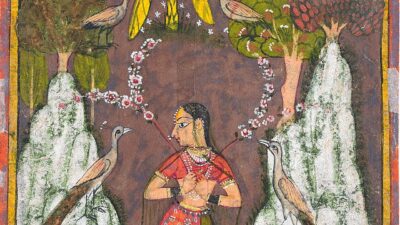
शास्त्र विंग · राग-पट्टिका · Raag Plate
ब्रमर
Bramara
एक शांत Carnatic राग · A Peace Carnatic Raag
भावशांतिपूर्ण · ध्यानपूर्ण · प्रशांत · शांत
ऊर्जाधीमी
स्वर-चित्र · The Swara Panel
आरोह — अवरोह · The Ascent and the Descent
पकड़ · पहचान वाक्यांश
—
—
The specific arohana and avarohana of Bramara are not documented in the current database entry. Without a verified scale the characteristic phrase cannot be derived. Please consult a primary Carnatic music reference text that covers the Bramara family of ragas.
वादी–संवादी टिप्पणी · Vadi–Samvadi note
Vadi — In the Carnatic tradition, Raag Bramara emphasizes Pancham (Pa) as a key resting note.
Samvadi — Sa (Shadj) serves as the complementary note.
समय और भाव
Time Theory & Moodसमय-सिद्धांत · Time Theory
संध्या काल
परंपरागत रूप से संध्या काल (4:00 PM - 7:00 PM) में गाया जाता है।
Traditionally performed during evening/twilight hours (4:00 PM - 7:00 PM), when day transitions to night.
भाव और गति · Mood & Tempo
शांत · Peace/Tranquility
आंतरिक शांति, सुकून और आध्यात्मिक वैराग्य का रस। शांति, ध्यान और अध्यात्म को जगाता है।
ऊर्जा · Energyधीमी
स्तर · Leveladvanced — राग Bramara के लिए कर्नाटक संगीत सिद्धांत की मजबूत नींव आवश्यक है।
पट्टिका-लेख
The Monographपरिचय Introduction
राग Bramara कर्नाटक शास्त्रीय संगीत परंपरा का एक राग है। इसका प्रमुख रस शांत (Peace/Tranquility) है। यह परंपरागत रूप से संध्या काल (4:00 PM - 7:00 PM) में गाया जाता है। गाया जाता है।
अंग्रेज़ी में पढ़ें · Read in English
Raag Bramara is a complete scale with all 7 notes in both ascent and descent raga in the Carnatic classical music tradition.. With its Sampurna-Sampurna jati structure, this raag creates a distinctive tonal landscape. The predominant rasa is Peace/Tranquility (शांत), making it suitable for compositions that evoke peaceful, meditative emotions. It is traditionally performed during evening hours, and its melodic contour offers rich possibilities for alapana, kalpanaswaram, and creative improvisation.
सांस्कृतिक महत्व Cultural Significance
भारतीय शास्त्रीय संगीत की समृद्ध परंपरा के अंग के रूप में, राग Bramara Carnatic परंपरा को परिभाषित करने वाले स्वर संरचना और भावनात्मक अभिव्यक्ति के बीच गहरे संबंध का प्रतिनिधित्व करता है।
अंग्रेज़ी में पढ़ें · Read in English
As part of the rich tapestry of Indian classical music, Raag Bramara represents the deep connection between melodic structure and emotional expression that defines the Carnatic tradition.
ऐतिहासिक महत्व Historical Significance
ब्रमर कर्नाटक संगीत की 'ब्रमर' राग-परिवार का एक जन्य राग है। 'ब्रमर' संस्कृत के 'भ्रमर' (bhrumara) शब्द से बना है, जिसका अर्थ है 'भँवरा' या 'काला मधुमक्खी'। भारतीय काव्य और संगीत में भँवरा प्रेम की तल्लीनता, मधुर रस में डूबे रहने और भक्ति-भाव का प्रतीक है।
'' (The root/primary raag of the Bramara family, named directly for the bumblebee) उपसर्ग इस राग की विशेष स्वर-गुणवत्ता या भक्ति-आयाम को रेखांकित करता है। ब्रमर राग-परिवार कर्नाटक सैद्धांतिक ग्रंथों में मिलता है, किंतु आधुनिक मंच पर यह परिवार अत्यंत दुर्लभ है। इसका मेलकर्ता जनक उपलब्ध स्रोतों में स्पष्ट नहीं है।
ब्रमर परिवार के जनक-राग के रूप में, मूल 'ब्रमर' राग वह आधार है जिससे सभी उपरोक्त भिन्नताएँ (भोगी, द्वानी, केथन आदि) बनी हैं। भँवरे की अवधारणा भागवत पुराण के 'भ्रमरगीत' से जुड़ी है — जिसमें उद्धव का भँवरा-संदेश वृंदावन की गोपियों तक पहुँचता है — जो कृष्ण-भक्ति का अत्यंत मार्मिक प्रसंग है।
अंग्रेज़ी में पढ़ें · Read in English
Bramara is a Carnatic janya raag belonging to the 'Bramara' family of ragas — a group of ragas whose names derive from the Sanskrit word bhrumara (भ्रमर), meaning 'bumblebee' or 'black bee'. In Indian poetry and music, the bumblebee is a potent symbol of intoxication with beauty, of the lover humming around the lotus of the beloved's face, and of deep absorption in sweetness (madhura bhava). The qualifier '' (The root/primary raag of the Bramara family, named directly for the bumblebee) further specifies the melodic character or devotional aspect of this particular member of the Bramara family.
The Bramara family of ragas appears in Carnatic theoretical compilations and is believed to represent a cluster of ragas evolved in Karnataka's classical musical tradition for compositions in the bhakti (devotional) and shringara (amorous) rasas. These ragas are extremely rare in contemporary concert performance and have not been the subject of major musicological monographs in widely accessible English or Hindi sources. The melakarta parent of Bramara is not definitively established, so a Hindustani thaat equivalent cannot be assigned.
As the eponymous raag of the Bramara family, Bramara (plain) is likely the parent or prototype from which the other variants (Bhogi, Dwani, Kethana, Narayani, Tarangini, Uttari, Vardhini) are derived. The bumblebee imagery connects to deep bhakti and shringara traditions in South Indian music — the bhramarageet (bee-song) is a literary form in which the devotee sends a message through the bee, as in the famous Bhramarageeta section of the Bhagavata Purana where Uddhava's bee-messenger brings news of Krishna to the gopis of Vrindavan.
शिक्षा
Teaching & LearningBegin with slow aalapana to internalize the raag's swaroopa (melodic form)
Practice the arohana and avarohana patterns with a tanpura drone
Listen to recordings by master performers to understand the raag's gamakas (ornamentations)
Work on kalpanaswaram (improvisation) within the raag's framework
Using incorrect gamakas that belong to a different raag
Not maintaining proper swar sthana (note placement)
Rushing through phrases without allowing the raag bhava to develop
प्रस्तुति
Performance- Description
- परंपरागत रूप से संध्या काल (4:00 PM - 7:00 PM) में गाया जाता है। Traditionally performed during evening/twilight hours (4:00 PM - 7:00 PM), when day transitions to night.
- Prahar Number
- 5
- Prahar Name
- संध्या काल Sandhya Kaal
- Time Start
- 16:00
- Time End
- 19:00
- Time Flexibility
- flexible
Time
और जानें
More to KnowIn Film Music
Bramara has no documented presence in Hindi film music. As a member of the rare Carnatic Bramara family of ragas, it has not been drawn upon by Bollywood or Hindustani film composers, and no known Hindi film songs are based on this raag.
सीखने के लिए
For Learners- Difficulty Level
- advanced
अन्य विवरण
More Details- Indian_Music_Raga_Encyclopedia_v2.xlsx
- Carnatic music theoretical compilations listing Bramara janya ragas
References
नमूना-पट्टी
The Specimen Table| नाम | ब्रमर · Bramara |
|---|---|
| थाट | — |
| पकड़ | — |
| जाति | संपूर्ण-संपूर्ण · Sampurna-Sampurna |
| समय | संध्या काल |
| ऊर्जा | धीमी |
| परिवार | Bramara |
| स्तर | advanced |
| लोकप्रियता | Obscure |
जुड़े हुए पन्ने
Connected Plates · The Graph Made Visibleअटलस में कोई पन्ना अकेला नहीं — इस राग से गीत, प्रस्तुतियाँ, कलाकार, ताल, घराने और मिलते-जुलते राग, सब यहाँ से खुलते हैं।
ताल-साथी · Taal Pairings
श्रवण-कक्ष · The Listening Room
सुनिए — ब्रमर · Hear the Raag
Raga Ratnamalikache
प्रश्नोत्तर
Questions & Answersराग Bramara किस संगीत पद्धति का राग है?
राग Bramara कर्नाटक (दक्षिण भारतीय) शास्त्रीय संगीत पद्धति का राग है।
अंग्रेज़ी में पढ़ें · Read in English
Which music system does Raga Bramara belong to? — Raga Bramara belongs to the Carnatic (South Indian) classical music system.
साझा कीजिए · Share this Plate