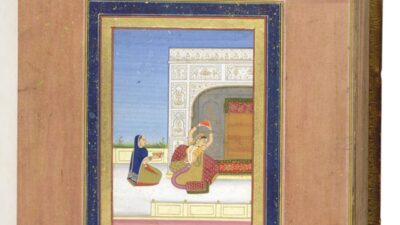
शास्त्र विंग · राग-पट्टिका · Raag Plate
भवप्रिय
Bhavapriya
एक श्रृंगार Carnatic राग · A Romance Carnatic Raag
भावरोमांटिक · सुंदर · कोमल · प्रेमपूर्ण
ऊर्जामध्यम
स्वर-चित्र · The Swara Panel
आरोह — अवरोह · The Ascent and the Descent
आरोह · Aroha चढ़ती हुई सीढ़ी
अवरोह · Avaroha उतरती हुई सीढ़ी
सˊ = तार सप्तक का षड्ज
पकड़ · पहचान वाक्यांश
रे॒ ग॒ म॑ प ध॒ नि॒ सा'
Re♭ Ga♭ Ma♯ Pa Dha♭ Ni♭ Sa'
Bhavapriya has no fixed Hindustani-tradition pakad. This ascending phrase through all six altered swaras—komal Re, komal Ga, tivra Ma, komal Dha, komal Ni—is the characteristic gamaka-laden phrase used by Carnatic performers in alapana to establish the raga's dense chromatic identity.
वादी–संवादी टिप्पणी · Vadi–Samvadi note
Vadi — In the Carnatic tradition, Raag Bhavapriya emphasizes Pancham (Pa) as a key resting note.
Samvadi — Sa (Shadj) serves as the complementary note.
समय और भाव
Time Theory & Moodसमय-सिद्धांत · Time Theory
संध्या काल
परंपरागत रूप से संध्या काल (4:00 PM - 7:00 PM) में गाया जाता है।
Traditionally performed during evening/twilight hours (4:00 PM - 7:00 PM), when day transitions to night.
भाव और गति · Mood & Tempo
श्रृंगार · Romance/Beauty
प्रेम, सौंदर्य और भक्ति का रस। रोमांटिक तड़प, सौंदर्यपरक आनंद और गहरे भावनात्मक जुड़ाव को जगाता है।
ऊर्जा · Energyमध्यम
स्तर · Leveladvanced — राग Bhavapriya के लिए कर्नाटक संगीत सिद्धांत की मजबूत नींव आवश्यक है।
पट्टिका-लेख
The Monographपरिचय Introduction
राग Bhavapriya कर्नाटक शास्त्रीय संगीत परंपरा का एक राग है। इसका प्रमुख रस श्रृंगार (Romance/Beauty) है। यह परंपरागत रूप से संध्या काल (4:00 PM - 7:00 PM) में गाया जाता है। गाया जाता है।
अंग्रेज़ी में पढ़ें · Read in English
Raag Bhavapriya is a complete scale with all 7 notes in both ascent and descent raga in the Carnatic classical music tradition. It is derived from the Bhavapriya melakarta (#44). With its Sampurna-Sampurna jati structure, this raag creates a distinctive tonal landscape. The predominant rasa is Romance/Beauty (श्रृंगार), making it suitable for compositions that evoke romantic, beautiful emotions. It is traditionally performed during evening hours, and its melodic contour offers rich possibilities for alapana, kalpanaswaram, and creative improvisation.
सांस्कृतिक महत्व Cultural Significance
भारतीय शास्त्रीय संगीत की समृद्ध परंपरा के अंग के रूप में, राग Bhavapriya Carnatic परंपरा को परिभाषित करने वाले स्वर संरचना और भावनात्मक अभिव्यक्ति के बीच गहरे संबंध का प्रतिनिधित्व करता है।
अंग्रेज़ी में पढ़ें · Read in English
As part of the rich tapestry of Indian classical music, Raag Bhavapriya represents the deep connection between melodic structure and emotional expression that defines the Carnatic tradition.
ऐतिहासिक महत्व Historical Significance
भवप्रिय कर्नाटक संगीत की 72-मेलकर्ता वर्गीकरण प्रणाली का 44वाँ मेलकर्ता है, जिसे थंजावूर के विद्वान-संगीतकार वेंकटमखिन ने अपनी कृति चतुर्दंडिप्रकाशिका (लगभग 1620 ई.) में सूत्रबद्ध किया था। यह वसु चक्र (8वाँ चक्र, मेलकर्ता 43–48) का द्वितीय सदस्य है। इस चक्र की विशेषता है प्रतिमध्यम (तीव्र मध्यम) का प्रयोग। भवप्रिय में कोमल ऋषभ, साधारण गंधार, तीव्र मध्यम, शुद्ध पंचम, कोमल धैवत और कैशिक निषाद का संयोग है — अर्थात् छः विकृत स्वर एक साथ, जो इसे अत्यंत क्रोमैटिक बनाता है। 'भव' (भावना) और 'प्रिय' (प्रिय) से बने नाम के बावजूद यह राग कर्नाटक संगीत-मंच पर विरले ही प्रस्तुत होता है। संगीत-त्रयी — त्यागराज, मुत्तुस्वामी दीक्षितर और श्यामा शास्त्री — की रचनाओं में इस मेलकर्ता पर आधारित कोई प्रसिद्ध कृति नहीं है। इसका अध्ययन मुख्यतः सैद्धांतिक है और 72-मेलकर्ता ढाँचे की बौद्धिक पूर्णता का प्रमाण है।
अंग्रेज़ी में पढ़ें · Read in English
Bhavapriya is the 44th melakarta in the 72-raga classificatory system codified by the Thanjavur scholar-musician Venkatamakhin in his Caturdandiprakasika (c. 1620 CE). It belongs to the Vasu chakra, the 8th of the 12 chakras, which covers melakartas 43–48 and is distinguished by the use of prati-madhyama (tivra Ma). Bhavapriya occupies the second position within this chakra, combining komal Rishabha, sadharana Gandhara, prati Madhyama, shuddha Panchama, komal Dhaivata, and kaisika Nishada. The name signifies 'beloved of emotions' (bhava = feeling, priya = beloved), pointing to a potential for deep emotional expressiveness. However, this promise is rarely realised in the concert hall: among the 72 melakartas, Bhavapriya is one of the most seldom performed, its highly chromatic six-altered-note scale lying outside the tonal idiom of most Carnatic compositions in the standard repertoire. There are no prominent kritis by the Trinity—Tyagaraja, Muthuswami Dikshitar, or Syama Sastri—in this raga. Its study in Carnatic music is primarily theoretical, serving as an object of intellectual classification and systematic completeness in the 72-melakarta framework.
शिक्षा
Teaching & LearningBegin with slow aalapana to internalize the raag's swaroopa (melodic form)
Practice the arohana and avarohana patterns with a tanpura drone
Listen to recordings by master performers to understand the raag's gamakas (ornamentations)
Work on kalpanaswaram (improvisation) within the raag's framework
Using incorrect gamakas that belong to a different raag
Not maintaining proper swar sthana (note placement)
Rushing through phrases without allowing the raag bhava to develop
तुलना
A Specimen Comparison| तुलनाSpecimen | भवप्रिय | रामप्रिया |
|---|---|---|
| स्वर-अंतर | Both have tivra Madhyam but differ in Re, Ga, Dha, and Ni choices | |
कामवर्धिनी (51वाँ मेलकर्ता, 'पंतुवराली' नाम से प्रचलित) तीव्र-म, कोमल-रे समूह का सबसे प्रसिद्ध राग है और कर्नाटक कंसर्ट में व्यापक रूप से प्रस्तुत होता है; यह हिंदुस्तानी पूर्वी ठाट के समतुल्य है। भवप्रिय उससे गंधार और निषाद में भिन्न है, जो तनाव की एक अलग गुणवत्ता बनाता है।
| तुलनाSpecimen | भवप्रिय | कामवर्धिनी |
|---|---|---|
| स्वर-अंतर | Bhavapriya differs from Kamavardhini in its Gandhar and Nishad choices; both share tivra Madhyam and komal Re | |
हेमावती (58वाँ) भी तीव्र-म वाला राग है किन्तु भिन्न गंधार और निषाद विकल्पों के साथ — यह तुलना दिखाती है कि तीव्र मध्यम के आसपास के सहायक स्वरों का चुनाव किस तरह एक राग की भावनात्मक दिशा बदल देता है।
| तुलनाSpecimen | भवप्रिय | हेमावती |
|---|---|---|
| स्वर-अंतर | Both have tivra Madhyam; Hemavati uses different Ga and Ni variants | |
प्रस्तुति
Performance- Description
- परंपरागत रूप से संध्या काल (4:00 PM - 7:00 PM) में गाया जाता है। Traditionally performed during evening/twilight hours (4:00 PM - 7:00 PM), when day transitions to night.
- Prahar Number
- 5
- Prahar Name
- संध्या काल Sandhya Kaal
- Time Start
- 16:00
- Time End
- 19:00
- Time Flexibility
- flexible
Time
और जानें
More to Know- raag-ramapriya — Ramapriya — रामप्रिया — Both have tivra Madhyam, but they differ in their Re, Ga, Dha, and Ni choices, giving them distinct identities despite sharing the heightened tension of the sharp fourth. — Both have tivra Madhyam but differ in Re, Ga, Dha, and Ni choices
- raag-kamavardhini — Kamavardhini — कामवर्धिनी — Kamavardhini (51st melakarta, also known as Pantuvarali) is the best-known raga of the tivra-Ma, komal-Re cluster and is widely performed in concerts; it corresponds to the Hindustani Poorvi thaat. Bhavapriya's note set differs from Kamavardhini in its Gandhar and Nishad choices, creating a somewhat different quality of tension, but both share that characteristic sense of elevated longing produced by the tivra Madhyam. — कामवर्धिनी (51वाँ मेलकर्ता, 'पंतुवराली' नाम से प्रचलित) तीव्र-म, कोमल-रे समूह का सबसे प्रसिद्ध राग है और कर्नाटक कंसर्ट में व्यापक रूप से प्रस्तुत होता है; यह हिंदुस्तानी पूर्वी ठाट के समतुल्य है। भवप्रिय उससे गंधार और निषाद में भिन्न है, जो तनाव की एक अलग गुणवत्ता बनाता है। — Bhavapriya differs from Kamavardhini in its Gandhar and Nishad choices; both share tivra Madhyam and komal Re
- raag-hemavati — Hemavati — हेमावती — Hemavati (58th melakarta) is another raag with tivra Ma but uses different Ga and Ni variants; the comparison highlights how the choice of supporting swaras around tivra Ma entirely changes a raga's emotional direction. — हेमावती (58वाँ) भी तीव्र-म वाला राग है किन्तु भिन्न गंधार और निषाद विकल्पों के साथ — यह तुलना दिखाती है कि तीव्र मध्यम के आसपास के सहायक स्वरों का चुनाव किस तरह एक राग की भावनात्मक दिशा बदल देता है। — Both have tivra Madhyam; Hemavati uses different Ga and Ni variants
In Film Music
Bhavapriya (44th melakarta) is a rare and seldom-performed Carnatic raga whose highly chromatic note set — combining two komal (flattened) swaras with a tivra (sharp) Madhyam — creates a distinctive, somewhat dissonant scale that lies outside the tonal language of mainstream Hindi film music. Its name means 'beloved of emotions' (bhava = emotion, priya = beloved), suggesting a capacity for deep emotional expressiveness, but this expressiveness is realised primarily in the specialised Carnatic concert context through elaborate alapana and kriti rendition. Hindi film music has not drawn on Bhavapriya by name or by scale; the specific combination of its notes does not correspond to any established Hindustani raag that served film composers. Its concert life is also limited: even within Carnatic classical music, the 44th melakarta and its derivatives are rarely featured. Listeners interested in this raga's emotional range should explore the small number of Carnatic classical recordings dedicated to it.
Comparisons
सीखने के लिए
For Learners- Difficulty Level
- advanced
अन्य विवरण
More Details- Indian_Music_Raga_Encyclopedia_v2.xlsx
- 72-melakarta system: Bhavapriya as the 44th melakarta in the Vasu chakra
- Carnatic raga Kamavardhini (Pantuvarali) as the closest popular raga in the same tivra-Ma group
- Carnatic 72-melakarta system: Bhavapriya as the 44th melakarta in the Vasu chakra (Venkatamakhin, Caturdandiprakasika, c. 1620 CE)
- Govindacharya, Samgraha-Chudamani, c. 1800 CE
References
नमूना-पट्टी
The Specimen Table| नाम | भवप्रिय · Bhavapriya |
|---|---|
| थाट | — |
| आरोह | Sa Re♭ Ga♭ Ma♯ Pa Dha♭ Ni♭ Sa' Sa' |
| अवरोह | Sa' Sa' Ni♭ Dha♭ Pa Ma♯ Ga♭ Re♭ Sa |
| पकड़ | रे॒ ग॒ म॑ प ध॒ नि॒ सा' |
| जाति | संपूर्ण-संपूर्ण · Sampurna-Sampurna |
| समय | संध्या काल |
| ऊर्जा | मध्यम |
| परिवार | Bhavapriya |
| स्तर | advanced |
| लोकप्रियता | Obscure |
| कर्नाटक समतुल्य | Bhavapriya · Melakarta 44 |
जुड़े हुए पन्ने
Connected Plates · The Graph Made Visibleअटलस में कोई पन्ना अकेला नहीं — इस राग से गीत, प्रस्तुतियाँ, कलाकार, ताल, घराने और मिलते-जुलते राग, सब यहाँ से खुलते हैं।
ताल-साथी · Taal Pairings
श्रवण-कक्ष · The Listening Room
सुनिए — भवप्रिय · Hear the Raag
Raag Bhavapriya — Classical Performance
प्रश्नोत्तर
Questions & Answersराग Bhavapriya किस संगीत पद्धति का राग है?
राग Bhavapriya कर्नाटक (दक्षिण भारतीय) शास्त्रीय संगीत पद्धति का राग है।
अंग्रेज़ी में पढ़ें · Read in English
Which music system does Raga Bhavapriya belong to? — Raga Bhavapriya belongs to the Carnatic (South Indian) classical music system.
साझा कीजिए · Share this Plate