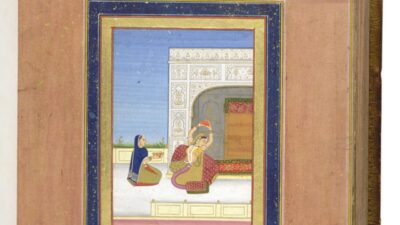
शास्त्र विंग · राग-पट्टिका · Raag Plate
पवनि
Pavani
एक शांत Carnatic राग · A Peace Carnatic Raag
भावशांतिपूर्ण · ध्यानपूर्ण · प्रशांत · शांत
ऊर्जाधीमी
स्वर-चित्र · The Swara Panel
आरोह — अवरोह · The Ascent and the Descent
आरोह · Aroha चढ़ती हुई सीढ़ी
अवरोह · Avaroha उतरती हुई सीढ़ी
सˊ = तार सप्तक का षड्ज
पकड़ · पहचान वाक्यांश
स रे॒ ग॒॒ म♯ प | ध नि सा | सा नि ध प म♯ ग॒॒ रे॒ स
Sa Re♭ Ga♭♭ Ma♯ Pa | Dha Ni Sa' | Sa' Ni Dha Pa Ma♯ Ga♭♭ Re♭ Sa
Pavani pairs atikomal gandhara (G1 / shuddha gandhara in Carnatic) with prati madhyama (tivra Ma / M2) while keeping shuddha dhaivata and shuddha nishada in the upper octave. G1 has no Hindustani equivalent. The phrase foregrounds the tense G1-M2 span in both ascent and the expressive descent.
वादी–संवादी टिप्पणी · Vadi–Samvadi note
Vadi — In the Carnatic tradition, Raag Pavani emphasizes Pancham (Pa) as a key resting note.
Samvadi — Sa (Shadj) serves as the complementary note.
समय और भाव
Time Theory & Moodसमय-सिद्धांत · Time Theory
रात्रि
परंपरागत रूप से रात्रि (9:00 PM - 12:00 AM) में गाया जाता है।
Traditionally performed during late night hours (9:00 PM - 12:00 AM), evoking the depth and stillness of night.
भाव और गति · Mood & Tempo
शांत · Peace/Tranquility
आंतरिक शांति, सुकून और आध्यात्मिक वैराग्य का रस। शांति, ध्यान और अध्यात्म को जगाता है।
ऊर्जा · Energyधीमी
स्तर · Leveladvanced — राग Pavani के लिए कर्नाटक संगीत सिद्धांत की मजबूत नींव आवश्यक है।
पट्टिका-लेख
The Monographपरिचय Introduction
राग Pavani कर्नाटक शास्त्रीय संगीत परंपरा का एक राग है। इसका प्रमुख रस शांत (Peace/Tranquility) है। यह परंपरागत रूप से रात्रि (9:00 PM - 12:00 AM) में गाया जाता है। गाया जाता है।
अंग्रेज़ी में पढ़ें · Read in English
Raag Pavani is a complete scale with all 7 notes in both ascent and descent raga in the Carnatic classical music tradition. It is derived from the Pavani melakarta (#41). With its Sampurna-Sampurna jati structure, this raag creates a distinctive tonal landscape. The predominant rasa is Peace/Tranquility (शांत), making it suitable for compositions that evoke peaceful, meditative emotions. It is traditionally performed during night hours, and its melodic contour offers rich possibilities for alapana, kalpanaswaram, and creative improvisation.
सांस्कृतिक महत्व Cultural Significance
भारतीय शास्त्रीय संगीत की समृद्ध परंपरा के अंग के रूप में, राग Pavani Carnatic परंपरा को परिभाषित करने वाले स्वर संरचना और भावनात्मक अभिव्यक्ति के बीच गहरे संबंध का प्रतिनिधित्व करता है।
अंग्रेज़ी में पढ़ें · Read in English
As part of the rich tapestry of Indian classical music, Raag Pavani represents the deep connection between melodic structure and emotional expression that defines the Carnatic tradition.
ऐतिहासिक महत्व Historical Significance
पावनी कर्नाटक की 72-मेलकर्ता पद्धति का 41वाँ मेलकर्ता है, जो सातवें चक्र 'ऋषि' (मेलकर्ता 37–42) का पंचम राग है। यह प्रति मध्यम खण्ड (मेलकर्ता 37–72) के अन्तर्गत आता है। 'पावनी' का अर्थ — पवित्र करने वाली, वायु — कर्नाटक की राग-नामकरण परम्परा को दर्शाता है। वेंकटमखी ने 1660 ई. में इस स्वर-संरचना का वर्णन किया। ऋषि चक्र में पावनी के निकट नवनीतम् (#40) और राघुप्रिया (#42) हैं, जो सभी शुद्ध गान्धार (G1 / अतिकोमल ग) को साझा करते हैं। डॉ. बालमुरलीकृष्ण ने इसमें कृति रची है।
अंग्रेज़ी में पढ़ें · Read in English
Pavani is the 41st melakarta in the Carnatic 72-melakarta system, the fifth raag of the seventh chakra, Rishi (melakartas 37–42). It belongs to the prati madhyama half (melakartas 37–72). Venkatamakhi catalogued this scale in the Caturdandi Prakasika (1660 CE). The name Pavani — meaning 'wind' or 'purifying one' — aligns with the Carnatic tradition of naming melakartas after evocative natural or divine concepts. Pavani neighbours Navaneetam (#40) and Raghupriya (#42) in the Rishi chakra, sharing the atikomal gandhara (G1) that characterises this group of scales. Dr. M. Balamuralikrishna composed a kriti in Pavani for the Janaka Raga Kriti Manjari. The raag has no established performance tradition outside academic circles.
शिक्षा
Teaching & LearningBegin with slow aalapana to internalize the raag's swaroopa (melodic form)
Practice the arohana and avarohana patterns with a tanpura drone
Listen to recordings by master performers to understand the raag's gamakas (ornamentations)
Work on kalpanaswaram (improvisation) within the raag's framework
Using incorrect gamakas that belong to a different raag
Not maintaining proper swar sthana (note placement)
Rushing through phrases without allowing the raag bhava to develop
तुलना
A Specimen Comparisonपवनि और नवनीतम् (#40) निषाद को छोड़कर प्रत्येक स्वर साझा करते हैं: पवनि में शुद्ध नि (N2) है जबकि नवनीतम् में कोमल नि (N1)। पवनि का शुद्ध नि तार सप्तक के षड्ज की ओर थोड़ा अधिक खुला आरोहण बनाता है — अष्टव्य की पहुँच पूर्ण और अबाधित लगती है। नवनीतम् का कोमल नि अधिक अंतर्मुखी, विचलित पहुँच देता है।
| तुलनाSpecimen | पवनि | नवनीतम् |
|---|---|---|
| स्वर-अंतर | Pavani: shuddha Ni (N2, kakali Nishada); Navaneetam: komal Ni (N1, kaisiki Nishada). All other notes identical. | |
व्यापक तुलना मेचकल्याणी (#65) के साथ: दोनों राग मध्यम के ऊपर पूरी तरह शुद्ध हैं। लेकिन मेचकल्याणी निचले सप्तक में मानक शुद्ध रे और शुद्ध ग का उपयोग करता है, जो इसे उज्ज्वल, खुली गुणवत्ता देता है। पवनि के असाधारण R1 और G1 इसे आधार में मौलिक रूप से गहरा और संकुचित बनाते हैं।
| तुलनाSpecimen | पवनि | मेचकल्याणी |
|---|---|---|
| स्वर-अंतर | Both have Pa, shuddha Dha, shuddha Ni above Madhyama; Mechakalyani uses shuddha Re (R2) and shuddha Ga (G2) in lower register; Pavani uses komal Re (R1) and lowest Ga (G1). | |
| भाव-अंतर | Mechakalyani: bright, open, Kalyani-like; Pavani: darker and more compressed despite similar upper structure. | |
प्रस्तुति
Performance- Description
- परंपरागत रूप से रात्रि (9:00 PM - 12:00 AM) में गाया जाता है। Traditionally performed during late night hours (9:00 PM - 12:00 AM), evoking the depth and stillness of night.
- Prahar Number
- 7
- Prahar Name
- रात्रि Ratri
- Time Start
- 21:00
- Time End
- 00:00
- Time Flexibility
- flexible
Time
और जानें
More to Know- raag-navaneetam — Navaneetam — नवनीतम् — Pavani and Navaneetam (#40) share every note except Nishada: Pavani uses shuddha Ni (N2, kakali Nishada) while Navaneetam uses komal Ni (N1, kaisiki Nishada). The shuddha Ni of Pavani creates a slightly more open ascent toward the upper Sa — the approach to the octave feels complete and unimpeded. Navaneetam's komal Ni gives a more introverted, deflected approach to Sa that creates a mild, unresolved suspension before the final arrival. — पवनि और नवनीतम् (#40) निषाद को छोड़कर प्रत्येक स्वर साझा करते हैं: पवनि में शुद्ध नि (N2) है जबकि नवनीतम् में कोमल नि (N1)। पवनि का शुद्ध नि तार सप्तक के षड्ज की ओर थोड़ा अधिक खुला आरोहण बनाता है — अष्टव्य की पहुँच पूर्ण और अबाधित लगती है। नवनीतम् का कोमल नि अधिक अंतर्मुखी, विचलित पहुँच देता है। — Pavani: shuddha Ni (N2, kakali Nishada); Navaneetam: komal Ni (N1, kaisiki Nishada). All other notes identical.
- raag-mechakalyani — Mechakalyani — मेचकल्याणी — Both Pavani and Mechakalyani (#65) are entirely shuddha above the Madhyama (Pa, shuddha Dha, shuddha Ni in both). But Mechakalyani uses the standard shuddha Re and shuddha Ga in the lower register, giving it the bright, open quality of the Carnatic Kalyani (Hindustani Yaman). Pavani's unusual komal Re (R1) and lowest Ga (G1) in the lower register make it fundamentally darker and more compressed at the base despite the similar upper structure. — व्यापक तुलना मेचकल्याणी (#65) के साथ: दोनों राग मध्यम के ऊपर पूरी तरह शुद्ध हैं। लेकिन मेचकल्याणी निचले सप्तक में मानक शुद्ध रे और शुद्ध ग का उपयोग करता है, जो इसे उज्ज्वल, खुली गुणवत्ता देता है। पवनि के असाधारण R1 और G1 इसे आधार में मौलिक रूप से गहरा और संकुचित बनाते हैं। — Both have Pa, shuddha Dha, shuddha Ni above Madhyama; Mechakalyani uses shuddha Re (R2) and shuddha Ga (G2) in lower register; Pavani uses komal Re (R1) and lowest Ga (G1). — Mechakalyani: bright, open, Kalyani-like; Pavani: darker and more compressed despite similar upper structure.
In Film Music
Pavani, the 41st melakarta of the Carnatic system and the fifth raag of the Rishi chakra, is a concert-specialist raag with no documented presence in Hindi film music. It shares all but one note with its immediate predecessor Navaneetam (#40) — the sole difference being that Pavani uses shuddha Ni (natural seventh) where Navaneetam uses komal Ni (flat seventh). While this single-note distinction may seem minimal, it places Pavani in slightly different emotional territory: the shuddha Ni gives it a marginally more open, resolved upper closure compared to Navaneetam's restrained komal Ni.
Pavani's scale — komal Re (R1), the lowest form of Ga (G1), prati Madhyama (tivra Ma, M2), Pa, shuddha Dha (D2), shuddha Ni (N2) — has no equivalent in the Hindustani thaat system. The compressed density of the lower tetrachord (where G1 is enharmonically very close to R2) combined with the raised fourth creates a tonality entirely outside the Hindustani modal framework. Hindi film composers, working within Hindustani raag categories, would have had no vocabulary or precedent for approaching this scale. Pavani's peaceful (Shanta) rasa and late-night performance time mark it as a raag for advanced practitioners in the Carnatic concert tradition, not for popular film consumption.
Comparisons
सीखने के लिए
For Learners- Difficulty Level
- advanced
अन्य विवरण
More Details- Indian_Music_Raga_Encyclopedia_v2.xlsx
- Dr. M. Balamuralikrishna, Janaka Raga Kriti Manjari — Pavani (Video 41)
- P. Sambamurthy, Dictionary of South Indian Music and Musicians (1952–71)
- S. Bhagyalekshmy, Ragas in Carnatic Music (1990)
References
नमूना-पट्टी
The Specimen Table| नाम | पवनि · Pavani |
|---|---|
| थाट | — |
| आरोह | Sa Re♭ Ga♭♭ Ma♯ Pa Dha Ni Sa' Sa' |
| अवरोह | Sa' Sa' Ni Dha Pa Ma♯ Ga♭♭ Re♭ Sa |
| पकड़ | स रे॒ ग॒॒ म♯ प | ध नि सा | सा नि ध प म♯ ग॒॒ रे॒ स |
| जाति | संपूर्ण-संपूर्ण · Sampurna-Sampurna |
| समय | रात्रि |
| ऊर्जा | धीमी |
| परिवार | Pavani |
| स्तर | advanced |
| लोकप्रियता | Obscure |
| कर्नाटक समतुल्य | Pavani · Melakarta 41 |
जुड़े हुए पन्ने
Connected Plates · The Graph Made Visibleअटलस में कोई पन्ना अकेला नहीं — इस राग से गीत, प्रस्तुतियाँ, कलाकार, ताल, घराने और मिलते-जुलते राग, सब यहाँ से खुलते हैं।
ताल-साथी · Taal Pairings
श्रवण-कक्ष · The Listening Room
सुनिए — पवनि · Hear the Raag
Jaya Dhanada Sakha – Pavani – Janaka Raga Kriti Manjari – Dr. M Balamuralikrishna – Video 41
प्रश्नोत्तर
Questions & Answersराग Pavani किस संगीत पद्धति का राग है?
राग Pavani कर्नाटक (दक्षिण भारतीय) शास्त्रीय संगीत पद्धति का राग है।
अंग्रेज़ी में पढ़ें · Read in English
Which music system does Raga Pavani belong to? — Raga Pavani belongs to the Carnatic (South Indian) classical music system.
साझा कीजिए · Share this Plate