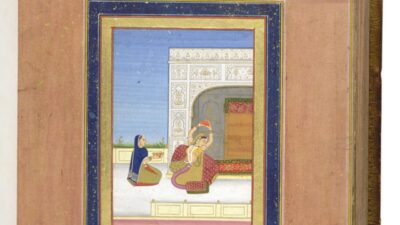
शास्त्र विंग · राग-पट्टिका · Raag Plate
नवनीतम्
Navaneetam
एक शांत Carnatic राग · A Peace Carnatic Raag
भावशांतिपूर्ण · ध्यानपूर्ण · प्रशांत · शांत
ऊर्जाधीमी
स्वर-चित्र · The Swara Panel
आरोह — अवरोह · The Ascent and the Descent
आरोह · Aroha चढ़ती हुई सीढ़ी
अवरोह · Avaroha उतरती हुई सीढ़ी
सˊ = तार सप्तक का षड्ज
पकड़ · पहचान वाक्यांश
स रे॒ ग॒॒ म♯ प | ध नि॒ सा | सा नि॒ ध प म♯ ग॒॒ रे॒ स
Sa Re♭ Ga♭♭ Ma♯ Pa | Dha Ni♭ Sa' | Sa' Ni♭ Dha Pa Ma♯ Ga♭♭ Re♭ Sa
Navaneetam combines atikomal gandhara (G1 / shuddha gandhara in Carnatic) with prati madhyama (tivra Ma / M2), an especially tense pairing. G1 has no equivalent in Hindustani and cannot be placed within the thaat system. The characteristic phrase foregrounds both these unusual svaras in ascent and descent.
वादी–संवादी टिप्पणी · Vadi–Samvadi note
Vadi — In the Carnatic tradition, Raag Navaneetam emphasizes Pancham (Pa) as a key resting note.
Samvadi — Sa (Shadj) serves as the complementary note.
समय और भाव
Time Theory & Moodसमय-सिद्धांत · Time Theory
रात्रि
परंपरागत रूप से रात्रि (9:00 PM - 12:00 AM) में गाया जाता है।
Traditionally performed during late night hours (9:00 PM - 12:00 AM), evoking the depth and stillness of night.
भाव और गति · Mood & Tempo
शांत · Peace/Tranquility
आंतरिक शांति, सुकून और आध्यात्मिक वैराग्य का रस। शांति, ध्यान और अध्यात्म को जगाता है।
ऊर्जा · Energyधीमी
स्तर · Leveladvanced — राग Navaneetam के लिए कर्नाटक संगीत सिद्धांत की मजबूत नींव आवश्यक है।
पट्टिका-लेख
The Monographपरिचय Introduction
राग Navaneetam कर्नाटक शास्त्रीय संगीत परंपरा का एक राग है। इसका प्रमुख रस शांत (Peace/Tranquility) है। यह परंपरागत रूप से रात्रि (9:00 PM - 12:00 AM) में गाया जाता है। गाया जाता है।
अंग्रेज़ी में पढ़ें · Read in English
Raag Navaneetam is a complete scale with all 7 notes in both ascent and descent raga in the Carnatic classical music tradition. It is derived from the Navaneetam melakarta (#40). With its Sampurna-Sampurna jati structure, this raag creates a distinctive tonal landscape. The predominant rasa is Peace/Tranquility (शांत), making it suitable for compositions that evoke peaceful, meditative emotions. It is traditionally performed during night hours, and its melodic contour offers rich possibilities for alapana, kalpanaswaram, and creative improvisation.
सांस्कृतिक महत्व Cultural Significance
भारतीय शास्त्रीय संगीत की समृद्ध परंपरा के अंग के रूप में, राग Navaneetam Carnatic परंपरा को परिभाषित करने वाले स्वर संरचना और भावनात्मक अभिव्यक्ति के बीच गहरे संबंध का प्रतिनिधित्व करता है।
अंग्रेज़ी में पढ़ें · Read in English
As part of the rich tapestry of Indian classical music, Raag Navaneetam represents the deep connection between melodic structure and emotional expression that defines the Carnatic tradition.
ऐतिहासिक महत्व Historical Significance
नवनीतम् कर्नाटक की 72-मेलकर्ता पद्धति का 40वाँ मेलकर्ता है, जो सातवें चक्र 'ऋषि' (मेलकर्ता 37–42) का चतुर्थ राग है। यह प्रति मध्यम खण्ड (मेलकर्ता 37–72) के अन्तर्गत आता है। वेंकटमखी ने 1660 ई. में इसका वर्णन किया। इसमें शुद्ध गान्धार (G1 / अतिकोमल ग) और प्रति मध्यम (तीव्र म / M2) का संयोजन एक विशेष तीखा और तनावपूर्ण स्वर-वर्ण उत्पन्न करता है जो हिन्दुस्तानी ठाट पद्धति से बाहर है। डॉ. बालमुरलीकृष्ण ने इसमें कृति रची है।
अंग्रेज़ी में पढ़ें · Read in English
Navaneetam is the 40th melakarta in the Carnatic 72-melakarta system, the fourth raag of the seventh chakra, Rishi (melakartas 37–42). As the last melakarta in the shuddha madhyama half of the system (melakartas 1–36 end at Chakravakam), Navaneetam in fact belongs to the prati madhyama half (melakartas 37–72). Venkatamakhi included this scale in the Caturdandi Prakasika (1660 CE). The shuddha gandhara (G1 / atikomal Ga) combined with prati madhyama (M2) creates a particularly sharp and tense tonal colour unusual even within the Carnatic system. Dr. M. Balamuralikrishna composed a kriti in Navaneetam. The raag is primarily theoretical in scope.
शिक्षा
Teaching & LearningBegin with slow aalapana to internalize the raag's swaroopa (melodic form)
Practice the arohana and avarohana patterns with a tanpura drone
Listen to recordings by master performers to understand the raag's gamakas (ornamentations)
Work on kalpanaswaram (improvisation) within the raag's framework
Using incorrect gamakas that belong to a different raag
Not maintaining proper swar sthana (note placement)
Rushing through phrases without allowing the raag bhava to develop
तुलना
A Specimen Comparisonनवनीतम् और पवनि प्रत्येक स्वर साझा करते हैं — सा, कोमल रे (R1), निम्नतम ग (G1), तीव्र म (M2), प, शुद्ध ध (D2) — और केवल अंतिम स्वर में भिन्न हैं: नवनीतम् में कोमल नि (N1) है जबकि पवनि में शुद्ध नि (N2)। नवनीतम् का कोमल नि ऊपरी छोर पर एक हल्की, अनिर्धारित गुणवत्ता देता है, जबकि पवनि का शुद्ध नि अधिक खुला, पूर्ण समापन प्रदान करता है।
| तुलनाSpecimen | नवनीतम् | पवनि |
|---|---|---|
| स्वर-अंतर | Navaneetam: komal Ni (N1, kaisiki Nishada); Pavani: shuddha Ni (N2, kakali Nishada). All other notes identical. | |
प्रस्तुति
Performance- Description
- परंपरागत रूप से रात्रि (9:00 PM - 12:00 AM) में गाया जाता है। Traditionally performed during late night hours (9:00 PM - 12:00 AM), evoking the depth and stillness of night.
- Prahar Number
- 7
- Prahar Name
- रात्रि Ratri
- Time Start
- 21:00
- Time End
- 00:00
- Time Flexibility
- flexible
Time
और जानें
More to Know- raag-pavani — Pavani — पवनि — Navaneetam and Pavani (#41) share every note — Sa, komal Re (R1), the lowest Ga (G1), tivra Ma (M2), Pa, shuddha Dha (D2) — and differ only in their final note: Navaneetam uses komal Ni (N1, kaisiki Nishada) while Pavani uses shuddha Ni (N2, kakali Nishada). Navaneetam's komal Ni gives it a slightly restrained, unresolved quality at the upper end, while Pavani's shuddha Ni provides a more open, complete closure. — नवनीतम् और पवनि प्रत्येक स्वर साझा करते हैं — सा, कोमल रे (R1), निम्नतम ग (G1), तीव्र म (M2), प, शुद्ध ध (D2) — और केवल अंतिम स्वर में भिन्न हैं: नवनीतम् में कोमल नि (N1) है जबकि पवनि में शुद्ध नि (N2)। नवनीतम् का कोमल नि ऊपरी छोर पर एक हल्की, अनिर्धारित गुणवत्ता देता है, जबकि पवनि का शुद्ध नि अधिक खुला, पूर्ण समापन प्रदान करता है। — Navaneetam: komal Ni (N1, kaisiki Nishada); Pavani: shuddha Ni (N2, kakali Nishada). All other notes identical.
In Film Music
Navaneetam, the 40th melakarta of the Carnatic system and the fourth raag of the Rishi chakra, is among the more tonally unusual melakartas and has never entered Hindi film music. Its scale carries three consecutive flattened notes at the bottom — komal Re (R1), the lowest form of Ga (Shuddha Gandhara, G1, a sort of double-flat Ga in Western terms), and prati Madhyama (tivra Ma, the raised fourth) — followed by a more standard upper tetrachord of Pa, shuddha Dha, and komal Ni. This combination of unusually lowered lower-tetrachord notes with a raised Ma gives Navaneetam a distinctly exotic, chromatic quality that has no parallel in the Hindustani thaat system.
Hindi film composers who occasionally explored unusual scales invariably worked within Hindustani or commonly-known Carnatic frameworks. Navaneetam's specific note structure — particularly the G1 (the lowest possible Gandhara, enharmonically close to Rishabha) — places it in territory that has no recognised Hindustani name or film song tradition. It is performed late at night (9 PM–midnight), and its peaceful-meditative (Shanta) rasa aligns it with introspective devotional contexts. Its musical home is the concert stage and the 72-melakarta study curriculum, not cinema.
Comparisons
सीखने के लिए
For Learners- Difficulty Level
- advanced
अन्य विवरण
More Details- Indian_Music_Raga_Encyclopedia_v2.xlsx
- Dr. M. Balamuralikrishna, Janaka Raga Kriti Manjari — Navaneetam (Video 40)
- P. Sambamurthy, Dictionary of South Indian Music and Musicians (1952–71)
- S. Bhagyalekshmy, Ragas in Carnatic Music (1990)
References
नमूना-पट्टी
The Specimen Table| नाम | नवनीतम् · Navaneetam |
|---|---|
| थाट | — |
| आरोह | Sa Re♭ Ga♭♭ Ma♯ Pa Dha Ni♭ Sa' Sa' |
| अवरोह | Sa' Sa' Ni♭ Dha Pa Ma♯ Ga♭♭ Re♭ Sa |
| पकड़ | स रे॒ ग॒॒ म♯ प | ध नि॒ सा | सा नि॒ ध प म♯ ग॒॒ रे॒ स |
| जाति | संपूर्ण-संपूर्ण · Sampurna-Sampurna |
| समय | रात्रि |
| ऊर्जा | धीमी |
| परिवार | Navaneetam |
| स्तर | advanced |
| लोकप्रियता | Obscure |
| कर्नाटक समतुल्य | Navaneetam · Melakarta 40 |
जुड़े हुए पन्ने
Connected Plates · The Graph Made Visibleअटलस में कोई पन्ना अकेला नहीं — इस राग से गीत, प्रस्तुतियाँ, कलाकार, ताल, घराने और मिलते-जुलते राग, सब यहाँ से खुलते हैं।
ताल-साथी · Taal Pairings
श्रवण-कक्ष · The Listening Room
सुनिए — नवनीतम् · Hear the Raag
Himatmaje Satatam – Navaneetam – Janaka Raga Kriti Manjari – Dr. M Balamuralikrishna – Video 40
प्रश्नोत्तर
Questions & Answersराग Navaneetam किस संगीत पद्धति का राग है?
राग Navaneetam कर्नाटक (दक्षिण भारतीय) शास्त्रीय संगीत पद्धति का राग है।
अंग्रेज़ी में पढ़ें · Read in English
Which music system does Raga Navaneetam belong to? — Raga Navaneetam belongs to the Carnatic (South Indian) classical music system.
साझा कीजिए · Share this Plate