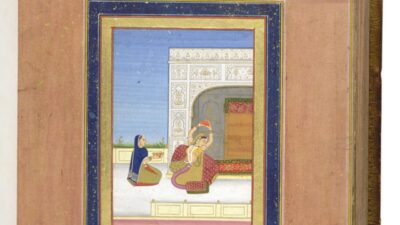
शास्त्र विंग · राग-पट्टिका · Raag Plate
जलरनवम्
Jalarnavam
एक भयानक Carnatic राग · A Fear Carnatic Raag
भावगंभीर · भव्य · कठोर · गहन
ऊर्जाधीमी
स्वर-चित्र · The Swara Panel
आरोह — अवरोह · The Ascent and the Descent
आरोह · Aroha चढ़ती हुई सीढ़ी
अवरोह · Avaroha उतरती हुई सीढ़ी
सˊ = तार सप्तक का षड्ज
पकड़ · पहचान वाक्यांश
रे॒ ग॒॒ म॑ प ध॒ नि॒ सा'
Re♭ Ga♭♭ Ma♯ Pa Dha♭ Ni♭ Sa'
Jalarnavam has no Hindustani-tradition pakad. This ascending phrase moves through the raga's densely chromatic lower tetrachord—adjacent komal Re and G1 (only one semitone apart)—then leaps to tivra Ma, before traversing komal Dha and komal Ni to reach Sa'. This distinctive movement encapsulates the oceanic density and strangeness of the raga's sound-world.
वादी–संवादी टिप्पणी · Vadi–Samvadi note
Vadi — In the Carnatic tradition, Raag Jalarnavam emphasizes Pancham (Pa) as a key resting note.
Samvadi — Sa (Shadj) serves as the complementary note.
समय और भाव
Time Theory & Moodसमय-सिद्धांत · Time Theory
संध्या काल
परंपरागत रूप से संध्या काल (4:00 PM - 7:00 PM) में गाया जाता है।
Traditionally performed during evening/twilight hours (4:00 PM - 7:00 PM), when day transitions to night.
भाव और गति · Mood & Tempo
भयानक · Fear/Awe
विस्मय, गंभीरता और उदात्त का रस। गहरा सम्मान, गंभीरता और गांभीर्य जगाता है।
ऊर्जा · Energyधीमी
स्तर · Leveladvanced — राग Jalarnavam के लिए कर्नाटक संगीत सिद्धांत की मजबूत नींव आवश्यक है।
पट्टिका-लेख
The Monographपरिचय Introduction
राग Jalarnavam कर्नाटक शास्त्रीय संगीत परंपरा का एक राग है। इसका प्रमुख रस भयानक (Fear/Awe) है। यह परंपरागत रूप से संध्या काल (4:00 PM - 7:00 PM) में गाया जाता है। गाया जाता है।
अंग्रेज़ी में पढ़ें · Read in English
Raag Jalarnavam is a complete scale with all 7 notes in both ascent and descent raga in the Carnatic classical music tradition. It is derived from the Jalarnavam melakarta (#38). With its Sampurna-Sampurna jati structure, this raag creates a distinctive tonal landscape. The predominant rasa is Fear/Awe (भयानक), making it suitable for compositions that evoke solemn, grave emotions. It is traditionally performed during evening hours, and its melodic contour offers rich possibilities for alapana, kalpanaswaram, and creative improvisation.
सांस्कृतिक महत्व Cultural Significance
भारतीय शास्त्रीय संगीत की समृद्ध परंपरा के अंग के रूप में, राग Jalarnavam Carnatic परंपरा को परिभाषित करने वाले स्वर संरचना और भावनात्मक अभिव्यक्ति के बीच गहरे संबंध का प्रतिनिधित्व करता है।
अंग्रेज़ी में पढ़ें · Read in English
As part of the rich tapestry of Indian classical music, Raag Jalarnavam represents the deep connection between melodic structure and emotional expression that defines the Carnatic tradition.
ऐतिहासिक महत्व Historical Significance
जलार्णवम् कर्नाटक संगीत की 72-मेलकर्ता प्रणाली में 38वाँ मेलकर्ता है और ऋषि चक्र (मेलकर्ता 37–42), अर्थात् 7वें चक्र, का द्वितीय सदस्य है। ऋषि चक्र प्रतिमध्यम (तीव्र मध्यम) समूह का पहला चक्र है और इंदु चक्र (1–6) का प्रतिमध्यम समतुल्य है। इसमें कोमल ऋषभ (1 अर्धस्वर) और शुद्ध गंधार/चतुःश्रुति ऋषभ (G1=R2, 2 अर्धस्वर) — एक-एक अर्धस्वर की दूरी वाले स्वर — साथ आते हैं। दूसरे स्थान में शुद्ध धैवत और कैशिक निषाद हैं। वेंकटमखिन ने इसे चतुर्दंडिप्रकाशिका (लगभग 1620 ई.) में वर्गीकृत किया। 'जलार्णवम्' नाम का अर्थ है 'जल का समुद्र' — इस राग के घने, असाधारण स्वर-संसार का भावपूर्ण रूपक। यह मुख्यधारा के कर्नाटक मंच पर प्रायः नहीं सुना जाता।
अंग्रेज़ी में पढ़ें · Read in English
Jalarnavam is the 38th melakarta in the Carnatic 72-raga system, the second member of the Rishi chakra (melakartas 37–42), the 7th of the 12 chakras and the first chakra of the prati-madhyama (tivra Ma) group. The Rishi chakra uses komal Rishabha (R1, 1 semitone) and chatusshruti Rishabha / shuddha Gandhara (G1=R2, 2 semitones)—two notes only a semitone apart—making it the prati-madhyama counterpart of the Indu chakra (melakartas 1–6). The second position within this chakra uses shuddha Dhaivata (D1, 8 semitones) and kaisika Nishada (N2, 10 semitones). Venkatamakhin classified it in the Caturdandiprakasika (c. 1620 CE). The name 'Jalarnavam' means 'ocean of water' (jala = water, arnava = ocean), evoking boundlessness and depth—fitting for a raga whose compressed lower tetrachord and wide upper spans create an unusual acoustic landscape. Like most Rishi chakra melakartas, Jalarnavam is rarely if ever performed in mainstream Carnatic concerts and is primarily a theoretical object of study.
शिक्षा
Teaching & LearningBegin with slow aalapana to internalize the raag's swaroopa (melodic form)
Practice the arohana and avarohana patterns with a tanpura drone
Listen to recordings by master performers to understand the raag's gamakas (ornamentations)
Work on kalpanaswaram (improvisation) within the raag's framework
Using incorrect gamakas that belong to a different raag
Not maintaining proper swar sthana (note placement)
Rushing through phrases without allowing the raag bhava to develop
तुलना
A Specimen Comparisonक्रम में अगला। दोनों में सा कोमल रे दो-कोमल ग तीव्र म प कोमल ध — छह स्वर समान। केवल सातवाँ स्वर अलग: जलरनवम् में कोमल नि, झलवरलि में शुद्ध नि। इस सूक्ष्म अंतर के बावजूद दोनों के पास न सभा-परंपरा है, न फ़िल्मी उपस्थिति।
| तुलनाSpecimen | जलरनवम् | Jhalavarali |
|---|
इसमें भी तीव्र म है और असाधारण स्वर-संरचना है, पर दो-कोमल ग नहीं — सा कोमल रे ग तीव्र म प कोमल ध कोमल नि। रामप्रिया उतनी ही दुर्लभ है, पर सुरीली पहुँच में थोड़ी अधिक सहज।
| तुलनाSpecimen | जलरनवम् | Ramapriya |
|---|
७२ मेलकर्ताओं में अंतिम और क्रोमेटिक दृष्टि से चरम स्थिति में। दोनों — जलरनवम् और रसिकाप्रिया — प्रणाली के सैद्धांतिक किनारे पर हैं, जहाँ प्रदर्शन नगण्य है।
| तुलनाSpecimen | जलरनवम् | Rasikapriya |
|---|
प्रस्तुति
Performance- Description
- परंपरागत रूप से संध्या काल (4:00 PM - 7:00 PM) में गाया जाता है। Traditionally performed during evening/twilight hours (4:00 PM - 7:00 PM), when day transitions to night.
- Prahar Number
- 5
- Prahar Name
- संध्या काल Sandhya Kaal
- Time Start
- 16:00
- Time End
- 19:00
- Time Flexibility
- flexible
Time
और जानें
More to Know- raag-jhalavarali — Jhalavarali — The immediately adjacent melakarta. Both share Sa Re♭ Ga♭♭ Ma♯ Pa Dha♭ — six of seven notes are identical. The only difference is the seventh note: Jalarnavam has Ni♭ (komal Ni) while Jhalavarali has shuddha Ni (natural seventh). Despite this minimal difference, neither raga has an established concert or film tradition. The key sonic distinction is the slightly more open quality of Jhalavarali's shuddha Ni against Jalarnavam's komal Ni♭. — क्रम में अगला। दोनों में सा कोमल रे दो-कोमल ग तीव्र म प कोमल ध — छह स्वर समान। केवल सातवाँ स्वर अलग: जलरनवम् में कोमल नि, झलवरलि में शुद्ध नि। इस सूक्ष्म अंतर के बावजूद दोनों के पास न सभा-परंपरा है, न फ़िल्मी उपस्थिति।
- raag-ramapriya — Ramapriya — Both use tivra Ma♯ and have unusual lower tetrachords, but Ramapriya's note set differs significantly — Sa Re♭ Ga Ma♯ Pa Dha♭ Ni♭ — without the double-flat Ga♭♭. Ramapriya, while also rare, is more accessible melodically. — इसमें भी तीव्र म है और असाधारण स्वर-संरचना है, पर दो-कोमल ग नहीं — सा कोमल रे ग तीव्र म प कोमल ध कोमल नि। रामप्रिया उतनी ही दुर्लभ है, पर सुरीली पहुँच में थोड़ी अधिक सहज।
- raag-rasikapriya — Rasikapriya — The last melakarta, which also occupies an extreme theoretical position with unusual intervals. Both Jalarnavam and Rasikapriya exist at the chromatic edges of the system, rarely performed. — ७२ मेलकर्ताओं में अंतिम और क्रोमेटिक दृष्टि से चरम स्थिति में। दोनों — जलरनवम् और रसिकाप्रिया — प्रणाली के सैद्धांतिक किनारे पर हैं, जहाँ प्रदर्शन नगण्य है।
In Film Music
Jalarnavam (Melakarta #38) is among the most theoretically remote of all Carnatic melakartas from the world of popular music. Its scale — Sa Re♭ Ga♭♭ Ma♯ Pa Dha♭ Ni♭ — employs a double-flat Ga♭♭ (a note so low it is virtually never heard in any melodic tradition outside the mechanistic completeness of the melakarta system), combined with a tivra Ma♯ (raised fourth). This extreme chromatic construction gives the raga an almost atonal, unsettled quality. It has no Hindustani counterpart, no popular performance tradition in Carnatic concerts, and no presence whatsoever in Hindi film music. The name 'Jalarnavam' (ocean of water) is evocative, but the raga itself remains in the realm of theoretical music — sung in systematic melakarta demonstrations rather than in emotional performance contexts. For a Hindi film music listener, Jalarnavam represents the furthest frontier of the Indian classical system: a raga that exists to complete a mathematical architecture of 72 parent scales.
Comparisons
सीखने के लिए
For Learners- Difficulty Level
- advanced
अन्य विवरण
More Details- Indian_Music_Raga_Encyclopedia_v2.xlsx
- P. Sambamoorthy, 'South Indian Music' — Rishi chakra, melakarta #38
- Venkatamakhi, 'Chaturdandi Prakashika' (17th century) — foundation of the 72 melakarta system
- YouTube: 'Melakarta Ragas' series by Srikanth (practical demonstration)
- Carnatic 72-melakarta system: melakarta 38 in the Rishi chakra (Venkatamakhin, Caturdandiprakasika, c. 1620 CE)
- Govindacharya, Samgraha-Chudamani, c. 1800 CE
References
नमूना-पट्टी
The Specimen Table| नाम | जलरनवम् · Jalarnavam |
|---|---|
| थाट | — |
| आरोह | Sa Re♭ Ga♭♭ Ma♯ Pa Dha♭ Ni♭ Sa' Sa' |
| अवरोह | Sa' Sa' Ni♭ Dha♭ Pa Ma♯ Ga♭♭ Re♭ Sa |
| पकड़ | रे॒ ग॒॒ म॑ प ध॒ नि॒ सा' |
| जाति | संपूर्ण-संपूर्ण · Sampurna-Sampurna |
| समय | संध्या काल |
| ऊर्जा | धीमी |
| परिवार | Jalarnavam |
| स्तर | advanced |
| लोकप्रियता | Obscure |
| कर्नाटक समतुल्य | Jalarnavam · Melakarta 38 |
जुड़े हुए पन्ने
Connected Plates · The Graph Made Visibleअटलस में कोई पन्ना अकेला नहीं — इस राग से गीत, प्रस्तुतियाँ, कलाकार, ताल, घराने और मिलते-जुलते राग, सब यहाँ से खुलते हैं।
ताल-साथी · Taal Pairings
श्रवण-कक्ष · The Listening Room
सुनिए — जलरनवम् · Hear the Raag
38 | Jalarnavam | Rishi Chakra | Melakarta Ragas | Listen Learn Sing | Indian Classical | Srikanth
प्रश्नोत्तर
Questions & Answersराग Jalarnavam किस संगीत पद्धति का राग है?
राग Jalarnavam कर्नाटक (दक्षिण भारतीय) शास्त्रीय संगीत पद्धति का राग है।
अंग्रेज़ी में पढ़ें · Read in English
Which music system does Raga Jalarnavam belong to? — Raga Jalarnavam belongs to the Carnatic (South Indian) classical music system.
साझा कीजिए · Share this Plate