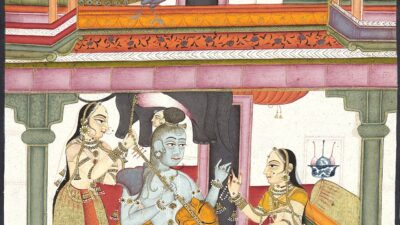
शास्त्र विंग · राग-पट्टिका · Raag Plate
हतकंबरि
Hatakambari
एक अद्भुत Carnatic राग · A Wonder Carnatic Raag
भावरहस्यमय · अद्भुत · दिव्य · रहस्यपूर्ण
ऊर्जामध्यम
स्वर-चित्र · The Swara Panel
आरोह — अवरोह · The Ascent and the Descent
आरोह · Aroha चढ़ती हुई सीढ़ी
अवरोह · Avaroha उतरती हुई सीढ़ी
सˊ = तार सप्तक का षड्ज
पकड़ · पहचान वाक्यांश
रे॒ ग म प ध॑ नि सा'
Re♭ Ga Ma Pa Dha♯ Ni Sa' — Sa' Ni Dha♯ Pa Ma Ga Re♭ Sa
Hatakambari has no Hindustani-tradition pakad. This phrase moves from komal Re through antara Ga and shuddha Ma to the unusual shatshruti Dha♯ (10 semitones) before resolving to shuddha Ni and Sa'—the raised Dha being the raga's most distinctive and unexpected feature in an otherwise relatively conventional ascending scale.
वादी–संवादी टिप्पणी · Vadi–Samvadi note
Vadi — In the Carnatic tradition, Raag Hatakambari emphasizes Pancham (Pa) as a key resting note.
Samvadi — Sa (Shadj) serves as the complementary note.
समय और भाव
Time Theory & Moodसमय-सिद्धांत · Time Theory
संध्या काल
परंपरागत रूप से संध्या काल (4:00 PM - 7:00 PM) में गाया जाता है।
Traditionally performed during evening/twilight hours (4:00 PM - 7:00 PM), when day transitions to night.
भाव और गति · Mood & Tempo
अद्भुत · Wonder/Mystery
आश्चर्य, विस्मय और रहस्य का रस। जिज्ञासा, विस्मय और अलौकिक भाव जगाता है।
ऊर्जा · Energyमध्यम
स्तर · Leveladvanced — राग Hatakambari के लिए कर्नाटक संगीत सिद्धांत की मजबूत नींव आवश्यक है।
पट्टिका-लेख
The Monographपरिचय Introduction
राग Hatakambari कर्नाटक शास्त्रीय संगीत परंपरा का एक राग है। इसका प्रमुख रस अद्भुत (Wonder/Mystery) है। यह परंपरागत रूप से संध्या काल (4:00 PM - 7:00 PM) में गाया जाता है। गाया जाता है।
अंग्रेज़ी में पढ़ें · Read in English
Raag Hatakambari is a complete scale with all 7 notes in both ascent and descent raga in the Carnatic classical music tradition. It is derived from the Hatakambari melakarta (#18). With its Sampurna-Sampurna jati structure, this raag creates a distinctive tonal landscape. The predominant rasa is Wonder/Mystery (अद्भुत), making it suitable for compositions that evoke mysterious, wondrous emotions. It is traditionally performed during evening hours, and its melodic contour offers rich possibilities for alapana, kalpanaswaram, and creative improvisation.
सांस्कृतिक महत्व Cultural Significance
भारतीय शास्त्रीय संगीत की समृद्ध परंपरा के अंग के रूप में, राग Hatakambari Carnatic परंपरा को परिभाषित करने वाले स्वर संरचना और भावनात्मक अभिव्यक्ति के बीच गहरे संबंध का प्रतिनिधित्व करता है।
अंग्रेज़ी में पढ़ें · Read in English
As part of the rich tapestry of Indian classical music, Raag Hatakambari represents the deep connection between melodic structure and emotional expression that defines the Carnatic tradition.
ऐतिहासिक महत्व Historical Significance
हटकांबरी कर्नाटक संगीत की 72-मेलकर्ता प्रणाली में 18वाँ मेलकर्ता है और अग्नि चक्र (मेलकर्ता 13–18), अर्थात् 3वें चक्र, का अंतिम (छठा) सदस्य है। अग्नि चक्र में कोमल ऋषभ और अंतर गंधार का प्रयोग होता है; छठे स्थान में षट्श्रुति धैवत (10 अर्धस्वर, ध॑) और काकली निषाद (11 अर्धस्वर) हैं। इस प्रकार निचले चतुष्टक में कोमल ऋषभ और ऊपरी में उठा हुआ ध॑ — यह असंतुलित संयोजन हिंदुस्तानी ठाट से परे है। वेंकटमखिन ने इसे चतुर्दंडिप्रकाशिका (लगभग 1620 ई.) में वर्गीकृत किया। 'हटकांबरी' नाम का अर्थ 'सोने का आधार' हो सकता है। अग्नि चक्र का समापन करने वाला यह मेलकर्ता कर्नाटक मंच पर विरले ही प्रस्तुत होता है।
अंग्रेज़ी में पढ़ें · Read in English
Hatakambari is the 18th melakarta in the Carnatic 72-raga system, the last member of the Agni chakra (melakartas 13–18), the 3rd of the 12 chakras. The Agni chakra uses komal Rishabha (R1, 1 semitone) and antara Gandhara (G3, 4 semitones); the sixth and final position within the Agni chakra uses shatshruti Dhaivata (D3, 10 semitones) and kakali Nishada (N3, 11 semitones). The scale therefore has komal Re in the lower tetrachord but uses the raised Dha♯ (D3) in the upper tetrachord—an asymmetric combination that falls outside the Hindustani thaat framework. Venkatamakhin classified it in the Caturdandiprakasika (c. 1620 CE). The name 'Hatakambari' may derive from 'hataka' (gold) and 'ambari' (embankment/support), suggesting 'golden support.' As the concluding melakarta of the Agni chakra, Hatakambari completes the set of shuddha-madhyama melakartas using komal Ri and antara Ga. It is rarely performed as an independent Carnatic concert raga.
शिक्षा
Teaching & LearningBegin with slow aalapana to internalize the raag's swaroopa (melodic form)
Practice the arohana and avarohana patterns with a tanpura drone
Listen to recordings by master performers to understand the raag's gamakas (ornamentations)
Work on kalpanaswaram (improvisation) within the raag's framework
Using incorrect gamakas that belong to a different raag
Not maintaining proper swar sthana (note placement)
Rushing through phrases without allowing the raag bhava to develop
तुलना
A Specimen Comparisonइसमें भी कोमल रे और शुद्ध ग हैं, पर ऊपरी चतुष्टय में शुद्ध ध और कोमल नि हैं — हतकंबरि के तीव्र ध और शुद्ध नि के विपरीत। निचले चार स्वर (सा कोमल रे ग म प) दोनों में समान हैं।
| तुलनाSpecimen | हतकंबरि | Suvarnangi |
|---|
यह भले ही क्रम में अगला है, पर स्वर-संरचना बिल्कुल अलग है — शुद्ध रे, कोमल ग, शुद्ध म, और दो-कोमल नि। संख्यात्मक निकटता के बावजूद दोनों राग स्वर-जगत में दूर हैं।
| तुलनाSpecimen | हतकंबरि | Jhankaradhwani |
|---|
यह अधिक प्रचलित राग है — सा रे ग म प कोमल ध कोमल नि — किंतु हतकंबरि से स्वर-संरचना में सर्वथा भिन्न है। हतकंबरि की पहचान उसके तीव्र ध और कोमल रे के असाधारण संयोजन में है।
| तुलनाSpecimen | हतकंबरि | Charukeshi |
|---|
प्रस्तुति
Performance- Description
- परंपरागत रूप से संध्या काल (4:00 PM - 7:00 PM) में गाया जाता है। Traditionally performed during evening/twilight hours (4:00 PM - 7:00 PM), when day transitions to night.
- Prahar Number
- 5
- Prahar Name
- संध्या काल Sandhya Kaal
- Time Start
- 16:00
- Time End
- 19:00
- Time Flexibility
- flexible
Time
और जानें
More to Know- raag-suvarnangi — Suvarnangi — Shares the same komal Re♭ and shuddha Ga as Hatakambari, but differs in the upper tetrachord — Suvarnangi has shuddha Dha and komal Ni♭ rather than Hatakambari's tivra Dha♯ and shuddha Ni. The lower four notes (Sa Re♭ Ga Ma Pa) are shared. — इसमें भी कोमल रे और शुद्ध ग हैं, पर ऊपरी चतुष्टय में शुद्ध ध और कोमल नि हैं — हतकंबरि के तीव्र ध और शुद्ध नि के विपरीत। निचले चार स्वर (सा कोमल रे ग म प) दोनों में समान हैं।
- raag-jhankaradhwani — Jhankaradhwani — Jhankaradhwani has an entirely different note structure — shuddha Re, komal Ga♭, shuddha Ma, and a double-flat Ni♭♭. Despite being adjacent numerically, the two ragas are melodically worlds apart. — यह भले ही क्रम में अगला है, पर स्वर-संरचना बिल्कुल अलग है — शुद्ध रे, कोमल ग, शुद्ध म, और दो-कोमल नि। संख्यात्मक निकटता के बावजूद दोनों राग स्वर-जगत में दूर हैं।
- raag-charukeshi — Charukeshi — Charukeshi has the more familiar Sa Re Ga Ma Pa Dha♭ Ni♭ structure and is widely performed. It shares a superficially austere chromatic quality with Hatakambari but is tonally entirely different. The defining feature of Hatakambari is the rare tivra Dha♯ (augmented sixth) combined with komal Re♭ — a combination that creates an unsettled, wondering sonic character matching its Adbhuta rasa. — यह अधिक प्रचलित राग है — सा रे ग म प कोमल ध कोमल नि — किंतु हतकंबरि से स्वर-संरचना में सर्वथा भिन्न है। हतकंबरि की पहचान उसके तीव्र ध और कोमल रे के असाधारण संयोजन में है।
In Film Music
Hatakambari (Melakarta #18) is an almost exclusively pedagogical raga — one of the 72 melakartas whose primary function is to complete the theoretical architecture of Carnatic music rather than to enter the concert hall or the film studio. Its unusual combination of komal Re♭ (flat second), shuddha Ga (natural third), tivra Dha♯ (sharp sixth), and shuddha Ni (natural seventh) creates an angular, chromatic scale that does not map onto any familiar Hindustani thaat or any recognisable melodic tradition within Hindi film music. No Hindi film songs have been composed in Hatakambari, and the raga has no indirect presence through a Hindustani counterpart. Its concert life, even in Carnatic music, is rare. Occasionally Carnatic educators include a simple Hatakambari geetha (exercise song) in teaching, but sustained alapana or kriti performance in this raga is exceptional. For a Hindi film music listener, Hatakambari is best understood as one of the theoretical building blocks of Indian classical music — a raga whose value lies in the completeness it gives to the melakarta system, not in the songs it has inspired.
Comparisons
सीखने के लिए
For Learners- Difficulty Level
- advanced
अन्य विवरण
More Details- Indian_Music_Raga_Encyclopedia_v2.xlsx
- P. Sambamoorthy, 'South Indian Music' — Agni chakra and melakarta #18
- 72 Melakarta system — Carnatic music theory (Venkatamakhi, 17th century)
- Carnatic 72-melakarta system: melakarta 18 in the Agni chakra (Venkatamakhin, Caturdandiprakasika, c. 1620 CE)
- Govindacharya, Samgraha-Chudamani, c. 1800 CE
References
नमूना-पट्टी
The Specimen Table| नाम | हतकंबरि · Hatakambari |
|---|---|
| थाट | — |
| आरोह | Sa Re♭ Ga Ma Pa Dha♯ Ni Sa' Sa' |
| अवरोह | Sa' Sa' Ni Dha♯ Pa Ma Ga Re♭ Sa |
| पकड़ | रे॒ ग म प ध॑ नि सा' |
| जाति | संपूर्ण-संपूर्ण · Sampurna-Sampurna |
| समय | संध्या काल |
| ऊर्जा | मध्यम |
| परिवार | Hatakambari |
| स्तर | advanced |
| लोकप्रियता | Obscure |
| कर्नाटक समतुल्य | Hatakambari · Melakarta 18 |
जुड़े हुए पन्ने
Connected Plates · The Graph Made Visibleअटलस में कोई पन्ना अकेला नहीं — इस राग से गीत, प्रस्तुतियाँ, कलाकार, ताल, घराने और मिलते-जुलते राग, सब यहाँ से खुलते हैं।
ताल-साथी · Taal Pairings
श्रवण-कक्ष · The Listening Room
सुनिए — हतकंबरि · Hear the Raag
Raag Hatakambari — Classical Performance
प्रश्नोत्तर
Questions & Answersराग Hatakambari किस संगीत पद्धति का राग है?
राग Hatakambari कर्नाटक (दक्षिण भारतीय) शास्त्रीय संगीत पद्धति का राग है।
अंग्रेज़ी में पढ़ें · Read in English
Which music system does Raga Hatakambari belong to? — Raga Hatakambari belongs to the Carnatic (South Indian) classical music system.
साझा कीजिए · Share this Plate