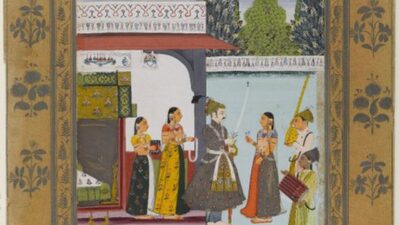
शास्त्र विंग · राग-पट्टिका · Raag Plate
मल्कौंस
Malkauṃs
रहस्यमय राग · The Mystical Raag
भावध्यानमय · शांतिपूर्ण · आत्मचिंतक · आध्यात्मिक · शांत
गतिati_vilambit ऊर्जाअति धीमी
अन्य नामMalkosh · Malkans · मल्कौंस
स्वर-चित्र · The Swara Panel
आरोह — अवरोह · The Ascent and the Descent
कोमल स्वर — Ga, Dha — तीव्रित हरे रंग में।
आरोह · Aroha चढ़ती हुई सीढ़ी
अवरोह · Avaroha उतरती हुई सीढ़ी
कोमल स्वर — नीचे की ओर झुका चिह्न (◌॒)सˊ = तार सप्तक का षड्ज
मल्कौंस केवल 4 नोटों का उपयोग करता है — हिंदुस्तानी संगीत में सबसे विरल जाति। प्रत्येक नोट की सूक्ष्म बारीकियों की गहरी खोज को मजबूर करता है।
अंग्रेज़ी में पढ़ें · Read in English
Malkauns uses only 4 notes — the sparsest jati in Hindustani music (Audav-Audav, 5-5). The limitation to Sa, Ga♭, Ma, Dha♭ forces profound exploration of each note's microtonal nuances. The absence of Re and Ni creates a gap-filled, non-scalar quality that feels ancient and otherworldly.
वर्जित स्वर — अवरोह में: Re, Ni
पकड़ · पहचान वाक्यांश
सा ग॒ म ध॒ सˊ | ध॒ म ग॒
Sa Ga♭ Ma Dha♭ Sa' | Dha♭ Ma Ga♭
विरल, पेंटाटोनिक आकृति मल्कौंस की परिभाषित विशेषता है। चार-नोट सरलता एक ध्यानमय, लगभग सम्मोहक गुणवत्ता बनाता है।
अंग्रेज़ी में पढ़ें · Read in English
The sparse, pentatonic figure is Malkauns's defining characteristic. The four-note simplicity creates a meditative, almost hypnotic quality. The descent from Sa' through Dha♭-Ma-Ga♭ is the raag's signature.
वादी–संवादी टिप्पणी · Vadi–Samvadi note
Vadi — The most important note in Malkauns — the center of gravity. All melodic phrases revolve around Ma.
Samvadi — The second most important note — provides tonal stability and return point.
चलन · स्वर-यात्रा
सा ग॒ म, ध॒ सˊ | सˊ ध॒ म ग॒, स | ग॒ म ध॒ म ग॒
Sa Ga♭ Ma, Dha♭ Sa' | Sa' Dha♭ Ma Ga♭, Sa | Ga♭ Ma Dha♭ Ma Ga♭
मल्कौंस की पूर्ण मधुर प्रगति। राग की अत्यधिक विरलता के कारण, सरल वाक्यांश भी गहरा वजन रखते हैं।
अंग्रेज़ी में पढ़ें · Read in English
The complete melodic progression of Malkauns. Due to the raag's extreme sparsity, even simple phrases carry profound weight. The movement is deliberate and measured.
न्यास स्वर — Sa, Ma, Dha♭ अनुवादी — Ga♭, Dha♭
विशेष स्वर-वाक्य
Characteristic Phrasesसमय और भाव
Time Theory & Moodसमय-सिद्धांत · Time Theory
प्रदोष से निशा
देर शाम से रात (प्रहर 5-6: सूर्यास्त के बाद रात में)। अधिकतम ध्यानमय प्रभाव के लिए सबसे गहरी अंधकार की घंटियों में गाया जाता है।
Late evening to night (prahar 5-6: post-sunset into night). Performed in the deepest darkness hours for maximum meditative effect.
Autumn & Winter
भाव और गति · Mood & Tempo
शांति · Peace / Serenity / Transcendence
मल्कौंस का प्राथमिक रस — सांसारिक चिंताओं से परे गहरी आध्यात्मिक शांति। राग ध्यानमय पार-लौकिकता प्रेरित करता है।
ati_vilambit
ऊर्जा · Energyअति धीमी
स्तर · Leveladvanced — मल्कौंस एक उन्नत राग है जिसमें परिपक्व संगीतकारिता की आवश्यकता है। विरलता के कारण सूक्ष्म भिन्नताओं की गहरी सम…
लक्षण गीत · The Mnemonic Verse
लक्षण गीत
मल्कौंस का गा मा, ध कोमल सान
पाँच स्वर औड़व, तत्व विद्वान जान
अर्थमल्कौंस में: ग म का प्रयोग, ध कोमल। पाँच स्वर औड़व — ऐसे विद्वान समझते हैं।
अंग्रेज़ी में पढ़ें · Read in English
Malkauns ka Ga Ma, Dha komal saan
Paanch swar audav, tatva vidwan jaan
In Malkauns: Ga Ma are used, Dha is komal. Five notes audav (pentatonic) — thus the learned understand.
पट्टिका-लेख
The Monographपरिचय Introduction
मल्कौंस (मल्कौंस) हिंदुस्तानी शास्त्रीय संगीत में सबसे दुर्लभ और रहस्यमय राग में से एक है। केवल 4 नोटों (सा, ग॒, म, ध॒) का उपयोग करते हुए, यह शास्त्रीय प्रणाली में सबसे विरल राग में से एक है। यह चरम सरलता विरोधाभास से गहरी गहराई बनाता है: सीमित मेलोडिक पैलेट कलाकार को टोन, समय, और अनुक्रम में सूक्ष्म भिन्नताओं की खोज करने के लिए मजबूर करता है। मल्कौंस आध्यात्मिक पार-लौकिकता और गहरी आत्मचिंतन की भावना को जागृत करता है।
अंग्रेज़ी में पढ़ें · Read in English
Malkauns (मल्कौंस) is one of the rarest and most mysterious raags in Hindustani classical music. Using only 4 notes (Sa, Ga♭, Ma, Dha♭), it ranks among the sparsest raags in the classical system, with an Audav-Audav (5-5) jati classification. This extreme simplicity paradoxically creates profound depth: the limited melodic palette forces the performer to explore minute variations in tone, timing, and inflection, transforming simple note sequences into meditative explorations of cosmic contemplation. Malkauns evokes a sense of spiritual transcendence and deep introspection, often compared to meditation or prayer. The absence of Re and Ni creates a gap-filled scale that feels ancient, primordial, and otherworldly — as if the raag connects to a time before recorded history. Traditionally performed in the late evening or night hours (Pradosh/Nisha prahar) in slow, languid Khayal form with extensive unmetered alap (melodic prelude), Malkauns allows the musician to linger on each note and explore its emotional and spiritual resonance. The raag is particularly favored for devotional pieces, especially those honoring Lord Shiva. While Malkauns is extremely rare in film music due to its demanding, non-commercial character, it remains deeply respected and cherished in classical circles as one of the most spiritually profound raags in the entire tradition.
सांस्कृतिक महत्व Cultural Significance
मल्कौंस शास्त्रीय संगीत परंपरा में एक अनूठा स्थान रखता है जो संगीतात्मक प्रदर्शन से परे आध्यात्मिक अभ्यास के क्षेत्र में प्रवेश करता है। यह प्राचीन ग्रंथों में ध्यान और आध्यात्मिक साधकों के लिए आरक्षित राग के रूप में उल्लिखित है, न कि मनोरंजन के लिए। पटियाला घराना परंपरा में, मल्कौंस केवल उन्नत छात्रों को सिखाया जाता है जिन्होंने परिपक्वता, समर्पण, और आध्यात्मिक झुकाव प्रदर्शित किया है।
अंग्रेज़ी में पढ़ें · Read in English
Malkauns holds a unique position in the classical music tradition as a raag that transcends musical performance and enters the realm of spiritual practice. It is mentioned in ancient texts as a raag reserved for meditation and spiritual seekers, not for entertainment or public performance. In the Patiala Gharana tradition, Malkauns is taught only to advanced students who have demonstrated maturity, dedication, and spiritual inclination. The raag's connection to Shaivite (Shiva-worshipping) traditions is profound — it is traditionally performed in temples during late-night vigils and meditation sessions. The sparsity of Malkauns reflects the philosophical principle that 'less is more' in spiritual practice — just as a single drop of water contains infinite complexity, a single note of Malkauns contains infinite potential for exploration. Unlike raags that aim to entertain, move, or impress, Malkauns seeks to silence the mind and elevate consciousness. This is why Malkauns concerts are not common events — they are spiritual experiences requiring both performer and audience to approach with reverence.
ऐतिहासिक महत्व Historical Significance
मल्कौंस की उत्पत्ति प्राचीनता में खो गई है, लेकिन राग 16वीं सदी के संगीत ग्रंथों में गहरी आध्यात्मिक गुणवत्ता के राग के रूप में उल्लिखित है। नाम स्वयं संस्कृत मूल से आ सकता है जो 'अंधकार' या 'रहस्य' सुझाता है। मुगल काल में, मल्कौंस दरबारी मनोरंजन का राग नहीं था बल्कि सूफी साधकों और आध्यात्मिक चिकित्सकों के लिए आरक्षित था।
अंग्रेज़ी में पढ़ें · Read in English
The origins of Malkauns are lost in antiquity, but the raag is mentioned in 16th-century music treatises as a raag of profound spiritual character. The name itself may derive from Sanskrit roots suggesting 'darkness' or 'mystery,' or alternatively from 'Malkhan' — an ancient musical lineage. During the Mughal period, Malkauns was not a raag of courtly entertainment but rather one reserved for Sufi ascetics and spiritual practitioners. The raag rose to prominence in the Hindustani tradition through the Patiala Gharana, where it became associated with late-night meditative sessions. In the 20th century, great maestros like Ustad Amir Khan and Ustad Bade Ghulam Ali Khan brought Malkauns to concert halls, establishing it as part of the classical repertoire while maintaining its spiritual essence. Today, Malkauns remains one of the least-performed raags in public concerts — a deliberate choice reflecting the raag's nature as a vehicle for spiritual exploration rather than musical entertainment.
शिक्षा
Teaching & Learning| बंदिश | ताल · लय | बोल |
|---|---|---|
| Bhaiya Jhooth Mat Bolo Traditional |
Teentaal | |
| Maata Giri Har Reet Nikari Devotional tradition |
Teentaal |
सा-ग॒-म-ध॒ पैटर्न से शुरू करें। लेकिन जल्दबाजी न करें। प्रत्येक नोट को कम से कम 4-5 सेकंड के लिए होल्ड करें।
अंग्रेज़ी में पढ़ें · Read in English
Begin with simple Sa-Ga-Ma-Dha patterns. But do not rush. Hold each note for at least 4-5 seconds. Listen to the silence between notes — this is as important as the notes themselves.
समझें कि मल्कौंस अत्यधिक नियंत्रण की मांग करता है। ग॒ और म के बीच की दूरी एक सरल अंतराल नहीं है।
अंग्रेज़ी में पढ़ें · Read in English
Understand that Malkauns demands extreme control of microtones. The distance between Ga♭ and Ma is not a simple interval — explore the subtle variations. Spend time oscillating gently between Ga♭ and Ma to develop sensitivity.
श्वास नियंत्रण और सहनशीलता विकसित करें। मल्कौंस के लिए लंबे नोट होल्ड करने की क्षमता चाहिए।
अंग्रेज़ी में पढ़ें · Read in English
Develop breath control and stamina. Malkauns requires you to hold notes for extended periods without wavering. Practice long tones (12-15 seconds per note) to build this capacity. Every phrase should feel like a meditation, not a musical display.
राग के इतिहास और दर्शन का अध्ययन करें। मल्कौंस शिव पूजा और ध्यान परंपराओं से जुड़ा है।
अंग्रेज़ी में पढ़ें · Read in English
Study the raag's history and philosophy. Malkauns is connected to Shiva worship and meditation traditions. Understanding the spiritual intent will help you interpret it authentically. Listen to Malkauns in its truest classical renditions — not film songs, but pure khayal and alap.
मल्कौंस को बहुत तेजी से गाना या बहुत अधिक सजावट के साथ। विरलता सरलता मांगती है।
अंग्रेज़ी में पढ़ें · Read in English
Singing Malkauns too quickly or with too much ornamentation. The sparsity demands simplicity.
सुधार: Slow down drastically. Let silence be part of the music. Each note should be sung as if it is the only note in the universe. Avoid flourishes and extra notes — stay strictly to Sa, Ga♭, Ma, Dha♭.
कठोर, चमकदार टोन का उपयोग करना। मल्कौंस को अंधकारपूर्ण, गर्म, आत्मचिंतक टोन की आवश्यकता है।
अंग्रेज़ी में पढ़ें · Read in English
Using a harsh, bright tone. Malkauns requires a dark, warm, introspective tone.
सुधार: Cultivate a deep, resonant tone. Imagine singing into a deep well or cave. Let your voice be gentle and introspective, not bright or extroverted.
राग के ध्यानमय उद्देश्य को अनदेखा करना। इसे तकनीकी प्रदर्शन के रूप में मानना।
अंग्रेज़ी में पढ़ें · Read in English
Ignoring the raag's meditative purpose. Treating it as just another classical raag to be displayed technically.
सुधार: Approach Malkauns as a spiritual practice, not a performance. Every rendering should transport both the musician and listener into a state of profound peace.
तुलना
A Specimen Comparisonदोनों भैरवी थाट के बहन राग हैं, लेकिन वे विपरीत उद्देश्य पूरा करते हैं।
| तुलनाSpecimen | मल्कौंस | भैरवी |
|---|---|---|
| स्वर-अंतर | Bhairavi uses all 7 swaras (Sa Re♭ Ga♭ Ma Pa Dha♭ Ni♭). Malkauns uses only 4 (Sa Ga♭ Ma Dha♭), omitting Re and Ni entirely. | |
| भाव-अंतर | Bhairavi = Romantic longing, emotional expression, tender devotion. Malkauns = Spiritual transcendence, meditative peace, cosmic contemplation. | |
भैरवी थाट के बहन राग। बिलस्खानी तोडी 6 नोटों का उपयोग करता है और गीत विधा में है।
| तुलनाSpecimen | मल्कौंस | बिलस्खानी तोडी |
|---|---|---|
| स्वर-अंतर | Bilaskhani Todi: Sa Ga♭ Ma Pa Dha♭ Ni♭. Malkauns: Sa Ga♭ Ma Dha♭ (much sparser). | |
| भाव-अंतर | Bilaskhani Todi = Lyrical, elegant, contemplative but still emotional. Malkauns = Austere, transcendent, beyond emotion. | |
रोचक तथ्य
Margin Notesमल्कौंस हिंदुस्तानी संगीत के उन कुछ रागों में से एक है जहां मौन की गुणवत्ता ध्वनि की गुणवत्ता जितनी महत्वपूर्ण मानी जाती है।
अंग्रेज़ी में पढ़ें · Read in English
Malkauns is one of the only raags in Hindustani music where the quality of silence is considered as important as the quality of sound. Musicians often pause between notes for extended periods, allowing the listener to contemplate what has been sung.
मल्कौंस सप्तक में 12 संभावित सेमिटोन में से केवल 4 नोटों का उपयोग करता है।
अंग्रेज़ी में पढ़ें · Read in English
Malkauns uses only 4 notes out of the possible 12 semitones in the octave, making it the sparsest commonly-used raag. This extreme economy of notes is considered analogous to spiritual simplicity and minimalism.
राग परंपरागत रूप से पटियाला घराना में केवल उन्नत छात्रों को सिखाया जाता है — कभी शुरुआती को नहीं।
अंग्रेज़ी में पढ़ें · Read in English
The raag is traditionally taught only to advanced students in the Patiala Gharana — never to beginners. This reflects the belief that Malkauns requires a certain spiritual maturity to perform authentically.
कुछ परंपराओं में, मल्कौंस शिव ध्यान से जुड़ा है और देर रात के मंदिर जागरण के दौरान गाया जाता है।
अंग्रेज़ी में पढ़ें · Read in English
In some traditions, Malkauns is associated with Shiva meditation and is performed during late-night temple vigils. Its meditative quality is believed to facilitate spiritual experiences and inner peace.
अधिकांश रागों के विपरीत, मल्कौंस के बहुत कम फ़िल्मी गीत हैं। यह दुर्लभता राग की सच्ची प्रकृति को दर्शाता है।
अंग्रेज़ी में पढ़ें · Read in English
Unlike most raags, Malkauns has very few film songs. This rarity reflects the raag's true nature — it is fundamentally unsuited to commercial, entertainment-focused music and belongs to the realm of pure, classical spiritual expression.
प्रस्तुति
Performance- Description
- देर शाम से रात (प्रहर 5-6: सूर्यास्त के बाद रात में)। अधिकतम ध्यानमय प्रभाव के लिए सबसे गहरी अंधकार की घंटियों में गाया जाता है। Late evening to night (prahar 5-6: post-sunset into night). Performed in the deepest darkness hours for maximum meditative effect.
- Prahar Number
- 6
- Prahar Name
- प्रदोष से निशा Pradosh to Nisha
- Time Start
- 18:00
- Time End
- 21:00
- Time Flexibility
- strict
- Time Notes
- Traditionally performed only in evening/night hours. The darkness complements the raag's introspective, meditative quality.
Time
और जानें
More to Know- raag-bhairavi — Bhairavi — भैरवी — Both are sister raags of the Bhairavi thaat, but they serve opposite purposes. Bhairavi is the accessible, emotionally expressive 'Queen of Raags' (7 notes), while Malkauns is the rare, meditative 'Mystical Raag' (4 notes). — दोनों भैरवी थाट के बहन राग हैं, लेकिन वे विपरीत उद्देश्य पूरा करते हैं। — Bhairavi uses all 7 swaras (Sa Re♭ Ga♭ Ma Pa Dha♭ Ni♭). Malkauns uses only 4 (Sa Ga♭ Ma Dha♭), omitting Re and Ni entirely. — Bhairavi = Romantic longing, emotional expression, tender devotion. Malkauns = Spiritual transcendence, meditative peace, cosmic contemplation. — Bhairavi = Common, performed frequently, accessible to audiences. Malkauns = Rare, specialized, for advanced musicians and spiritual seekers.
- raag-bilaskhani-todi — Bilaskhani Todi — बिलस्खानी तोडी — Sister raags of Bhairavi thaat. Bilaskhani Todi uses 6 notes and has a lyrical, playful character. Malkauns uses 4 notes and has a meditative, austere character. — भैरवी थाट के बहन राग। बिलस्खानी तोडी 6 नोटों का उपयोग करता है और गीत विधा में है। — Bilaskhani Todi: Sa Ga♭ Ma Pa Dha♭ Ni♭. Malkauns: Sa Ga♭ Ma Dha♭ (much sparser). — Bilaskhani Todi = Lyrical, elegant, contemplative but still emotional. Malkauns = Austere, transcendent, beyond emotion. — Bilaskhani Todi = Moderate complexity, suitable for intermediate students. Malkauns = Extreme simplicity requiring deep understanding.
Comparisons
सीखने के लिए
For Learners- Difficulty Level
- advanced
नमूना-पट्टी
The Specimen Table| नाम | मल्कौंस · Malkauns |
|---|---|
| थाट | भैरवी |
| आरोह | सा ग॒ म ध॒ सˊ |
| अवरोह | सˊ ध॒ म ग॒ स |
| पकड़ | सा ग॒ म ध॒ सˊ | ध॒ म ग॒ |
| जाति | औड़व-औड़व · Audav-Audav |
| कोमल स्वर | Ga, Dha |
| समय | प्रदोष से निशा |
| ऋतु | Autumn & Winter |
| गति | ati_vilambit |
| ऊर्जा | अति धीमी |
| प्रकृति | Shuddha |
| परिवार | भैरवी परिवार |
| स्तर | advanced |
| लोकप्रियता | Known |
| कर्नाटक समतुल्य | Dheerashankarabharanam (also Sankarabharanam with komal notes) |
| पाश्चात्य समतुल्य | Pentatonic (minor pentatonic with flattened degrees) |
| अन्य नाम | Malkosh · Malkans · मल्कौंस |
जुड़े हुए पन्ने
Connected Plates · The Graph Made Visibleअटलस में कोई पन्ना अकेला नहीं — इस राग से गीत, प्रस्तुतियाँ, कलाकार, ताल, घराने और मिलते-जुलते राग, सब यहाँ से खुलते हैं।
इस राग के गीत · Songs in this Raag
प्रसिद्ध प्रस्तुतियाँ · Legendary Renditions
इस राग के कलाकार · Notable Artists
ताल-साथी · Taal Pairings
घराने · Gharanas
मिलते-जुलते राग · Similar Raags
शास्त्र-सूत्र · Shastra Threads
श्रवण-कक्ष · The Listening Room
सुनिए — मल्कौंस · Hear the Raag
Raag Malkauns — Ustad Rashid Khan — Live at Saptak Festival
प्रश्नोत्तर
Questions & Answersराग मल्कौंस का आरोहन-अवरोहन क्या है?
राग मल्कौंस का आरोहन: सा ग॒ म ध॒ सˊ | अवरोहन: सˊ ध॒ म ग॒ स
अंग्रेज़ी में पढ़ें · Read in English
What is the arohana and avarohana of Raag Malkauns? — Raag Malkauns arohana: Sa Ga♭ Ma Dha♭ Sa' | Avarohana: Sa' Dha♭ Ma Ga♭ Sa
राग मल्कौंस किस समय गाया जाता है?
राग मल्कौंस शाम को सूर्यास्त के बाद रात की घड़ियों में गाया जाता है (प्रहर 5-6: प्रदोष से निशा)। यह एक ध्यानमय राग है जो देर रात की गहरी अंधकार घड़ियों में सर्वोत्तम है।
अंग्रेज़ी में पढ़ें · Read in English
When is Raag Malkauns performed? — Raag Malkauns is performed in late evening and night hours (prahar 5-6: Pradosh to Nisha). It is a meditative raag best performed in the deepest darkness hours.
मल्कौंस की पकड़ क्या है?
राग मल्कौंस की पकड़: सा ग॒ म ध॒ सˊ | ध॒ म ग॒ | यह राग के विरल, पेंटाटोनिक स्वभाव को दर्शाता है।
अंग्रेज़ी में पढ़ें · Read in English
What is the pakad of Raag Malkauns? — Raag Malkauns pakad: Sa Ga♭ Ma Dha♭ Sa' | Dha♭ Ma Ga♭ | This shows the raag's sparse, pentatonic character.
मल्कौंस में कितने स्वर हैं?
मल्कौंस केवल 4 नोटों का उपयोग करता है: सा, ग॒, म, ध॒। यह हिंदुस्तानी संगीत का सबसे विरल राग है।
अंग्रेज़ी में पढ़ें · Read in English
How many notes does Raag Malkauns use? — Malkauns uses only 4 notes: Sa, Ga♭, Ma, Dha♭. It is the sparsest raag in Hindustani music.
राग मल्कौंस भैरवी से कैसे अलग है?
भैरवी 7 नोट (पूर्ण राग) है जो सुलभ और भावनात्मक है। मल्कौंस केवल 4 नोट (बहुत विरल) है जो ध्यानमय और आध्यात्मिक है। दोनों भैरवी थाट के हैं लेकिन विपरीत उद्देश्य पूरा करते हैं।
अंग्रेज़ी में पढ़ें · Read in English
How is Raag Malkauns different from Raag Bhairavi? — Bhairavi uses 7 notes (complete) and is accessible, emotional. Malkauns uses only 4 notes (very sparse) and is meditative, spiritual. Both are of Bhairavi thaat but serve opposite purposes.
क्या मल्कौंस बॉलीवुड में गीत हैं?
नहीं। मल्कौंस अत्यंत दुर्लभ है और लगभग कोई बॉलीवुड गीत नहीं हैं। यह शुद्ध शास्त्रीय और आध्यात्मिक राग है, व्यावसायिक संगीत के लिए नहीं।
अंग्रेज़ी में पढ़ें · Read in English
Are there Bollywood songs in Raag Malkauns? — No. Malkauns is extremely rare and has virtually no Bollywood songs. It is a pure classical and spiritual raag, not suited to commercial music.
मल्कौंस को क्यों 'रहस्यमय राग' कहा जाता है?
मल्कौंस को इसलिए रहस्यमय कहा जाता है क्योंकि इसके 4 नोटों की विरलता और इसका गहरा ध्यानमय गुणवत्ता इसे आध्यात्मिक और रहस्यमय अनुभूति देती है। यह संगीत से परे एक आध्यात्मिक अभ्यास है।
अंग्रेज़ी में पढ़ें · Read in English
Why is Malkauns called the 'Mystical Raag'? — Malkauns is called mystical because its extreme sparsity (4 notes) and deep meditative quality give it a spiritual, mysterious character. It transcends music and enters spiritual practice.
साझा कीजिए · Share this Plate