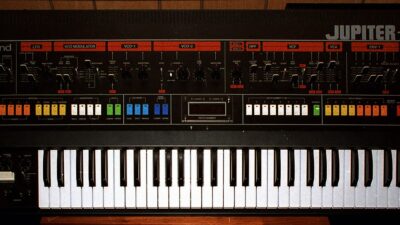
शास्त्र विंग · वाद्य-पट्टिका · Instrument Plate
सिंथेसाइज़र
Synthesizer
अन्य नामसिंथ · सिन्थेसाइज़र · इलेक्ट्रॉनिक कीबोर्ड / विद्युत वाद्य · Synth
परिचय
Overviewसिंथेसाइज़र आधुनिक भारतीय संगीत का सबसे लचीला यंत्र है — न तार, न फूँक, केवल बिजली से गढ़ी ध्वनि, जो बास की गड़गड़ाहट से लेकर राग की कोमल मीड तक कुछ भी बन सकती है। बप्पी लाहिड़ी के डिस्को से लेकर चरणजीत सिंह के 'टेन रागाज़ टू अ डिस्को बीट' और ए.आर. रहमान के फ़िल्म-स्कोर तक, इसने भारतीय ध्वनि-संसार को पूरी तरह नया रूप दे दिया।
अंग्रेज़ी में पढ़ें · Read in English
The synthesizer is the most flexible instrument of modern Indian music — no strings, no breath, only sound sculpted from electricity, which can become anything from the growl of a bassline to the gentle meend of a raga. From Bappi Lahiri's disco to Charanjit Singh's 'Ten Ragas to a Disco Beat' and A.R. Rahman's film scores, it wholly reshaped the Indian sound-world.
वर्गीकरण
ClassificationNatya Shastra Category
विद्युत वाद्य (Electronic — outside the classical four categories)
सिंथेसाइज़र प्राचीन नाट्यशास्त्र की चार पारंपरिक श्रेणियों (तत, अवनद्ध, सुषिर, घन) में नहीं आता — इसमें कोई ताँत, चमड़ा, वायु-स्तंभ या ठोस पिंड कंपित नहीं होता। इसकी ध्वनि इलेक्ट्रॉनिक परिपथों (ऑसिलेटर) से उत्पन्न होती है, इसलिए इसे आधुनिक 'विद्युत वाद्य' श्रेणी में रखा जाता है, जिसे कुछ विद्वान पाँचवाँ वर्ग मानते हैं।
The synthesizer does not fall within the four traditional Natya Shastra categories (Tata/strings, Avanaddha/membrane, Sushira/wind, Ghana/solid). No string, skin, air-column, or solid body vibrates — its sound is generated by electronic circuits (oscillators). It is therefore placed in a modern 'electronic instrument' (vidyut vadya) class, which some scholars treat as a fifth category.
Western Category
Electronic keyboard instrument (electrophone)
Western Family
Electrophone / electronic sound-generating family (related to the electric organ, drum machine, and sampler; distinct from acoustic keyboards like the piano and harmonium)
Sub Classification
बनावट
PhysicalDescription Hindi
सिंथेसाइज़र एक इलेक्ट्रॉनिक वाद्य है जिसमें आमतौर पर पियानो जैसी कुंजी-पंक्ति (कीबोर्ड) होती है, किंतु ध्वनि तारों या हवा से नहीं बल्कि विद्युत ऑसिलेटरों से उत्पन्न होती है। घुंडियाँ, स्लाइडर, पैच-केबल और पहिये (व्हील) ध्वनि के हर पहलू — पिच, स्वर-रंग, आवाज़ का उभरना-मिटना — को गढ़ते हैं। यह पूरी तरह से गढ़ी हुई (सिंथेसाइज़्ड) ध्वनि है, इसलिए इसका नाम 'सिंथेसाइज़र' पड़ा।
Description English
The synthesizer is an electronic instrument, usually fitted with a piano-style keyboard, but its sound is generated not by strings or air but by electronic oscillators. Knobs, sliders, patch cables and wheels shape every aspect of the tone — pitch, timbre, and how the sound swells and fades. Because the sound is entirely fabricated ('synthesized'), it takes the name 'synthesizer'.
Body
Flat console / chassis housing electronics, topped by a control panel and keyboard
समतल कंसोल / धातु-प्लास्टिक का ढाँचा, जिसके ऊपर नियंत्रण-पैनल और कुंजी-पंक्ति होती है
Metal and plastic chassis; printed circuit boards; wooden end-cheeks on classic models
धातु और प्लास्टिक का ढाँचा; परिपथ-बोर्ड; क्लासिक मॉडलों में लकड़ी के किनारे
10-20 (depth ~40-60, width ~90-120 for a 61-key model)
None — there is no acoustic resonating body; sound leaves through an audio output jack to amplifiers and speakers
Strings
Sound source is one or more electronic oscillators (VCO/DCO), not strings; the keyboard triggers pitches
No sympathetic strings; 'richness' comes instead from layering multiple oscillators, detuning, chorus and reverb effects
A sustained drone (like a tanpura) can be held by pressing and latching a key or using a sequencer/arpeggiator loop
Bow
पिच-बेंड / मॉड्युलेशन पहिया
Pitch-bend / modulation wheel (no bow)
Rubber and plastic wheels or a joystick beside the keyboard
N/A
There is no bow. Expression is added with the pitch-bend wheel (to slide pitch), the modulation wheel (to add vibrato/tremolo), and portamento/glide — which lets a synth imitate the meend of a sarangi or voice
Tuning Pegs
ट्यूनिंग घुंडी / ऑक्टेव स्विच
Master-tune knob / octave switch
A master-tune control and octave selector set overall pitch; individual oscillators can be detuned against each other for a fatter sound
Bridge
फ़िल्टर एवं एम्प्लिफायर परिपथ
Filter (VCF) and amplifier (VCA) circuits
In place of a bridge, the raw oscillator tone passes through a filter (which sculpts brightness) and an amplifier (which sets loudness over time) before reaching the output
Electronic circuitry
Frets
कुंजी-पंक्ति पूर्वनिर्धारित अर्ध-स्वर देती है (फ्रेटयुक्त वाद्य जैसी), किंतु पोर्टामेंटो (ग्लाइड) और पिच-बेंड पहिये से लगातार, फ्रेटलेस-जैसी मीड भी संभव है — यही कारण है कि चरणजीत सिंह जैसे कलाकार सिंथेसाइज़र पर राग की मीड उतार सके।
The keyboard gives fixed semitones (like a fretted instrument), but portamento (glide) and the pitch-bend wheel also allow continuous, fretless-like meend — which is exactly how artists such as Charanjit Singh could render raga meend on a synthesizer.
ध्वनि-चरित्र
SoundTonal Character Hindi
सिंथेसाइज़र की ध्वनि असीम रूप से लचीली है — यह गर्म और मखमली बास से लेकर चमकती, धातु-सी लीड, धड़कते अर्पेजियो, अंतरिक्षीय पैड और तीखे 'एसिड' स्वरों तक कुछ भी बन सकती है। इसका कोई एक 'स्वभाव' नहीं; इसका स्वभाव ही परिवर्तनशीलता है।
Tonal Character English
The synthesizer's sound is infinitely malleable — it can be a warm, velvety bass, a bright metallic lead, a pulsing arpeggio, a spacey pad, or a squelchy 'acid' line. It has no single 'character'; its character is changeability itself.
Timbre
Anything from pure sine warmth to bright buzzing sawtooth and hollow square-wave tones, reshaped in real time by the filter
Range
Typically the full audible range; a 61-key model spans about five octaves, extendable up or down via octave switches
Dynamic Range
Extremely wide and fully controllable — from a barely-there whisper pad to a wall of sound; entirely dependent on amplification
Techniques
सुनने का मार्गदर्शन
The Listening Guideसिंथेसाइज़र को समझना हो तो पहले बप्पी लाहिड़ी के 'डिस्को डांसर' के गीत सुनिए — उस धड़कती बासलाइन को पकड़िए जो पूरे गाने को खींचती है। फिर चरणजीत सिंह का 'राग भैरव' सुनिए और देखिए कैसे वही मशीन एक प्राचीन राग की मीड गा उठती है। अंत में ए.आर. रहमान का कोई आधुनिक स्कोर सुनिए, जहाँ सिंथ पृष्ठभूमि का रंग बन चुका है।
अंग्रेज़ी में पढ़ें · Read in English
To understand the synthesizer, first hear Bappi Lahiri's 'Disco Dancer' songs and follow the throbbing, singing bassline that drives the whole track. Then hear Charanjit Singh's 'Raga Bhairav' — notice how the same machine sings the meend and gamak of an ancient raga. Finally, listen to a modern A.R. Rahman score, where the synth has become atmospheric colour. In all three you meet three faces of one instrument.
परिचय
Identity- Year Of Origin
- 1964
अन्य विवरण
More DetailsTimbre
Anything from pure sine warmth to bright buzzing sawtooth and hollow square-wave tones, reshaped in real time by the filter
रोचक तथ्य
Margin Notesएक प्रयोग जो युग से आगे था — चरणजीत सिंह एक व्यस्त बॉलीवुड सेशन-वादक थे। 1982 में उन्होंने शौक़ में 'टेन रागाज़ टू अ डिस्को बीट' रिकॉर्ड किया, जो बिकी नहीं। लगभग तीन दशक बाद, 2010 के पुनः-प्रकाशन ने इसे विश्वभर में 'एसिड हाउस से पहले का एसिड हाउस' कहलवाया।
Charanjit Singh was a busy Bollywood session musician. In 1982 he recorded 'Ten Ragas to a Disco Beat' as a lark; it did not sell. Nearly three decades later, the 2010 reissue had the world calling it 'acid house before acid house'.
मशीन पर मीड — समस्वरित कुंजी-पंक्ति होते हुए भी, पोर्टामेंटो (ग्लाइड) और पिच-बेंड पहिये की मदद से सिंथेसाइज़र पर एक स्वर से दूसरे तक सतत मीड बजाई जा सकती है — यही तकनीक चरणजीत सिंह को रागों की आत्मा पकड़ने में काम आई।
Despite its equal-tempered keyboard, portamento (glide) and the pitch-bend wheel let a synthesizer play a continuous meend from one note to the next — the very technique that helped Charanjit Singh capture the soul of the ragas.
एक कलाकार, पूरा ऑर्केस्ट्रा — सिंथेसाइज़र की सबसे बड़ी क्रांति यह थी कि एक अकेला वादक बास, स्ट्रिंग, ब्रास, ताल — सब की आवाज़ें अकेले गढ़ सकता था। इसीलिए विवाह-ऑर्केस्ट्रा और छोटे स्टूडियो के लिए यह वरदान बन गया और इसने कई पारंपरिक साज़ों के वादकों की भूमिका बदल दी।
The synthesizer's greatest revolution was that a single player could conjure the sounds of bass, strings, brass and percussion alone. This made it a boon for wedding orchestras and small studios — and reshaped the role of many traditional-instrument players.
सवाल-जवाब
Questions & Answersसिंथेसाइज़र क्या है?
सिंथेसाइज़र एक इलेक्ट्रॉनिक वाद्य है जो तार, चमड़े या फूँक की बजाय विद्युत ऑसिलेटरों से ध्वनि उत्पन्न करता है। इसमें आमतौर पर पियानो जैसी कुंजी-पंक्ति होती है और घुंडियों-स्लाइडरों से हर स्वर को गढ़ा जाता है।
सिंथेसाइज़र भारतीय संगीत में कब लोकप्रिय हुआ?
भारत में सिंथेसाइज़र डिस्को युग (1979-1985) में केंद्र में आया, जब बप्पी लाहिड़ी ने 'डिस्को डांसर' जैसी फ़िल्मों में इसे प्रमुखता दी। बाद में ए.आर. रहमान ने इसे आधुनिक फ़िल्म-संगीत की रीढ़ बना दिया।
चरणजीत सिंह का 'टेन रागाज़ टू अ डिस्को बीट' क्यों प्रसिद्ध है?
1982 में चरणजीत सिंह ने रोलैंड जुपिटर-8, TB-303 और TR-808 पर हिंदुस्तानी रागों को डिस्को की ताल पर बजाया। 2010 में इसके पुनः-प्रकाशन के बाद इसे 'एसिड हाउस' शैली का पूर्वज माना गया, जो उस शैली के जन्म से भी वर्षों पहले रिकॉर्ड हुआ था।
क्या सिंथेसाइज़र पर राग की मीड बजाई जा सकती है?
हाँ। यद्यपि कुंजी-पंक्ति समस्वरित है, पोर्टामेंटो (ग्लाइड) और पिच-बेंड पहिये से एक स्वर से दूसरे तक सतत मीड बजाई जा सकती है — यही तकनीक चरणजीत सिंह ने रागों की आत्मा पकड़ने के लिए इस्तेमाल की।
बप्पी लाहिड़ी को 'डिस्को किंग' क्यों कहा जाता है?
1980 के दशक में बप्पी लाहिड़ी ने सिंथेसाइज़र-चालित बासलाइनों और इलेक्ट्रॉनिक ताल से बॉलीवुड में डिस्को की लहर चलाई। 'डिस्को डांसर' (1982) जैसी फ़िल्मों के गीत भारत ही नहीं, विदेशों तक अपार लोकप्रिय हुए।
नमूना-पट्टी
The Specimen Table| नाम | सिंथेसाइज़र · Synthesizer |
|---|---|
| अन्य नाम | सिंथ · सिन्थेसाइज़र · इलेक्ट्रॉनिक कीबोर्ड / विद्युत वाद्य · Synth · Synthesizer (also: Synthesiser) |
| उद्गम | 1964 |
| प्रकार | वाद्य · Instruments |
इस वाद्य के गीत
Songs of this Instruments










साझा कीजिए · Share this Plate