गीत विंग · गीत-पट्टिका · Song Plate
भिक्षा दे दे मैया पिंगला
Bhiksha De De Maiya Pingala
त्यागी राजा अपनी ही रानी के द्वार पर भिक्षापात्र लिए खड़ा है — 'भिक्षा दे दे मैया पिंगला, जोगी खड़ा है द्वार।'
भावउदास · दार्शनिक · आध्यात्मिक
भाषाhindi गतिधीमी स्वरूपयुगल
श्रेय
The Creditsबोल · The Lyrics
बोल — झलक · Lyrics Preview
जोगी खड़ा है द्वार।
jogi khada hai dwaar.
कॉपीराइट के कारण केवल झलक — पूरे बोल आधिकारिक मंचों पर।
सूत्र-वाक्य · The Hook
सूत्र-वाक्य
त्यागी राजा अपनी ही रानी के द्वार पर भिक्षापात्र लिए खड़ा है — 'भिक्षा दे दे मैया पिंगला, जोगी खड़ा है द्वार।'
In EnglishThe renunciate king turns up at his own queen's door with a begging bowl — 'give alms, mother Pingala, a yogi stands at the gate.'
पट्टिका-लेख
The Monographपरिचय Overview
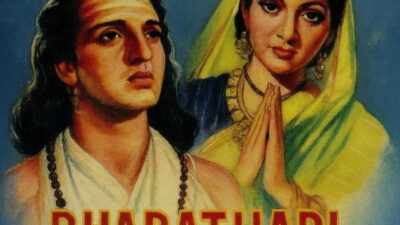
'भिक्षा दे दे मैया पिंगला' भर्तृहरि (1944) का भावनात्मक और भक्ति-केंद्र है — चतुर्भुज दोशी की नवीन पिक्चर्स द्वारा राजा भर्तृहरि किंवदंती का पुनराख्यान। सुरेंद्र और अमीरबाई कर्नाटकी द्वारा पंडित इंद्र के बोलों पर गाया यह युगल उस क्षण को दर्शाता है जब त्यागी राजा एक घुमक्कड़ जोगी के रूप में अपने महल लौटकर अपनी पूर्व रानी पिंगला से भिक्षा माँगता है। 1940 के दशक के सबसे प्रसिद्ध भक्ति फ़िल्म-गीतों में से एक, कहा जाता है कि इसने उस समय के कई युवा श्रोताओं को वैराग्य की ओर प्रेरित किया।
अंग्रेज़ी में पढ़ें · Read in English
'Bhiksha De De Maiya Pingala' is the emotional and devotional centrepiece of Bhartrahari (1944), Chaturbhuj Doshi's Navin Pictures retelling of the Raja Bhartrihari legend. Sung as a duet by Surendra and Amirbai Karnataki to Pandit Indra's lyrics, it stages the moment the renounced king returns to his palace as a wandering jogi to beg alms from his former queen Pingala. Among the most famous devotional film songs of the 1940s, it is said to have moved several young listeners of the time towards asceticism.
संगीत The Music
खेमचंद प्रकाश इस युगल को एक धीमी, संन्यासी लय में बाँधते हैं — एक धुन-प्रधान भक्ति-पंक्ति जो विरल हारमोनियम और तबले पर, करुण सारंगी के रंग के साथ चलती है, और सुरेंद्र के त्यागी राजा तथा अमीरबाई कर्नाटकी की शोकाकुल रानी के बीच प्रश्न-उत्तर के लिए स्थान छोड़ती है। संगीतकार का यह संयम ही मर्म है: संयोजन की सादगी राजा के वैराग्य को प्रतिबिंबित करती है।
अंग्रेज़ी में पढ़ें · Read in English
Khemchand Prakash sets the duet in a slow, mendicant register — a melody-first devotional line carried over sparse harmonium and tabla with a plaintive sarangi colour, leaving space for the call-and-response between Surendra's renouncing king and Amirbai Karnataki's grieving queen. The composer's restraint here is the point: the austerity of the arrangement mirrors the king's renunciation.
काव्य The Poetry
दो-पंक्ति का पूर्वावलोकन — 'भिक्षा दे दे मैया पिंगला, / जोगी खड़ा है द्वार' — भर्तृहरि की किंवदंती को उसकी सबसे भावभरी छवि में संकुचित करता है: अपने ही महल के दरवाज़े पर भिक्षापात्र लिए खड़ा त्यागी राजा। पिंगला का नाम इस कथा में एक प्रिय रानी या पटरानी को संदर्भित करता है, और यह मुठभेड़ — पूर्व शासक का अनाम साधु के रूप में लौटना — संस्कृत भक्ति साहित्य और क्षेत्रीय प्रदर्शन परंपराओं में हिंदी सिनेमा से बहुत पहले से था। पंडित इंद्र का बोल भजन की श्रेणी में काम करता है, न कि शास्त्रीय कविता की परंपरा में: छंद सरल, बोली सुलभ, और अपील सीधी करुणा से, न कि भाषायी अलंकरण से। 'मैया' (माँ/रानी — सम्मानपूर्ण संबोधन) और 'जोगी' (घुमक्कड़ संन्यासी — सामाजिक रूप से सबसे नीचे) का सामना एक संक्षिप्त सामाजिक उलटफेर रचता है: जो राजकीय आज्ञा देता था वही अब भिक्षा माँगता है। यह नैतिक ज्यामिति — वैराग्य की पूर्णता के प्रमाण के रूप में पद का संपूर्ण समर्पण — भक्ति परंपरा की विनम्रता-के-माध्यम-से-त्याग की धारा से है।
अंग्रेज़ी में पढ़ें · Read in English
The two-line preview — 'Bhiksha de de maiya Pingala, / Jogi khada hai dwaar' — condenses the Bhartrihari legend into its most charged image: the renounced king standing at his own palace gate with a begging bowl. The name 'Pingala' in the legend refers to a favourite queen or consort, and this encounter — the former ruler returned as an anonymous mendicant — was a staple of Sanskrit devotional literature and regional performance traditions long before Hindi cinema. Pandit Indra's lyric works within the bhajan register rather than the classical kavita tradition: the metre is simple, the diction accessible, and the appeal is through direct pathos rather than linguistic elaboration. The juxtaposition of 'maiya' (mother/queen, an honorific of reverence) with 'jogi' (wandering ascetic, socially lowest) creates a compact social inversion: the one who gave royal commands now begs. This moral geometry — absolute surrender of rank as proof of renunciation's completeness — belongs to the bhakti tradition of humility-through-giving-up, where the dissolution of social identity is the devotional act itself.
कहानी The Story
भर्तृहरि (1944) चतुर्भुज दोशी द्वारा नवीन पिक्चर्स के लिए निर्देशित, पी.बी. ज़वेरी द्वारा निर्मित था। फ़िल्म उज्जयिनी के राजा भर्तृहरि की किंवदंती पर आधारित थी — वे संस्कृत के व्याकरणकार-राजा जिन्हें परंपरागत रूप से लगभग पहली शताब्दी ईसा पूर्व में रखा जाता है, और जिन्होंने एक अविश्वासी रानी से मोहभंग के बाद अपना सिंहासन त्याग दिया। यह कहानी इस ध्वनि-युग के पुनर्कथन से पहले ही असंख्य क्षेत्रीय नाटकों और मूक फ़िल्मों में नाटकीय की जा चुकी थी। फ़िल्म में सुरेंद्र राजा की भूमिका में थे, और मुमताज़ शांति तथा अमीरबाई कर्नाटकी प्रमुख भूमिकाओं में। संगीत निर्देशक खेमचंद प्रकाश को यह भक्ति सामग्री निरंतर अर्ध-शास्त्रीय रचना का अवसर दे रही थी। 'भिक्षा दे दे मैया पिंगला' फ़िल्म का सबसे लोकप्रिय गीत दर्ज है, के.सी. डे के भक्ति-गीत 'तेरी गठरी में लागा चोर' (धूप छाँव, 1935) की परंपरा को आगे बढ़ाते हुए।
अंग्रेज़ी में पढ़ें · Read in English
Bhartrahari (1944) was directed by Chaturbhuj Doshi for Navin Pictures, produced by P.B. Zaveri. The film drew on the legend of King Bhartrihari (Bhartrahari), the Sanskrit grammarian-king of Ujjaini traditionally dated to around the 1st century BCE, who renounced his throne after being disillusioned by an unfaithful queen — a story that had already been dramatized in numerous regional plays and earlier silent films before this sound-era retelling. The film starred Surendra as the king and Mumtaz Shanti alongside Amirbai Karnataki in key roles. Music director Khemchand Prakash received this devotional material as an opportunity for sustained semi-classical composition — a different register from the lighter fare he composed for comic or social films. The song 'Bhiksha De De Maiya Pingala' is documented as the film's most popular number, following the precedent set by K.C. Dey's devotional landmark 'Teri Gathari Mein Laaga Chor' from Dhoop Chhaon (1935), which had established the mendicant-figure's simple appeal as a potent box-office device in the religious-film genre.
विरासत The Legacy
भर्तृहरि (1944) उस वर्ष की पाँचवीं सबसे अधिक कमाई करने वाली भारतीय फ़िल्म थी, जिसने 1940 के दशक के मध्य भारत में भक्ति-ऐतिहासिक शैली की स्थायी व्यावसायिक शक्ति की पुष्टि की। 'भिक्षा दे दे मैया पिंगला' सुरेंद्र के साथ जुड़ी रही — जो स्वातंत्र्य-पूर्व युग की परिभाषात्मक पुरुष आवाज़ों में से एक थे और भक्ति तथा अर्ध-शास्त्रीय गीतों के लिए विशेष रूप से जाने जाते थे। खेमचंद प्रकाश की संगीत-पट्टी उनके 1940 के दशक के मध्य के सर्वश्रेष्ठ कामों में है; वे आगे चलकर लता मंगेशकर की कुछ आरंभिक महत्त्वपूर्ण रिकॉर्डिंगें — जिनमें महल (1949) का 'आयेगा आनेवाला' शामिल है — रचने के बाद 1950 में असमय चल बसे। भर्तृहरि की किंवदंती बाद के दशकों में क्षेत्रीय भाषाओं में फिर से कही गई, लेकिन इस गीत को केंद्र में रखते हुए 1944 की नवीन पिक्चर्स की फ़िल्म बीसवीं शताब्दी की सबसे सफल हिंदी प्रस्तुति रही।
अंग्रेज़ी में पढ़ें · Read in English
Bhartrahari (1944) was the fifth highest-grossing Indian film of the year, confirming the continued commercial power of the devotional-historical genre in mid-1940s India. 'Bhiksha De De Maiya Pingala' remained associated with Surendra, who alongside K.L. Saigal and Mukesh was one of the defining male voices of the pre-independence era, particularly noted for devotional and semi-classical numbers. Khemchand Prakash's score is among the most celebrated of his mid-1940s output; he would go on to compose some of Lata Mangeshkar's earliest breakthrough recordings, including 'Aayega Aanewala' from the supernatural hit Mahal (1949), before his early death in 1950. The Bhartrihari legend continued to be retold in later decades in regional languages, but the 1944 Navin Pictures version — with this song at its emotional centre — was the most commercially successful Hindi telling of the twentieth century.
वर्गीकरण
Classification- Tempo
- Slow
Genre
अन्य विवरण
More Details- https://en.wikipedia.org/wiki/Bhartrahari
- https://atulsongaday.me/2012/10/18/bhiksha-de-de-maiyya-pingalaa/
- https://atulmovies.wordpress.com/2013/01/08/bharthari-1944/
- https://en.wikipedia.org/wiki/Khemchand_Prakash
References
रोचक तथ्य
Margin Notesभर्तृहरि (1944) 1944 की पांचवीं सबसे अधिक कमाई करने वाली भारतीय फ़िल्म थी, जो परंपरागत रूप से पहली शताब्दी ईसा पूर्व के उज्जैनी के संस्कृत व्याकरणाचार्य-राजा की कथा पर आधारित थी।
अंग्रेज़ी में पढ़ें · Read in English
Bhartrahari (1944) was the fifth highest-grossing Indian film of 1944, based on the legend of the Sanskrit grammarian-king of Ujjaini traditionally dated to the 1st century BCE.
यह गीत सचेत रूप से के.सी. डे के धूप छांव (1935) के भक्ति हिट गीत 'तेरी गठरी में लागा चोर' के व्यावसायिक प्रतिरूप का अनुसरण करता है, जिसने भिक्षुक चरित्र की सरल अपील को धार्मिक-फ़िल्म विधा के भावनात्मक केंद्रबिंदु के रूप में स्थापित किया था।
अंग्रेज़ी में पढ़ें · Read in English
The song consciously follows the commercial model of K.C. Dey's devotional hit 'Teri Gathari Mein Laaga Chor' from Dhoop Chhaon (1935), which had established the mendicant figure's simple appeal as the emotional centrepiece of the religious-film genre.
संगीत निर्देशक खेमचंद प्रकाश (लगभग 1907-1950) का निधन कम आयु में हो गया, लेकिन उन्होंने एक महत्वपूर्ण विरासत छोड़ी: अलौकिक हिट फ़िल्म महल (1949) के लिए उनके संगीत ने लता मंगेशकर के प्रारंभिक करियर की शुरुआत की और इसमें ऐतिहासिक गीत 'आएगा आनेवाला' शामिल था।
अंग्रेज़ी में पढ़ें · Read in English
Music director Khemchand Prakash (c. 1907–1950) died young but left a significant legacy: his score for the supernatural hit Mahal (1949) launched Lata Mangeshkar's early career and included the landmark 'Aayega Aanewala'.
अमीरबाई कर्नाटकी, जो इस गीत में सुरेंद्र की युगल-गायन साथी थीं, ने भर्तृहरि के साउंडट्रैक में अन्यत्र राग मारूबिहाग में एक अर्ध-शास्त्रीय 'बोल-बनाव' ठुमरी ('चंदा देस पिया के') भी प्रस्तुत की — जो इस संगीत की भक्ति-सरलता से लेकर शास्त्रीय गहराई तक की व्यापकता को दर्शाती है।
अंग्रेज़ी में पढ़ें · Read in English
Amirbai Karnataki, Surendra's duet partner in this song, also performed a semi-classical bol-banav thumri in Raga Marubihag ('Chanda Des Piya Ke') elsewhere in the Bhartrahari soundtrack — demonstrating the score's range from devotional simplicity to classical depth.
नमूना-पट्टी
The Specimen Table| शीर्षक | भिक्षा दे दे मैया पिंगला · Bhiksha De De Maiya Pingala |
|---|---|
| फ़िल्म | भर्तृहरि · 1944 |
| वर्ष · युग | 1944 |
| गायक | Surendra, Amirbai Karnataki |
| गीतकार | Pandit Indra |
| संगीतकार | Khemchand Prakash |
| स्वरूप | युगल |
| गति | धीमी |
| भाषा | hindi |
| भाव | उदास · दार्शनिक · आध्यात्मिक |
| लोकप्रियता | Popular |
| बोल-स्थिति | केवल झलक |
जुड़े हुए पन्ने
Connected Plates · The Graph Made Visibleअटलस में कोई पन्ना अकेला नहीं — इस गीत से जुड़े गीत, कलाकार, फ़िल्म, राग-ताल-विधा, सब यहाँ से खुलते हैं।
मिलते-जुलते गीत · Related Songs
कलाकार · The Artists
फ़िल्म · The Film
साझा कीजिए · Share this Plate