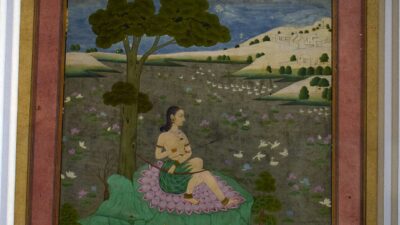
शास्त्र विंग · राग-पट्टिका · Raag Plate
बरव
Barwa
भावशांतिपूर्ण · ध्यानपूर्ण · प्रशांत · शांत
ऊर्जाधीमी
स्वर-चित्र · The Swara Panel
आरोह — अवरोह · The Ascent and the Descent
पकड़ · पहचान वाक्यांश
नि॒ स रे ग॒ म | प ध नि॒ सा | सा नि॒ ध प म ग॒ रे स
Ni♭ Sa Re Ga♭ Ma | Pa Dha Ni♭ Sa' | Sa' Ni♭ Dha Pa Ma Ga♭ Re Sa
Barwa's distinguishing feature within the Kafi family is the use of shuddha dhaivata (natural Dha), which separates it from Bageshri (which uses komal Dha). This characteristic phrase opens from the lower komal nishada, moves through komal gandhara, and rests on shuddha Dha before completing the phrase. The samvadi Ni gives weight to the upper Sa region.
वादी–संवादी टिप्पणी · Vadi–Samvadi note
Vadi — The vadi (primary) note provides the tonal center of Raag Barwa.
Samvadi — Ni (Nishad) is the samvadi, complementing the vadi note.
समय और भाव
Time Theory & Moodसमय-सिद्धांत · Time Theory
संध्या काल
परंपरागत रूप से संध्या काल (4:00 PM - 7:00 PM) में गाया जाता है।
Traditionally performed during evening/twilight hours (4:00 PM - 7:00 PM), when day transitions to night.
भाव और गति · Mood & Tempo
शांत · Peace/Tranquility
आंतरिक शांति, सुकून और आध्यात्मिक वैराग्य का रस। शांति, ध्यान और अध्यात्म को जगाता है।
ऊर्जा · Energyधीमी
स्तर · Leveladvanced — राग Barwa के लिए इसके मूल ठाट की समझ और मींड, गमक, आंदोलन के माध्यम से इसके अद्वितीय चरित्र को उभारने की क्षमत…
पट्टिका-लेख
The Monographपरिचय Introduction
राग Barwa हिंदुस्तानी शास्त्रीय संगीत का एक राग है। इसका प्रमुख रस शांत (Peace/Tranquility) है। यह परंपरागत रूप से संध्या काल (4:00 PM - 7:00 PM) में गाया जाता है। गाया जाता है।
अंग्रेज़ी में पढ़ें · Read in English
Raag Barwa is a complete scale with all 7 notes in both ascent and descent raga in Hindustani classical music. This raag embodies the Peace/Tranquility (शांत) rasa, creating an atmosphere of peaceful, meditative emotion. It is traditionally performed during evening hours. The raag offers rich melodic possibilities through its characteristic phrases and ornamentations, making it a rewarding subject for both khayal and instrumental performance.
सांस्कृतिक महत्व Cultural Significance
भारतीय शास्त्रीय संगीत की समृद्ध परंपरा के अंग के रूप में, राग Barwa Hindustani परंपरा को परिभाषित करने वाले स्वर संरचना और भावनात्मक अभिव्यक्ति के बीच गहरे संबंध का प्रतिनिधित्व करता है।
अंग्रेज़ी में पढ़ें · Read in English
As part of the rich tapestry of Indian classical music, Raag Barwa represents the deep connection between melodic structure and emotional expression that defines the Hindustani tradition.
ऐतिहासिक महत्व Historical Significance
राग बरवा हिन्दुस्तानी शास्त्रीय संगीत का एक राग है जो कफ़ी ठाट से सम्बद्ध है। इसमें कोमल ग, शुद्ध ध और कोमल नि का प्रयोग होता है। यह देर रात का राग है जो शान्त विरह और अन्तरंगता का भाव उत्पन्न करता है। बरवा अपेक्षाकृत दुर्लभ राग है और किराना तथा आगरा घराने की परम्परा में इसे जानने वाले विशेषज्ञ सीमित हैं। इसके निकटतम सम्बन्धी बागेश्री और कफ़ी हैं। बागेश्री से इसे शुद्ध ध (बनाम बागेश्री का कोमल ध) अलग करता है, जिससे इसमें उन रागों की तुलना में हल्का सा उजलापन आता है। पं. विष्णु नारायण भातखण्डे और पं. विष्णु दिगम्बर पलुस्कर के 20वीं शती के ग्रन्थों में इसका उल्लेख मिलता है।
अंग्रेज़ी में पढ़ें · Read in English
Raag Barwa is a Hindustani classical raag of the Kafi thaat, characterised by komal gandhara (G2), shuddha dhaivata (D2), and komal nishada (N2). Performed in the late night hours, it carries a mood of quiet longing and intimacy. Barwa is a relatively rare raag, known mainly to specialists within the Kirana and Agra gharana traditions. Its closest relatives are Bageshri and Kafi, from which it is distinguished principally by the use of shuddha Dha — the same note that lends it a slightly brighter, less shadowed character than its sister raags. The raag has been documented in 20th-century anthologies of Hindustani ragas compiled by Pandit Vishnu Narayan Bhatkhande and Pandit Vishnu Digambar Paluskar, though its repertoire of bandish compositions remains limited.
शिक्षा
Teaching & LearningStart with aaroha-avaroha practice with tanpura
Focus on the pakad (catch phrase) to establish the raag's identity
Practice alap in vilambit (slow) laya to internalize the mood
Gradually build speed through jod and jhala patterns
Confusing this raag with similar-sounding raags
Not giving enough weight to the vadi and samvadi swaras
Using inappropriate meend or gamak patterns
तुलना
A Specimen Comparisonयदि बरव को काफ़ी थाट के अंतर्गत माना जाए, तो दोनों में कोमल ग और कोमल नि समान होंगे। अंतर विशिष्ट स्वर-वाक्यांशों, धैवत के उपचार और पकड़ में होगा। काफ़ी की लोक-उष्मा और विस्तार की तुलना में बरव को कुछ ग्रंथों में अधिक मापा हुआ बताया गया है।
| तुलनाSpecimen | बरव | काफ़ी |
|---|---|---|
| स्वर-अंतर | Both share komal Ga (flat third) and komal Ni (flat seventh); the distinction lies in the treatment of Dha (natural or flat) and characteristic phrases (pakad) | |
| भाव-अंतर | Kafi has a well-established folk warmth and open character; Barwa has a more measured and contained quality | |
यदि बरव को काफ़ी थाट के अंतर्गत माना जाए, तो पीलू के साथ कोमल ग और कोमल नि समान होंगे। अंतर विशिष्ट स्वर-वाक्यांशों, धैवत के उपचार और पकड़ में होगा।
| तुलनाSpecimen | बरव | पीलू |
|---|---|---|
| स्वर-अंतर | Both share komal Ga (flat third) and komal Ni (flat seventh); the distinction lies in the treatment of Dha (natural or flat) and characteristic phrases (pakad) | |
यदि बरव को काफ़ी थाट के अंतर्गत माना जाए, तो भीमपलासी के साथ कोमल ग और कोमल नि समान होंगे। अंतर विशिष्ट स्वर-वाक्यांशों, धैवत के उपचार और पकड़ में होगा।
| तुलनाSpecimen | बरव | भीमपलासी |
|---|---|---|
| स्वर-अंतर | Both share komal Ga (flat third) and komal Ni (flat seventh); the distinction lies in the treatment of Dha (natural or flat) and characteristic phrases (pakad) | |
प्रस्तुति
Performance- Description
- परंपरागत रूप से संध्या काल (4:00 PM - 7:00 PM) में गाया जाता है। Traditionally performed during evening/twilight hours (4:00 PM - 7:00 PM), when day transitions to night.
- Prahar Number
- 5
- Prahar Name
- संध्या काल Sandhya Kaal
- Time Start
- 16:00
- Time End
- 19:00
- Time Flexibility
- flexible
Time
और जानें
More to Know- raag-kafi — Kafi — काफ़ी — If Barwa belongs to the Kafi thaat family (as some sources suggest), both share komal Ga (flat third) and komal Ni (flat seventh). The distinction lies in specific melodic phrases, the treatment of Dha (natural or flat), and the characteristic patterns (pakad). Unlike Kafi — which has a well-established folk warmth and open character — Barwa is described in some texts as having a more measured and contained quality. — यदि बरव को काफ़ी थाट के अंतर्गत माना जाए, तो दोनों में कोमल ग और कोमल नि समान होंगे। अंतर विशिष्ट स्वर-वाक्यांशों, धैवत के उपचार और पकड़ में होगा। काफ़ी की लोक-उष्मा और विस्तार की तुलना में बरव को कुछ ग्रंथों में अधिक मापा हुआ बताया गया है। — Both share komal Ga (flat third) and komal Ni (flat seventh); the distinction lies in the treatment of Dha (natural or flat) and characteristic phrases (pakad) — Kafi has a well-established folk warmth and open character; Barwa has a more measured and contained quality
- raag-pilu — Pilu — पीलू — If Barwa belongs to the Kafi thaat family, both share komal Ga (flat third) and komal Ni (flat seventh) with Pilu. The distinction between Barwa and Pilu lies in specific melodic phrases, the treatment of Dha (natural or flat), and the characteristic patterns (pakad). Without a standardized and widely documented arohana-avarohana for Barwa, more specific comparison is not possible from public sources. — यदि बरव को काफ़ी थाट के अंतर्गत माना जाए, तो पीलू के साथ कोमल ग और कोमल नि समान होंगे। अंतर विशिष्ट स्वर-वाक्यांशों, धैवत के उपचार और पकड़ में होगा। — Both share komal Ga (flat third) and komal Ni (flat seventh); the distinction lies in the treatment of Dha (natural or flat) and characteristic phrases (pakad)
- raag-bhimpalasi — Bhimpalasi — भीमपलासी — If Barwa belongs to the Kafi thaat family, both share komal Ga (flat third) and komal Ni (flat seventh) with Bhimpalasi. The distinction between Barwa and Bhimpalasi lies in specific melodic phrases, the treatment of Dha (natural or flat), and the characteristic patterns (pakad). Without a standardized and widely documented arohana-avarohana for Barwa, more specific comparison is not possible from public sources. — यदि बरव को काफ़ी थाट के अंतर्गत माना जाए, तो भीमपलासी के साथ कोमल ग और कोमल नि समान होंगे। अंतर विशिष्ट स्वर-वाक्यांशों, धैवत के उपचार और पकड़ में होगा। — Both share komal Ga (flat third) and komal Ni (flat seventh); the distinction lies in the treatment of Dha (natural or flat) and characteristic phrases (pakad)
In Film Music
Raag Barwa has no documented presence in Hindi film music. This is an obscure, rarely performed raag in the Hindustani classical tradition, and film composers — who need instantly recognizable emotional hooks — have never drawn on it. Barwa belongs to the small category of Hindustani raags that exist primarily in theoretical and encyclopedic documentation rather than active concert practice. In the classical concert world, Barwa surfaces only occasionally in the repertoire of specialized khayal vocalists exploring lesser-known raags from theoretical compilations. Its exact melodic identity is not uniformly agreed upon across different gharanas, and no single landmark recording has established it as a performance tradition. For listeners interested in this raag, the path leads to specialized Hindustani recordings and musicological texts — not to film music archives.
Comparisons
सीखने के लिए
For Learners- Difficulty Level
- advanced
अन्य विवरण
More Details- Indian_Music_Raga_Encyclopedia_v2.xlsx
- ragajunglism.org — Hindustani Raga Index (general reference)
- sarod.com.au — The majesty of Shahana (related Kafi-family raag comparison)
References
नमूना-पट्टी
The Specimen Table| नाम | बरव · Barwa |
|---|---|
| थाट | Kafi |
| पकड़ | नि॒ स रे ग॒ म | प ध नि॒ सा | सा नि॒ ध प म ग॒ रे स |
| जाति | संपूर्ण-संपूर्ण · Sampurna-Sampurna |
| समय | संध्या काल |
| ऊर्जा | धीमी |
| परिवार | Barwa |
| स्तर | advanced |
| लोकप्रियता | Obscure |
जुड़े हुए पन्ने
Connected Plates · The Graph Made Visibleअटलस में कोई पन्ना अकेला नहीं — इस राग से गीत, प्रस्तुतियाँ, कलाकार, ताल, घराने और मिलते-जुलते राग, सब यहाँ से खुलते हैं।
ताल-साथी · Taal Pairings
शास्त्र-सूत्र · Shastra Threads
श्रवण-कक्ष · The Listening Room
सुनिए — बरव · Hear the Raag
Raga Barwa | Ustad Vilayat Khan | Mesmerizing Sitar Recital | Hindustani Classical Music
प्रश्नोत्तर
Questions & Answersराग Barwa क्या है?
राग Barwa Hindustani शास्त्रीय संगीत का एक राग है।
अंग्रेज़ी में पढ़ें · Read in English
What is Raag Barwa? — Raag Barwa is a raag in Hindustani classical music.
साझा कीजिए · Share this Plate