शास्त्र विंग · वाद्य-पट्टिका · Instrument Plate
टिम्पानी
Timpani
अन्य नामटिम्पानी · केटलड्रम (kettledrums) · पौकन / Pauken (German) · टिम्बाल / Timbales (French)
परिचय
Overviewटिम्पानी, या केटलड्रम, पश्चिमी ऑर्केस्ट्रा का सबसे गंभीर और भव्य ताल-वाद्य है — ताँबे के बड़े कटोरों पर मढ़ी झिल्लियाँ जो पैर के पेडल से सुर बदलती हैं। यह उन गिने-चुने ड्रमों में है जो असली संगीत-नोट बजाते हैं, इसलिए ऑर्केस्ट्रा को ताल के साथ-साथ सुर-आधार भी देता है। बीथोवन और श्ट्राउस के हाथों नाटक की आवाज़ बना यह वाद्य 1940 के बाद बंबई के फ़िल्म-स्टूडियो में पहुँचा और हिंदी सिनेमा के हर तनावपूर्ण, रोमांचकारी क्षण की गड़गड़ाती नींव बन गया।
अंग्रेज़ी में पढ़ें · Read in English
The timpani, or kettledrums, is the gravest and grandest percussion of the Western orchestra — membranes over great copper bowls that change pitch by a foot pedal. It is one of the few drums that plays a true musical note, so it gives the orchestra harmonic foundation as well as rhythm. Made the voice of drama by Beethoven and Strauss, this instrument reached Bombay's film studios after 1940 and became the rumbling foundation of every tense, thrilling moment of Hindi cinema.
वर्गीकरण
ClassificationNatya Shastra Category
अवनद्ध (Avanaddha — membrane/percussion instruments)
यद्यपि टिम्पानी एक पश्चिमी वाद्य है और नाट्यशास्त्र में इसका उल्लेख नहीं है, वर्गीकरण की दृष्टि से यह 'अवनद्ध वाद्य' (चमड़े/झिल्ली से मढ़े हुए वाद्य) की श्रेणी में आता है — जैसे नगाड़ा, मृदंग और तबला। किंतु टिम्पानी इस श्रेणी में एक दुर्लभ गुण रखता है: यह निश्चित सुर (definite pitch) उत्पन्न करता है, इसलिए इसे 'सुरबद्ध ताल-वाद्य' कहा जा सकता है।
Although the timpani is a Western instrument absent from the Natya Shastra, by classification it belongs to the Avanaddha (membranophone / skin-covered) family — like the nagara, mridang and tabla. Yet within that family the timpani is rare in producing a definite pitch, making it a 'tuned drum'.
Western Category
Pitched (tuned) percussion — membranophone
Western Family
Kettledrum family — the West's principal drums of definite pitch, standard bass foundation of the symphony orchestra
Sub Classification
बनावट
PhysicalDescription Hindi
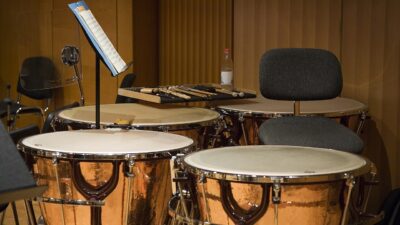
टिम्पानी एक विशाल केटल (कड़ाही) के आकार का ताल-वाद्य है — एक ताँबे या फ़ाइबरग्लास का बड़ा कटोरा जिसके मुँह पर एक झिल्ली (सिर) खिंची होती है। ऑर्केस्ट्रा में सामान्यतः चार टिम्पानी का समूह होता है, हर एक अलग आकार का, ताकि अलग-अलग सुर मिल सकें। इसकी सबसे बड़ी विशेषता है कि इसका सुर बदला जा सकता है — पुराने वाद्यों में हाथ के पेंच से, और आधुनिक वाद्यों में पैर के पेडल से बजाते-बजाते ही।
Description English
The timpani is a large kettle-shaped drum — a big copper or fibreglass bowl with a membrane (head) stretched across its mouth. An orchestra usually has a set of four timpani, each of a different size to yield a different pitch. Its defining feature is that its pitch can be changed — on older instruments by hand-turned screws, and on modern instruments by a foot pedal even while playing.
Kettle
कड़ाही / कटोरा (केटल)
Kettle / Bowl
Hemispherical or parabolic bowl
अर्धगोलाकार या परवलयाकार कटोरा
Traditionally hammered copper; modern instruments also use fibreglass or aluminium
परंपरागत रूप से हथौड़े से गढ़ा ताँबा; आधुनिक वाद्यों में फ़ाइबरग्लास या ऐल्युमिनियम भी
The bowl acts as the resonating chamber; its shape (hemispherical vs. parabolic) shapes the tone — hemispherical bowls give a brighter sound, parabolic a darker one
मानक समूह में चार ड्रम — लगभग 32", 29", 26" और 23" व्यास (कभी 20" भी) — बड़ा कटोरा गहरा सुर देता है।
A standard set has four drums of roughly 32", 29", 26" and 23" diameter (sometimes a 20" too) — the larger the bowl, the lower the pitch.
Head
सिर / झिल्ली (हेड)
Head / Membrane
Traditionally calfskin; modern heads are plastic (Mylar/polyester film)
परंपरागत रूप से बछड़े का चमड़ा; आधुनिक सिर प्लास्टिक (माइलर) के होते हैं
कटोरे के मुँह पर खिंची झिल्ली ही आघात-सतह है। इसका खिंचाव (tension) ही सुर तय करता है — जितना अधिक खिंचाव, उतना ऊँचा सुर।
The membrane stretched over the bowl's mouth is the striking surface. Its tension sets the pitch — greater tension yields a higher note.
Held by a metal counterhoop and tensioned by six to eight tuning rods spaced around the rim
Tuning Mechanism
सुर-मिलान तंत्र (पेडल)
Tuning mechanism (pedal)
आधुनिक 'पेडल टिम्पानी' में एक पैर का पेडल सभी तनाव-छड़ों को एक साथ खींचता या ढीला करता है, जिससे वादक बजाते-बजाते सुर बदल सकता है और यहाँ तक कि 'ग्लिसांडो' (सुर की फिसलन) भी पैदा कर सकता है। यह तंत्र 19वीं सदी के अंत में ड्रेस्डेन (जर्मनी) में विकसित हुआ।
On modern 'pedal timpani' a single foot pedal tightens or loosens all the tension rods together, letting the player change pitch while playing — and even produce a glissando (a slide in pitch). This mechanism was developed in Dresden, Germany, in the late 19th century.
A pitch gauge on the drum shows the approximate note the pedal is set to
Mallets
मैलेट / डंडे (टिम्पानी स्टिक)
Mallets / Timpani sticks
Wooden, bamboo or cane shafts with felt-, flannel- or cork-covered heads
लकड़ी या बाँस की डंडी, जिसके सिरे पर फ़ेल्ट या रुई से मढ़ा सिर
टिम्पानी को मुलायम गद्देदार मैलेटों से बजाया जाता है। कठोर, मध्यम और मुलायम — अलग-अलग सिर अलग-अलग रंग की ध्वनि देते हैं; वादक एक ही रचना में कई जोड़ी मैलेट बदलता है। आघात कटोरे के किनारे से एक-चौथाई भीतर मारा जाता है, केंद्र पर नहीं।
The timpani is struck with soft, padded mallets. Hard, medium and soft heads produce different tone colours; a player switches between several pairs within one piece. The strike is made about a quarter of the way in from the rim, not at the centre.
ध्वनि-चरित्र
SoundTonal Character Hindi
टिम्पानी की ध्वनि गहरी, गंभीर और भव्य है — गड़गड़ाते बादलों या दूर की तोप जैसी। यह ऑर्केस्ट्रा को नींव और नाटकीय भार देती है: कोमल 'रोल' से रहस्य और तनाव, और तीव्र आघात से विस्फोटक चरमोत्कर्ष। यही कारण है कि फ़िल्म-संगीत के पार्श्व-संगीत (BGM) में टिम्पानी नाटकीय क्षणों की रीढ़ है।
Tonal Character English
The timpani's sound is deep, grave and majestic — like rolling thunder or distant cannon. It gives the orchestra its foundation and dramatic weight: a soft roll builds mystery and tension, a hard strike delivers an explosive climax. This is why, in film background scores (BGM), the timpani is the backbone of dramatic moments.
Timbre
Warm, dark, resonant with a clear fundamental pitch and a long, singing sustain
Range
Across a set of four, roughly D2 up to A3 — each drum spans about a perfect fifth to an octave (32" ≈ low D–A, 23" ≈ D–A an octave higher)
Dynamic Range
Enormous — from a barely audible pianissimo roll to a thunderous fortissimo capable of cutting through a full orchestra without amplification
Techniques
सुनने का मार्गदर्शन
The Listening Guideटिम्पानी को समझने का सबसे अच्छा तरीका है उसकी अकेली आवाज़ पर ध्यान देना। पहले एक धीमे 'रोल' को सुनिए जो बढ़ते-बढ़ते तनाव भरता है, फिर एक अकेली ज़ोरदार थाप का भार महसूस कीजिए। श्ट्राउस के 'ज़राथुस्त्र' के आरंभ में वही गड़गड़ाहट टिम्पानी है। और अगली बार जब कोई हिंदी फ़िल्म का रहस्य या संघर्ष-दृश्य देखें, तो नीचे से उठती 'धड़-धड़' को पहचानिए — वही टिम्पानी दृश्य को बड़ा बना रही है।
अंग्रेज़ी में पढ़ें · Read in English
To understand the timpani, first hear it alone — on a good speaker or headphones so the deep fundamental is clear. Listen first to a 'roll' that slowly grows louder (crescendo) and feel how it builds tension. Then hear the opening of Strauss's 'Zarathustra': that sunrise rumble is the timpani. Finally, attend to the background score of a Hindi-film fight or suspense scene — every hidden 'thud-thud' there is the timpani.
परिचय
Identity- Year Of Origin
- 1250
अन्य विवरण
More DetailsTimbre
Warm, dark, resonant with a clear fundamental pitch and a long, singing sustain
रोचक तथ्य
Margin Notesजोड़ी में मिलाया जाने वाला ड्रम — बरोक और शास्त्रीय युग में टिम्पानी सामान्यतः जोड़ी में — 'टॉनिक' और 'डॉमिनेंट' दो सुरों पर — मिलाया जाता था, ठीक जैसे तुरही के साथ राजसी संगीत में बजता था। बीथोवन के बाद ही चार या अधिक टिम्पानी और अधिक सुर सामान्य हुए।
In the Baroque and Classical eras the timpani was usually tuned in a pair — to the 'tonic' and 'dominant' — just as it sounded in royal music with trumpets. Only after Beethoven did four or more timpani and more pitches become common.
पेडल की क्रांति — 1870 के दशक में ड्रेस्डेन (जर्मनी) में पेडल-तंत्र के आविष्कार ने टिम्पानी को बदल दिया। पहले सुर बदलने के लिए वादक को कई पेंच हाथ से घुमाने पड़ते थे; अब एक ही पैर के दबाव से पूरी झिल्ली का खिंचाव बदल जाता है — बजाते-बजाते।
The invention of the pedal mechanism in Dresden, Germany, in the 1870s transformed the timpani. Earlier, changing pitch meant hand-turning several screws; now a single press of the foot changes the whole head's tension — while playing.
फ़िल्म-संगीत का गुप्त नायक — हिंदी फ़िल्मों के पार्श्व-संगीत में टिम्पानी अक्सर 'सुनाई देकर भी अनदेखा' रहता है। संघर्ष, पीछा, रहस्य और भावुक चरमोत्कर्ष के दृश्यों में जो गहरी 'धड़-धड़' नीचे से उठती है — वह प्रायः टिम्पानी ही होती है, जो दृश्य का भावनात्मक भार बढ़ा देती है।
In Hindi-film background scores the timpani is often 'heard but unseen'. In fight, chase, suspense and emotional-climax scenes, the deep 'thud-thud' rising from below is usually the timpani, magnifying the scene's emotional weight.
ताँबे का कटोरा, ध्वनि का रंग — टिम्पानी की ध्वनि का रंग उसके कटोरे के आकार पर निर्भर करता है: अर्धगोलाकार कटोरा उजला, खनकता स्वर देता है, जबकि परवलयाकार कटोरा गहरा, गंभीर स्वर। इसीलिए वादक और निर्माता कटोरे के आकार को बड़ी सावधानी से चुनते हैं।
The colour of a timpani's sound depends on the shape of its bowl: a hemispherical bowl gives a bright, ringing tone, while a parabolic bowl gives a darker, graver one. This is why players and makers choose the bowl shape with great care.
सवाल-जवाब
Questions & Answersटिम्पानी क्या है?
टिम्पानी (केटलड्रम) एक पश्चिमी ऑर्केस्ट्रल ताल-वाद्य है — ताँबे या फ़ाइबरग्लास के बड़े कटोरे पर मढ़ी झिल्ली, जिसे मुलायम मैलेटों से बजाया जाता है। यह उन गिने-चुने ड्रमों में है जो निश्चित संगीत-सुर बजाते हैं।
टिम्पानी का सुर कैसे बदलता है?
आधुनिक 'पेडल टिम्पानी' में एक पैर का पेडल झिल्ली का खिंचाव बढ़ाता या घटाता है — अधिक खिंचाव, ऊँचा सुर। वादक बजाते-बजाते सुर बदल सकता है और ग्लिसांडो (सुर की फिसलन) भी बना सकता है।
हिंदी फ़िल्म-संगीत में टिम्पानी का क्या उपयोग है?
1940-50 के दशक से जब हिंदी फ़िल्म-संगीत ने पश्चिमी ऑर्केस्ट्रा को अपनाया, टिम्पानी पार्श्व-संगीत (BGM) का हिस्सा बना — नाटकीय प्रवेश, संघर्ष-दृश्यों के तनाव, रहस्य और भावनात्मक चरमोत्कर्ष की गड़गड़ाती नींव के लिए।
टिम्पानी और भारतीय नगाड़े में क्या संबंध है?
दोनों मध्य-पूर्वी 'नक़्क़ारा' से उतरे हैं और दोनों कटोरे के आकार के, जोड़ी में अलग-अलग सुरों पर मिलाकर बजाए जाने वाले ड्रम हैं। एक यूरोपीय ऑर्केस्ट्रा में पहुँचा (टिम्पानी), दूसरा भारतीय मंदिर और लोक-संगीत में बस गया (नगाड़ा)।
एक ऑर्केस्ट्रा में कितने टिम्पानी होते हैं?
एक मानक ऑर्केस्ट्रल समूह में आमतौर पर चार टिम्पानी होते हैं (लगभग 32", 29", 26" और 23" व्यास के), जिन्हें एक ही वादक बजाता है। बड़ी रचनाओं में इससे अधिक ड्रम और एक से अधिक वादक भी हो सकते हैं।
नमूना-पट्टी
The Specimen Table| नाम | टिम्पानी · Timpani |
|---|---|
| अन्य नाम | टिम्पानी · केटलड्रम (kettledrums) · पौकन / Pauken (German) · टिम्बाल / Timbales (French) · टिम्पानो (Timpano — singular) |
| उद्गम | 1250 |
| प्रकार | वाद्य · Instruments |
इस वाद्य के गीत
Songs of this Instruments


साझा कीजिए · Share this Plate