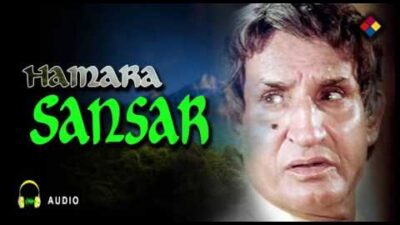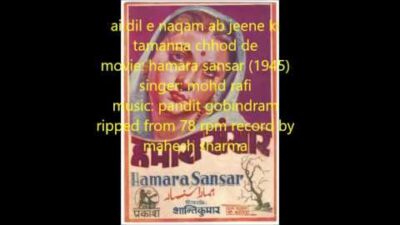
ऐ दिल-ए-नाकाम अब जीने की तमन्ना छोड़ दे
Ae Dil-e-Nakaam Ab Jeene Ki Tamanna Chhod De
सिनेमा विंग · फ़िल्म-पट्टिका · Film Plate
Hamara Sansar
शैलीDrama · Social · Family
भाषाhindi प्रकारकथा-चित्र (फ़ीचर)
गीत8 — नीचे पूरी संगीत-सूची
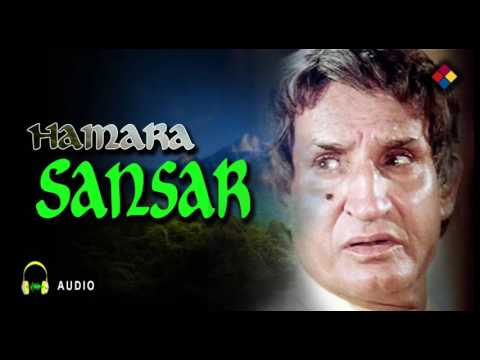
'हमारा संसार' — यानी वह संसार जो घर की चारदीवारी के भीतर बसता है — प्रकाश पिक्चर्स की 1945 में आई एक सामाजिक फ़िल्म है, जो ठीक उस मोड़ पर बनी जब यह बंबई स्टूडियो 'पौराणिक फ़िल्मों की कंपनी' वाली अपनी पहचान से बाहर निकलने की कोशिश कर रहा था। आज उपलब्ध किसी भी संदर्भ-स्रोत में इस फ़िल्म का कथासार सुरक्षित नहीं है: प्रिंट लुप्त प्रतीत होते हैं, और 1945 का लेखा-जोखा रखने वाले फ़िल्म-कोश तथा इसके गीत सुरक्षित रखने वाले गीत-संग्रह — दोनों में कहानी का कोई विवरण नहीं मिलता। लेकिन जो पात्र-सूची बची है, वह एक पूरी पीढ़ी तक फैली पारिवारिक गाथा का ढाँचा दिखाती है। जीवन को दोहरी भूमिका में 'मुंशीजी / कैलाश' के रूप में दर्ज किया गया है, और युवा कैलाश की भूमिका मधुसूदन ने निभाई; घर की दो स्त्रियाँ नाम से नहीं, बल्कि परिवार में अपने स्थान से पहचानी गई हैं — बड़ी बहू (राजकुमारी शुक्ला) और मंझली बहू (सत्यरानी); और दिनेश तथा रामू — दो पुरुष पात्र — दो-दो बार कास्ट किए गए हैं, बचपन में (मास्टर उमाकांत, सौरभ) और युवावस्था में (उमाकांत, सुशील कुमार)। रिश्ते से पहचाने जाने वाले पात्र और बचपन-से-जवानी तक दोहराई गई भूमिकाएँ — यही 1940 के दशक की हिंदी 'सोशल' फ़िल्म की बुनियादी बनावट है, और शीर्षक स्वयं संयुक्त परिवार को ही फ़िल्म का विषय बताता है।
Hamara Sansar — 'our world', meaning the household — is a social drama Prakash Pictures released in 1945, at the exact point when the Bombay studio was trying to shed its reputation as a maker of mythologicals. No plot summary of the film survives in the reference sources available today: prints appear to be lost, and neither the film encyclopaedias that cover 1945 nor the song compendia that preserve its soundtrack carry a story outline. What the surviving credit list does show is the shape of a household saga spanning a generation. Jeevan is billed in a double capacity as 'Munshiji / Kailash', with Madhusudan cast as the younger Kailash; two of the women are credited not by name but by their rank in the family, Badi Bahu (Rajkumari Shukla) and Manjhli Bahu (Satyarani); and two male characters, Dinesh and Ramu, are cast twice over — as children (Master Umakant, Saurabh) and as adults (Umakant, Sushil Kumar). Characters identified by relationship rather than by profession, and roles doubled across childhood and adulthood, are the standard architecture of the 1940s Hindi 'social', and the title points squarely at the joint family as the film's subject.
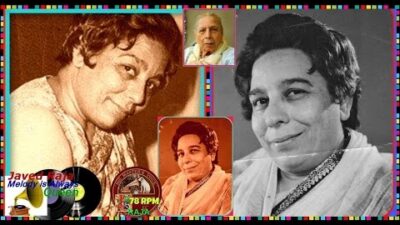
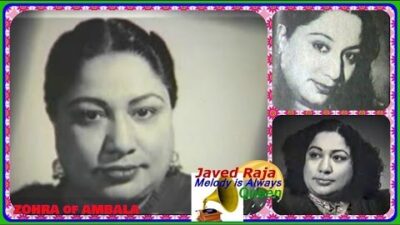
एचएफ़जीके-आधारित गीत-सूचियों में 'हमारा संसार' के आठ गीत दर्ज हैं; सारेगामा पर उपलब्ध बचे हुए व्यावसायिक एलबम में इनमें से छह हैं। हर धुन गोबिंद राम की है और हर बोल रमेश गुप्ता के — 1945 की किसी सामाजिक फ़िल्म के लिए यह असामान्य रूप से साफ़ 'एक संगीतकार, एक गीतकार' का श्रेय है। आवाज़ें हैं मोहम्मद रफ़ी, शमशाद बेगम, ज़ोहराबाई अम्बालेवाली और नसीम अख़्तर — यानी यह संगीत उस समय प्रचलित दोनों स्त्री-शैलियों तक पहुँचता है: शमशाद का चमकीला, तीखा, आगे बढ़कर लगने वाला स्वर और ज़ोहराबाई की भरी-पूरी, शास्त्रीय रूप से सधी हुई आवाज़। छह बचे हुए गीतों की रेंज इतने छोटे एलबम के लिहाज़ से काफ़ी चौड़ी है — सैगल-शैली की एक धीमी पुरुष ग़ज़ल, तक़दीर की बेबसी पर शमशाद का विलाप, तीन आवाज़ों में गाया आशा-भरा 'नैया' गीत, भीड़ के ऊपर स्त्री-स्वरों को परत-दर-परत रखता होली का समवेत गीत, एक पाती-गीत, और प्रेम-विस्मय में डूबा ज़ोहराबाई का एकल। सूचियों में सुरक्षित दो और शीर्षक — 'एक पत्थर के दो टुकड़ो' और 'रास रचाए' — किसी भी देखे गए स्रोत में गायक के नाम के बिना हैं, और यहाँ कोई नाम गढ़ा नहीं गया है।
Eight songs are documented for Hamara Sansar in the HFGK-derived song indexes; the surviving commercial album carried by Saregama holds six of them. Every composition is by Gobind Ram and every lyric by Ramesh Gupta — an unusually clean single-composer, single-lyricist credit for a 1945 social. The voices are Mohammed Rafi, Shamshad Begum, Zohrabai Ambalewali and Naseem Akhtar, which is to say the score reaches across both of the female styles then in circulation: Shamshad's bright, forward, cutting tone and Zohrabai's fuller, classically schooled one. The range of the six surviving numbers is wide for so short an album — a slow male ghazal in the Saigal manner, a Shamshad lament on the helplessness of fate, a hopeful three-voice 'naiya' (little boat) song, a Holi chorus with the women's voices layered over a crowd, a letter-song, and a Zohrabai solo of romantic wonder. Two further titles preserved in the indexes, 'Ek Patthar Ke Do Tukdo' and 'Raas Rachaye', carry no singer attribution in any source consulted, and none is invented here.


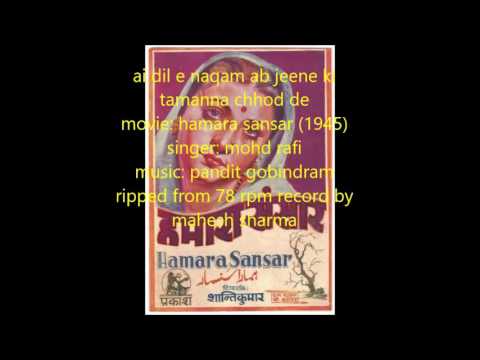
1943 तक प्रकाश पिक्चर्स भारत में 'पौराणिक फ़िल्मों वाला स्टूडियो' बन चुका था: 'भरत मिलाप' (1942) और 'राम राज्य' (1943) — दोनों ज़बरदस्त सफलताएँ थीं, और स्टूडियो के संचालकों ने तय किया कि वे किसी एक विधा में बँधकर नहीं रहना चाहते। 'पुलिस' (1944) और 'हमारा संसार' (1945) उसी सोची-समझी दिशा-बदल की दो सामाजिक फ़िल्में थीं, और इनमें से कोई भी पिछली कमाई नहीं दोहरा सकी। निर्देशन शांति कुमार का था, पटकथा गिरीश पंडित की। संगीत गोबिंद राम को सौंपा गया — लाहौर में प्रशिक्षित संगीतकार, जिन्होंने 'जीवन ज्योति' (1937) से शुरुआत की, 'हिम्मत' (1941) से पहली सफलता पाई, और फिर पंजाबी फ़िल्म 'मंगती' (1942) से एक मील का पत्थर खड़ा किया; ख़ास बात यह कि उनका संगीत अपनी पंजाबी जड़ें शायद ही सतह पर दिखाता था — वह 1940 के दशक के बंबइया मुख्यधारा मुहावरे में ही टिका रहता था: हल्की सुरीली धुनें, ग़ज़ल और ठुमरी की छाया। यहाँ मोहम्मद रफ़ी को पहला बिना-साझा रिकॉर्ड-साइड नौशाद ने नहीं, गोबिंद राम ने दिया।
Prakash Pictures had become, by 1943, the studio that India associated with the mythological: Bharat Milap (1942) and Ram Rajya (1943) were both enormous successes, and the studio's management decided it did not want to be typecast by a single genre. Police (1944) and Hamara Sansar (1945) were the two socials made in that deliberate turn away, and neither repeated the earlier box-office. Shanti Kumar directed from a script by Girish Pandit. The music was handed to Gobind Ram, a Lahore-trained composer who had come up through Jeevan Jyoti (1937), scored his first hit with Himmat (1941), and then made a landmark of the Punjabi film Mangti (1942); notably, his work rarely wore its Punjabi origins on the surface, sitting instead squarely in the mainstream 1940s Bombay idiom of light melody, ghazal and thumri-inflected song. It was Gobind Ram, not Naushad, who gave Mohammed Rafi his first unshared record side here.
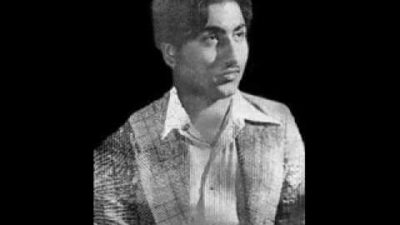
'हमारा संसार' बॉक्स-ऑफ़िस पर असफल रही और आलोचना में इसका कोई विशेष उल्लेख नहीं मिलता, फिर भी हिंदी फ़िल्म-संगीत के इतिहास में इसका एक स्थायी स्थान है: यही वह फ़िल्म है जिसमें युवा मोहम्मद रफ़ी ने पहली बार बिना किसी दूसरी आवाज़ के एक पूरा रिकॉर्ड अपने कंधों पर उठाया। रफ़ी ने पिछले वर्ष नौशाद की 'पहले आप' (1944) से हिंदी सिनेमा में प्रवेश किया था, लेकिन वहाँ वे श्याम कुमार के साथ युगल गीतों तक सीमित थे; यहाँ, गोबिंद राम के 'ऐ दिल-ए-नाकाम अब जीने की तमन्ना छोड़ दे' में, वे अकेले गाते हैं। 'सॉन्ग्स ऑफ़ योर', जो रफ़ी के विकास का अपना लेखा-जोखा इसी रिकॉर्ड से शुरू करता है, इसे गोबिंद राम का रफ़ी के लिए पहला गीत बताता है; संगीतकार पर मिलेनियम पोस्ट की प्रोफ़ाइल इसे वह फ़िल्म कहती है जिसमें रफ़ी ने अपनी पहली सफल ग़ज़ल गाई। यह रफ़ी का हिंदी फ़िल्मों का सर्वप्रथम एकल था — ऐसा कुछ लोकप्रिय विवरण दोहराते हैं, पर इस प्रविष्टि के लिए देखे गए किसी स्रोत से यह सिद्ध नहीं होता, और यहाँ इसका दावा नहीं किया गया है। यह गायन युवा रफ़ी को 'सैगल-शैली' में काम करते हुए भी दर्ज करता है — के.एल. सैगल से निकली वह धीमी, पीड़ा-भरी, ठहराव-भरी पुरुष गायकी जिससे 1940 के दशक के लगभग हर नवागंतुक को गुज़रना पड़ा — और वह भी 'शाहजहाँ' (1946) में स्वयं सैगल के साथ रिकॉर्ड करने से पूरे एक वर्ष पहले।
Hamara Sansar failed at the box office and has left almost no critical footprint, yet it holds a permanent place in the history of Hindi film music as the film on which the young Mohammed Rafi first carried a record side without a second voice beside him. Rafi had entered Hindi cinema the previous year in Naushad's Pehle Aap (1944), but only in duets alongside Shyam Kumar; here, in Gobind Ram's 'Ae Dil-e-Nakaam Ab Jeene Ki Tamanna Chhod De', he sings alone. Songs of Yore, which opens its survey of Rafi's development with this record, describes it as Gobind Ram's first song for Rafi; the Millennium Post profile of the composer calls it the film in which Rafi sang his first successful ghazal. That it was Rafi's first Hindi film solo in absolute terms is repeated by some popular accounts, but no source consulted for this entry establishes it, and it is not claimed here. The performance is also a document of the young Rafi working inside the Saigal idiom — the K.L. Saigal-derived manner of pained, slow, heavily inflected male singing that almost every 1940s newcomer had to pass through — a full year before he would actually record alongside Saigal in Shahjehan (1946).
फ़िल्म स्वयं दर्शकों के लिए व्यावहारिक रूप से लुप्त है — कोई प्रिंट प्रचलन में नहीं, खुली-लाइसेंस वाली चित्र-अभिलेखागारों में इसका कोई स्थिर-चित्र या लॉबी कार्ड सामने नहीं आया, और इसकी कहानी छपे हुए रिकॉर्ड से वापस नहीं पाई जा सकती। इसके विपरीत इसका संगीत असामान्य रूप से अच्छी तरह बचा है: सारेगामा आज भी छह गीतों का एलबम व्यावसायिक रूप से रखता है, और उनमें से कई रिकॉर्ड 78-आरपीएम शेलाक से उतारकर पुराने संगीत के संग्राहकों द्वारा साझा किए गए हैं। 'ऐ दिल-ए-नाकाम अब जीने की तमन्ना छोड़ दे' इस निर्माण की सबसे टिकाऊ धरोहर बन गया है: 'सॉन्ग्स ऑफ़ योर' रफ़ी के विकास के अपने सर्वेक्षण की शुरुआत इसी से करता है और इसे गोबिंद राम का रफ़ी के लिए पहला गीत दर्ज करता है, और संगीतकार पर मिलेनियम पोस्ट की प्रोफ़ाइल इसे रफ़ी की पहली सफल ग़ज़ल के रूप में अलग से रेखांकित करती है। यही 'हमारा संसार' की विचित्र नियति है: 1945 की एक व्यावसायिक असफलता, जिसे अस्सी साल बाद एक बीस-वर्षीय गायक की तीन मिनट की आवाज़ के लिए याद किया जाता है।
The film itself is effectively lost to viewers — no print circulates, no still or lobby card has surfaced on the open-licence image archives, and its story is unrecoverable from the printed record. Its soundtrack, by contrast, has survived unusually well: Saregama still carries a six-track album of it commercially, and several of those sides have been transferred from 78-rpm shellac and reposted by vintage-music archivists. 'Ae Dil-e-Nakaam Ab Jeene Ki Tamanna Chhod De' has become the most durable artefact of the production: Songs of Yore places it at the head of its survey of Rafi's development and records it as Gobind Ram's first song for the singer, and the Millennium Post profile of the composer singles it out as Rafi's first successful ghazal. That is the strange fate of Hamara Sansar: a commercial failure in 1945 that is remembered eighty years later for three minutes of a twenty-year-old's voice.
| शीर्षक | हमारा संसार · Hamara Sansar |
|---|---|
| वर्ष · युग | 1945 — Pre Independence |
| निर्देशक | शांति कुमार · Shanti Kumar |
| संगीत-निर्देशक | गोबिंद राम · Gobind Ram |
| गीतकार | रमेश गुप्ता · Ramesh Gupta |
| कलाकार-मंडली | जीवन · Jeevan · रंजना · Ranjana · उमाकांत · Umakant · राजकुमारी शुक्ला · Rajkumari Shukla · सुशील कुमार · Sushil Kumar · सुमति गुप्ते · Sumati Gupte · जिल्लोबाई · Jillobai · मधुसूदन · Madhusudan · सत्यरानी · Satyarani · श्रीभगवान · Shree Bhagwan |
| निर्माण-गृह | Prakash Pictures, Bombay |
| शैली | Drama · Social · Family |
| भाषा | hindi |
| प्रकार | कथा-चित्र (फ़ीचर) |
| गीत | 8 गीत — ऊपर पूरी संगीत-सूची |
अटलस में कोई पन्ना अकेला नहीं — 'हमारा संसार' से उसके गीत, कलाकार, राग और युग, सब जुड़े हैं।
साझा कीजिए · Share this Plate
Ae Dil-e-Nakaam Ab Jeene Ki Tamanna Chhod De
Chhoti Si Ek Banayenge Naiya
Mohammed Rafi, Shamshad Begum, Zohrabai Ambalewali · Hamara Sansar
Kaun Jeevan Mein Mere Samaye Ja Raha Hai