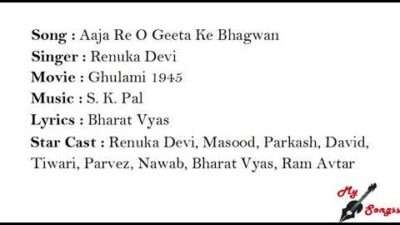
आजा रे ओ गीता के भगवान (रेणुका देवी और कोरस)
Aaja Re O Geeta Ke Bhagwan (Renuka Devi and Chorus)

सिनेमा विंग · फ़िल्म-पट्टिका · Film Plate
Ghulami
शैलीSocial · Drama
भाषाhindi प्रकारकथा-चित्र (फ़ीचर)
गीत9 — नीचे पूरी संगीत-सूची
'ग़ुलामी' — शीर्षक का अर्थ ही दासता है — एक हिंदी-उर्दू सामाजिक फ़िल्म है, जिसका निर्देशन मोहन वाधवानी ने किया और जिसे शालीमार पिक्चर्स ने 1945 में, आज़ादी से दो साल पहले, प्रस्तुत किया। उस समय की सूचियाँ इसे 'सोशल' श्रेणी में रखती हैं — यानी समकालीन समाज-सुधार नाटक। इसमें रेणुका देवी (बेगम ख़ुर्शीद मिर्ज़ा का पर्दा-नाम) और मसूद परवेज़ मुख्य भूमिकाओं में थे, तथा डेविड अब्राहम, मुमताज़ बेगम, रामायण तिवारी और गीतकार-अभिनेता भरत व्यास सहयोगी भूमिकाओं में। फ़िल्म की कथा का कोई विस्तृत विवरण उपलब्ध अभिलेखों में सुरक्षित नहीं है, इसलिए यह प्रविष्टि उसके कथानक के बारे में कोई दावा नहीं करती। जो पूरी तरह बचा रह गया, वह है संगीत — एस. के. पाल के रचे नौ गीत, जो सरेगामा/एचएमवी की सूची में सुरक्षित हैं और आज डिजिटल रूप में उपलब्ध हैं। इसी संगीत के कारण यह फ़िल्म आज भी याद की जाती है.
Ghulami — the word means 'slavery' or 'bondage' — is a Hindi-Urdu social drama directed by Mohan Wadhwani for Shalimar Pictures and released in 1945, two years before Independence. Contemporary listings classify it as a 'social', the trade term for a present-day reform drama, and it starred Renuka Devi (the screen name of Begum Khurshid Mirza) opposite Masood Parvez, with David Abraham, Mumtaz Begum, Ramayan Tiwari and the lyricist-actor Bharat Vyas in support. No detailed plot record of the film survives in the public archives consulted, and its narrative is not documented in the catalogues, censor summaries or trade indexes available today — so this entry deliberately makes no claim about its story. What does survive, and survives completely, is the soundtrack: nine songs by music director S. K. Pal, preserved in the Saregama/HMV catalogue and reissued digitally, which is why the film is remembered at all.
एस. के. पाल ने 'ग़ुलामी' के लिए नौ गीत रचे और पूरा एलबम मुश्किल से आधे घंटे का है — 1940 के दशक के 78-आरपीएम फ़िल्मी साउंडट्रैक का यही मानक आकार था। नौ में से आठ गीतों में रेणुका देवी की आवाज़ है — कहीं एकल, कहीं मसूद परवेज़ के साथ युगल, कहीं कोरस के साथ; वे उस अंतिम पीढ़ी की अभिनेत्री-गायिकाओं में थीं जो पार्श्वगायन के पूरी तरह हावी होने से पहले अपने गीत स्वयं गाती थीं। भरत व्यास इस फ़िल्म में असामान्य रूप से तीन भूमिकाओं में हैं: अभिनेता के रूप में, पाँच गीतों के गीतकार के रूप में, और 'इस नश्वर संसार में' तथा 'आजा रे ओ गीता के भगवान' के युगल रूप में गायक के रूप में। नौ गीत उस दौर के पूरे भाव-मानचित्र को छूते हैं — वतन को संबोधित एक देशभक्ति गीत, एक भक्ति-पुकार, एक सावन-गीत, एक नृत्य-गीत, एक दार्शनिक एकल और एक उर्दू नज़्म — और ये सभी सरेगामा, जियोसावन और हिंदी गीत माला में एक-सी दर्ज हैं।
S. K. Pal scored nine songs for Ghulami, and the album runs barely half an hour — the standard shape of a 1940s 78-rpm film soundtrack. Renuka Devi sings on eight of the nine, either solo, in duet with Masood Parvez, or with chorus; she was one of the last generation of actress-singers who rendered their own songs on screen before playback fully displaced them. Bharat Vyas, unusually, appears three ways on this film: as an actor, as the lyricist of five songs, and as a singing voice on 'Is Nashwar Sansar Mein' and the duet version of 'Aaja Re O Geeta Ke Bhagwan'. The nine tracks cover the standard emotional map of the period — a patriotic address to the homeland, a devotional call, a monsoon song, a dance number, a philosophical solo and an Urdu nazm — and are documented consistently across the Saregama catalogue, JioSaavn and Hindi Geet Mala.
रेणुका देवी असामान्य रूप से एक बौद्धिक पृष्ठभूमि से सिनेमा में आई थीं। अलीगढ़ में ख़ुर्शीद जहाँ के नाम से जन्मीं, वे शेख़ अब्दुल्ला और वहीद जहाँ बेगम की बेटी थीं — जिन्होंने वहाँ महिला महाविद्यालय की स्थापना की — और प्रगतिशील लेखक आंदोलन की संस्थापक हस्ती, उर्दू लेखिका रशीद जहाँ की बहन। देविका रानी ने उन्हें बॉम्बे टॉकीज़ में अनुबंधित किया और अपनी दिवंगत बहन की स्मृति में उन्हें यह पर्दा-नाम दिया। 'ग़ुलामी' उस दौर के अंत के क़रीब आई — फ़रवरी 1945 में रेणुका देवी ने फ़िल्मों से संन्यास की घोषणा कर दी — और विभाजन के बाद वे पाकिस्तान चली गईं, जहाँ 1960 के दशक में वे पाकिस्तान टेलीविज़न पर चरित्र अभिनेत्री के रूप में लौटीं। उनके सह-कलाकार मसूद परवेज़ ने 1947 से पहले भारतीय फ़िल्मों में काम किया और बाद में पाकिस्तान के सबसे सम्मानित निर्देशकों में गिने गए — 'हीर राँझा' (1970) और 'ख़ाक और ख़ून' (1979) के लिए निगार पुरस्कार जीते।
Renuka Devi came to films from an unusually rarefied background: she was born Khurshid Jehan in Aligarh, daughter of Sheikh Abdullah and Waheed Jahan Begum, founders of the Women's College there, and sister of the Urdu writer Rashid Jahan, a founding figure of the Progressive Writers' Movement. Devika Rani signed her at Bombay Talkies and gave her the screen name in memory of her own late sister. Ghulami came near the end of that run — Renuka Devi announced her retirement from films in February 1945 — and after Partition she moved to Pakistan, returning to performance only in the 1960s as a character actress on Pakistan Television. Masood Parvez, her co-star here, worked in Indian films before 1947 and then became one of Pakistan's most decorated directors, winning Nigar Awards for Heer Ranjha (1970) and Khak Aur Khoon (1979).
'ग़ुलामी' अपनी कथा से कहीं अधिक अपने गीत-श्रेय के नामों के कारण उल्लेखनीय है। शालीमार पिक्चर्स — डब्ल्यू. ज़ेड. अहमद का पूना स्टूडियो — बंबई-युग का वह अकेला निर्माण-घराना था जिसने प्रगतिशील लेखक संघ के रचनाकारों को नियमित रूप से काम पर रखा; जोश मलीहाबादी, कृष्ण चंदर, रामानंद सागर, अख़्तर-उल-ईमान और सागर निज़ामी — सभी वहाँ जुड़े रहे। 'ग़ुलामी' वह फ़िल्म है जहाँ यह नीति एक ही साउंडट्रैक पर सबसे साफ़ दिखती है। इसके चार में से तीन गीतकार बड़े उर्दू प्रगतिशील कवि हैं: 'शायर-ए-इंक़लाब' जोश मलीहाबादी ने दो गीत लिखे, अख़्तर-उल-ईमान ने एक, और मजाज़ लखनवी ने एक। शेष पाँच गीत भरत व्यास के हैं, जिनका लंबा कैरियर आगे 'दो आँखें बारह हाथ' और 'नवरंग' तक जाने वाला था। 1945 में 'ग़ुलामी' नाम की फ़िल्म में जोश मलीहाबादी का वतन को संबोधित गीत होना — यह तथ्य अपने आप में दर्ज करने योग्य है।
Ghulami is remarkable less for its story than for whose names appear on its song credits. Shalimar Pictures, W. Z. Ahmed's Poona studio, was the one Bombay-era production house that put the Progressive Writers' Association on its payroll — Josh Malihabadi, Krishan Chander, Ramanand Sagar, Akhtar-ul-Iman and Saghar Nizami all worked there — and Ghulami is where that policy shows most plainly on a single soundtrack. Three of its four lyricists are major Urdu progressives: Josh Malihabadi, the 'Shair-e-Inquilab', wrote two songs; Akhtar-ul-Iman, later one of the most respected voices in modern Urdu nazm, wrote one; and Majaz Lucknawi supplied the fourth. The remaining five went to Bharat Vyas, then early in a career that would run to Do Aankhen Barah Haath and Navrang. For a 1945 film called 'Slavery' to carry a Josh Malihabadi song addressed to the homeland is a matter of record worth noting in itself.
फ़िल्म स्वयं प्रचलन से लगभग लुप्त हो चुकी है — न कोई पुनर्स्थापित प्रिंट सार्वजनिक रूप से उपलब्ध है, न मानक संदर्भ-ग्रंथों में उसकी कथा दर्ज है। पर उसका संगीत एक बहुत विशिष्ट ढंग से जीवित रहा। 'ऐ ग़म-ए-दिल क्या करूँ' मजाज़ लखनवी की सबसे प्रसिद्ध टेक का फ़िल्मी रूप है, और यह उस संस्करण से आठ वर्ष पहले का है जिसे सब याद रखते हैं — सरदार मलिक की धुन में, तलत महमूद की आवाज़ में, 'ठोकर' (1953) के लिए, जो अब तक के सबसे प्रिय उर्दू फ़िल्मी गीतों में गिना जाने लगा और जिसकी पहली पंक्ति आगे चलकर मजाज़ पर बनी 2017 की एक जीवनी-फ़िल्म का शीर्षक बनी। 'ग़ुलामी' का गीत मजाज़ की नज़्म 'आवारा' की ही पंक्तियाँ बरतता है या उसी टेक पर अलग से लिखा गया फ़िल्मी गीत है — यह किसी भी परामर्श किए गए स्रोत से सिद्ध नहीं होता, इसलिए यहाँ श्रेय-पट से आगे कोई दावा नहीं किया गया है: मजाज़ के बोल, एस. के. पाल का संगीत, 1945। इसके अलावा यह एलबम रेणुका देवी की गायकी का — नायिका के रूप में उनके अंतिम वर्ष का — सबसे पूर्ण बचा हुआ दस्तावेज़ है, और भरत व्यास के चार-दशकीय कैरियर की शुरुआत का भी।
The film itself has effectively vanished from circulation; there is no restored print in public view and no surviving plot record in the standard reference works. Its music, however, has had a long afterlife of a very specific kind. 'Ae Gham-e-Dil Kya Karoon' is a film setting of Majaz Lucknawi's most famous refrain, and it predates by eight years the version everyone remembers — Sardar Malik's setting sung by Talat Mahmood for Thokar (1953), which became one of the most-loved Urdu film songs ever recorded and whose opening line has since supplied the title of a 2017 biographical film about Majaz. Whether the Ghulami lyric uses the same verses as Majaz's nazm 'Aawaara' or a separately written film lyric on the same refrain is not established by any source consulted, so no claim is made here beyond what the song credits show: Majaz's words, S. K. Pal's music, 1945. Beyond that, the album is one of the fullest surviving records of Renuka Devi's singing voice in her final year as a leading lady, and of Bharat Vyas at the very start of a four-decade career.
| शीर्षक | ग़ुलामी · Ghulami |
|---|---|
| वर्ष · युग | 1945 — Pre Independence |
| निर्देशक | मोहन वाधवानी · Mohan Wadhwani |
| संगीत-निर्देशक | एस. के. पाल · S. K. Pal |
| गीतकार | भरत व्यास · Bharat Vyas · जोश मलीहाबादी · Josh Malihabadi · मजाज़ लखनवी · Majaz Lucknawi · अख़्तर-उल-ईमान · Akhtar-ul-Iman |
| कलाकार-मंडली | रेणुका देवी · Renuka Devi · मसूद परवेज़ · Masood Parvez · डेविड अब्राहम · David Abraham · मुमताज़ बेगम · Mumtaz Begum · भरत व्यास · Bharat Vyas · राम अवतार · Ram Avtar · रामायण तिवारी · Ramayan Tiwari · राजकुमारी शुक्ला · Rajkumari Shukla · प्रकाश · Prakash |
| निर्माण-गृह | Shalimar Pictures, Poona |
| शैली | Social · Drama |
| भाषा | hindi |
| प्रकार | कथा-चित्र (फ़ीचर) |
| गीत | 9 गीत — ऊपर पूरी संगीत-सूची |
अटलस में कोई पन्ना अकेला नहीं — 'ग़ुलामी' से उसके गीत, कलाकार, राग और युग, सब जुड़े हैं।
साझा कीजिए · Share this Plate