कहानियाँ विंग · कहानी · Music History · 1945
निषिद्ध महफ़िल: कैसे 'ज़ीनत' की ऑल-फ़ीमेल क़व्वाली ने सदियों पुरानी सीमा तोड़ी
The Forbidden Congregation: How Zeenat's All-Female Qawwali Broke a Centuries-Old Rule
निषिद्ध महफ़िल: कैसे 'ज़ीनत' की ऑल-फ़ीमेल क़व्वाली ने सदियों पुरानी सीमा तोड़ी
प्रकाशित18 June 2026
आमुख
क़व्वाली सदियों से पुरुषों का क्षेत्र रही थी। चिश्ती संतों की दरगाहों में — अजमेर में, निज़ामुद्दीन में, कलियर शरीफ़ में — क़व्वाली पुरुष-समूहों द्वारा सूफ़ी भक्ति के संगीत-रूप के रूप में विकसित हुई थी।
अंग्रेज़ी में पढ़ें · Read in English
The qawwali had, for centuries, been a male preserve. In the dargahs of the Chishti saints — at Ajmer, at Nizamuddin, at Kaliyar Sharif — qawwali had developed as a musical form of Sufi devotion performed by male ensembles, the poetry of Amir Khusrau and his successors carried by male voices in a devotional space from
निषिद्ध महफ़िल: कैसे 'ज़ीनत' की ऑल-फ़ीमेल क़व्वाली ने सदियों पुरानी सीमा तोड़ी
क़व्वाली सदियों से पुरुषों का क्षेत्र रही थी। चिश्ती संतों की दरगाहों में — अजमेर में, निज़ामुद्दीन में, कलियर शरीफ़ में — क़व्वाली पुरुष-समूहों द्वारा सूफ़ी भक्ति के संगीत-रूप के रूप में विकसित हुई थी। अमीर ख़ुसरो और उनके उत्तराधिकारियों की शायरी पुरुष-आवाज़ों में उस भक्ति-स्थान पर गूँजती थी जहाँ से महिलाओं को अक्सर बाहर रखा जाता था। मंच पर और शादी-समारोहों में मिश्रित रूप विकसित हुए, और महिलाओं ने अपनी परंपराओं में भक्ति-काव्य गाया — लेकिन क़व्वाली एक समवेत रूप के रूप में, अपने मुखिया-गायक और कोरस के बीच सवाल-जवाब के साथ, अपनी बढ़ती लयात्मक तीव्रता के साथ, आध्यात्मिक परमानंद की स्थिति पैदा करने के लिए बनी वाग्मिता-आवृत्ति के साथ — वह व्यवहार और सांस्कृतिक कल्पना दोनों में पुरुषों का रूप ही रहा। जब ग़ुलाम हैदर ने 'ज़ीनत' (1945) के लिए 'आहें न भरीं शिकवे न किए' रचा, हफ़ीज़ जालंधरी के बोलों और एक स्त्री-समूह का नेतृत्व करती नूर जहाँ के साथ, हिंदी सिनेमा में कुछ अभूतपूर्व हुआ: एक पूर्णतः साकार क़व्वाली — क़व्वाली की तड़क-भड़क के साथ पतला लोकगीत नहीं, बल्कि इस रूप की वाग्मिता-संरचना का वास्तविक प्रयोग — पूरी तरह महिलाओं द्वारा प्रस्तुत किया गया। यह चुनाव आकस्मिक नहीं था। ग़ुलाम हैदर लाहौर से थे, जहाँ महिला-महफ़िल की परंपरा का अपना समानांतर इतिहास था — हीरामंडी के कोठे की संगीतकारों की अपनी समवेत परंपराएँ थीं, और नूर जहाँ ख़ुद उसी दुनिया में पली-बढ़ी थीं, उसमें तालीम पाई थी, और वर्षों तक उसकी प्रस्तुति-परंपराओं को आत्मसात करती रही थीं। दो साल बाद, विभाजन नूर जहाँ (पाकिस्तान), ग़ुलाम हैदर (पाकिस्तान) और हफ़ीज़ जालंधरी (पाकिस्तान) को उस बंबई फ़िल्मी दुनिया से अलग कर देगा जिसे उन्होंने बनाने में मदद की थी। 'ज़ीनत' की क़व्वाली पूर्वदृष्टि में एक अंतिम महफ़िल बन गई — अंतिम बार जब ये आवाज़ें परदे पर साथ गाईं।
अंग्रेज़ी में पढ़ें · Read in English
The qawwali had, for centuries, been a male preserve.
In the dargahs of the Chishti saints — at Ajmer, at Nizamuddin, at Kaliyar Sharif — qawwali had developed as a musical form of Sufi devotion performed by male ensembles, the poetry of Amir Khusrau and his successors carried by male voices in a devotional space from which women were frequently excluded. On the concert stage and at wedding celebrations, mixed forms developed, and women sang devotional poetry in their own traditions — but the qawwali as an ensemble form, with its call-and-response between a lead singer and a chorus, its building rhythmic intensity, its rhetorical repetition designed to induce states of spiritual ecstasy — that remained, in practice and in cultural imagination, a men's form.
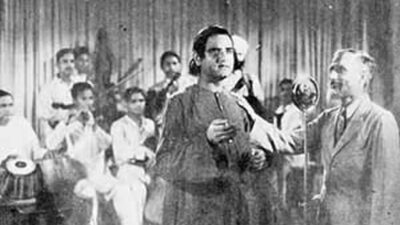
When Ghulam Haider composed 'Aahen Na Bhareen Shikwe Na Kiye' for Zeenat (1945), with Hafeez Jalandhari's lyric and Noor Jehan leading a female ensemble through its performances, something unprecedented happened in Hindi cinema: a fully realised qawwali — not a diluted folk-song with qawwali trappings, but an actual application of the form's rhetorical architecture — was performed entirely by women.
The choice was not accidental. Ghulam Haider was from Lahore, where the female mehfil (gathering) tradition had its own parallel history alongside the male dargah qawwali — the courtesan-musicians of the Hira Mandi district maintained their own ensemble traditions, and Noor Jehan herself had grown up in that world, trained in it, and had spent years absorbing its performance conventions. The all-female qawwali of Zeenat was not a novelty imposed from outside the tradition but a recognition of a tradition that had always existed alongside the better-documented male form.
What Hafeez Jalandhari wrote for the song was itself a kind of formal reversal: a lyric about a woman who keeps all outward signs of grief suppressed — no sighs, no complaints — communicating only through her eyes. In the qawwali's usual emotional arc, the singer or singers gradually expose their inner world, building to ecstatic revelation. Jalandhari's lyric inverts this: the revelation is the suppression itself, the most powerful emotion the one that cannot be expressed. This gave the female ensemble a particular power — they were performing the form while the lyric insisted on silence.
The recording required assembling multiple female singers in a sustained group performance, unusual for Bombay film production of the period. Noor Jehan anchored the ensemble. The result was among the most technically ambitious film music sequences of the 1940s and became one of the most-discussed recordings in the pre-Partition canon.
Two years later, Partition would separate Noor Jehan (Pakistan), Ghulam Haider (Pakistan), and Hafeez Jalandhari (Pakistan) from the Bombay film world they had helped build. Zeenat's qawwali became, in retrospect, a kind of final gathering — the last time these voices sang together on film.
परिचय
IdentityEpithet
निषिद्ध महफ़िल: कैसे 'ज़ीनत' की ऑल-फ़ीमेल क़व्वाली ने सदियों पुरानी सीमा तोड़ी
The Forbidden Congregation: How Zeenat's All-Female Qawwali Broke a Centuries-Ol
कहानी-नमूना
The Story Specimen| शीर्षक | निषिद्ध महफ़िल: कैसे 'ज़ीनत' की ऑल-फ़ीमेल क़व्वाली ने सदियों पुरानी सीमा तोड़ी · The Forbidden Congregation: How Zeenat's All-Female Qawwali Broke a Centuries-Old Rule |
|---|---|
| श्रेणी | Music History |
| प्रकार | विशेष लेख |
| प्रकाशित | 18 June 2026 — admin |
| वर्ष | 1945 |
| टैग | zeenat-1945 · noor-jehan · ghulam-haider · qawwali · female-voice · pre-partition |
इस कहानी में
In This Story · The Cast & Its Platesकहानी में आए नामों के अटलस में अपने पन्ने हैं — यहीं से यात्रा जारी रखिए।
फ़िल्में-सूत्र · Films
कलाकार-सूत्र · Artists
विधाएँ-सूत्र · Vidhas
और कहानियाँ
More Stories from the Atlas
साझा कीजिए · Share this Plate