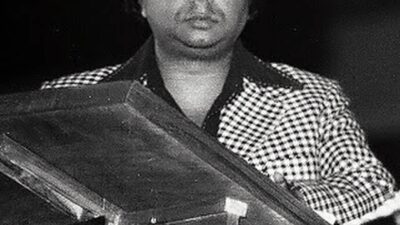
कलाकार विंग · कलाकार-पट्टिका · Artist Plate
आर.डी. बर्मन
R.D. Burman · Rahul Dev Burman
पंचम
जन्म27 June 1939 — कलकत्ता, बंगाल, ब्रिटिश भारत
निधन4 January 1994 — Bombay (Mumbai), Maharashtra, India
जीवन-पट्टी
The Life Specimen| नाम | आर.डी. बर्मन · R.D. Burman |
|---|---|
| जन्म नाम | राहुल देव बर्मन · Rahul Dev Burman |
| उपनाम | पंचम · पंचम दा |
| जन्म | 27 June 1939 — कलकत्ता, बंगाल, ब्रिटिश भारत · Calcutta, Bengal Presidency, British India |
| निधन | 4 January 1994 — Bombay (Mumbai), Maharashtra, India |
| भूमिकाएँ | संगीतकार · रचनाकार · गायक |
| सक्रिय वर्ष | 1961–1994 |
| युग | 70s Masala |
| राष्ट्रीयता | Indian |
| विधाएँ | फ़िल्मी · पॉप · रॉक · लोक · उप-शास्त्रीय · ग़ज़ल |
| भाषाएँ | Hindi · Bengali |
| पिता | एस.डी. बर्मन |
| माता | मीरा देव बर्मन |
| जीवनसाथी | रीता पटेल · आशा भोसले |
हस्ताक्षर-पंक्ति · The Signature
हस्ताक्षर-पंक्ति
पंचम · पंचम दा
In EnglishPancham — the man who made Hindi film music dance: bottles, combs, sandpaper and a growl in 'Mehbooba' were all instruments in his hands.
पट्टिका-लेख
The Monographजीवनी Biography
राहुल देव बर्मन (27 जून 1939 – 4 जनवरी 1994) — सारी दुनिया के लिए 'पंचम' — हिंदी फ़िल्म संगीत के सबसे क्रांतिकारी संगीतकार थे। कलकत्ता में जन्मे राहुल महान संगीतकार एस.डी. बर्मन और गीतकार मीरा देव बर्मन के इकलौते बेटे थे। कहा जाता है कि बचपन में उनके रोने में पाँचवें सुर 'प' की गूँज सुनकर अभिनेता अशोक कुमार ने उन्हें 'पंचम' नाम दिया। तालीम भी शाही मिली — उस्ताद अली अकबर ख़ान से सरोद और पंडित सामता प्रसाद से तबला। किशोरावस्था में ही उनकी बनाई धुनें पिता की फ़िल्मों में जगह पाने लगीं ('फंटूश' का 'ए मेरी टोपी पलट के आ')। बतौर स्वतंत्र संगीतकार पहली फ़िल्म 'छोटे नवाब' (1961) थी, पर धमाका हुआ 'तीसरी मंज़िल' (1966) से — 'आजा आजा मैं हूँ प्यार तेरा' और 'ओ हसीना ज़ुल्फ़ोंवाली' ने हिंदी संगीत में रॉक-एंड-रोल की बिजली दौड़ा दी। फिर एक दशक ऐसा आया जिसकी कोई दूसरी मिसाल नहीं: 'पड़ोसन' (1968), 'कटी पतंग' (1970), 'अमर प्रेम' (1971 — 'रैना बीती जाए' और 'चिंगारी कोई भड़के' जैसी शास्त्रीय-गहरी रचनाएँ), 'हरे रामा हरे कृष्णा' (1971 — 'दम मारो दम'), 'कारवाँ', 'सीता और गीता', 'यादों की बारात' (1973), 'आँधी' (1975 — 'तेरे बिना ज़िंदगी से कोई'), 'शोले' (1975 — 'महबूबा' की उनकी अपनी गुर्राती आवाज़ समेत) और 'हम किसी से कम नहीं' (1977)। लगभग 331 फ़िल्मों का संगीत रचने वाले पंचम ने किशोर कुमार और आशा भोसले के साथ आधुनिक हिंदी गीत की त्रिमूर्ति बनाई; 1980 में आशा से विवाह हुआ। 'सनम तेरी क़सम' (1982) और 'मासूम' (1984) के फ़िल्मफेयर के बाद 1980 के दशक के अंत में काम घटा, असफलताओं और दिल के दौरे ने घेरा। 4 जनवरी 1994 को उनका निधन हुआ — और उसी वर्ष '1942: अ लव स्टोरी' के अमर संगीत ने उन्हें मरणोपरांत तीसरा फ़िल्मफेयर दिलाया। आज हर रीमिक्स, हर लाउंज-कवर, हर नई पीढ़ी का संगीतकार पंचम का क़र्ज़दार है।
अंग्रेज़ी में पढ़ें · Read in English
Rahul Dev Burman (27 June 1939 – 4 January 1994) — 'Pancham' to the whole world — was the most revolutionary composer Hindi film music has known. Born in Calcutta, he was the only son of the great composer S.D. Burman and the lyricist Meera Dev Burman. Family legend says the actor Ashok Kumar named him 'Pancham' because the infant's cry seemed to echo Pa, the fifth note of the scale. His training was princely: sarod under Ustad Ali Akbar Khan, tabla under Pandit Samta Prasad. While still a boy he was composing — tunes of his made their way into his father's films ('Ae Meri Topi Palat Ke Aa' in Funtoosh).
His first film as an independent composer was Chhote Nawab (1961), but the detonation came with Teesri Manzil (1966): 'Aaja Aaja Main Hoon Pyar Tera' and 'O Haseena Zulfonwali' sent rock-and-roll voltage through Hindi music. There followed a decade without parallel: Padosan (1968), Kati Patang (1970), Amar Prem (1971 — with classically profound work like 'Raina Beeti Jaye' and 'Chingari Koi Bhadke'), Hare Rama Hare Krishna (1971 — 'Dum Maro Dum'), Caravan, Seeta Aur Geeta, Yaadon Ki Baaraat (1973), Aandhi (1975 — 'Tere Bina Zindagi Se Koi'), Sholay (1975, including his own growling vocal on 'Mehbooba Mehbooba') and Hum Kisise Kum Naheen (1977).
Composing for roughly 331 films, Pancham formed with Kishore Kumar and Asha Bhosle the trinity of the modern Hindi song; he married Asha in 1980. After Filmfare Awards for Sanam Teri Kasam (1982) and Masoom (1984), the late 1980s brought failing assignments, flops and a heart attack — yet he kept experimenting. He died on 4 January 1994; that same year the deathless score of 1942: A Love Story won him a third, posthumous Filmfare. Today every remix, every lounge cover, every young composer stands in Pancham's debt — the man who recorded breath, bottles, combs and rain, and made them all sing.
प्रारंभिक जीवन Early Life
राहुल देव बर्मन का जन्म 27 जून 1939 को कलकत्ता में एस.डी. बर्मन और मीरा देव बर्मन के घर हुआ। शैशव में ही 'पंचम' नाम मिला — क़िस्सा अशोक कुमार के नाम है, जिन्होंने शिशु के रुदन में सरगम का पाँचवाँ सुर सुना। पिता बंबई फ़तह करते रहे, और बालक कुछ बरस कलकत्ता में दादा-दादी के पास पला। संगीत हर दिशा से आया: पिता की भटियाली-जड़ों वाली प्रतिभा, उस्ताद अली अकबर ख़ान से सरोद की बाक़ायदा तालीम, पंडित सामता प्रसाद से तबला, और माउथ-ऑर्गन — जिसे वे इतना अच्छा बजाते थे कि 'है अपना दिल तो आवारा' (सोलवाँ साल, 1958) का सोलो उन्हीं का है। रचना उन्होंने चौंकाने वाली कम उम्र में शुरू की — 'ए मेरी टोपी पलट के आ' (फंटूश, 1956) की धुन नौ वर्ष के पंचम की मानी जाती है, और 'सर जो तेरा चकराए' (प्यासा, 1957) भी उनकी एक धुन से उपजा। किशोरावस्था के अंत तक वे पिता के सहायक थे — रिकॉर्डिंग स्टूडियो की वह कारीगरी सोखते हुए जिसे आगे चलकर वे भीतर से विस्फोटित करने वाले थे।
अंग्रेज़ी में पढ़ें · Read in English
Rahul Dev Burman was born on 27 June 1939 in Calcutta to S.D. Burman and Meera Dev Burman. Nicknamed Pancham in infancy — the story credits Ashok Kumar, who heard the fifth note in the baby's cry — he grew up partly in Calcutta with his grandparents while his father conquered Bombay. Music arrived from every direction: his father's bhatiyali-rooted genius, formal sarod taleem from Ustad Ali Akbar Khan, tabla from Pandit Samta Prasad, and the harmonica, which he played well enough that his solo graced 'Hai Apna Dil To Awara' (Solva Saal, 1958). He composed startlingly early — the tune that became 'Ae Meri Topi Palat Ke Aa' (Funtoosh, 1956) is attributed to the nine-year-old Pancham, and 'Sar Jo Tera Chakraye' (Pyaasa, 1957) grew from a tune of his. By his late teens he was his father's assistant, absorbing the craft of the recording studio that he would later explode from within.
करियर Career
पंचम ने 'छोटे नवाब' (1961) से पदार्पण किया और 'भूत बंगला' (1965) जैसी कल्ट कॉमेडी का संगीत दिया, पर 'तीसरी मंज़िल' (1966) — जो उन्हें शम्मी कपूर की ज़िद से मिली — ने उन्हें रातोंरात भारत की नई ध्वनि बना दिया। 1970 का दशक उनके अकेले की आधुनिकता था: 'कारवाँ' और 'अपना देश' में इलेक्ट्रिक गिटार और ट्रांज़िस्टर-पॉप, 'हरे रामा हरे कृष्णा' में कैबरे की साइकेडेलिया, 'अमर प्रेम' और 'किनारा' में विशुद्ध राग-जड़ों वाली गहराई, और 'आँधी', 'खुशबू' से 'इजाज़त' ('मेरा कुछ सामान', 1987) तक गुलज़ार की कविता पर पानी के निशान-सी धुनें। 'शोले' का प्रतिष्ठित ध्वनि-संसार रचा और 'महबूबा महबूबा' अपनी पहचान बन चुकी गुर्राती आवाज़ में ख़ुद गाया। किशोर कुमार के साथ दो दशकों की पुरुष-आवाज़ गढ़ी; आशा भोसले के साथ — जिनसे 1980 में विवाह किया — लय और मादकता को नई ज़मीन दी ('पिया तू अब तो आजा', 'दुनिया में')। फ़िल्मफेयर ने 'सनम तेरी क़सम' (1982) और 'मासूम' (1984) के लिए सम्मानित किया। 1980 के दशक के अंत का सूखा उसी तरह टूटा जैसे किंवदंतियों में होता है: 4 जनवरी 1994 को निधन के बाद रिलीज़ हुई '1942: अ लव स्टोरी' ने मरणोपरांत तीसरा फ़िल्मफेयर और स्थायी दूसरा जीवन दिलाया।
अंग्रेज़ी में पढ़ें · Read in English
Pancham debuted with Chhote Nawab (1961) and scored the cult comedy Bhoot Bangla (1965), but Teesri Manzil (1966) — won for him by Shammi Kapoor's insistence — made him the new sound of India overnight. Through the 1970s he was a one-man modernity: electric guitars and transistor-radio pop in Caravan and Apna Desh, cabaret psychedelia in Hare Rama Hare Krishna, pure raag-rooted depth in Amar Prem and Kinara, Gulzar's poetry set like watermarks in Aandhi, Khushboo and Ijaazat ('Mera Kuchh Saamaan', 1987). He scored Sholay's iconic soundscape and sang 'Mehbooba Mehbooba' himself in his trademark growl. With Kishore Kumar he built the male voice of two decades; with Asha Bhosle — whom he married in 1980 — he pushed rhythm and sensuality into new territory ('Piya Tu Ab To Aaja', 'Duniya Mein'). Filmfare honoured him for Sanam Teri Kasam (1982) and Masoom (1984). The late-80s drought ended in the only way legends allow: 1942: A Love Story (1994), released after his death on 4 January 1994, won him a posthumous third Filmfare and a permanent second life.
विरासत Legacy
आर.डी. बर्मन इस विश्वास में गए कि ज़माना उनसे आगे निकल गया; तीन दशक बाद वे हिंदी फ़िल्म संगीत के सबसे अधिक सैम्पल, रीमिक्स और अध्ययन किए जाने वाले संगीतकार हैं। 1990 के दशक की रीमिक्स लहर लगभग पंचम-पुनर्जागरण का उद्योग थी; लाउंज कलाकार, इंडी बैंड और बड़े मंचों की श्रद्धांजलियाँ आज भी उनके गीतों में नए कमरे खोजती रहती हैं। उनके स्टूडियो आविष्कार — साँस को ताल बनाना, बोतलें और कंघियाँ बजाना, बेस-प्रधान मिक्सिंग, ख़याल और भटियाली पर लैटिन व फ़ंक की क़लम — जतिन-ललित से विशाल-शेखर तक सबका प्रोडक्शन-व्याकरण बने; ए.आर. रहमान और विशाल भारद्वाज खुलकर उनका नाम लेते हैं। 1995 में फ़िल्मफेयर ने उनकी स्मृति में नई संगीत प्रतिभा के लिए 'आर.डी. बर्मन पुरस्कार' शुरू किया — उद्योग की औपचारिक स्वीकारोक्ति कि उसका भविष्य उन्हीं से होकर बहता है। वार्षिक श्रद्धांजलि-संगीत सभाओं और जुनूनी संग्रहकर्ताओं वाला 'पंचम-पंथ' किसी भी अन्य भारतीय संगीतकार के इर्द-गिर्द नहीं है: यह स्मृति-मोह नहीं, चलती हुई कार्यशाला है।
अंग्रेज़ी में पढ़ें · Read in English
R.D. Burman died believing himself out of fashion; three decades on, he is Hindi film music's most sampled, most remixed, most studied composer. The 1990s remix wave was practically a Pancham revival industry; lounge acts, indie bands and Grammy-stage tributes keep finding new rooms in his songs. His studio inventions — breath as percussion, bottles and combs as instruments, the bass-forward mixing, Latin and funk grafted onto khayal and bhatiyali — became the production grammar of everyone from Jatin-Lalit to Vishal-Shekhar; A.R. Rahman and Vishal Bhardwaj cite him openly. Filmfare instituted the R.D. Burman Award for New Music Talent in his memory in 1995 — the industry's formal admission that its future flows through him. The cult of Pancham, with its annual tribute concerts and obsessive collectors, is unlike anything around any other Indian composer: not nostalgia, but a living workshop.
गायन-शैली Musical Style
पंचम की कारीगरी में तीन शिक्षाएँ घुली थीं: शास्त्रीय तालीम (सरोद, तबला), पिता की धुन-मितव्ययिता, और दुनिया भर के लिए शॉर्टवेव-रेडियो जैसी भूख — जैज़, बोसा नोवा, फ़ंक, नेपाली और बांग्ला लोक, साइकेडेलिया। स्टूडियो को ही वे वाद्य मानते थे: ताल के लिए रेगमाल रगड़ना ('मेरे सामने वाली खिड़की में'), बीयर की बोतलों पर फूँक ('महबूबा महबूबा'), साँसें, फुसफुसाहटें और उलटे चलते टेप रिकॉर्ड करना। उनकी बेस-लाइनों और ड्रम-पैटर्नों ने हिंदी गीतों को पहली बार 'ग्रूव' दिया, पर 'रैना बीती जाए' (टोड़ी-खमाज छाया) और 'बीती ना बिताई' ने दिखाया कि उनकी राग-दारी कितनी गहरी थी। वे गायकों से कसरती गायन माँगते — और पाते — थे: आशा की सप्तक-कलाबाज़ियाँ, किशोर का सधा उन्माद। धुन पहले, शरारत हमेशा, फ़ॉर्मूला कभी नहीं।
अंग्रेज़ी में पढ़ें · Read in English
Pancham's craft fused three educations: classical taleem (sarod, tabla), his father's melodic economy, and a shortwave-radio appetite for the world — jazz, bossa nova, funk, Nepali and Bengali folk, psychedelia. He treated the studio itself as an instrument: rubbing sandpaper for rhythm ('Meri Samne Wali Khidki Mein'), blowing across beer bottles ('Mehbooba Mehbooba'), recording breath, whispers and reversed tapes. His bass lines and drum patterns made Hindi songs groove for the first time, yet 'Raina Beeti Jaye' (Todi-Khamaj shades) and 'Beeti Na Bitai' proved his raag-daari ran deep. He demanded — and got — athletic singing: Asha's octave gymnastics, Kishore's controlled abandon. Melody first, mischief always, formula never.
तालीम, विधाएँ और भाषाएँ
Training · Genres · Languagesतालीम · Training
उस्ताद अली अकबर ख़ान (1950s, Calcutta)
सरोद — मैहर घराने का अनुशासन
पंडित सामता प्रसाद (1950s)
तबला — बनारस बाज
एस.डी. बर्मन (late 1950s–1960s)
फ़िल्म-संगीत रचना — पिता के सहायक के रूप में
विधाएँ · Genres
भाषाएँ · Languages Sung
जीवन-रेखा
Career Highlights-
1956
बालक पंचम की धुन पिता की 'फंटूश' में 'ए मेरी टोपी पलट के आ' बनी
A tune composed by the boy Pancham becomes 'Ae Meri Topi Palat Ke Aa' in his father's Funtoosh
- 1961 'छोटे नवाब' से स्वतंत्र संगीतकार के रूप में पदार्पण Debut as independent music director with Chhote Nawab
- 1966 'तीसरी मंज़िल' ने हिंदी फ़िल्म संगीत में बिजली दौड़ाई — रॉक-एंड-रोल का आगमन Teesri Manzil electrifies Hindi film music — rock-and-roll arrives
-
1971
अद्वितीय वर्ष: 'अमर प्रेम', 'हरे रामा हरे कृष्णा' ('दम मारो दम'), 'कारवाँ', 'बुड्ढा मिल गया'
An unmatched year: Amar Prem, Hare Rama Hare Krishna ('Dum Maro Dum'), Caravan, Buddha Mil Gaya
- 1975 एक ही वर्ष में 'शोले' और 'आँधी' — महागाथा भी, कविता भी Sholay and Aandhi in the same year — the blockbuster and the poem
- 1980 अपनी महान स्वर-साथी आशा भोसले से विवाह Marries Asha Bhosle, his great vocal partner
- 1982 'सनम तेरी क़सम' के लिए सर्वश्रेष्ठ संगीतकार का पहला फ़िल्मफेयर Wins his first Filmfare Award for Best Music Director (Sanam Teri Kasam)
- 1984 'मासूम' के लिए दूसरा फ़िल्मफेयर — 'तुझसे नाराज़ नहीं ज़िंदगी' Second Filmfare for Masoom — 'Tujhse Naraz Nahin Zindagi'
- 1987 'इजाज़त' — 'मेरा कुछ सामान' ने फ़िल्मी गीत की परिभाषा बदल दी Ijaazat — 'Mera Kuchh Saamaan' redefines what a film song can be
- 1994 4 जनवरी को निधन; '1942: अ लव स्टोरी' ने मरणोपरांत तीसरा फ़िल्मफेयर दिलाया Dies on 4 January; 1942: A Love Story wins him a posthumous third Filmfare
- 1995 फ़िल्मफेयर ने उनकी स्मृति में नई संगीत प्रतिभा के लिए 'आर.डी. बर्मन पुरस्कार' शुरू किया Filmfare institutes the R.D. Burman Award for New Music Talent in his memory
पुरस्कार एवं सम्मान
Awards & Recognition- 1982 फ़िल्मफेयर पुरस्कार — सर्वश्रेष्ठ संगीतकार Filmfare Award — Best Music Director
- 1984 फ़िल्मफेयर पुरस्कार — सर्वश्रेष्ठ संगीतकार Filmfare Award — Best Music Director
- 1995 फ़िल्मफेयर पुरस्कार — सर्वश्रेष्ठ संगीतकार (मरणोपरांत) Filmfare Award — Best Music Director (posthumous)
रोचक तथ्य
Margin Notes'महबूबा महबूबा' (शोले) की गुर्राती आवाज़ ख़ुद पंचम की है — और ताल के लिए बीयर की बोतलों पर फूँक मारी गई थी।
अंग्रेज़ी में पढ़ें · Read in English
The growling voice on 'Mehbooba Mehbooba' (Sholay) is Pancham's own — and beer bottles were blown for the rhythm.
'मेरे सामने वाली खिड़की में' की खरखराती लय रेगमाल (सैंडपेपर) रगड़कर बनाई गई थी।
अंग्रेज़ी में पढ़ें · Read in English
The scratchy rhythm of 'Mere Samne Wali Khidki Mein' was created by rubbing sandpaper.
नौ वर्ष की उम्र में बनाई उनकी धुन पिता ने 'फंटूश' (1956) में इस्तेमाल की।
अंग्रेज़ी में पढ़ें · Read in English
A tune he composed at nine was used by his father in Funtoosh (1956).
'है अपना दिल तो आवारा' (सोलवाँ साल) का प्रसिद्ध माउथ-ऑर्गन सोलो किशोर पंचम ने बजाया था।
अंग्रेज़ी में पढ़ें · Read in English
The famous harmonica solo of 'Hai Apna Dil To Awara' (Solva Saal) was played by the teenaged Pancham.
1995 से फ़िल्मफेयर नई संगीत प्रतिभा को 'आर.डी. बर्मन पुरस्कार' देता है।
अंग्रेज़ी में पढ़ें · Read in English
Since 1995, Filmfare has given the R.D. Burman Award for New Music Talent in his memory.
अन्य विवरण
More Details- Birth Year
- 1939
- Death Year
- 1994
- Active Years
- 1961–1994
- Kishore Kumar — the male voice of his cinema (Kati Patang to Saagar)
- Asha Bhosle — rhythm, sensuality and marriage (1980)
- Gulzar — the poet of his subtlest scores (Aandhi, Khushboo, Ijaazat, Libaas)
- Majrooh Sultanpuri — Teesri Manzil, Caravan, Yaadon Ki Baaraat
- Anand Bakshi — the 70s hit machine (Kati Patang, Amar Prem, Love Story)
- Nasir Hussain — the blockbuster house (Yaadon Ki Baaraat, Hum Kisise Kum Naheen)
- S.D. Burman — son, assistant and heir
Early Life
राहुल देव बर्मन का जन्म 27 जून 1939 को कलकत्ता में एस.डी. बर्मन और मीरा देव बर्मन के घर हुआ। शैशव में ही 'पंचम' नाम मिला — क़िस्सा अशोक कुमार के नाम है, जिन्होंने शिशु के रुदन में सरगम का पाँचवाँ सुर सुना। पिता बंबई फ़तह करते रहे, और बालक कुछ बरस कलकत्ता में दादा-दादी के पास पला। संगीत हर दिशा से आया: पिता की भटियाली-जड़ों वाली प्रतिभा, उस्ताद अली अकबर ख़ान से सरोद की बाक़ायदा तालीम, पंडित सामता प्रसाद से तबला, और माउथ-ऑर्गन — जिसे वे इतना अच्छा बजाते थे कि 'है अपना दिल तो आवारा' (सोलवाँ साल, 1958) का सोलो उन्हीं का है। रचना उन्होंने चौंकाने वाली कम उम्र में शुरू की — 'ए मेरी टोपी पलट के आ' (फंटूश, 1956) की धुन नौ वर्ष के पंचम की मानी जाती है, और 'सर जो तेरा चकराए' (प्यासा, 1957) भी उनकी एक धुन से उपजा। किशोरावस्था के अंत तक वे पिता के सहायक थे — रिकॉर्डिंग स्टूडियो की वह कारीगरी सोखते हुए जिसे आगे चलकर वे भीतर से विस्फोटित करने वाले थे।
Rahul Dev Burman was born on 27 June 1939 in Calcutta to S.D. Burman and Meera Dev Burman. Nicknamed Pancham in infancy — the story credits Ashok Kumar, who heard the fifth note in the baby's cry — he grew up partly in Calcutta with his grandparents while his father conquered Bombay. Music arrived from every direction: his father's bhatiyali-rooted genius, formal sarod taleem from Ustad Ali Akbar Khan, tabla from Pandit Samta Prasad, and the harmonica, which he played well enough that his solo graced 'Hai Apna Dil To Awara' (Solva Saal, 1958). He composed startlingly early — the tune that became 'Ae Meri Topi Palat Ke Aa' (Funtoosh, 1956) is attributed to the nine-year-old Pancham, and 'Sar Jo Tera Chakraye' (Pyaasa, 1957) grew from a tune of his. By his late teens he was his father's assistant, absorbing the craft of the recording studio that he would later explode from within.
Career
पंचम ने 'छोटे नवाब' (1961) से पदार्पण किया और 'भूत बंगला' (1965) जैसी कल्ट कॉमेडी का संगीत दिया, पर 'तीसरी मंज़िल' (1966) — जो उन्हें शम्मी कपूर की ज़िद से मिली — ने उन्हें रातोंरात भारत की नई ध्वनि बना दिया। 1970 का दशक उनके अकेले की आधुनिकता था: 'कारवाँ' और 'अपना देश' में इलेक्ट्रिक गिटार और ट्रांज़िस्टर-पॉप, 'हरे रामा हरे कृष्णा' में कैबरे की साइकेडेलिया, 'अमर प्रेम' और 'किनारा' में विशुद्ध राग-जड़ों वाली गहराई, और 'आँधी', 'खुशबू' से 'इजाज़त' ('मेरा कुछ सामान', 1987) तक गुलज़ार की कविता पर पानी के निशान-सी धुनें। 'शोले' का प्रतिष्ठित ध्वनि-संसार रचा और 'महबूबा महबूबा' अपनी पहचान बन चुकी गुर्राती आवाज़ में ख़ुद गाया। किशोर कुमार के साथ दो दशकों की पुरुष-आवाज़ गढ़ी; आशा भोसले के साथ — जिनसे 1980 में विवाह किया — लय और मादकता को नई ज़मीन दी ('पिया तू अब तो आजा', 'दुनिया में')। फ़िल्मफेयर ने 'सनम तेरी क़सम' (1982) और 'मासूम' (1984) के लिए सम्मानित किया। 1980 के दशक के अंत का सूखा उसी तरह टूटा जैसे किंवदंतियों में होता है: 4 जनवरी 1994 को निधन के बाद रिलीज़ हुई '1942: अ लव स्टोरी' ने मरणोपरांत तीसरा फ़िल्मफेयर और स्थायी दूसरा जीवन दिलाया।
Pancham debuted with Chhote Nawab (1961) and scored the cult comedy Bhoot Bangla (1965), but Teesri Manzil (1966) — won for him by Shammi Kapoor's insistence — made him the new sound of India overnight. Through the 1970s he was a one-man modernity: electric guitars and transistor-radio pop in Caravan and Apna Desh, cabaret psychedelia in Hare Rama Hare Krishna, pure raag-rooted depth in Amar Prem and Kinara, Gulzar's poetry set like watermarks in Aandhi, Khushboo and Ijaazat ('Mera Kuchh Saamaan', 1987). He scored Sholay's iconic soundscape and sang 'Mehbooba Mehbooba' himself in his trademark growl. With Kishore Kumar he built the male voice of two decades; with Asha Bhosle — whom he married in 1980 — he pushed rhythm and sensuality into new territory ('Piya Tu Ab To Aaja', 'Duniya Mein'). Filmfare honoured him for Sanam Teri Kasam (1982) and Masoom (1984). The late-80s drought ended in the only way legends allow: 1942: A Love Story (1994), released after his death on 4 January 1994, won him a posthumous third Filmfare and a permanent second life.
Legacy
आर.डी. बर्मन इस विश्वास में गए कि ज़माना उनसे आगे निकल गया; तीन दशक बाद वे हिंदी फ़िल्म संगीत के सबसे अधिक सैम्पल, रीमिक्स और अध्ययन किए जाने वाले संगीतकार हैं। 1990 के दशक की रीमिक्स लहर लगभग पंचम-पुनर्जागरण का उद्योग थी; लाउंज कलाकार, इंडी बैंड और बड़े मंचों की श्रद्धांजलियाँ आज भी उनके गीतों में नए कमरे खोजती रहती हैं। उनके स्टूडियो आविष्कार — साँस को ताल बनाना, बोतलें और कंघियाँ बजाना, बेस-प्रधान मिक्सिंग, ख़याल और भटियाली पर लैटिन व फ़ंक की क़लम — जतिन-ललित से विशाल-शेखर तक सबका प्रोडक्शन-व्याकरण बने; ए.आर. रहमान और विशाल भारद्वाज खुलकर उनका नाम लेते हैं। 1995 में फ़िल्मफेयर ने उनकी स्मृति में नई संगीत प्रतिभा के लिए 'आर.डी. बर्मन पुरस्कार' शुरू किया — उद्योग की औपचारिक स्वीकारोक्ति कि उसका भविष्य उन्हीं से होकर बहता है। वार्षिक श्रद्धांजलि-संगीत सभाओं और जुनूनी संग्रहकर्ताओं वाला 'पंचम-पंथ' किसी भी अन्य भारतीय संगीतकार के इर्द-गिर्द नहीं है: यह स्मृति-मोह नहीं, चलती हुई कार्यशाला है।
R.D. Burman died believing himself out of fashion; three decades on, he is Hindi film music's most sampled, most remixed, most studied composer. The 1990s remix wave was practically a Pancham revival industry; lounge acts, indie bands and Grammy-stage tributes keep finding new rooms in his songs. His studio inventions — breath as percussion, bottles and combs as instruments, the bass-forward mixing, Latin and funk grafted onto khayal and bhatiyali — became the production grammar of everyone from Jatin-Lalit to Vishal-Shekhar; A.R. Rahman and Vishal Bhardwaj cite him openly. Filmfare instituted the R.D. Burman Award for New Music Talent in his memory in 1995 — the industry's formal admission that its future flows through him. The cult of Pancham, with its annual tribute concerts and obsessive collectors, is unlike anything around any other Indian composer: not nostalgia, but a living workshop.
Musical Style
पंचम की कारीगरी में तीन शिक्षाएँ घुली थीं: शास्त्रीय तालीम (सरोद, तबला), पिता की धुन-मितव्ययिता, और दुनिया भर के लिए शॉर्टवेव-रेडियो जैसी भूख — जैज़, बोसा नोवा, फ़ंक, नेपाली और बांग्ला लोक, साइकेडेलिया। स्टूडियो को ही वे वाद्य मानते थे: ताल के लिए रेगमाल रगड़ना ('मेरे सामने वाली खिड़की में'), बीयर की बोतलों पर फूँक ('महबूबा महबूबा'), साँसें, फुसफुसाहटें और उलटे चलते टेप रिकॉर्ड करना। उनकी बेस-लाइनों और ड्रम-पैटर्नों ने हिंदी गीतों को पहली बार 'ग्रूव' दिया, पर 'रैना बीती जाए' (टोड़ी-खमाज छाया) और 'बीती ना बिताई' ने दिखाया कि उनकी राग-दारी कितनी गहरी थी। वे गायकों से कसरती गायन माँगते — और पाते — थे: आशा की सप्तक-कलाबाज़ियाँ, किशोर का सधा उन्माद। धुन पहले, शरारत हमेशा, फ़ॉर्मूला कभी नहीं।
Pancham's craft fused three educations: classical taleem (sarod, tabla), his father's melodic economy, and a shortwave-radio appetite for the world — jazz, bossa nova, funk, Nepali and Bengali folk, psychedelia. He treated the studio itself as an instrument: rubbing sandpaper for rhythm ('Meri Samne Wali Khidki Mein'), blowing across beer bottles ('Mehbooba Mehbooba'), recording breath, whispers and reversed tapes. His bass lines and drum patterns made Hindi songs groove for the first time, yet 'Raina Beeti Jaye' (Todi-Khamaj shades) and 'Beeti Na Bitai' proved his raag-daari ran deep. He demanded — and got — athletic singing: Asha's octave gymnastics, Kishore's controlled abandon. Melody first, mischief always, formula never.
Collaborations
अभिलेख-सार
Discography Summary| संग्रह में गीत | 2 — नीचे जुड़े हुए पन्नों में सूचीबद्ध |
|---|
अभिलेख व संदर्भ
Archives & References| विकिपीडिया | Wikipedia |
|---|---|
| संदर्भ | R. D. Burman — Wikipedia · R.D. Burman: The Man, The Music — Anirudha Bhattacharjee and Balaji Vittal (2011) |
| प्रसिद्ध सहयोग |
अंग्रेज़ी में पढ़ें · Read in English
|
जुड़े हुए पन्ने
Connected Plates · The Graph Made Visibleअटलस में कोई पन्ना अकेला नहीं — आर.डी. बर्मन से उनके गीत, फ़िल्में, घराना, समकालीन और युग, सब यहाँ से खुलते हैं।
हस्ताक्षर-गीत · Signature Songs
फ़िल्में · The Films
सहयोगी और समकालीन · Collaborators & Contemporaries
साझा कीजिए · Share this Plate
यह पन्ना आगे बढ़ाइए
सवाल-जवाब
Questions & Answersआर.डी. बर्मन को 'पंचम' क्यों कहा जाता था?
क़िस्सा है कि शिशु राहुल के रोने में सरगम का पाँचवाँ सुर 'प' गूँजता था — अभिनेता अशोक कुमार ने यह सुनकर उन्हें 'पंचम' नाम दिया।
How many films did R.D. Burman compose for?
Roughly 331 films across Hindi and Bengali cinema, from Chhote Nawab (1961) to 1942: A Love Story (1994).
आर.डी. बर्मन और आशा भोसले का विवाह कब हुआ?
1980 में। दोनों की संगीत-जोड़ी ने 'पिया तू अब तो आजा' और 'दम मारो दम' जैसे युगांतकारी गीत दिए।
Which was R.D. Burman's last film score?
1942: A Love Story (1994), released after his death on 4 January 1994 — it won him a posthumous Filmfare Award for Best Music Director.