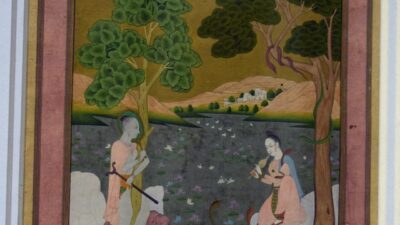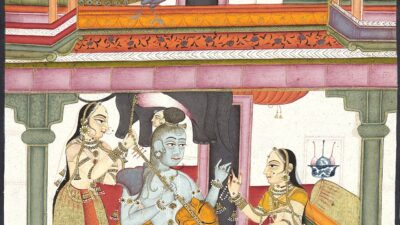
शास्त्र विंग · राग-पट्टिका · Raag Plate
अनंद भैरवी
Ananda Bhairavi
एक शांत Carnatic राग · A Peace Carnatic Raag
भावशांतिपूर्ण · ध्यानपूर्ण · प्रशांत · शांत
ऊर्जाधीमी
स्वर-चित्र · The Swara Panel
आरोह — अवरोह · The Ascent and the Descent
पकड़ · पहचान वाक्यांश
स ग रे ग म प ध प स / स नि ध प म ग रे स
S G2 R2 G2 M1 P D2 P S / S N2 D2 P M1 G2 R2 S
The opening vakra phrase S–G2–R2–G2 (Sa, then Komal Ga touching Shuddha Re and returning) is the hallmark of Ananda Bhairavi; its borrowing of both Shuddha and Komal forms of Ga, Dha, and Ni across the full performance gives the raag its uniquely tender, yearning quality that transcends any single melakarta.
वादी–संवादी टिप्पणी · Vadi–Samvadi note
Vadi — In the Carnatic tradition, Raag Ananda Bhairavi emphasizes Pancham (Pa) as a key resting note.
Samvadi — Sa (Shadj) serves as the complementary note.
समय और भाव
Time Theory & Moodसमय-सिद्धांत · Time Theory
संध्या काल
परंपरागत रूप से संध्या काल (4:00 PM - 7:00 PM) में गाया जाता है।
Traditionally performed during evening/twilight hours (4:00 PM - 7:00 PM), when day transitions to night.
भाव और गति · Mood & Tempo
शांत · Peace/Tranquility
आंतरिक शांति, सुकून और आध्यात्मिक वैराग्य का रस। शांति, ध्यान और अध्यात्म को जगाता है।
ऊर्जा · Energyधीमी
स्तर · Leveladvanced — राग Ananda भैरवी के लिए कर्नाटक संगीत सिद्धांत की मजबूत नींव आवश्यक है।
पट्टिका-लेख
The Monographपरिचय Introduction
राग Ananda भैरवी कर्नाटक शास्त्रीय संगीत परंपरा का एक राग है। इसका प्रमुख रस शांत (Peace/Tranquility) है। यह परंपरागत रूप से संध्या काल (4:00 PM - 7:00 PM) में गाया जाता है। गाया जाता है।
अंग्रेज़ी में पढ़ें · Read in English
Raag Ananda Bhairavi is a complete scale with all 7 notes in both ascent and descent raga in the Carnatic classical music tradition.. With its Sampurna-Sampurna jati structure, this raag creates a distinctive tonal landscape. The predominant rasa is Peace/Tranquility (शांत), making it suitable for compositions that evoke peaceful, meditative emotions. It is traditionally performed during evening hours, and its melodic contour offers rich possibilities for alapana, kalpanaswaram, and creative improvisation.
सांस्कृतिक महत्व Cultural Significance
भारतीय शास्त्रीय संगीत की समृद्ध परंपरा के अंग के रूप में, राग Ananda भैरवी Carnatic परंपरा को परिभाषित करने वाले स्वर संरचना और भावनात्मक अभिव्यक्ति के बीच गहरे संबंध का प्रतिनिधित्व करता है।
अंग्रेज़ी में पढ़ें · Read in English
As part of the rich tapestry of Indian classical music, Raag Ananda Bhairavi represents the deep connection between melodic structure and emotional expression that defines the Carnatic tradition.
ऐतिहासिक महत्व Historical Significance
आनंद भैरवी (Ānandabhairavi, 'आनंद स्वरूपा भैरवी') कर्नाटक शास्त्रीय संगीत के सबसे प्राचीन, लोकप्रिय और स्वर-वैविध्यपूर्ण रागों में से एक है। वेंकटमखिन की चतुर्दण्डी प्रकाशिका (लगभग 1660 ई., चक्र 4) में 72 मेलकर्ता पद्धति के अंतर्गत इसे नटभैरवी (20वाँ मेलकर्ता) के जन्य राग के रूप में वर्गीकृत किया गया है। नटभैरवी के स्वर हैं — शुद्ध ऋषभ, साधारण गंधार, शुद्ध मध्यम, शुद्ध धैवत और कैशिकी निषाद — जो हिंदुस्तानी आसावरी थाट के समतुल्य हैं। किंतु आनंद भैरवी एक 'मिश्र' राग है जो वास्तविक प्रदर्शन में साधारण और अंतर गंधार, शुद्ध और चतुश्रुति धैवत, तथा कैशिकी और काकली निषाद — दोनों-दोनों रूपों का प्रयोग करता है, जिससे इसकी स्वर-संपदा असाधारण रूप से समृद्ध हो जाती है। इसका आरोह वक्र होता है: स ग रे ग म प ध प स; अवरोह: स नि ध प म ग रे स। कर्नाटक संगीत की त्रिमूर्ति — त्यागराज (1767–1847), मुथुस्वामी दीक्षितर (1775–1835) और श्यामा शास्त्री (1762–1827) — ने इस राग में अनेक महत्त्वपूर्ण रचनाएँ की हैं। यह राग देवी के कोमल, मातृ और आनंदमय रूप से जुड़ा है।
अंग्रेज़ी में पढ़ें · Read in English
Ananda Bhairavi (Ānandabhairavi, 'she who is Bhairavi in her blissful form') is one of the most ancient, loved, and melodically complex rāgas in Carnatic classical music. It is classified as a janya rāga of the 20th melakarta Natabhairavi in the 72-melakarta system codified by Venkatamakhin in his Catuṛdaṇḍī Prakāśikā (c. 1660 CE, Chakra 4). Natabhairavi uses Shuddha Rishabha, Sadharana Gandhara, Shuddha Madhyama, Shuddha Dhaivata, and Kaisiki Nishada — a scale corresponding to Asavari thaat in the Hindustani system. Ananda Bhairavi, however, is celebrated for being a 'misra' (mixed) rāga that in actual practice draws upon both Sadharana and Antara Gandhara, Shuddha and Chatusruti Dhaivata, and Kaisiki and Kakali Nishada — giving it an exceptionally rich note palette. Its arohana is typically rendered vakra: S G2 R2 G2 M1 P D2 P S; its avarohana: S N2 D2 P M1 G2 R2 S. Among the oldest Carnatic references to the rāga is its appearance in the compositions of Tyagaraja (1767–1847), Muthuswami Dikshitar (1775–1835), and Syama Sastri (1762–1827) — the Carnatic trinity — who each left a substantial body of compositions in this rāga. It is associated with the goddess in her tender, motherly, and blissful aspect. In the Hindustani tradition, a closely related scalar type is heard in Raag Kafi and certain Bhairavi-inflected compositions.
शिक्षा
Teaching & LearningBegin with slow aalapana to internalize the raag's swaroopa (melodic form)
Practice the arohana and avarohana patterns with a tanpura drone
Listen to recordings by master performers to understand the raag's gamakas (ornamentations)
Work on kalpanaswaram (improvisation) within the raag's framework
Using incorrect gamakas that belong to a different raag
Not maintaining proper swar sthana (note placement)
Rushing through phrases without allowing the raag bhava to develop
प्रस्तुति
Performance- Description
- परंपरागत रूप से संध्या काल (4:00 PM - 7:00 PM) में गाया जाता है। Traditionally performed during evening/twilight hours (4:00 PM - 7:00 PM), when day transitions to night.
- Prahar Number
- 5
- Prahar Name
- संध्या काल Sandhya Kaal
- Time Start
- 16:00
- Time End
- 19:00
- Time Flexibility
- flexible
Time
और जानें
More to KnowIn Film Music
Ananda Bhairavi has found occasional use in Indian film music owing to its tender, yearning quality. In Tamil cinema it has been used for devotional and love songs. In Hindi film music, its scale closely parallels raags such as Kafi and Asavari, and composers have sometimes drawn on its characteristic phrases without formal attribution. Chandrakantha.com documents a dedicated page of film songs in this rāga (Rag Ananda Bhairav), attesting to its cross-over appeal.
सीखने के लिए
For Learners- Difficulty Level
- advanced
अन्य विवरण
More Details- Indian_Music_Raga_Encyclopedia_v2.xlsx
- https://en.wikipedia.org/wiki/Anandabhairavi
- http://www.carnatica.net/newsletter/anandabhairavinewsletter.htm
- https://chandrakantha.com/music-and-dance/film-and-pop/film-songs-rags/film-songs-in-rag-ananda-bhairavi/
References
नमूना-पट्टी
The Specimen Table| नाम | अनंद भैरवी · Ananda Bhairavi |
|---|---|
| थाट | Asavari |
| पकड़ | स ग रे ग म प ध प स / स नि ध प म ग रे स |
| जाति | संपूर्ण-संपूर्ण · Sampurna-Sampurna |
| समय | संध्या काल |
| ऊर्जा | धीमी |
| परिवार | Ananda Bhairavi |
| स्तर | advanced |
| लोकप्रियता | Obscure |
जुड़े हुए पन्ने
Connected Plates · The Graph Made Visibleअटलस में कोई पन्ना अकेला नहीं — इस राग से गीत, प्रस्तुतियाँ, कलाकार, ताल, घराने और मिलते-जुलते राग, सब यहाँ से खुलते हैं।
ताल-साथी · Taal Pairings
शास्त्र-सूत्र · Shastra Threads
श्रवण-कक्ष · The Listening Room
सुनिए — अनंद भैरवी · Hear the Raag
Anandabhairavi | Featuring C Charulatha (veena)
प्रश्नोत्तर
Questions & Answersराग Ananda Bhairavi किस संगीत पद्धति का राग है?
राग Ananda Bhairavi कर्नाटक (दक्षिण भारतीय) शास्त्रीय संगीत पद्धति का राग है।
अंग्रेज़ी में पढ़ें · Read in English
Which music system does Raga Ananda Bhairavi belong to? — Raga Ananda Bhairavi belongs to the Carnatic (South Indian) classical music system.
साझा कीजिए · Share this Plate