गीत विंग · गीत-पट्टिका · Song Plate
याद आ के न दिल को
Yaad Aa Ke Na Dil Ko
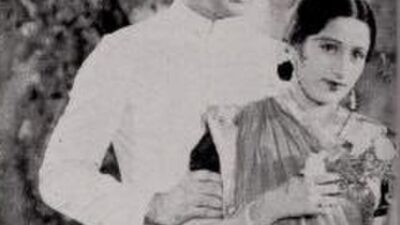
'आरती' (1945) का सुरेंद्र-वनमाला युगल — दो गायक-कलाकार, उस दौर में जब माइक्रोफ़ोन पार्श्वगायन के विशेषज्ञों को सौंपा जा चुका था, एक ऐसी याद को संबोधित करते हुए जो दिल का पीछा नहीं छोड़ती।
भावमीठा-कड़वा · उदास · पुरानी यादें
भाषाhindi स्वरूपयुगल
श्रेय
The Creditsसूत्र-वाक्य · The Hook
सूत्र-वाक्य
'आरती' (1945) का सुरेंद्र-वनमाला युगल — दो गायक-कलाकार, उस दौर में जब माइक्रोफ़ोन पार्श्वगायन के विशेषज्ञों को सौंपा जा चुका था, एक ऐसी याद को संबोधित करते हुए जो दिल का पीछा नहीं छोड़ती।
In EnglishThe Surendra-Vanmala duet from Aarti (1945) — two singing actors, in an age that had already handed the microphone to playback specialists, addressing a memory that will not leave the heart alone.
पट्टिका-लेख
The Monographपरिचय Overview
हिंदी फ़िल्म गीत-कोशों में 'आरती' (1945) के पहले गीत के रूप में दर्ज 'याद आ के न दिल को' का श्रेय वनमाला और सुरेंद्र दोनों को है — यह फ़िल्म के दो नायकों के बीच के दो युगल गीतों में से एक है, और दोनों ही परदे पर अपनी आवाज़ में गाते थे, किसी पार्श्व-गायक की आवाज़ में नहीं। संगीत अशोक घोष और अली बख़्श की जोड़ी का है, जिनका श्रेय फ़िल्म के सभी दस गीतों पर साझा है। कोशों में जो शीर्षक बचा है वह अधूरा है — 'याद आ के न दिल को' के बाद टूट जाता है — एक ऐसी शुरुआत जो उस दौर के उर्दू मुहावरे में याद से विनती का ढाँचा बनाती है: आकर दिल के साथ ऐसा मत करो। गीत की कोई रिकॉर्डिंग प्रचलन में नहीं है और फ़िल्म का गीतकार दर्ज नहीं है, इसलिए यह टुकड़ा ही उस रचना का बचा हुआ अवशेष है।
अंग्रेज़ी में पढ़ें · Read in English
Catalogued in the Hindi film song databases as the first song of Aarti (1945), 'Yaad Aa Ke Na Dil Ko' is credited to Vanmala and Surendra together — one of the film's two duets between its two leads, both of whom sang for themselves on screen rather than being dubbed by playback voices. The music is by the pairing of Ashok Ghosh and Ali Baksh, who share the credit on all ten of the film's songs. The title as it survives in the catalogues is a fragment, breaking off after 'Yaad aa ke na dil ko' — an opening that in the Urdu idiom of the period sets up a plea to a memory: having come, do not do this to the heart. No recording of the song is in circulation and no lyricist is recorded for the film, so the fragment is all that remains of the verse.
संगीत The Music
इस गीत की सज्जा के बारे में रिकॉर्डिंग से कुछ नहीं कहा जा सकता, क्योंकि उसकी कोई प्रति सार्वजनिक रूप से सुनाई नहीं देती; जो कहा जा सकता है वह यह है कि इसे बनाया किसने। अशोक घोष 1936 से सुरेंद्र के लिए गीत रच रहे थे, जब उन्होंने 'डेक्कन क्वीन' का संगीत-श्रेय साझा किया और 'मनमोहन' का संगीत अकेले दिया — दोनों सागर मूवीटोन के लिए महबूब ख़ान की फ़िल्में — और 'मनमोहन' का एक गीत, जो सुरेंद्र ने बिब्बो के साथ गाया, राग-पहचान सूचियों में आभेरी/भीमपलासी पर आधारित दर्ज है, जो घोष को उन संगीतकारों में रखता है जो शास्त्रीय ढाँचे के भीतर से काम करते थे। श्रेय में दूसरे नाम अली बख़्श ने साझा बिलिंग के अलावा कोई निशान नहीं छोड़ा। सुरेंद्र का अपना वाद्य बेहतर दर्ज है: महबूब ख़ान ने उन्हें स्पष्ट रूप से कलकत्ता के के. एल. सैगल के बंबइया जवाब के रूप में चुना था, और उनकी आवाज़ उसी धीमे, भारी, उर्दू-उच्चारण वाले ढंग में काम करती थी।
अंग्रेज़ी में पढ़ें · Read in English
Nothing of the setting can be described from the recording, because no copy of it is publicly audible; what can be said is who made it. Ashok Ghosh had been writing songs for Surendra since 1936, when he shared the music credit on Deccan Queen and composed Manmohan alone — both Mehboob Khan films for Sagar Movietone — and one of those Manmohan numbers, sung by Surendra with Bibbo, is catalogued in raga-identification lists as built on Abheri/Bhimpalasi, which places Ghosh among the composers who worked from classical frames rather than around them. Ali Baksh, the second name on the credit, left no trace beyond the joint billing. Surendra's own instrument is better documented: he was hired by Mehboob Khan explicitly as Bombay's answer to Calcutta's K. L. Saigal, and his voice worked in that same slow, weighted, Urdu-diction manner.
काव्य The Poetry
दर्ज शीर्षक पंक्ति के बीच में ही रुक जाता है, पर उसके दो नियामक शब्द उसे ठीक-ठीक जगह दे देते हैं: 'याद' और 'दिल' — 1940 के दशक के उर्दू फ़िल्मी गीत के स्थिर ध्रुव। उस मुहावरे में याद कोई निष्क्रिय स्मृति नहीं है — वह एक कर्ता है जो आती है, दिल पर असर करती है और चली जाती है, और उसे सीधे संबोधित करना उसी तरह मानक है जैसे किसी ऐसे व्यक्ति को संबोधित किया जाए जिसने बुरा बर्ताव किया हो। 'याद आ के न दिल को...' ठीक यही व्याकरण खोलता है: आकर वह मत करो जो तुम करने वाली हो। चूँकि फ़िल्म का गीतकार कहीं दर्ज नहीं है और कोई रिकॉर्डिंग प्रचलन में नहीं बची, शेष विचार खो चुका है; जो बचा है वह मिज़ाज है — संयत, मध्यम पुरुष में, उर्दू की ओर झुका — और यह तथ्य कि इसे स्त्री-पुरुष के संवाद के रूप में गाया जाना लिखा गया था, अकेले की शिकायत के रूप में नहीं।
अंग्रेज़ी में पढ़ें · Read in English
The catalogued title stops mid-line, but its two governing words place it exactly: yaad (memory) and dil (heart), the fixed poles of Urdu film lyric of the 1940s. In that idiom yaad is not a passive recollection — it is an agent that arrives, acts on the heart and departs, and the standard construction is to address it directly as one would address a person who has behaved badly. 'Yaad aa ke na dil ko...' opens exactly that grammar: having come, do not do the thing you are about to do. Because the film's lyricist is nowhere recorded and no recording survives in circulation, the rest of the thought is lost; what remains is the register — restrained, second-person, Urdu-leaning — and the fact that it was written to be sung as an exchange between a man and a woman rather than as a solo complaint.
कहानी The Story
'आरती' का निर्माण स्क्रीन अट्रैक्शंस कॉर्पोरेशन ने किया और निर्देशन रामचंद्र ठाकुर ने, जिन्होंने सात वर्ष पहले अपनी पहली निर्देशित फ़िल्म 'ग्रामोफ़ोन सिंगर' (1938) में सुरेंद्र को प्रमुख भूमिका दी थी। विकिपीडिया की 1945 की सूची 'आरती' को 'सोशल' श्रेणी में रखती है — समकालीन सुधारवादी मेलोड्रामा के लिए इस्तेमाल होने वाला व्यापारिक शब्द — और इसके कलाकारों में सुरेंद्र, वनमाला, हंसा वाडकर, शेख़ मुख़्तार, कन्हैयालाल, अंसारी और हरीश गिनाती है। वनमाला, जो सुरेंद्र के साथ यह युगल गाती हैं, 1945 तक स्थापित सितारा थीं: सोहराब मोदी ने उन्हें 'सिकंदर' (1941) में पृथ्वीराज कपूर के सामने रखा था और वे उस युग की गायिका-अभिनेत्रियों में थीं, जिन्हें 'वसंतसेना' (1942), 'राजा रानी' (1942), 'दिल की बात' (1944) और स्वयं 'आरती' में अपनी आवाज़ का श्रेय प्राप्त है।
अंग्रेज़ी में पढ़ें · Read in English
Aarti was produced by Screen Attractions Corporation and directed by Ramchandra Thakur, who had given Surendra a lead seven years earlier in Gramophone Singer (1938), Thakur's own first film as director. Wikipedia's 1945 list files Aarti under 'Social', the trade term for a contemporary reformist melodrama, and gives its cast as Surendra, Vanmala, Hansa Wadkar, Sheikh Mukhtar, Kanhaiyalal, Ansari and Harish. Vanmala, who takes this duet with Surendra, was by 1945 an established star: Sohrab Modi had cast her opposite Prithviraj Kapoor in Sikandar (1941) and she was one of the era's singing actresses, credited with her own vocals in Vasantsena (1942), Raja Rani (1942), Dil Ki Baat (1944) and Aarti itself.
विरासत The Legacy
यह गीत श्रवण-संस्कृति में नहीं बचा। यह स्ट्रीमिंग कोशों में अनुपस्थित है और यूट्यूब पर इसका कोई अपलोड सामने नहीं आया; यह एक गीत-सूची की पंक्ति भर के रूप में मौजूद है — दो गायकों के नाम, दो संगीतकारों के नाम, और कोई गीतकार नहीं। यह अनुपस्थिति ही ऐतिहासिक बिंदु है: 1945 'ज़ीनत', 'गाँव की गोरी', 'बड़ी माँ', 'फूल' और 'तदबीर' का वर्ष था, जो आज भी बजते हैं, और फिर भी दो स्थापित गायक-सितारों का एक बना-बनाया युगल एक ही जीवनकाल में पूरी तरह लुप्त हो सकता था। वनमाला का बाद का काम बचा — उन्होंने 'श्यामची आई' (1953) में शीर्षक भूमिका निभाई, जो सर्वश्रेष्ठ फ़ीचर फ़िल्म का राष्ट्रीय पुरस्कार जीतने वाली पहली फ़िल्म बनी — और सुरेंद्र का शिखर अगले वर्ष 'अनमोल घड़ी' (1946) में आया।
अंग्रेज़ी में पढ़ें · Read in English
The song did not survive into the listening culture. It is absent from the streaming catalogues and no upload of it has surfaced on YouTube; it exists as a row in a song index, with two singer names, two composer names, and no lyricist. That absence is itself the historical point: 1945 was the year of Zeenat, Gaon Ki Gori, Badi Maa, Phool and Tadbir, all of which are still played, and a working duet by two established singing stars could nonetheless vanish completely within a single lifetime. Vanmala's later work did survive — she took the title role in Shyamchi Aai (1953), the first film to win India's National Film Award for Best Feature Film — and Surendra's peak came the next year in Anmol Ghadi (1946).
वर्गीकरण
ClassificationGenre
अन्य विवरण
More Details- https://www.hindigeetmala.net/movie/aarti_1945.htm
- https://myswar.co/album/aarti-1945
- https://en.wikipedia.org/wiki/List_of_Hindi_films_of_1945
- https://en.wikipedia.org/wiki/Surendra_(actor)
References
रोचक तथ्य
Margin Notesसुरेंद्र क़ानून के स्नातक थे — पंजाब विश्वविद्यालय से बी.ए., एल.एल.बी. — और उनके माता-पिता ने फ़िल्मों में जाने की अनुमति इसी शर्त पर दी थी कि परदे पर उनका श्रेय 'सुरेंद्र नाथ बी.ए., एल.एल.बी.' लिखा जाए। महबूब ख़ान ने शर्त मान ली, फिर उन्हें छोटा करके सिर्फ़ 'सुरेंद्र' कर दिया।
अंग्रेज़ी में पढ़ें · Read in English
Surendra was a law graduate — B.A., LL.B from Punjab University — and his parents agreed to let him join films only on condition that his screen credit read 'Surendra Nath B.A., LL.B'. Mehboob Khan accepted the condition, then shortened him to the single name Surendra.
वनमाला का जन्म उज्जैन में सुशीला देवी पवार के रूप में कर्नल बापूराव आनंदराव पवार के घर हुआ था और उन्होंने शिक्षिका का प्रशिक्षण लिया था; नाटककार आचार्य अत्रे ने उन्हें वी. शांताराम, मास्टर विनायक और बाबूराव पेंढारकर से मिलवाया, और उन्होंने मराठी फ़िल्म 'लपंडाव' (1940) से शुरुआत की।
अंग्रेज़ी में पढ़ें · Read in English
Vanmala was born Susheela Devi Pawar in Ujjain to Colonel Bapurao Anandrao Pawar and trained as a teacher; the playwright Acharya Atre introduced her to V. Shantaram, Master Vinayak and Baburao Pendharkar, and she debuted in the Marathi film Lapandav (1940).
'आरती' के दसों गीतों पर अशोक घोष और अली बख़्श का संयुक्त संगीत-श्रेय है, और कोई गीतवार बँटवारा दर्ज नहीं है — 1940 के दशक की बंबई में यह आम व्यवस्था थी, जहाँ एक वरिष्ठ संगीतकार और एक सहायक या सह-संगीतकार को पूरी फ़िल्म के लिए साथ बिल किया जाता था।
अंग्रेज़ी में पढ़ें · Read in English
All ten songs of Aarti carry a joint music credit to Ashok Ghosh and Ali Baksh, with no song-by-song division recorded — a common arrangement in 1940s Bombay, where a senior composer and a working assistant or co-composer were billed together for a whole film.
नमूना-पट्टी
The Specimen Table| शीर्षक | याद आ के न दिल को · Yaad Aa Ke Na Dil Ko |
|---|---|
| फ़िल्म | आरती · 1945 |
| वर्ष · युग | 1945 |
| गायक | Vanmala, Surendra |
| संगीतकार | Ashok Ghosh, अली बख़्श |
| स्वरूप | युगल |
| भाषा | hindi |
| भाव | मीठा-कड़वा · उदास · पुरानी यादें |
| लोकप्रियता | Obscure |
| बोल-स्थिति | केवल झलक |
जुड़े हुए पन्ने
Connected Plates · The Graph Made Visibleअटलस में कोई पन्ना अकेला नहीं — इस गीत से जुड़े गीत, कलाकार, फ़िल्म, राग-ताल-विधा, सब यहाँ से खुलते हैं।
मिलते-जुलते गीत · Related Songs
कलाकार · The Artists
फ़िल्म · The Film
साझा कीजिए · Share this Plate