गीत विंग · गीत-पट्टिका · Song Plate
मोहब्बत में क्या क्या मज़े
Mohabbat Mein Kya Kya Maze
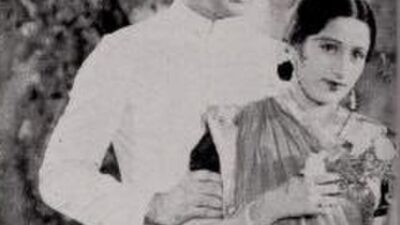
'आरती' (1945) के दो सुरेंद्र-वनमाला युगलों में हल्का वाला — मोहब्बत के मज़ों की एक फ़ेहरिस्त, जिसे दो ऐसे सितारों ने गाया जो अपनी आवाज़ ख़ुद देते थे।
भावउत्सव · चुलबुला · रोमांटिक
भाषाhindi स्वरूपयुगल
श्रेय
The Creditsसूत्र-वाक्य · The Hook
सूत्र-वाक्य
'आरती' (1945) के दो सुरेंद्र-वनमाला युगलों में हल्का वाला — मोहब्बत के मज़ों की एक फ़ेहरिस्त, जिसे दो ऐसे सितारों ने गाया जो अपनी आवाज़ ख़ुद देते थे।
In EnglishThe lighter of the two Surendra-Vanmala duets in Aarti (1945) — a catalogue of love's pleasures, sung by two stars who supplied their own voices.
पट्टिका-लेख
The Monographपरिचय Overview
'मोहब्बत में क्या क्या मज़े' उन दो युगल गीतों में दूसरा है जिनका श्रेय 'आरती' (1945) में वनमाला और सुरेंद्र को है — रामचंद्र ठाकुर निर्देशित स्क्रीन अट्रैक्शंस कॉर्पोरेशन की 'सोशल' फ़िल्म। हिंदीगीतमाला और माईस्वर दोनों इस पर दोनों के नाम साथ दर्ज करते हैं, संगीत अशोक घोष और अली बख़्श का। शीर्षक का अर्थ मोटे तौर पर 'मोहब्बत में कितने-कितने मज़े हैं' है — वह विस्मयात्मक 'क्या-क्या' रचना जिसे उर्दू फ़िल्मी गीत तर्क करने के लिए नहीं, गिनाने के लिए इस्तेमाल करता है, और जो फ़िल्म के दोरंगी दुनिया और वस्त्रहीन लोगों वाले भारी शीर्षकों के बीच एक हल्के गीत का संकेत है। कोई रिकॉर्डिंग प्रचलन में नहीं है और फ़िल्म का गीतकार दर्ज नहीं है, इसलिए वह गिनती स्वयं नहीं बची।
अंग्रेज़ी में पढ़ें · Read in English
'Mohabbat Mein Kya Kya Maze' is the second of the two duets Vanmala and Surendra are credited with in Aarti (1945), the Screen Attractions Corporation social directed by Ramchandra Thakur. Both HindiGeetMala and MySwar list the pair together on it, with music by Ashok Ghosh and Ali Baksh. The title translates roughly as 'what pleasures there are in love' — the exclamatory kya-kya construction that Urdu film lyric uses to enumerate rather than to argue, and the marker of a light number set against the film's heavier titles about a two-faced world and men without cloth on their backs. No recording is in circulation and the film's lyricist is unrecorded, so the enumeration itself has not survived.
संगीत The Music
रिकॉर्डिंग सार्वजनिक रूप से उपलब्ध नहीं है, इसलिए संगीत-सज्जा का वर्णन नहीं किया जा सकता; संगीतकारों की दर्ज कार्यशैली का किया जा सकता है। अशोक घोष की बची हुई ख्याति 'निर्दोष' (1941) पर टिकी है — नेशनल स्टूडियोज़ की वह फ़िल्म जिसने मुकेश को अभिनय और पार्श्वगायन दोनों की शुरुआत दी — और उसकी उस ग़ज़ल पर, जिसका ज़िक्र मुकेश के आरंभिक वर्षों के विवरणों में आज भी होता है; यानी एक ऐसा संगीतकार जो लोक-अनुकरण से अधिक उर्दू मिज़ाज की गेय कविता से जुड़ा था, जो 'मोहब्बत' शब्द पर खड़े युगल गीत से मेल खाता है। इस फ़िल्म में उनका नाम अली बख़्श के साथ है, जिनका नाम भर अभिलेख में बचा है। सुरेंद्र और वनमाला दोनों कैमरे पर गाते थे, इसलिए धुन जो भी रही हो, उसे दो अभिनय-आवाज़ों के भीतर बैठना था, दो प्रशिक्षित पार्श्व-आवाज़ों के भीतर नहीं — उस दौर में इस बाध्यता का अर्थ प्रायः सीमित सुरावली और एक मज़बूत, दोहराने योग्य मुखड़ा होता था।
अंग्रेज़ी में पढ़ें · Read in English
The recording is not publicly available, so the arrangement cannot be described; the composers' documented practice can. Ashok Ghosh's surviving reputation rests on Nirdosh (1941), the National Studios film that gave Mukesh both his acting and his playback debut, and on the ghazal from it that is still cited in accounts of Mukesh's beginnings — a composer, in other words, associated with sung poetry in the Urdu register rather than with folk pastiche, which fits a duet built on the word mohabbat. On this film he is billed with Ali Baksh, of whom the archive preserves nothing but the name. Surendra and Vanmala both sang on camera, so whatever the tune was, it had to sit inside two acting voices rather than two trained playback ones — a constraint that in this period generally meant a narrow range and a strong, repeatable refrain.
काव्य The Poetry
शीर्षक उर्दू-हिंदी फ़िल्मी गीत की सबसे उपजाऊ युक्तियों में से एक पर खड़ा है: 'क्या-क्या' — वह दोहराया हुआ प्रश्नवाचक जो प्रश्न रह ही नहीं जाता, सूची बन जाता है। 'मोहब्बत में क्या क्या मज़े' यह नहीं पूछता कि मोहब्बत के मज़े क्या हैं; वह घोषित करता है कि वे गिनने से अधिक हैं और फिर गिनाने लगता है — और यही इस रूप का पूरा आनंद है। युगल के रूप में गाए जाने पर इस युक्ति का स्पष्ट नाट्य-उपयोग है: हर गायक एक चीज़ जोड़ता है, और गिनती एकालाप की जगह एक प्रणय-संवाद बन जाती है। फ़िल्म की रचना ने इसे इसी तरह बरता या नहीं, यह अब जाँचा नहीं जा सकता: किसी उपलब्ध कोश में गीतकार का नाम नहीं है और कोई रिकॉर्डिंग प्रचलन में नहीं है, इसलिए केवल शीर्षक का व्याकरण ही पढ़ा जा सकता है।
अंग्रेज़ी में पढ़ें · Read in English
The title is built on one of the most productive figures in Urdu-Hindi film lyric: kya-kya, the doubled interrogative that stops being a question and becomes an inventory. 'Mohabbat mein kya kya maze' does not ask what the pleasures of love are; it declares that they are too many to list and then proceeds to list them, which is the entire pleasure of the form. Sung as a duet, the figure has an obvious dramatic use — each singer adds an item, and the enumeration becomes a courtship rather than a soliloquy. Whether the film's verse used it that way cannot now be checked: the lyricist is not named in any accessible catalogue and no recording circulates, so only the title's grammar can be read.
कहानी The Story
1945 तक वह गायक-अभिनेता जोड़ी, जिस पर यह युगल टिका है, पुरानी पड़ने लगी थी। 'रत्तन' (1944) ने रिकॉर्ड रॉयल्टी के साथ अभी-अभी सिद्ध किया था कि भविष्य समर्पित पार्श्व-आवाज़ों का है, और वर्ष की सबसे बड़ी फ़िल्म 'ज़ीनत' नूरजहाँ के कंधों पर थी। 'आरती' ने दूसरा रास्ता लिया — सुरेंद्र और वनमाला को लिया, जो दोनों अपने गीत स्वयं गाते थे, और उन्हें दो युगल दिए। उनके आसपास रामचंद्र ठाकुर ने एक मज़बूत चरित्र-मंडली जुटाई: शेख़ मुख़्तार, कन्हैयालाल और हंसा वाडकर, जिनकी आत्मकथा दशकों बाद श्याम बेनेगल की 'भूमिका' (1977) बनी।
अंग्रेज़ी में पढ़ें · Read in English
By 1945 the singing-actor pairing this duet depends on was becoming an anachronism. Rattan (1944) had just proved, with record royalties, that the future belonged to dedicated playback voices, and Zeenat — the year's biggest film — was carried by Noor Jehan. Aarti went the other way, casting Surendra and Vanmala, both of whom sang their own songs, and giving them two duets. Around them Ramchandra Thakur assembled a strong character cast: Sheikh Mukhtar, Kanhaiyalal and Hansa Wadkar, whose autobiography would decades later become Shyam Benegal's Bhumika (1977).
विरासत The Legacy
आज इस गीत का कुछ भी सुनाई नहीं देता। स्ट्रीमिंग सेवाओं पर इसकी कोई उपस्थिति नहीं है, यूट्यूब पर कोई अपलोड नहीं, और 1945 के फ़िल्म-संगीत की किसी भी मानक स्मृति-सूची में इसका ज़िक्र नहीं है। इसका एकमात्र बचा हुआ प्रमाण वे दो कोश-प्रविष्टियाँ हैं जो इसका शीर्षक, इसके दो गायक और इसके दो संगीतकार दर्ज करती हैं — यह सिद्ध करने के लिए पर्याप्त कि यह बना था, यह कहने के लिए अपर्याप्त कि यह कैसा सुनाई देता था। उसी वर्ष की 'ज़ीनत' और 'रत्तन' के गीतों की नियति के सामने रखकर पढ़ें, तो यह इस बात का साफ़ उदाहरण है कि 1940 के दशक के हिंदी फ़िल्म संगीत का बचना कितना चुनिंदा था।
अंग्रेज़ी में पढ़ें · Read in English
Nothing of this song is audible today. It has no presence on the streaming services and no YouTube upload, and it is not mentioned in any of the standard retrospectives of 1945 film music. Its only surviving evidence is the pair of catalogue entries that record its title, its two singers and its two composers — enough to prove it was made, not enough to say what it sounded like. Read against the fate of the same year's Zeenat and Rattan songs, which are still in circulation, it is a clean illustration of how selective the survival of 1940s Hindi film music actually was.
वर्गीकरण
ClassificationGenre
अन्य विवरण
More Details- https://www.hindigeetmala.net/movie/aarti_1945.htm
- https://myswar.co/album/aarti-1945
- https://en.wikipedia.org/wiki/List_of_Hindi_films_of_1945
- https://en.wikipedia.org/wiki/Surendra_(actor)
References
रोचक तथ्य
Margin Notesहंसा वाडकर, जो 'आरती' की सहायक मंडली में हैं, ने बाद में एक आत्मकथा लिखी जिस पर श्याम बेनेगल ने 'भूमिका' (1977) बनाई, जिसमें स्मिता पाटिल ने उनका किरदार निभाया; फ़िल्म ने सर्वश्रेष्ठ अभिनेत्री और सर्वश्रेष्ठ पटकथा के राष्ट्रीय पुरस्कार जीते।
अंग्रेज़ी में पढ़ें · Read in English
Hansa Wadkar, who appears in Aarti's supporting cast, later wrote an autobiography that Shyam Benegal filmed as Bhumika (1977), with Smita Patil playing her; the film won National Awards for Best Actress and Best Screenplay.
वनमाला को 'वसंतसेना' (1942), 'राजा रानी' (1942), 'दिल की बात' (1944) और 'आरती' (1945) में अपने गीत स्वयं गाने का श्रेय है — उन्होंने कुल मिलाकर लगभग 22 हिंदी और 10 मराठी फ़िल्मों में काम किया और अत्रे पिक्चर्स में साझेदार निर्माता भी थीं।
अंग्रेज़ी में पढ़ें · Read in English
Vanmala is credited with singing her own songs in Vasantsena (1942), Raja Rani (1942), Dil Ki Baat (1944) and Aarti (1945) — she appeared in roughly 22 Hindi and 10 Marathi films in all and was also a producing partner at Atre Pictures.
नमूना-पट्टी
The Specimen Table| शीर्षक | मोहब्बत में क्या क्या मज़े · Mohabbat Mein Kya Kya Maze |
|---|---|
| फ़िल्म | आरती · 1945 |
| वर्ष · युग | 1945 |
| गायक | Vanmala, Surendra |
| संगीतकार | Ashok Ghosh, अली बख़्श |
| स्वरूप | युगल |
| भाषा | hindi |
| भाव | उत्सव · चुलबुला · रोमांटिक |
| लोकप्रियता | Obscure |
| बोल-स्थिति | केवल झलक |
जुड़े हुए पन्ने
Connected Plates · The Graph Made Visibleअटलस में कोई पन्ना अकेला नहीं — इस गीत से जुड़े गीत, कलाकार, फ़िल्म, राग-ताल-विधा, सब यहाँ से खुलते हैं।
मिलते-जुलते गीत · Related Songs
कलाकार · The Artists
फ़िल्म · The Film
साझा कीजिए · Share this Plate