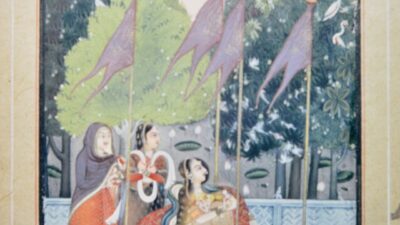
शास्त्र विंग · राग-पट्टिका · Raag Plate
खरहरप्रिय
Kharaharapriya
एक श्रृंगार Carnatic राग · A Romance Carnatic Raag
भावरोमांटिक · सुंदर · कोमल · प्रेमपूर्ण
ऊर्जामध्यम
स्वर-चित्र · The Swara Panel
आरोह — अवरोह · The Ascent and the Descent
आरोह · Aroha चढ़ती हुई सीढ़ी
अवरोह · Avaroha उतरती हुई सीढ़ी
सˊ = तार सप्तक का षड्ज
पकड़ · पहचान वाक्यांश
नि॒ सा रे ग॒ म प — प ध नि॒ सा' — सा' नि॒ ध प म ग॒ रे सा
Ni♭ Sa Re Ga♭ Ma Pa — Pa Dha Ni♭ Sa' — Sa' Ni♭ Dha Pa Ma Ga♭ Re Sa
Kharaharapriya corresponds exactly to Hindustani Kafi thaat. This characteristic phrase—beginning from the low Ni♭ leading into Sa, then ascending through Re, Ga♭, Ma, Pa, and the gentle upper movement through Dha and Ni♭—reflects the raga's quality of calm, dignified depth. In Carnatic tradition this movement is adorned with characteristic gamakas that deepen its emotional weight, paralleling the evocative character of Kafi in Hindustani music.
वादी–संवादी टिप्पणी · Vadi–Samvadi note
Vadi — In the Carnatic tradition, Raag Kharaharapriya emphasizes Pancham (Pa) as a key resting note.
Samvadi — Sa (Shadj) serves as the complementary note.
समय और भाव
Time Theory & Moodसमय-सिद्धांत · Time Theory
अपराह्न
परंपरागत रूप से दोपहर (12:00 PM - 4:00 PM) में गाया जाता है।
Traditionally performed during afternoon hours (12:00 PM - 4:00 PM), suited for the warmth and energy of midday.
भाव और गति · Mood & Tempo
श्रृंगार · Romance/Beauty
प्रेम, सौंदर्य और भक्ति का रस। रोमांटिक तड़प, सौंदर्यपरक आनंद और गहरे भावनात्मक जुड़ाव को जगाता है।
ऊर्जा · Energyमध्यम
स्तर · Leveladvanced — राग खरहरप्रिय के लिए कर्नाटक संगीत सिद्धांत की मजबूत नींव आवश्यक है।
पट्टिका-लेख
The Monographपरिचय Introduction
राग खरहरप्रिय कर्नाटक शास्त्रीय संगीत परंपरा का एक राग है। इसका प्रमुख रस श्रृंगार (Romance/Beauty) है। यह परंपरागत रूप से दोपहर (12:00 PM - 4:00 PM) में गाया जाता है। गाया जाता है।
अंग्रेज़ी में पढ़ें · Read in English
Raag Kharaharapriya is a complete scale with all 7 notes in both ascent and descent raga in the Carnatic classical music tradition. It is derived from the Kharaharapriya melakarta (#22). With its Sampurna-Sampurna jati structure, this raag creates a distinctive tonal landscape. The predominant rasa is Romance/Beauty (श्रृंगार), making it suitable for compositions that evoke romantic, beautiful emotions. It is traditionally performed during afternoon hours, and its melodic contour offers rich possibilities for alapana, kalpanaswaram, and creative improvisation.
सांस्कृतिक महत्व Cultural Significance
भारतीय शास्त्रीय संगीत की समृद्ध परंपरा के अंग के रूप में, राग खरहरप्रिय Carnatic परंपरा को परिभाषित करने वाले स्वर संरचना और भावनात्मक अभिव्यक्ति के बीच गहरे संबंध का प्रतिनिधित्व करता है।
अंग्रेज़ी में पढ़ें · Read in English
As part of the rich tapestry of Indian classical music, Raag Kharaharapriya represents the deep connection between melodic structure and emotional expression that defines the Carnatic tradition.
ऐतिहासिक महत्व Historical Significance
खराहरप्रिय कर्नाटक संगीत की 72-मेलकर्ता प्रणाली में 22वाँ मेलकर्ता है और वेद चक्र (मेलकर्ता 19–24), अर्थात् 4वें चक्र, का चौथा सदस्य है। इसमें चतुःश्रुति ऋषभ (शुद्ध रे), साधारण गंधार (कोमल ग), शुद्ध मध्यम, चतुःश्रुति धैवत (शुद्ध ध) और कैशिक निषाद (कोमल नि) का संयोग है — जो हिंदुस्तानी काफ़ी ठाट के स्वरों से पूर्णतः मेल खाता है। वेंकटमखिन ने इसे चतुर्दंडिप्रकाशिका (लगभग 1620 ई.) में वर्गीकृत किया। 'खर' (नाशक) और 'हर' (शिव) और 'प्रिय' (प्रिय) से बना नाम इस राग के भक्ति-भाव की ओर संकेत करता है। खराहरप्रिय कर्नाटक संगीत के सर्वाधिक महत्वपूर्ण और प्रसिद्ध मेलकर्ताओं में है। त्यागराज की प्रसिद्ध कृति 'सामि निन्ने कोरि' इसी राग में है। यह अनेक प्रिय जन्य रागों का जनक है और काफ़ी के समतुल्य के रूप में दोनों परंपराओं को जोड़ता है।
अंग्रेज़ी में पढ़ें · Read in English
Kharaharapriya is the 22nd melakarta in the Carnatic 72-raga system, the fourth member of the Veda chakra (melakartas 19–24), the 4th of the 12 chakras. It uses chatusshruti Rishabha (shuddha Re, R2, 2 semitones), sadharana Gandhara (komal Ga, G2, 3 semitones), shuddha Madhyama (M1, 5 semitones), chatusshruti Dhaivata (shuddha Dha, D2, 9 semitones), and kaisika Nishada (komal Ni, N2, 10 semitones)—a note set identical to the Hindustani Kafi thaat, making it one of the most significant cross-tradition equivalences in Indian classical music. Venkatamakhin classified it in the Caturdandiprakasika (c. 1620 CE). The name means 'beloved of Hara (Shiva) who destroys suffering' (khara = destroyer, hara = Shiva, priya = beloved). Kharaharapriya is one of the most important, widely performed, and beloved melakartas in all of Carnatic music. Tyagaraja composed his celebrated kriti 'Sami ninne kori' in this raga. It is the parent melakarta of numerous beloved janya ragas and has an extensive repertoire of kritis by the Trinity and later composers. As the Carnatic equivalent of the Kafi scale, it bridges two great traditions of Indian classical music.
शिक्षा
Teaching & LearningBegin with slow aalapana to internalize the raag's swaroopa (melodic form)
Practice the arohana and avarohana patterns with a tanpura drone
Listen to recordings by master performers to understand the raag's gamakas (ornamentations)
Work on kalpanaswaram (improvisation) within the raag's framework
Using incorrect gamakas that belong to a different raag
Not maintaining proper swar sthana (note placement)
Rushing through phrases without allowing the raag bhava to develop
तुलना
A Specimen Comparisonदोनों में सा, रे, कोमल ग, शुद्ध म, प समान हैं — केवल ध और नि में अंतर है। खरहरप्रिय में शुद्ध ध और कोमल नि है; कीरवनि में कोमल ध और शुद्ध नि। इस एकल बदलाव से भावभूमि बदल जाती है: खरहरप्रिय का शुद्ध ध उसे अधिक खुलापन और दोपहरी श्रृंगार देता है, जबकि कीरवनि का कोमल ध + शुद्ध नि संध्याकालीन करुण रस की ओर ले जाता है।
| तुलनाSpecimen | खरहरप्रिय | कीरवनि |
|---|---|---|
| स्वर-अंतर | Kharaharapriya: shuddha Dha, komal Ni; Keeravani: komal Dha, shuddha Ni | |
| भाव-अंतर | Kharaharapriya: afternoon Shringara; Keeravani: evening Karuna | |
एक अन्य भ्रामक समानता हरिकांभोजी (#28) से है, जिसमें भी शुद्ध ध और कोमल नि हैं, किंतु वहाँ गंधार शुद्ध है — कोमल नहीं — जिससे वह अधिक उजला और विस्तृत है, और हिंदुस्तानी खमाज का समकक्ष बनता है।
| तुलनाSpecimen | खरहरप्रिय | हरिकांभोजी |
|---|---|---|
| स्वर-अंतर | Harikambhoji: shuddha Ga; Kharaharapriya: komal Ga | |
काफ़ी (हिंदुस्तानी) और खरहरप्रिय (कर्नाटक) की तुलना एकदम सटीक है: दोनों के सात स्वर एक-समान हैं और दोनों ही अनेक जन्य/जन्य रागों के जनक हैं।
| तुलनाSpecimen | खरहरप्रिय | काफ़ी |
|---|
प्रस्तुति
Performance- Description
- परंपरागत रूप से दोपहर (12:00 PM - 4:00 PM) में गाया जाता है। Traditionally performed during afternoon hours (12:00 PM - 4:00 PM), suited for the warmth and energy of midday.
- Prahar Number
- 3
- Prahar Name
- अपराह्न Aparahna
- Time Start
- 12:00
- Time End
- 16:00
- Time Flexibility
- flexible
Time
और जानें
More to Know- raag-keeravani — Keeravani — कीरवनि — Keeravani (#21), the immediate neighbor, shares Sa Re komal-Ga shuddha-Ma Pa — differing only in Dha and Ni. Kharaharapriya carries shuddha Dha and komal Ni; Keeravani has komal Dha and shuddha Ni. This single exchange shifts the emotional center: Kharaharapriya's shuddha Dha gives it more openness and the afternoon Shringara quality, while Keeravani's komal Dha and shuddha Ni lean toward evening Karuna. — दोनों में सा, रे, कोमल ग, शुद्ध म, प समान हैं — केवल ध और नि में अंतर है। खरहरप्रिय में शुद्ध ध और कोमल नि है; कीरवनि में कोमल ध और शुद्ध नि। इस एकल बदलाव से भावभूमि बदल जाती है: खरहरप्रिय का शुद्ध ध उसे अधिक खुलापन और दोपहरी श्रृंगार देता है, जबकि कीरवनि का कोमल ध + शुद्ध नि संध्याकालीन करुण रस की ओर ले जाता है। — Kharaharapriya: shuddha Dha, komal Ni; Keeravani: komal Dha, shuddha Ni — Kharaharapriya: afternoon Shringara; Keeravani: evening Karuna
- raag-harikambhoji — Harikambhoji — हरिकांभोजी — Harikambhoji (#28) also has shuddha Dha and komal Ni, but uses shuddha Ga instead of Kharaharapriya's komal Ga — making Harikambhoji brighter and more expansive, corresponding to the Hindustani Khamaj. — एक अन्य भ्रामक समानता हरिकांभोजी (#28) से है, जिसमें भी शुद्ध ध और कोमल नि हैं, किंतु वहाँ गंधार शुद्ध है — कोमल नहीं — जिससे वह अधिक उजला और विस्तृत है, और हिंदुस्तानी खमाज का समकक्ष बनता है। — Harikambhoji: shuddha Ga; Kharaharapriya: komal Ga
- raag-kafi — Kafi — काफ़ी — The Kafi–Kharaharapriya parallel in Hindustani vs Carnatic is exact: both have the same seven notes (Sa Re komal-Ga Ma Pa Dha komal-Ni) and serve as parent scales for a large family of derivative ragas. — काफ़ी (हिंदुस्तानी) और खरहरप्रिय (कर्नाटक) की तुलना एकदम सटीक है: दोनों के सात स्वर एक-समान हैं और दोनों ही अनेक जन्य/जन्य रागों के जनक हैं।
In Film Music
Kharaharapriya, as a complete 7-note Carnatic melakarta, does not appear by that name in Hindi film compositions. However, its musical DNA runs deep through both South Indian and North Indian film music in two ways. First, as the parent scale (janaka) of many beloved Carnatic janya ragas — including Kaapi, Abhogi, Bhimpalasi, Madhyamavati, and Sriranjani — Kharaharapriya's note-world pervades Tamil and Telugu film music, especially in the compositions of Ilayaraja and M.S. Viswanathan who favored these derivative ragas. Second, in the Hindustani system, Kharaharapriya's note structure corresponds precisely to the Kafi thaat (Sa Re komal-Ga Ma Pa Dha komal-Ni), whose ragas — including Kafi, Bhimpalasi, Tilak Kamod, and Megh — are extensively used in Hindi film songs. The scale's combination of natural Re and Ga with the characteristic komal Ni gives it a quality that Carnatic scholars describe as madhura (sweet) with subtle pathos — which explains why Kharaharapriya-derived scales recur so often in expressive film melodies. However, any specific attribution of a Hindi film song to 'Kharaharapriya' by name should be treated cautiously; composers work from the Hindustani raag tradition, not the Carnatic melakarta.
Comparisons
सीखने के लिए
For Learners- Difficulty Level
- advanced
अन्य विवरण
More Details- Indian_Music_Raga_Encyclopedia_v2.xlsx
- https://en.wikipedia.org/wiki/Kharaharapriya
- https://bollypiano.com/indian-film-songs-in-raag-kaapi-a-melodic-journey/ — Indian Film Songs in Raag Kaapi
- https://dhanyasy.org/go/2010/10/10/indian-film-songs-in-kharahara-priya/ — Indian Film Songs in Kharaharapriya
- https://www.karnatik.com/hcragatable.shtml — Carnatic-Hindustani raga equivalence table
- Carnatic 72-melakarta system: melakarta 22 in the Veda chakra (Venkatamakhin, Caturdandiprakasika, c. 1620 CE)
- Govindacharya, Samgraha-Chudamani, c. 1800 CE
References
नमूना-पट्टी
The Specimen Table| नाम | खरहरप्रिय · Kharaharapriya |
|---|---|
| थाट | Kafi |
| आरोह | Sa Re Ga♭ Ma Pa Dha Ni♭ Sa' Sa' |
| अवरोह | Sa' Sa' Ni♭ Dha Pa Ma Ga♭ Re Sa |
| पकड़ | नि॒ सा रे ग॒ म प — प ध नि॒ सा' — सा' नि॒ ध प म ग॒ रे सा |
| जाति | संपूर्ण-संपूर्ण · Sampurna-Sampurna |
| समय | अपराह्न |
| ऊर्जा | मध्यम |
| परिवार | Kharaharapriya |
| स्तर | advanced |
| लोकप्रियता | Obscure |
| कर्नाटक समतुल्य | Kharaharapriya · Melakarta 22 |
जुड़े हुए पन्ने
Connected Plates · The Graph Made Visibleअटलस में कोई पन्ना अकेला नहीं — इस राग से गीत, प्रस्तुतियाँ, कलाकार, ताल, घराने और मिलते-जुलते राग, सब यहाँ से खुलते हैं।
ताल-साथी · Taal Pairings
शास्त्र-सूत्र · Shastra Threads
श्रवण-कक्ष · The Listening Room
सुनिए — खरहरप्रिय · Hear the Raag
Raag Kharaharapriya — Classical Performance
प्रश्नोत्तर
Questions & Answersराग Kharaharapriya किस संगीत पद्धति का राग है?
राग Kharaharapriya कर्नाटक (दक्षिण भारतीय) शास्त्रीय संगीत पद्धति का राग है।
अंग्रेज़ी में पढ़ें · Read in English
Which music system does Raga Kharaharapriya belong to? — Raga Kharaharapriya belongs to the Carnatic (South Indian) classical music system.
साझा कीजिए · Share this Plate