गीत विंग · गीत-पट्टिका · Song Plate
मैया मोरी मैं नहीं माखन खायो
Maiya Mori Main Nahi Makhan Khayo
मैया, मैंने माखन नहीं खाया — सहगल सूरदास के सबसे प्रिय बाल-कृष्ण पद को गाते हैं।
भावभक्ति · चुलबुला · Tender
भाषाhindi गतिमध्यम स्वरूपएकल पुरुष
श्रेय
The Creditsसूत्र-वाक्य · The Hook
सूत्र-वाक्य
मैया, मैंने माखन नहीं खाया — सहगल सूरदास के सबसे प्रिय बाल-कृष्ण पद को गाते हैं।
In EnglishMother, I did not eat the butter — Saigal sings Surdas's most beloved child-Krishna pad.
पट्टिका-लेख
The Monographपरिचय Overview
यह गीत सूरदास के सबसे प्रसिद्ध और व्यापक रूप से प्रिय पदों में से एक को साकार करता है — नन्हे कृष्ण का माँ यशोदा से यह निर्दोष इनकार कि उन्होंने माखन चुराया। के. एल. सहगल द्वारा गाया गया, यह संत-कवि की भक्ति के चंचल, आत्मीय वात्सल्य-तंतु को फ़िल्म में लाता है।
अंग्रेज़ी में पढ़ें · Read in English
This song renders one of Surdas's most famous and widely loved padas — the little Krishna's innocent denial to mother Yashoda that he stole the butter. Sung by K. L. Saigal, it brings the playful, intimate vatsalya (parental-love) strand of the saint-poet's devotion into the film.
संगीत The Music
ज्ञान दत्त इस पद को एक हल्की, मध्यम-लय की भजन-धुन में रचते हैं जिसकी छेड़ती, बाल-सी लटक पाठ के निर्दोष इनकार को प्रतिबिंबित करती है। सहगल अपनी सामान्यतः गंभीर आवाज़ को यहाँ कोमलता की ओर मोड़ते हैं, और कोमल लय व हारमोनियम मनोभाव को स्नेहमय और सहज बनाए रखते हैं।
अंग्रेज़ी में पढ़ें · Read in English
Gyan Dutt sets the pad to a light, mid-tempo bhajan melody with a teasing, childlike lilt that mirrors the innocent denial of the text. Saigal modulates his usually grave voice toward tenderness here, the gentle rhythm and harmonium keeping the mood affectionate and unforced.
काव्य The Poetry
यह गीत सूरदास के समूचे सूरसागर के सबसे प्रिय पद को साकार करता है: नन्हे कृष्ण का माँ यशोदा से चंचल इनकार कि उन्होंने माखन चुराया। मूल ब्रज भाषा पद, वैष्णव भक्ति में वात्सल्य-रस (माता-पिता का प्रेम) परंपरा के आधारभूत पाठों में से एक है — कृष्ण और यशोदा के बीच का प्रेम आत्मा और ईश्वर के बीच कोमल संबंध के प्रतिरूप के रूप में। इस पद में सूरदास की प्रतिभा एक बच्चे की तर्क-नकल में है: कृष्ण कहते हैं कि उनकी बाहें मटकी तक पहुँचने के लिए बहुत छोटी हैं, कि वे सारे दिन जंगल में रहे, कि दूसरे ग्वाल-बाल झूठ बोलते हैं। हर बहाना पारदर्शी रूप से झूठा फिर भी अप्रतिरोध्य रूप से मनमोहक है। माधोक का इस अमर पाठ का फ़िल्मी रूपांतर सहगल को एक बालक-व्यक्तित्व में बसने की चुनौती देता है — गंभीर बैरिटोन निर्दोषता की ओर मुड़ती, भक्तिमय ऊष्मा चंचलता तक नरम होती। गीत की सफलता इसी स्वर-परिवर्तन पर निर्भर है।
अंग्रेज़ी में पढ़ें · Read in English
This song renders the most beloved pada in Surdas's entire Sursagar: the child Krishna's playful denial to mother Yashoda that he stole the butter. The original Braj Bhasha pada is among the foundational texts of the vatsalya rasa (parental-love sentiment) tradition in Vaishnava devotion — the love between Krishna and Yashoda as a model for the soul's tender relationship with the divine. Surdas's genius in this pada lies in its perfect mimicry of a child's logic: Krishna argues that his arms are too small to reach the pot, that he has been in the forest all day, that the other cowherd boys must have told lies. Each excuse is transparently false yet irresistibly charming. D.N. Madhok's film adaptation of this immortal text gives Saigal the challenge of inhabiting a childlike persona — the grave baritone modulating toward innocence, the devotional warmth softened to playfulness. The success of the number depends on this tonal modulation.
कहानी The Story
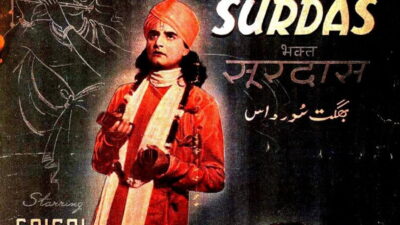
भक्त सूरदास (1942, रणजीत स्टूडियोज़, बंबई, निर्देशक चतुर्भुज दोशी) अंधे संत सूरदास के जीवन को चित्रित करती है, जिनकी भक्ति में वियोगपूर्ण विरह-गान और स्नेहमय बाल-भक्ति (बाल-कृष्ण) परंपरा दोनों शामिल थे। सूरदास का 'मैया मोरी मैं नहीं माखन खायो' उनके सबसे प्रसिद्ध पदों में से एक है और दर्शकों के लिए फ़िल्म से पहले भी परिचित रहा होगा — यह उत्तर भारतीय शास्त्रीय, उप-शास्त्रीय और लोक-भक्ति संगीत में कई प्रदर्शन-परंपराओं में विद्यमान है। फ़िल्म में इसका समावेश सूरदास के अपने संग्रह को श्रद्धांजलि और दर्शकों के लिए एक अंतर्निर्मित पहचान-बिंदु दोनों था। इस कविता की सहगल की व्याख्या उनकी विस्तार-परीक्षा थी: फ़िल्म ने उन्हें एक ऐसे अभिनेता-गायक के रूप में स्थापित किया जो गहनतम भक्ति-गंभीरता (विरह-एकल) से इस बाल-इनकार की चंचल हलकाई तक, सब एक ही संगीत-पट्टी में जा सकते हैं।
अंग्रेज़ी में पढ़ें · Read in English
Bhakta Surdas (1942, Ranjit Studios, Bombay, dir. Chaturbhuj Doshi) depicts the life of the blind saint Surdas, whose devotion encompassed both the anguished viraha song and the affectionate bal-bhakti (child-Krishna) tradition. Surdas's 'Maiya Mori Main Nahi Makhan Khayo' is one of his best-known padas and would have been familiar to audiences even before the film — it exists in multiple performing traditions across North Indian classical, semi-classical, and folk-devotional music. Its inclusion in the film was thus both a tribute to Surdas's own canon and a built-in point of recognition for audiences. Saigal's interpretation of the poem was a test of his range: the film established him as an actor-singer who could move from the deepest devotional gravitas (the viraha solos) to the playful lightness of this child's denial, all within the same soundtrack.
विरासत The Legacy
सूरदास का 'मैया मोरी मैं नहीं माखन खायो' उत्तर भारतीय भक्ति संगीत के सबसे अधिक प्रस्तुत और रिकॉर्ड किए गए पदों में से एक है; सदी भर में एम. एस. सुब्बुलक्ष्मी, शास्त्रीय गायकों और भजन गायकों द्वारा इसके अनेक संस्करण हैं। सहगल का फ़िल्मी रूपांतरण इस पद की व्यापक ग्रहण-परंपरा का हिस्सा है। भक्त सूरदास (1942) संस्करण पाठ को एक विशेष बंबई-स्टूडियो रंग देता है — सहगल की आवाज़ का भार ज्ञान दत्त की हल्की संगत के विरुद्ध — जो इसे शास्त्रीय और लोक दोनों रूपों से अलग करता है।
अंग्रेज़ी में पढ़ें · Read in English
Surdas's 'Maiya Mori Main Nahi Makhan Khayo' is among the most performed and recorded padas in all of North Indian devotional music; versions exist by M.S. Subbulakshmi, classical vocalists, and bhajan singers across the century. Saigal's film adaptation is part of this larger tradition of the pada's reception. The Bhakta Surdas (1942) version gives the text a particular Bombay-studio inflection — the weight of Saigal's voice against Gyan Dutt's light accompaniment — that distinguishes it from both the classical and the folk variants.
वर्गीकरण
Classification- Tempo
- Medium
Genre
अन्य विवरण
More Details- https://en.wikipedia.org/wiki/Surdas
- https://en.wikipedia.org/wiki/Bhakta_Surdas
- https://kaavyaalaya.org/maiyaa_moree
References
रोचक तथ्य
Margin Notesपद 'मैया मोरी मैं नहीं माखन खायो' सूरदास के सूरसागर की सबसे प्रसिद्ध रचनाओं में से एक है और इसे हिंदुस्तानी शास्त्रीय ख़याल से लेकर लोक-भजन तक के पूरे दायरे में प्रस्तुत किया जाता है।
अंग्रेज़ी में पढ़ें · Read in English
The pada 'Maiya Mori Main Nahi Makhan Khayo' is among the best-known texts in Surdas's Sursagar and is performed across the full spectrum from Hindustani classical khyal to folk bhajan.
यह पद वात्सल्य रस — संस्कृत सौंदर्यशास्त्र के नौ रसों में से एक — का प्रयोग करता है, जिसमें भक्त का ईश्वर से संबंध एक माँ के बच्चे के प्रति प्रेम के अनुरूप गढ़ा गया है।
अंग्रेज़ी में पढ़ें · Read in English
The poem deploys the rasa of vatsalya (parental love) — one of the nine rasas in Sanskrit aesthetics — in which the devotee's relationship to God is modelled on a mother's love for a child.
माना जाता है कि सूरदास जन्म से या बचपन की शुरुआत से ही नेत्रहीन थे; भक्त-कवि का वह स्वरूप जो केवल अंतर्दृष्टि से 'देखता' है, उन्हें 1930-1940 के दशकों में हावी रही भक्त-फ़िल्म विधा की जीवनी-आधारित फ़िल्मों के लिए एक स्वाभाविक विषय बना देता है।
अंग्रेज़ी में पढ़ें · Read in English
Surdas is believed to have been blind from birth or early childhood; the persona of the bhakta-poet who 'sees' only with inner vision made him a natural subject for biographical films in the bhakta-film genre that dominated the 1930s–1940s.
इस पद द्वारा अपेक्षित चंचलता की ओर अपनी विशिष्ट गंभीरता को ढालने का के.एल. सहगल का निर्णय उनके समकालीनों द्वारा न केवल उनकी गायकी बल्कि उनके अभिनय की क्षमता के प्रदर्शन के रूप में भी नोट किया गया।
अंग्रेज़ी में पढ़ें · Read in English
K.L. Saigal's decision to modulate his characteristic gravity toward the playfulness required by this pada was noted by contemporaries as a demonstration of his actor's range, not merely his singer's range.
नमूना-पट्टी
The Specimen Table| शीर्षक | मैया मोरी मैं नहीं माखन खायो · Maiya Mori Main Nahi Makhan Khayo |
|---|---|
| फ़िल्म | भक्त सूरदास · 1942 |
| वर्ष · युग | 1942 |
| गायक | K.L. Saigal |
| गीतकार | D. N. Madhok |
| संगीतकार | Gyan Dutt |
| स्वरूप | एकल पुरुष |
| गति | मध्यम |
| भाषा | hindi |
| भाव | भक्ति · चुलबुला · Tender |
| लोकप्रियता | Popular |
| बोल-स्थिति | केवल झलक |
जुड़े हुए पन्ने
Connected Plates · The Graph Made Visibleअटलस में कोई पन्ना अकेला नहीं — इस गीत से जुड़े गीत, कलाकार, फ़िल्म, राग-ताल-विधा, सब यहाँ से खुलते हैं।
मिलते-जुलते गीत · Related Songs
कलाकार · The Artists
फ़िल्म · The Film
साझा कीजिए · Share this Plate