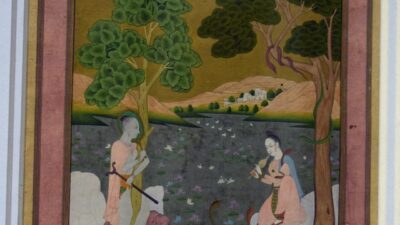
शास्त्र विंग · राग-पट्टिका · Raag Plate
दीपक
Deepak
भावशांतिपूर्ण · ध्यानपूर्ण · प्रशांत · शांत
ऊर्जाधीमी
स्वर-चित्र · The Swara Panel
आरोह — अवरोह · The Ascent and the Descent
पकड़ · पहचान वाक्यांश
स रे ग म प ध नि सा
Sa Re Ga Ma Pa Dha Ni Sa'
Raag Deepak is a legendary raag whose exact scale is disputed and not standardised in any living performance tradition. The most commonly cited theoretical account describes all seven shuddha svaras (corresponding to Bilawal thaat), but other sources differ. The phrase above represents the theoretical all-shuddha version only; no authentic pakad from a performed tradition can be given honestly.
वादी–संवादी टिप्पणी · Vadi–Samvadi note
Vadi — The vadi (primary) note provides the tonal center of Raag Deepak.
Samvadi — Ni (Nishad) is the samvadi, complementing the vadi note.
समय और भाव
Time Theory & Moodसमय-सिद्धांत · Time Theory
संध्या काल
परंपरागत रूप से संध्या काल (4:00 PM - 7:00 PM) में गाया जाता है।
Traditionally performed during evening/twilight hours (4:00 PM - 7:00 PM), when day transitions to night.
भाव और गति · Mood & Tempo
शांत · Peace/Tranquility
आंतरिक शांति, सुकून और आध्यात्मिक वैराग्य का रस। शांति, ध्यान और अध्यात्म को जगाता है।
ऊर्जा · Energyधीमी
स्तर · Leveladvanced — राग दीपक के लिए इसके मूल ठाट की समझ और मींड, गमक, आंदोलन के माध्यम से इसके अद्वितीय चरित्र को उभारने की क्षमता…
पट्टिका-लेख
The Monographपरिचय Introduction
राग दीपक हिंदुस्तानी शास्त्रीय संगीत का एक राग है। इसका प्रमुख रस शांत (Peace/Tranquility) है। यह परंपरागत रूप से संध्या काल (4:00 PM - 7:00 PM) में गाया जाता है। गाया जाता है।
अंग्रेज़ी में पढ़ें · Read in English
Raag Deepak is a complete scale with all 7 notes in both ascent and descent raga in Hindustani classical music. This raag embodies the Peace/Tranquility (शांत) rasa, creating an atmosphere of peaceful, meditative emotion. It is traditionally performed during evening hours. The raag offers rich melodic possibilities through its characteristic phrases and ornamentations, making it a rewarding subject for both khayal and instrumental performance.
सांस्कृतिक महत्व Cultural Significance
भारतीय शास्त्रीय संगीत की समृद्ध परंपरा के अंग के रूप में, राग दीपक Hindustani परंपरा को परिभाषित करने वाले स्वर संरचना और भावनात्मक अभिव्यक्ति के बीच गहरे संबंध का प्रतिनिधित्व करता है।
अंग्रेज़ी में पढ़ें · Read in English
As part of the rich tapestry of Indian classical music, Raag Deepak represents the deep connection between melodic structure and emotional expression that defines the Hindustani tradition.
ऐतिहासिक महत्व Historical Significance
राग दीपक हिन्दुस्तानी संगीत परम्परा का एक पौराणिक और रहस्यमयी राग है, जो सम्राट अकबर के दरबारी संगीतकार तानसेन की कथा से सर्वाधिक प्रसिद्ध है। कथानुसार, तानसेन को दीपक राग गाने का आदेश दिया गया — यह राग इतनी तीव्र ऊष्मा उत्पन्न करता है कि दीपक स्वयं जल उठते हैं। परन्तु उस अग्नि ने तानसेन को भस्म करने की धमकी दी, जिससे राग मेघ गाकर उन्हें बचाया गया। यह कथा 16वीं-17वीं शती के अनेक जीवनी-ग्रन्थों में, जिनमें अकबरनामा और आइन-ए-अकबरी सम्मिलित हैं, उल्लिखित है। किन्तु एक सजीव प्रदर्शन-परम्परा के रूप में दीपक का कोई मानकीकृत सुर-समूह या बन्दिश उपलब्ध नहीं है — विभिन्न घरानों और सैद्धान्तिक ग्रन्थों में इसे अलग-अलग स्वर दिए गए हैं।
अंग्रेज़ी में पढ़ें · Read in English
Raag Deepak is a legendary and mythologised raag in the Hindustani tradition, most famous through the story of the court musician Tansen at the Mughal court of Emperor Akbar. According to the legend, Tansen was commanded to sing Deepak, a raag said to produce intense heat and light lamps — which he did, but the supernatural fire threatened to consume him. Only the cooling effect of Raag Megh (sung by singers brought from elsewhere) could extinguish the flames. This narrative, recorded in several 16th and 17th-century biographical accounts (including the Ain-i-Akbari), has made Deepak one of the most cited raags in Indian literary culture. However, Deepak as a living, performed raag has no documented, standardised scale or repertoire. Different gharanas and theoretical texts assign it different note-sets, and no authoritative reconstruction exists. It persists primarily as a cultural and mythological referent rather than a musical object.
शिक्षा
Teaching & LearningStart with aaroha-avaroha practice with tanpura
Focus on the pakad (catch phrase) to establish the raag's identity
Practice alap in vilambit (slow) laya to internalize the mood
Gradually build speed through jod and jhala patterns
Confusing this raag with similar-sounding raags
Not giving enough weight to the vadi and samvadi swaras
Using inappropriate meend or gamak patterns
तुलना
A Specimen Comparisonछह आदि रागों (षडंग) की प्राचीन परंपरा में दीपक मध्याह्न/सायंकाल से जुड़ा था — भैरव (प्रभात, गंभीरता) के विपरीत।
| तुलनाSpecimen | दीपक | भैरव |
|---|---|---|
| समय-अंतर | Deepak: noon or early evening; Bhairav: morning, dawn | |
छह आदि रागों की प्राचीन परंपरा में दीपक अग्नि-तत्व और सायंकाल से जुड़ा था — मल्कौंस (मध्यरात्रि, गहन अंतर्मुखता) के विपरीत।
| तुलनाSpecimen | दीपक | मल्कौंस |
|---|---|---|
| भाव-अंतर | Deepak: fierce intensity and illumination (teevra); Malkauns: deep introspection | |
| समय-अंतर | Deepak: noon or early evening; Malkauns: midnight | |
| तुलनाSpecimen | दीपक | मेघ |
|---|---|---|
| भाव-अंतर | Deepak: fire element, fierce intensity, illumination; Megh: monsoon and rain | |
| तुलनाSpecimen | दीपक | पूरिया धनाश्री |
|---|---|---|
| भाव-अंतर | Both described as intense in character | |
| समय-अंतर | Both suggested for evening performance | |
प्रस्तुति
Performance- Description
- परंपरागत रूप से संध्या काल (4:00 PM - 7:00 PM) में गाया जाता है। Traditionally performed during evening/twilight hours (4:00 PM - 7:00 PM), when day transitions to night.
- Prahar Number
- 5
- Prahar Name
- संध्या काल Sandhya Kaal
- Time Start
- 16:00
- Time End
- 19:00
- Time Flexibility
- flexible
Time
और जानें
More to Know- raag-bhairav — Bhairav — भैरव — In the ancient Indian classification of six parent raags (shadanga), Deepak was associated with the fire element and the noon or early evening hour, contrasting with Bhairav which was associated with morning, dawn, and gravity. — छह आदि रागों (षडंग) की प्राचीन परंपरा में दीपक मध्याह्न/सायंकाल से जुड़ा था — भैरव (प्रभात, गंभीरता) के विपरीत। — Deepak: noon or early evening; Bhairav: morning, dawn
- raag-malkauns — Malkauns — मल्कौंस — In the ancient Indian classification of six parent raags (shadanga), Deepak was associated with the fire element and the noon or early evening hour, contrasting with Malkauns which was associated with midnight and deep introspection. — छह आदि रागों की प्राचीन परंपरा में दीपक अग्नि-तत्व और सायंकाल से जुड़ा था — मल्कौंस (मध्यरात्रि, गहन अंतर्मुखता) के विपरीत। — Deepak: noon or early evening; Malkauns: midnight — Deepak: fierce intensity and illumination (teevra); Malkauns: deep introspection
- raag-megh — Megh — मेघ — In the ancient Indian classification of six parent raags (shadanga), Deepak was associated with the fire element, contrasting with Megh which was associated with monsoon and rain — a direct elemental opposition between fire and water. — Deepak: fire element, fierce intensity, illumination; Megh: monsoon and rain
- raag-puriya-dhanashri — Puriya Dhanashri — पूरिया धनाश्री — Music theorists have sometimes compared Deepak to Puriya Dhanashri in terms of its suggested evening performance time and its intense character, but this remains a speculative mapping rather than an established musical equivalence, since Deepak is not performed. — Both suggested for evening performance — Both described as intense in character
- raag-marwa — Marwa — मारवा — Music theorists have sometimes compared Deepak to Marwa in terms of its suggested evening performance time and its intense character, but this remains a speculative mapping rather than an established musical equivalence, since Deepak is not performed. — Both suggested for evening performance — Both described as intense in character
In Film Music
Raag Deepak has virtually no presence in Hindi film music as a musical form — and this absence is entirely deliberate. Deepak is primarily a mythological and legendary raag, one of the six original 'parent ragas' (shadanga) of ancient Indian music theory, cited in Sarngadeva's 13th-century Sangita Ratnakara alongside Bhairav, Malkauns, Hindol, Megh, and Shri. Its fame rests on one of the most vivid legends in Indian musical history: that the great court musician Tansen (c. 1500–1586), one of the nine gems (navratnas) of Emperor Akbar's court, was once commanded to sing Deepak. As Tansen sang, lamps throughout the court ignited spontaneously and Tansen himself began to burn with a severe fever. He was saved only when his daughter Saraswati (some accounts say his guru's daughter Tani) performed Raag Megh Malhar, which summoned rain and extinguished the fire. This legend makes Deepak perhaps the only raag in the world whose performance is considered literally dangerous. In practice, Deepak is never performed today — its exact melodic structure is not uniformly agreed upon across different schools, and almost no compositions exist in it. What film music has done instead is reference Deepak's mythology: the 1943 Hindi film 'Tansen' starring K.L. Saigal featured a narrative based on this legend, but the songs were not composed in the actual raag. The name 'Deepak' and its fire-invoking myth appear occasionally in film dialogues and songs as cultural reference points, but the raag as a musical form remains a mythological artifact.
Comparisons
सीखने के लिए
For Learners- Difficulty Level
- advanced
अन्य विवरण
More Details- Indian_Music_Raga_Encyclopedia_v2.xlsx
- scroll.in — Interpretations of the rare raag Deepak associated with Tansen
- ragajunglism.org — Raag Deepak: Hindustani Raga Index
- britannica.com — Tansen biography
- thepositivediary.com — Tansen and the Deepak Raag
References
नमूना-पट्टी
The Specimen Table| नाम | दीपक · Deepak |
|---|---|
| थाट | — |
| पकड़ | स रे ग म प ध नि सा |
| जाति | संपूर्ण-संपूर्ण · Sampurna-Sampurna |
| समय | संध्या काल |
| ऊर्जा | धीमी |
| परिवार | Deepak |
| स्तर | advanced |
| लोकप्रियता | Obscure |
जुड़े हुए पन्ने
Connected Plates · The Graph Made Visibleअटलस में कोई पन्ना अकेला नहीं — इस राग से गीत, प्रस्तुतियाँ, कलाकार, ताल, घराने और मिलते-जुलते राग, सब यहाँ से खुलते हैं।
ताल-साथी · Taal Pairings
श्रवण-कक्ष · The Listening Room
सुनिए — दीपक · Hear the Raag
Raga Deepak | Ghulam Mustafa Khan
प्रश्नोत्तर
Questions & Answersराग Deepak क्या है?
राग Deepak Hindustani शास्त्रीय संगीत का एक राग है।
अंग्रेज़ी में पढ़ें · Read in English
What is Raag Deepak? — Raag Deepak is a raag in Hindustani classical music.
साझा कीजिए · Share this Plate