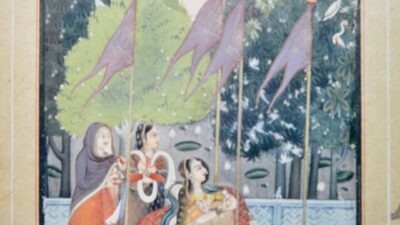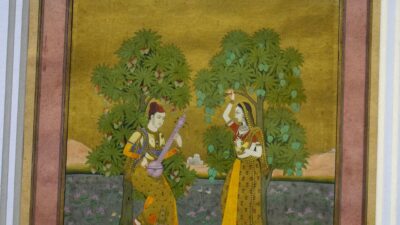
शास्त्र विंग · राग-पट्टिका · Raag Plate
ब्रिंदवनि सारंग
Brindavani Sarang
एक शांत Carnatic राग · A Peace Carnatic Raag
भावशांतिपूर्ण · ध्यानपूर्ण · प्रशांत · शांत
ऊर्जाधीमी
स्वर-चित्र · The Swara Panel
आरोह — अवरोह · The Ascent and the Descent
पकड़ · पहचान वाक्यांश
स रे म प, रे म रे स
Sa Re Ma Pa, Re Ma Re Sa
Vrindavani Sarang is defined by the strategic omission of Ga and Dha. The phrase Sa–Re–Ma–Pa–Re–Ma–Re–Sa reveals the raag's identity: the leap from Re up to Ma (skipping Ga entirely), the use of Pa as the upper resting point, and the return via Ma–Re–Sa. This absence of Ga and Dha, set against the Kafi thaat background (komal Ga and Ni), produces a distinctive open, yearning, mid-day quality. The komal Ni appears softly in some traditions of the avarohana.
वादी–संवादी टिप्पणी · Vadi–Samvadi note
Vadi — In the Carnatic tradition, Raag Brindavani Sarang emphasizes Pancham (Pa) as a key resting note.
Samvadi — Sa (Shadj) serves as the complementary note.
समय और भाव
Time Theory & Moodसमय-सिद्धांत · Time Theory
संध्या काल
परंपरागत रूप से संध्या काल (4:00 PM - 7:00 PM) में गाया जाता है।
Traditionally performed during evening/twilight hours (4:00 PM - 7:00 PM), when day transitions to night.
भाव और गति · Mood & Tempo
शांत · Peace/Tranquility
आंतरिक शांति, सुकून और आध्यात्मिक वैराग्य का रस। शांति, ध्यान और अध्यात्म को जगाता है।
ऊर्जा · Energyधीमी
स्तर · Leveladvanced — राग Brindavani सारंग के लिए कर्नाटक संगीत सिद्धांत की मजबूत नींव आवश्यक है।
पट्टिका-लेख
The Monographपरिचय Introduction
राग Brindavani सारंग कर्नाटक शास्त्रीय संगीत परंपरा का एक राग है। इसका प्रमुख रस शांत (Peace/Tranquility) है। यह परंपरागत रूप से संध्या काल (4:00 PM - 7:00 PM) में गाया जाता है। गाया जाता है।
अंग्रेज़ी में पढ़ें · Read in English
Raag Brindavani Sarang is a complete scale with all 7 notes in both ascent and descent raga in the Carnatic classical music tradition.. With its Sampurna-Sampurna jati structure, this raag creates a distinctive tonal landscape. The predominant rasa is Peace/Tranquility (शांत), making it suitable for compositions that evoke peaceful, meditative emotions. It is traditionally performed during evening hours, and its melodic contour offers rich possibilities for alapana, kalpanaswaram, and creative improvisation.
सांस्कृतिक महत्व Cultural Significance
भारतीय शास्त्रीय संगीत की समृद्ध परंपरा के अंग के रूप में, राग Brindavani सारंग Carnatic परंपरा को परिभाषित करने वाले स्वर संरचना और भावनात्मक अभिव्यक्ति के बीच गहरे संबंध का प्रतिनिधित्व करता है।
अंग्रेज़ी में पढ़ें · Read in English
As part of the rich tapestry of Indian classical music, Raag Brindavani Sarang represents the deep connection between melodic structure and emotional expression that defines the Carnatic tradition.
ऐतिहासिक महत्व Historical Significance
वृंदावनी सारंग (ब्रिंदावनी सारंग) सारंग राग-परिवार के सबसे प्रिय सदस्यों में से एक है — और सारंग परिवार भारतीय शास्त्रीय संगीत के प्राचीनतम राग-कुलों में गिना जाता है। इसका नाम वृंदावन — मथुरा के पास भगवान कृष्ण का पवित्र वन — और 'सारंग' (चित्तीदार हिरण, कृष्ण का प्रतीक या 'रंगीला') से बना है।
हिंदुस्तानी संगीत में वृंदावनी सारंग कापी थाट के अंतर्गत आता है। इसमें सातों स्वर हैं लेकिन ग और ध की लगभग अनुपस्थिति इसे विशिष्ट बनाती है — ये स्वर केवल तैयारी या कण-स्वर के रूप में कहीं-कहीं आते हैं। यह मध्याह्न राग है (दोपहर 12 से 3 बजे) और ग्रीष्म ऋतु की तपन तथा विरह-भाव से जुड़ा है।
कर्नाटक संगीत में यह राग खरहरप्रिया (22वें मेलकर्ता — कापी थाट का समतुल्य) का जन्य माना जाता है। पं. भीमसेन जोशी और उस्ताद बड़े ग़ुलाम अली ख़ाँ जैसे दिग्गजों के मध्याह्न कालीन वृंदावनी सारंग के गायन परंपरा में अमर हैं।
अंग्रेज़ी में पढ़ें · Read in English
Vrindavani Sarang (Brindavani Sarang) is one of the most beloved members of the Sarang family of raags, which itself is among the most ancient groupings in Indian classical music. The name derives from Vrindavan (Brindavan) — the sacred forest near Mathura in Uttar Pradesh where Lord Krishna spent his youth — and 'Sarang', a term of multiple meanings: the spotted deer (an emblem of Krishna), the multicoloured, or simply an evocative ancient musical name.
In Hindustani music, Vrindavani Sarang is classified under the Kafi thaat. It uses all seven swaras but is characterised by the near-absence of Ga and Dha — these appear only as passing or grace notes in some renditions. The result is an open-textured, pentatonic-feeling raag of great lyricism. It is traditionally performed at mid-day (noon to 3 PM) and is associated with the burning heat of summer and the longing of separation (viraha bhava).
In Carnatic music, 'Brindavani Sarang' appears as a related raag in the Vrindavana tradition, often treated as a janya of Kharaharapriya (22nd melakarta — the Carnatic equivalent of Kafi thaat). The Carnatic treatment introduces specific gamakas and ornaments that distinguish it from the Hindustani version. Legendary performers of the Hindustani Vrindavani Sarang include Pandit Bhimsen Joshi and Ustad Bade Ghulam Ali Khan, whose midday concerts in this raag are deeply cherished in the tradition.
शिक्षा
Teaching & LearningBegin with slow aalapana to internalize the raag's swaroopa (melodic form)
Practice the arohana and avarohana patterns with a tanpura drone
Listen to recordings by master performers to understand the raag's gamakas (ornamentations)
Work on kalpanaswaram (improvisation) within the raag's framework
Using incorrect gamakas that belong to a different raag
Not maintaining proper swar sthana (note placement)
Rushing through phrases without allowing the raag bhava to develop
प्रस्तुति
Performance- Description
- परंपरागत रूप से संध्या काल (4:00 PM - 7:00 PM) में गाया जाता है। Traditionally performed during evening/twilight hours (4:00 PM - 7:00 PM), when day transitions to night.
- Prahar Number
- 5
- Prahar Name
- संध्या काल Sandhya Kaal
- Time Start
- 16:00
- Time End
- 19:00
- Time Flexibility
- flexible
Time
और जानें
More to KnowIn Film Music
Vrindavani Sarang has had a genuine, if limited, presence in Hindi film music. Its distinctive open mid-day quality and strong association with the Sarang family (brightness, longing, summer heat) have made it attractive to sensitive film composers. Among the songs believed to draw on Vrindavani Sarang or closely related Sarang-family raags are certain compositions by S.D. Burman and Madan Mohan in the Golden Era. However, film composers rarely identified specific raags in their notes, and many such attributions are by musicologists after the fact. The raag is more commonly encountered in semi-classical recordings and bhajan contexts than in mainstream film songs.
सीखने के लिए
For Learners- Difficulty Level
- advanced
अन्य विवरण
More Details- Indian_Music_Raga_Encyclopedia_v2.xlsx
- chandrakantha.com — Raag Vrindavani Sarang
- Kharaharapriya (22nd melakarta) — Carnatic parent of Brindavani Sarang
References
नमूना-पट्टी
The Specimen Table| नाम | ब्रिंदवनि सारंग · Brindavani Sarang |
|---|---|
| थाट | Kafi |
| पकड़ | स रे म प, रे म रे स |
| जाति | संपूर्ण-संपूर्ण · Sampurna-Sampurna |
| समय | संध्या काल |
| ऊर्जा | धीमी |
| परिवार | Brindavani Sarang |
| स्तर | advanced |
| लोकप्रियता | Obscure |
जुड़े हुए पन्ने
Connected Plates · The Graph Made Visibleअटलस में कोई पन्ना अकेला नहीं — इस राग से गीत, प्रस्तुतियाँ, कलाकार, ताल, घराने और मिलते-जुलते राग, सब यहाँ से खुलते हैं।
ताल-साथी · Taal Pairings
शास्त्र-सूत्र · Shastra Threads
श्रवण-कक्ष · The Listening Room
सुनिए — ब्रिंदवनि सारंग · Hear the Raag
Brindavan Sarang - Sitar
प्रश्नोत्तर
Questions & Answersराग Brindavani Sarang किस संगीत पद्धति का राग है?
राग Brindavani Sarang कर्नाटक (दक्षिण भारतीय) शास्त्रीय संगीत पद्धति का राग है।
अंग्रेज़ी में पढ़ें · Read in English
Which music system does Raga Brindavani Sarang belong to? — Raga Brindavani Sarang belongs to the Carnatic (South Indian) classical music system.
साझा कीजिए · Share this Plate