शास्त्र विंग · वाद्य-पट्टिका · Instrument Plate
ड्रम किट
Drum Kit
अन्य नामड्रम सेट · ट्रैप सेट (trap set) · ट्रैप्स (traps) · Drum kit (also: drum set, trap set, kit, traps)
परिचय
Overviewड्रम किट, पुराना नाम 'ट्रैप सेट', किसी एक वाद्य का नहीं बल्कि बास ड्रम, स्नेयर, टॉम और सिम्बलों के एक चतुर समूह का नाम है, जिसे एक वादक दोनों हाथों और दोनों पैरों से एक साथ बजाता है। अमेरिकी थिएटर-पिट में पैसे और जगह बचाने के जुगाड़ से जन्मी यह किट रॉक-एंड-रोल के साथ दुनिया की धड़कन बनी, और 1960 के दशक में हिंदी सिनेमा के कैबरे-नाइटक्लब दृश्यों तथा आर. डी. बर्मन की धुनों के ज़रिए भारतीय पॉप-फ़िल्म ध्वनि की रीढ़ बन गई।
अंग्रेज़ी में पढ़ें · Read in English
The drum kit, older name the 'trap set', is not one instrument but a clever assembly of bass drum, snare, toms and cymbals played by a single drummer with both hands and both feet at once. Born of thrift for money and space in the American theatre pit, the kit became the world's pulse with rock-and-roll, and in the 1960s — through the cabaret-nightclub sequences of Hindi cinema and the arrangements of R. D. Burman — it became the backbone of the Indian pop-film sound.
वर्गीकरण
ClassificationNatya Shastra Category
आवनद्ध + घन (Avanaddha membranophones + Ghana idiophones — a hybrid Western set)
ड्रम किट कोई एक पारंपरिक भारतीय वाद्य नहीं, बल्कि पश्चिमी वाद्यों का एक समूह है। नाट्यशास्त्र की चार श्रेणियों के अनुसार इसे दो में बाँटा जा सकता है — इसके ढोल-जैसे भाग (बास ड्रम, स्नेयर, टॉम) 'आवनद्ध वाद्य' (चमड़े/झिल्ली से ढके ताल-वाद्य) हैं, और इसके झाँझ (सिम्बल, हाई-हैट) 'घन वाद्य' (ठोस, टकराकर बजने वाले) हैं।
The drum kit is not a single traditional Indian instrument but a Western assemblage. Mapped onto the four Natya Shastra categories, it straddles two: its drum components (bass drum, snare, toms) are Avanaddha vadya (membrane percussion), while its cymbals (crash, ride, hi-hat) are Ghana vadya (solid, struck idiophones).
Western Category
Multi-instrument percussion setup (played by one drummer)
Western Family
Percussion — a combination of membranophones (drums) and idiophones (cymbals) arranged around a single seated player
Sub Classification
बनावट
PhysicalDescription Hindi
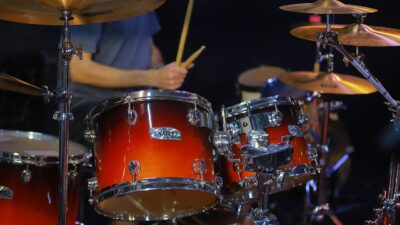
ड्रम किट एक ही वादक द्वारा बजाया जाने वाला वाद्यों का समूह है, जिसे एक स्टूल (थ्रोन) के चारों ओर सजाया जाता है। वादक दोनों हाथों में डंडियाँ (स्टिक्स) पकड़ता है और दोनों पैर पैडल पर रखता है — दायाँ पैर बास ड्रम पर, बायाँ पैर हाई-हैट पर। इस तरह एक व्यक्ति एक साथ चार-पाँच वाद्य बजा लेता है, जो इस किट की सबसे बड़ी विशेषता है।
Description English
The drum kit is a collection of drums and cymbals played by a single seated drummer, arranged around a stool (the 'throne'). The player holds a stick in each hand and works a pedal with each foot — the right foot on the bass drum, the left on the hi-hat. In this way one person plays four or five instruments at once, which is the kit's defining innovation.
Core Components
Hardware
हार्डवेयर (पैडल, स्टैंड, थ्रोन)
Hardware (pedals, stands, throne)
बास-ड्रम पैडल (1909 में विलियम एफ़. लुडविग द्वारा लोकप्रिय), हाई-हैट पैडल, सिम्बल और टॉम के लिए स्टैंड, तथा वादक के बैठने का स्टूल — यही धातु का ढाँचा पूरी किट को एक इकाई के रूप में जोड़ता है।
The bass-drum pedal (popularised by William F. Ludwig in 1909), the hi-hat pedal, stands for cymbals and toms, and the drummer's stool — this metal framework binds the whole kit into a single playable unit.
Sticks
डंडियाँ, ब्रश और मैलेट
Sticks, brushes and mallets
Hickory or maple wood sticks; wire brushes; felt mallets
लकड़ी की डंडियाँ आम बजाव के लिए, तार वाले ब्रश धीमे जैज़/नर्म गीतों के लिए, और मुलायम मैलेट गंभीर, धीमी आवाज़ के लिए प्रयोग होते हैं।
Wooden sticks for general playing, wire brushes for soft jazz/ballad passages, and felt mallets for deep, swelling tones.
Materials
ड्रम के खोल आमतौर पर मेपल, बर्च या मेहॉगनी की परतदार लकड़ी (प्लाई) के, कभी-कभी धातु के भी। झिल्लियाँ (ड्रमहेड) पहले जानवर की खाल की, अब मायलर प्लास्टिक की।
Drum shells are usually layered (ply) maple, birch or mahogany wood, sometimes metal. Heads were once animal skin, now Mylar plastic.
सिम्बल कांस्य-मिश्रधातु (बेल-ब्रॉन्ज़ या B20) के होते हैं।
Cymbals are cast from bronze alloys (bell bronze or B20).
ध्वनि-चरित्र
SoundTonal Character Hindi
ड्रम किट की ध्वनि विस्तृत और शक्तिशाली है — बास ड्रम की गहरी 'बूम', स्नेयर की कड़क 'क्रैक', टॉम की गोल गूँज और सिम्बल की चमकीली झनक। यह मुख्यतः बिना सुर वाला (अ-रागात्मक) ताल-वाद्य है, जिसका काम धुन गाना नहीं बल्कि पूरे गीत को गति, ऊर्जा और ढाँचा देना है।
Tonal Character English
The drum kit's sound is broad and powerful — the deep 'boom' of the bass drum, the sharp 'crack' of the snare, the round resonance of the toms and the bright wash of cymbals. It is essentially an unpitched (non-melodic) rhythm instrument whose job is not to carry a tune but to give the whole song its pulse, energy and architecture.
Timbre
Percussive, wide-band — from sub-bass thump to metallic high-frequency shimmer
Range
Unpitched; spans very low bass-drum frequencies to very high cymbal overtones (roughly the full audible spectrum in noise-band terms)
Dynamic Range
Extremely wide — from a whispered brush stroke to a stadium-filling backbeat, one of the loudest acoustic instruments in an ensemble
Techniques
सुनने का मार्गदर्शन
The Listening Guideड्रम किट को समझना हो तो पहले उसकी परतें अलग-अलग सुनिए — नीचे बास ड्रम की 'बूम', बीच में स्नेयर की 'क्रैक', और ऊपर हाई-हैट व सिम्बल की झिलमिल। फिर गौर कीजिए कि अंतरे से मुखड़े की ओर लौटते समय वादक एक छोटा 'फ़िल' बजाकर मोड़ की घोषणा करता है। किसी पुराने कैबरे नंबर से शुरुआत कीजिए, जहाँ किट सबसे मुखर और चमकदार होती है।
अंग्रेज़ी में पढ़ें · Read in English
When listening to a drum kit, first learn to separate its three layers — the deep 'boom' of the bass drum below, the sharp 'crack' of the snare in the middle, and the shimmer of hi-hat/cymbals above. Then notice how, moving from a song's antara back to the mukhda, the drummer plays a short 'fill' to announce the turn. Begin with an old cabaret number, where the kit is at its most vocal.
परिचय
Identity- Year Of Origin
- 1900
अन्य विवरण
More DetailsTimbre
Percussive, wide-band — from sub-bass thump to metallic high-frequency shimmer
रोचक तथ्य
Margin Notesपैडल ने बदल दी दुनिया — 1909 में विलियम एफ़. लुडविग द्वारा लोकप्रिय बनाया गया व्यावहारिक बास-ड्रम पैडल आधुनिक ड्रम किट का निर्णायक आविष्कार था। इससे पहली बार एक ही वादक पैर से बास ड्रम और हाथों से बाक़ी वाद्य एक साथ बजा सका।
The practical bass-drum pedal popularised by William F. Ludwig in 1909 was the decisive invention of the modern drum kit. For the first time one player could sound the bass drum with a foot while the hands played everything else.
गोवा से बॉलीवुड तक — 1950-70 के दशक में हिंदी फ़िल्म संगीत की रिदम-रीढ़ बड़े पैमाने पर गोवा के मसीही संगीतकार थे। लेस्ली गोडिन्हो को 1956 में संगीतकार जयदेव फ़िल्मों में लाए; उन्होंने बॉलीवुड में कोंगा भी पहली बार बजाया और शंकर-जयकिशन से आर. डी. बर्मन तक अनगिनत गीतों की धड़कन बने।
In the 1950s-70s the rhythmic backbone of Hindi film music was, to a large degree, the Christian musicians of Goa. Leslie Godinho was brought into films by composer Jaidev in 1956; he also introduced the conga to Bollywood and became the pulse of countless songs from Shankar-Jaikishan to R. D. Burman.
एक वादक, चार वाद्य — ड्रम किट की सबसे बड़ी विशेषता यह है कि एक ही व्यक्ति एक साथ चार अंगों — दायाँ हाथ, बायाँ हाथ, दायाँ पैर, बायाँ पैर — से चार अलग वाद्य बजाता है। यह हाथ-पैर की स्वतंत्रता (limb independence) वर्षों के अभ्यास से आती है।
The drum kit's defining feature is that one person plays four separate instruments with four limbs at once — right hand, left hand, right foot, left foot. This limb independence comes only from years of practice.
कैबरे की धड़कन — 1960-70 के हिंदी सिनेमा में नाइटक्लब और कैबरे दृश्य ड्रम किट के बिना अधूरे थे। हेलन जैसी नर्तकियों के 'पिया तू अब तो आजा' जैसे गीतों में किट की तेज़, विद्युत् धड़कन ही परदे पर उस चकाचौंध रात का माहौल रचती थी।
In 1960s-70s Hindi cinema the nightclub and cabaret sequence was incomplete without the drum kit. In numbers like 'Piya Tu Ab To Aaja' for dancers like Helen, it was the kit's fast, electric pulse that built the atmosphere of that dazzling on-screen night.
सवाल-जवाब
Questions & Answersड्रम किट क्या है?
ड्रम किट (या ड्रम सेट, पुराना नाम 'ट्रैप सेट') बास ड्रम, स्नेयर, टॉम और सिम्बलों का एक समूह है, जिसे एक ही वादक दोनों हाथों की डंडियों और दोनों पैरों के पैडल से एक साथ बजाता है। यह मुख्यतः रॉक, पॉप और फ़िल्मी संगीत का बिना-सुर वाला ताल-वाद्य है।
ड्रम किट को 'ट्रैप सेट' क्यों कहते हैं?
'ट्रैप सेट' नाम अंग्रेज़ी शब्द 'contraption' (जुगाड़/यंत्र) से आया है। आरंभिक किटों में काउबेल, वुडब्लॉक और घंटियों जैसे तरह-तरह के जुगाड़ू वाद्य जोड़े जाते थे, जिन्हें 'traps' कहा जाता था — इसी से पूरे सेट का नाम पड़ा।
ड्रम किट भारतीय फ़िल्म संगीत में कब आई?
ड्रम किट हिंदी सिनेमा में 1950-60 के दशक में आई, जब रॉक-एंड-रोल और पश्चिमी रिदम सेक्शन का प्रभाव बढ़ा। यह नाइटक्लब और कैबरे दृश्यों की अनिवार्य ध्वनि बनी; गोवा के संगीतकार (जैसे लेस्ली गोडिन्हो) मुंबई के फ़िल्म-स्टूडियो की रिदम-रीढ़ थे।
ड्रम किट में कौन-कौन से मुख्य भाग होते हैं?
एक मानक ड्रम किट में बास ड्रम (पैर के पैडल से), स्नेयर ड्रम, कुछ टॉम-टॉम (रैक और फ़्लोर टॉम), हाई-हैट (पैर के पैडल से खुलने-बंद होने वाले दो सिम्बल), तथा क्रैश और राइड सिम्बल होते हैं — सब एक धातु के ढाँचे और स्टूल के चारों ओर सजे।
बॉलीवुड के प्रसिद्ध ड्रम-वादक कौन हैं?
अग्रणी वादकों में लेस्ली गोडिन्हो (1950-70 के दशक के गोवा-वादक, 'तीसरी मंज़िल' आदि), रंजीत बरोट, गिनो बैंक्स ('आज की रात', डॉन 2006) और दर्शन दोशी ('नादान परिंदे', रॉकस्टार 2011) शामिल हैं।
नमूना-पट्टी
The Specimen Table| नाम | ड्रम किट · Drum Kit |
|---|---|
| अन्य नाम | ड्रम सेट · ट्रैप सेट (trap set) · ट्रैप्स (traps) · Drum kit (also: drum set, trap set, kit, traps) |
| उद्गम | 1900 |
| प्रकार | वाद्य · Instruments |
इस वाद्य के गीत
Songs of this Instruments
गेट योर पार्टी स्टार्टेड
Get Your Party Started
ध्रुव विश्वनाथ, छवि सोधानी, प्रज्ञा सोधानी · Tu Yaa Main
साझा कीजिए · Share this Plate