शास्त्र विंग · वाद्य-पट्टिका · Instrument Plate
डोबा
Doba
अन्य नामডবা (असमिया / Assamese) · डोबा · Doba (also: Dobaa, Daba)
परिचय
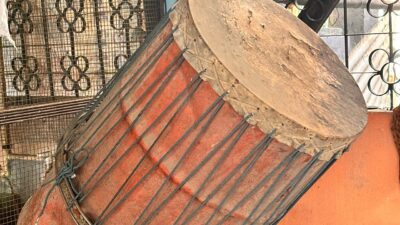
Overviewडोबा असम का विशाल कटोरेनुमा नगाड़ा है — मिट्टी, लकड़ी या धातु के खोल पर मढ़ी चमड़े की झिल्ली, जिसे लकड़ी की दो डंडियों से बजाकर गहरा, दूर तक गूँजता नाद उत्पन्न किया जाता है। श्रीमंत शंकरदेव की एकशरण-वैष्णव परंपरा में जन्मा यह वाद्य ग्रामीण असम के लगभग हर नामघर में मिलता है, जहाँ यह प्रतिदिन प्रातः और संध्या बजकर सामूहिक प्रार्थना का समय घोषित करता है।
अंग्रेज़ी में पढ़ें · Read in English
The doba is Assam's giant bowl-shaped kettledrum — a hide membrane stretched over a shell of clay, wood, or metal, struck with two wooden sticks to produce a deep, far-carrying boom. Born of Srimanta Sankardeva's Ekasarana Vaishnavite tradition, it is found in almost every naamghar of rural Assam, where it sounds each morning and evening to announce the time for congregational prayer.
वर्गीकरण
ClassificationNatya Shastra Category
अवनद्ध (Avanaddha - covered percussion / membranophones)
नाट्यशास्त्र के अवनद्ध वर्ग में डोबा एक झिल्ली-वाद्य है, जिसमें एक बड़े कटोरेनुमा खोल पर चमड़े की झिल्ली मढ़ी जाती है और उसे लकड़ी की डंडियों से आघात करके ध्वनि उत्पन्न की जाती है।
In the Avanaddha (covered/membrane) category of the Natya Shastra, the doba is a membranophone in which an animal-hide membrane is stretched over a large bowl-shaped shell and struck with wooden sticks to produce sound.
Western Category
Membranophone — large single-headed kettledrum
Western Family
Kettledrum family (bowl/cauldron-shaped, single-headed — comparable in principle to the timpani and to the Indian nagara, but far larger and used as a fixed temple drum)
Sub Classification
बनावट
PhysicalDescription Hindi
डोबा असम का एक विशाल कटोरेनुमा नगाड़ा-प्रकार का झिल्ली-वाद्य है। इसका खोल मिट्टी, लकड़ी अथवा धातु का बना होता है और उसके चौड़े मुख पर सुखाई हुई पशु-चमड़े की झिल्ली कसकर मढ़ी जाती है। यह इतना बड़ा होता है कि इसे प्रायः एक ढाँचे या चौकी पर हल्का झुकाकर रखा जाता है ताकि वादक सुविधा से आघात कर सके।
Description English
The doba is a massive bowl-shaped, nagara-type membranophone of Assam. Its shell is made of clay, wood, or metal, and a dried animal-hide membrane is stretched tightly over its wide mouth. It is so large that it is usually placed on a frame or stand at a slight incline so the player can strike it comfortably.
Body
Deep bowl / cauldron / hemispherical kettle shape
गहरे कटोरे या कड़ाही जैसा अर्धगोलाकार खोल
Clay, wood, or metal (regional availability decides the material)
मिट्टी, लकड़ी या धातु (क्षेत्रीय उपलब्धता के अनुसार)
approx. 100 (about one metre tall)
Large enclosed bowl acting as a single deep resonating cavity that gives the doba its booming, far-carrying tone
Strings
The doba is a membranophone and has no strings; sound is produced by a struck hide membrane
None — the doba has no sympathetic strings
None
Membrane
पुड़ी / चमड़े की झिल्ली
Hide membrane (drumhead)
Stretched and dried animal skin/hide fastened over the wide mouth of the shell
खोल के चौड़े मुख पर कसी हुई सुखाई गई पशु-चमड़े की झिल्ली
The single large drumhead is the sounding surface; its tension and thickness produce the doba's characteristic deep resonance
Bow
डंडी (मारि)
Wooden beater sticks
A pair of wooden sticks
N/A
The doba is usually struck with two wooden sticks; in certain ritual moments it may also be beaten by hand
Tuning Pegs
कसाव-रस्सी / काँटे
Lacing / tensioning
The hide is held and tensioned by lacing or fastening around the rim of the bowl rather than by tuning pegs
Bridge
लागू नहीं
N/A
Not applicable — the doba has no bridge
N/A
Frets
डोबा एक ताल-वाद्य है, इसमें फ्रेट या स्वर-पर्दे का प्रश्न ही नहीं उठता; यह लयबद्ध गहन नाद के लिए है, धुन के लिए नहीं।
As a percussion instrument the doba has no frets or pitched fingerboard; it exists for deep rhythmic sound and signalling, not melody.
ध्वनि-चरित्र
SoundTonal Character Hindi
डोबा की ध्वनि गहरी, गूँजती और दूर तक फैलने वाली होती है। इसका नाद इतना भारी और मर्मस्पर्शी होता है कि पूरे गाँव में गूँज उठता है — प्रातः और संध्या की प्रार्थना का सूचक बनकर वातावरण में एक पवित्र, गंभीर भाव भर देता है।
Tonal Character English
The doba's sound is deep, resonant, and far-carrying. Its heavy, sonorous boom echoes across an entire village — announcing morning and evening prayer and filling the air with a solemn, sacred atmosphere.
Timbre
Deep, booming, cavernous low resonance with a long decay
Range
Low, untuned bass register; a single powerful fundamental rather than a melodic range
Dynamic Range
From measured devotional strokes to thunderous full beats audible across long distances without amplification
Techniques
सुनने का मार्गदर्शन
The Listening Guideडोबा को समझना हो तो इसे किसी नामघर की प्रातः या संध्या-वेला में सुनिए — पहले एक गहरा, अकेला नाद उठता है, फिर लय बँधती है और वातावरण में गंभीर शांति उतरती है। इसे मंचीय राग-संगीत की तरह नहीं, बल्कि स्थान और क्षण से जुड़े सामूहिक अनुभव की तरह सुनिए।
अंग्रेज़ी में पढ़ें · Read in English
To appreciate the doba, hear it at a naamghar's dawn or dusk hour — first a deep, solitary boom rises, then a rhythm settles, and a solemn stillness descends on the surroundings. Listen to it not like concert raga music but as a communal experience bound to place and moment. Hearing it with khol and tal at Doul Utsav reveals its full power.
परिचय
Identity- Year Of Origin
- 1500
अन्य विवरण
More Details- Timbre
- Deep, booming, cavernous low resonance with a long decay
रोचक तथ्य
Margin Notesसमय की घड़ी, प्रार्थना का शंख — आधुनिक घड़ियों के आने से पहले, नियत समय पर बजने वाला डोबा ही ग्रामीण असम की सामूहिक घड़ी था। इसका गंभीर नाद न केवल समय बताता था, अपितु प्रार्थना के लिए पूरे गाँव को एक साथ आमंत्रित भी करता था।
Before modern clocks, the doba sounded at fixed hours served as rural Assam's collective clock. Its solemn boom not only told the time but summoned the whole village together for prayer.
एक खोल, तीन पदार्थ — डोबा के खोल का पदार्थ क्षेत्रीय उपलब्धता पर निर्भर करता है — कहीं मिट्टी का, कहीं लकड़ी का, तो कहीं धातु का। इसी कारण अलग-अलग क्षेत्रों के डोबा की गूँज में सूक्ष्म भिन्नता पाई जाती है।
The doba's shell material depends on regional availability — clay in some places, wood in others, metal elsewhere. Because of this, dobas from different regions differ subtly in resonance.
शंकरदेव की विरासत का ताल — डोबा असम की एकशरण-वैष्णव परंपरा से जुड़ा है, जिसे 15वीं-16वीं शताब्दी में श्रीमंत शंकरदेव ने प्रवर्तित किया। नामघर और सत्र की इस उपासना-संस्कृति में डोबा, खोल और ताल मिलकर सामूहिक भक्ति का नाद रचते हैं।
The doba is tied to Assam's Ekasarana Vaishnavite tradition, propagated by Srimanta Sankardeva in the 15th-16th centuries. In the naamghar-and-Sattra worship culture, doba, khol, and tal together weave the sound of collective devotion.
सवाल-जवाब
Questions & Answersडोबा क्या है?
डोबा असम का एक विशाल कटोरेनुमा झिल्ली-वाद्य (नगाड़ा-प्रकार) है, जिसका खोल मिट्टी, लकड़ी या धातु का होता है और उस पर पशु-चमड़े की झिल्ली मढ़ी जाती है। इसे लकड़ी की दो डंडियों से बजाया जाता है और यह नामघर एवं सत्र की वैष्णव उपासना-परंपरा का अंग है।
डोबा कैसे बजाया जाता है?
डोबा को सामान्यतः दो लकड़ी की डंडियों से आघात करके बजाया जाता है; कुछ विशेष धार्मिक अवसरों पर इसे हाथ से भी बजाया जाता है। यह इतना बड़ा होता है कि इसे ढाँचे पर हल्का झुकाकर रखा जाता है।
नामघर में डोबा क्यों बजाया जाता है?
ग्रामीण असम के नामघरों में डोबा प्रतिदिन दो बार — प्रातः और संध्या — बजाकर सामूहिक प्रार्थना का समय घोषित किया जाता है। यह सभा-आह्वान और आपातकालीन चेतावनी के लिए भी बजता है, और इसका गंभीर नाद वातावरण में पवित्रता भर देता है।
डोबा किस परंपरा से जुड़ा है?
डोबा असम की एकशरण-वैष्णव (नाम-धर्म) परंपरा से जुड़ा है, जिसे 15वीं-16वीं शताब्दी में श्रीमंत शंकरदेव ने प्रवर्तित किया। यह नामघर, सत्र, अंकिया नाट, भाओना और दौल उत्सव जैसे अवसरों का वाद्य है।
नमूना-पट्टी
The Specimen Table| नाम | डोबा · Doba |
|---|---|
| अन्य नाम | ডবা (असमिया / Assamese) · डोबा · Doba (also: Dobaa, Daba) |
| उद्गम | 1500 |
| प्रकार | वाद्य · Instruments |
साझा कीजिए · Share this Plate