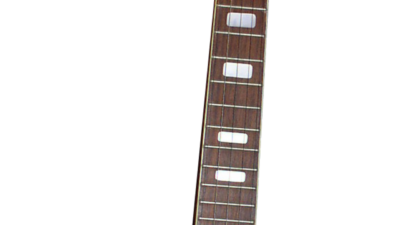
शास्त्र विंग · वाद्य-पट्टिका · Instrument Plate
बैंजो
Banjo
अन्य नामबैंजो (पाँच-तार वाला) · पश्चिमी बैंजो · Five-string banjo · Bluegrass banjo
परिचय
Overviewबैंजो एक पश्चिमी पाँच-तार वाला वाद्य है जिसका शरीर असल में एक ढोल है — कसी हुई झिल्ली पर टिके पुल से धातु के तार खनकते हैं और उसका छोटा पाँचवाँ ड्रोन तार लगातार चमकती गूँज देता है। पश्चिम अफ़्रीका की लौकी-लूट से जन्मा, अमेरिका में ब्लूग्रास और लोकसंगीत की रीढ़ बना, यह वाद्य गोवा के संगीतकारों के हाथों हिंदी सिनेमा के पश्चिमी-रंग व कैबरे गीतों तक पहुँचा। ध्यान रहे — भारतीय बोलचाल का 'बैंजो' प्रायः बुलबुल तरंग होता है, यह अमेरिकी बैंजो नहीं।
अंग्रेज़ी में पढ़ें · Read in English
The banjo is a Western five-string instrument whose body is really a drum — metal strings jangle through a bridge resting on a stretched membrane, while its short fifth drone string supplies a constant shimmering ring. Born from the gourd-lutes of West Africa and made the backbone of bluegrass and folk in America, it reached Hindi cinema's Western-flavoured and cabaret songs through Goan musicians. Note well — the everyday Indian 'banjo' is usually the bulbul tarang, not this American banjo.
वर्गीकरण
ClassificationNatya Shastra Category
तत (Tata - stringed instruments)
यदि इसे नाट्यशास्त्र की परंपरागत चार श्रेणियों में रखा जाए तो बैंजो 'तत' (तार वाले) वर्ग में आएगा, क्योंकि ध्वनि तारों को नोचने/झंकारने से उत्पन्न होती है। किंतु इसकी विशेषता यह है कि यह तत और अवनद्ध (चमड़े की झिल्ली) दोनों का मेल है — तार एक ढोलनुमा झिल्ली पर टिके पुल से गुँजते हैं।
Placed within the traditional four categories of the Natya Shastra, the banjo would fall under 'Tata' (stringed), since sound is produced by plucking/strumming strings. Uniquely, however, it blends Tata (string) and Avanaddha (membrane) principles — the strings resonate through a bridge that sits on a stretched drumhead.
Western Category
Plucked string instrument (membrane-resonated chordophone)
Western Family
Lute family — specifically a spike-lute with a drum-like resonating head, related to the guitar and mandolin but with a stretched membrane belly instead of a wooden soundboard
Sub Classification
बनावट
PhysicalDescription Hindi
बैंजो एक पश्चिमी तार-वाद्य है जिसका शरीर एक गोल 'पॉट' (ढोल जैसा घेरा) होता है जिस पर चमड़े या प्लास्टिक की झिल्ली (हेड) कसी रहती है; इसी झिल्ली पर एक तैरता हुआ पुल टिका रहता है। लंबी फ्रेट वाली गर्दन पर आमतौर पर पाँच धातु के तार होते हैं, जिनमें पाँचवाँ तार छोटा 'ड्रोन' तार है जिसकी अपनी अलग खूँटी गर्दन के बीचोबीच (5वें फ्रेट पर) लगी होती है। यही झिल्ली-गूँज इसे तीखी, खनकती, ढोल-सी चमक देती है।
Description English
The banjo is a Western string instrument whose body is a circular 'pot' (a drum-like rim) over which a skin or plastic membrane (the head) is stretched; a floating bridge rests directly on this head. A long fretted neck carries usually five metal strings, of which the fifth is a short 'drone' string with its own separate peg set into the side of the neck (at the 5th fret). This membrane resonance gives the banjo its bright, jangling, drum-like ring.
Body
Circular drum-like pot (rim) with a stretched membrane head; often backed by a wooden resonator (bluegrass) or left open-back (old-time/clawhammer)
गोल ढोलनुमा घेरा (पॉट) जिस पर झिल्ली कसी होती है; ब्लूग्रास बैंजो में पीछे लकड़ी का रेज़ोनेटर, पुराने-ढंग के बैंजो में खुली पीठ
Maple or mahogany rim and neck; a metal 'tone ring'; head of calfskin (traditional) or Mylar/plastic (modern); metal tension brackets/hooks
मेपल या महोगनी का घेरा व गर्दन; धातु का 'टोन रिंग'; झिल्ली पहले बछड़े की खाल की, अब मायलर/प्लास्टिक की; कसने के लिए धातु के हुक
90-100 (overall length); pot diameter approx. 28 cm (11 inch)
Stretched membrane head over an open or resonator-backed rim — a drumhead that amplifies string vibration percussively
Strings
Four full-length melody/rhythm strings plus one short high drone string
The banjo has NO sympathetic (resonating) strings, unlike the sitar or sarangi. Its shimmer comes from the drum-head resonance and the short 5th drone string, not from tarab strings.
The short 5th string acts as a re-entrant high drone, repeatedly sounded in rolls to create the banjo's characteristic ringing pulse
Bow
कोई नहीं (नोचकर/झंकारकर बजाया जाता है)
None (plucked/strummed, not bowed)
N/A — played with fingerpicks or bare fingers/nails
N/A
Played with metal/plastic fingerpicks (Scruggs three-finger style) or with the back of the nail in a downward 'clawhammer/frailing' stroke
Tuning Pegs
खूँटियाँ (ट्यूनिंग पेग/गियर)
Tuning pegs / geared tuners
Four pegs at the peghead plus one geared peg set into the side of the neck at the 5th fret for the short drone string
Bridge
पुल (ब्रिज)
Bridge
A small floating maple-and-ebony bridge that stands directly on the membrane head, transmitting string vibration into the drumhead
Maple with an ebony cap
Frets
बैंजो फ्रेट वाला वाद्य है — गिटार की तरह गर्दन पर धातु के फ्रेट होते हैं जो निश्चित (डायटॉनिक/समान) स्वर देते हैं। इसीलिए यह भारतीय मीड (सतत सुर-सर्पण) के लिए सारंगी जैसा उपयुक्त नहीं; यह टंकार, रोल और तेज़ लय के लिए बना है।
The banjo is a fretted instrument — metal frets on the neck give fixed (diatonic/tempered) pitches, like a guitar. Hence it is not suited to Indian 'meend' (continuous glide) the way a sarangi is; it is built for jangling rolls, arpeggios and fast rhythm.
ध्वनि-चरित्र
SoundTonal Character Hindi
बैंजो की ध्वनि तीखी, चमकीली, धातुई और टक्करदार (percussive) होती है — हर स्वर तेज़ी से उभरता और जल्दी बुझता है, जिससे 'खनक-खनक' की झरनेदार लय बनती है। पाँचवें ड्रोन तार की लगातार झंकार इसे एक ख़ुशमिज़ाज, कदमताल जैसी रवानी देती है।
Tonal Character English
The banjo's tone is bright, jangly, metallic and percussive — each note attacks sharply and decays quickly, producing a cascading, rolling pulse. The constant ring of the fifth drone string lends it a cheerful, marching-forward momentum.
Timbre
Bright, twangy, staccato, drum-resonant; more percussive than a guitar
Range
Roughly two octaves; open-G banjo lowest note D3, reaching up the 22-fret neck to about D5-G5
Dynamic Range
Naturally loud and cutting — historically valued because it projected over a full string band without amplification
Techniques
सुनने का मार्गदर्शन
The Listening Guideबैंजो का मज़ा लेना हो तो पहले एक तेज़ ब्लूग्रास 'ब्रेकडाउन' सुनिए और उस झरनेदार 'रोल' पर ध्यान दीजिए जिसमें छोटा पाँचवाँ तार बार-बार चमकता है। फिर पुराने-ढंग (clawhammer) की ढोल-सी धीमी लय सुनिए। अंत में किसी पुराने हिंदी फ़िल्मी सफ़र या पिकनिक गीत में उस हल्की, चुलबुली टंकार को खोजिए जहाँ बैंजो पश्चिमी रंग भरता है — यह वाद्य आँसू का नहीं, मुस्कान का है।
अंग्रेज़ी में पढ़ें · Read in English
Begin your banjo listening with a fast bluegrass 'breakdown' — tune your ear to the cascading 'roll' in which the short high fifth string keeps flashing. Then hear the slower, drum-like pulse of old-time clawhammer and feel how percussive the instrument is. Finally, hunt for the light, bouncy jangle in an old Hindi-film picnic/travel song — there the banjo supplies its Western colour.
परिचय
Identity- Year Of Origin
- 1830
अन्य विवरण
More DetailsTimbre
Bright, twangy, staccato, drum-resonant; more percussive than a guitar
रोचक तथ्य
Margin Notesअफ़्रीका से अमेरिका तक की यात्रा — बैंजो के पूर्वज पश्चिम अफ़्रीका के लौकी-शरीर वाले तार-वाद्य (अकोंटिंग, नगोनी) थे। ग़ुलामी के दौर में अफ़्रीकी लोग इनकी स्मृति अमेरिका ले गए, जहाँ लौकी और खाल से 'गोर्ड बैंजो' बने और फिर आधुनिक बैंजो में ढले। यह वाद्य अफ़्रीकी-अमेरिकी संगीत-विरासत का जीवंत प्रतीक है।
The banjo's ancestors were the gourd-bodied string instruments of West Africa (akonting, ngoni). Enslaved Africans carried their memory to America, where 'gourd banjos' of gourd and skin were built and later evolved into the modern banjo. The instrument is a living symbol of African-American musical heritage.
बैंजो बनाम बुलबुल तरंग — नाम का भ्रम — भारत में जिसे आम बोलचाल में 'बैंजो' कहा जाता है, वह असल में बुलबुल तरंग है — एक कुंजी (key) वाला तार-वाद्य जो जापानी ताइशोगोतो से उपजा और 1930 के दशक में भारत पहुँचा। यह पश्चिमी पाँच-तार वाले बैंजो से पूरी तरह भिन्न वाद्य है; केवल नाम साझा है।
What is colloquially called 'banjo' in India is actually the bulbul tarang — a keyed string instrument descended from the Japanese taishogoto that reached India in the 1930s. It is an entirely different instrument from the Western five-string banjo; only the name is shared.
गोवा के संगीतकार और बॉलीवुड ऑर्केस्ट्रा — 1950-70 के दशक में पश्चिमी वाद्य बजाना मुख्यतः गोवा के (ईसाई) संगीतकार जानते थे। सेबेस्टियन डिसूज़ा और एंथनी गॉन्साल्विस जैसे अरेंजर और असंख्य गोवा वादक शंकर-जयकिशन, सी. रामचंद्र, ओ.पी. नैयर, एस.डी. बर्मन आदि के लिए वाद्यवृंद सजाते थे — बैंजो जैसे पश्चिमी वाद्य इसी रास्ते हिंदी फ़िल्म-संगीत में आए।
In the 1950s-70s, it was chiefly Goan (Christian) musicians who knew how to play the Western instruments. Arrangers like Sebastian D'Souza and Anthony Gonsalves, and countless Goan instrumentalists, built the orchestras for Shankar-Jaikishan, C. Ramchandra, O.P. Nayyar, S.D. Burman and others — Western instruments such as the banjo entered Hindi film music this way.
बैंजो का शरीर एक ढोल है — बैंजो अकेला ऐसा आम तार-वाद्य है जिसका गुंजायमान शरीर लकड़ी की पटरी नहीं, बल्कि कसी हुई झिल्ली (ढोल का हेड) है। इसीलिए यह तत (तार) और अवनद्ध (चमड़े) दोनों वर्गों का मेल-सा लगता है और इसकी ध्वनि इतनी टक्करदार होती है।
The banjo is the one common string instrument whose resonating body is not a wooden soundboard but a stretched membrane (a drumhead). Hence it seems to straddle the Tata (string) and Avanaddha (membrane) categories, and this is why its sound is so percussive.
सवाल-जवाब
Questions & Answersबैंजो क्या है?
बैंजो एक पश्चिमी तार-वाद्य है जिसका शरीर एक गोल ढोलनुमा घेरा होता है जिस पर झिल्ली (हेड) कसी रहती है; इसी पर पुल टिका रहता है। आमतौर पर इसके पाँच धातु के तार होते हैं और यह अमेरिकी ब्लूग्रास व लोकसंगीत का प्रमुख वाद्य है।
बैंजो के कितने तार होते हैं?
सबसे प्रचलित पाँच-तार वाले बैंजो में पाँच तार होते हैं, जिनमें पाँचवाँ एक छोटा ऊँचा 'ड्रोन' तार है जिसकी अपनी खूँटी गर्दन के बीच (5वें फ्रेट पर) लगी होती है। टेनर बैंजो जैसे रूपों में चार तार भी होते हैं।
क्या भारतीय 'बैंजो' और अमेरिकी बैंजो एक ही हैं?
नहीं। भारत में बोलचाल का 'बैंजो' असल में बुलबुल तरंग है — एक कुंजी वाला तार-वाद्य जो जापानी ताइशोगोतो से उपजा और 1930 के दशक में भारत आया। पश्चिमी पाँच-तार वाला बैंजो पूरी तरह अलग वाद्य है; केवल नाम साझा है।
बैंजो हिंदी सिनेमा में कैसे आया?
बैंजो हिंदी सिनेमा में पश्चिमी वाद्यवृंद के रास्ते आया। 1950-70 के दशक के स्टूडियो-ऑर्केस्ट्रा में गोवा के संगीतकार पश्चिमी वाद्य बजाते थे। पश्चिमी-रंग, कैबरे और सफ़र-गीतों में बैंजो की तीखी टंकार सुनी जाती है; 'आज़ाद' (1955) के 'कितना हसीन है मौसम' में मीना कुमारी को बैंजो बजाते दिखाया गया है।
बैंजो और गिटार में क्या अंतर है?
दोनों फ्रेट वाले, नोचकर बजाए जाने वाले तार-वाद्य हैं, पर बैंजो का गुंजायमान शरीर लकड़ी की पटरी नहीं बल्कि कसी हुई झिल्ली (ढोल का हेड) है, और उसका पाँचवाँ ड्रोन तार अनोखा है। इसीलिए बैंजो अधिक तीखा, चमकीला और टक्करदार सुनाई देता है।
नमूना-पट्टी
The Specimen Table| नाम | बैंजो · Banjo |
|---|---|
| अन्य नाम | बैंजो (पाँच-तार वाला) · पश्चिमी बैंजो · Five-string banjo · Bluegrass banjo · Banjar / Banjo (also spelt Banjoe historically) |
| उद्गम | 1830 |
| प्रकार | वाद्य · Instruments |
जुड़े हुए पन्ने
Connected Plates · The Graph Made Visibleअटलस में कोई पन्ना अकेला नहीं — इस वाद्य से जुड़े गीत, कलाकार, शास्त्र और कहानियाँ, सब यहाँ से खुलते हैं।
जुड़े गीत · Songs
इस वाद्य के गीत
Songs of this Instruments



साझा कीजिए · Share this Plate