गीत विंग · गीत-पट्टिका · Song Plate
दिन से दुगुनी हो जाए रतिया
Din Se Duguni Ho Jaye Ratiya
रात दिन से दुगुनी हो जाती है — सहगल विरह की धीमी पीड़ा को गाते हैं।
भावभक्ति · उदास · Yearning
भाषाhindi गतिधीमी स्वरूपएकल पुरुष
श्रेय
The Creditsसूत्र-वाक्य · The Hook
सूत्र-वाक्य
रात दिन से दुगुनी हो जाती है — सहगल विरह की धीमी पीड़ा को गाते हैं।
In EnglishThe night grows twice as long as the day — Saigal sings the slow torment of separation.
पट्टिका-लेख
The Monographपरिचय Overview
भक्त सूरदास का एक विरह-गीत जिसमें वियोग की रात दिन से दुगुनी लंबी हो जाती है। के. एल. सहगल द्वारा गाया गया, यह भक्ति और उप-शास्त्रीय काव्य के शास्त्रीय विरह-भाव पर आधारित है — आत्मा अनुपस्थित प्रिय या प्रभु के लिए तड़पती हुई।
अंग्रेज़ी में पढ़ें · Read in English
A song of longing from Bhakta Surdas in which the night of separation stretches to twice the length of the day. Sung by K. L. Saigal, it draws on the classic viraha (separation) sentiment of devotional and semi-classical verse, the soul aching for the absent beloved or the divine.
संगीत The Music
ज्ञान दत्त इस विलाप को एक धीमी, खिंची हुई लय में रचते हैं जो बोल की लंबी होती रात को संगीत में साकार करती है। सहगल अपने विशिष्ट अंतर्मुखी भार के साथ ठहरे स्वरों पर रुकते हैं, और विरल संगत आवाज़ में बसी टीस को खुला छोड़ देती है।
अंग्रेज़ी में पढ़ें · Read in English
Gyan Dutt sets the lament in a slow, drawn-out tempo that musically enacts the lengthening night of the lyric. Saigal lingers over the sustained notes with his characteristic introspective weight, and the sparse arrangement leaves the ache exposed in the voice.
काव्य The Poetry
शीर्षक विरह-रस को अपने सबसे संकुचित काव्यात्मक रूप में व्यक्त करता है: बिछोह की रात शाब्दिक रूप से दिन से दुगुनी लंबी है, अनुपस्थिति के दबाव में समय स्वयं खिंच जाता है। यह कालिक विकृति सूरदास के विरह-पदों में एक प्रमुख परंपरा है — सूरसागर में कृष्ण-विहीन गोपियों की रातों का वर्णन ठीक इसी अवधि-विस्तार पर टिका है। 'रतिया' शब्द, ब्रज भाषा के लघु-प्रत्यय के साथ, भक्ति-मुहावरे की पहचान है: यह रात को आत्मीय और निकट बनाता है, भले ही वह कुछ विशाल और असहनीय का वर्णन करती हो। माधोक, सूरदास के ढाँचे के भीतर काम करते हुए, इस कालबोध को कविता की भावात्मक संरचना के रूप में प्रयुक्त करते हैं। दुगुनापन — दिन बनाम रतिया, परिचित माप बनाम असहनीय विस्तार — एक सरल विरोधाभास है जो भारी भक्तिमय भार वहन करता है। सहगल की आवाज़ के लिए, जो 1942 तक भक्ति-विलाप की धीमी टीस से अविभाज्य हो चुकी थी, यह कविता एक आदर्श माध्यम है।
अंग्रेज़ी में पढ़ें · Read in English
The title captures the viraha (separation) rasa in its most compressed poetic form: the night of longing is literally twice the length of the day, time itself dilating under the pressure of absence. This temporal distortion is a governing convention in Surdas's viraha padas — the Sursagar's accounts of the gopīs' nights without Krishna dwell on exactly this stretching of duration. The word 'ratiya', using the Braj Bhasha diminutive suffix, is characteristic of the devotional register: it makes the night intimate and near even as it describes something vast and unbearable. D.N. Madhok, working within the Surdas framework, deploys this time-sense as the poem's emotional architecture. The doubling — din (day) against ratiya (night), the familiar measure against the unbearable extension — is a simple opposition that carries enormous devotional freight. For Saigal's voice, which by 1942 was inseparable from the slow ache of the devotional lament, the poem is a perfect vehicle.
कहानी The Story
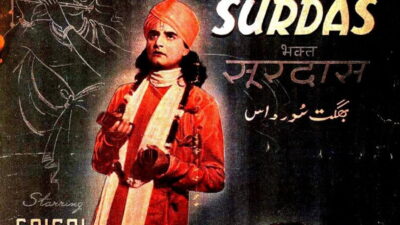
भक्त सूरदास (1942, रणजीत स्टूडियोज़, निर्देशक चतुर्भुज दोशी) में विरह कोई आकस्मिक भावनात्मक स्वर नहीं है बल्कि फ़िल्म की मूल धुरी है — अंधे संत सूरदास ने अपना जीवन उस ईश्वर की चाहत में बिताया जिसे वे देख नहीं सकते थे। ज्ञान दत्त के संगीत ने सहगल को इस भक्ति-विस्तार में कई एकल गीत दिए; रात-विलाप संत-जीवनी शैली का एक स्वाभाविक और अपेक्षित घटक था। 1942 तक, रणजीत स्टूडियोज़ ने एक दशक के पौराणिक और भक्ति विषयों में ऐसी फ़िल्मों के निर्माण को परिपक्व कर लिया था, और यह विरह एकल फ़िल्म के आख्यान-चाप में एक विशिष्ट भावनात्मक कार्य निभाता था — किसी कथा-मोड़ से पहले संत की लालसा का सबसे अंधेरा क्षण। फ़िल्म उस संक्रमण के क्षण में बनी जब सहगल नए-नए बंबई पहुँचे थे और स्टूडियो-व्यवस्था स्वयं अपने अंतिम प्रतिस्पर्धी चरण में प्रवेश कर रही थी।
अंग्रेज़ी में पढ़ें · Read in English
In Bhakta Surdas (1942, Ranjit Studios, dir. Chaturbhuj Doshi), viraha is not an incidental emotional note but the film's very core — the blind saint Surdas spent his life in a state of longing for the God he could not see. Gyan Dutt's score for the film gave Saigal several solos across this devotional spectrum; the night-lament was a natural and expected component of the saint-biopic genre. By 1942, Ranjit Studios had honed the production of such films across a decade of mythological and devotional subjects, and this viraha solo would have occupied a specific emotional function in the film's narrative arc — the saint's darkest hour of longing before some narrative turn. The film was made at a moment of transition for both Saigal, newly arrived in Bombay, and for the studio system itself, which was entering its final competitive phase before Partition reshaped the industry.
वर्गीकरण
Classification- Tempo
- Slow
Genre
अन्य विवरण
More Details- https://en.wikipedia.org/wiki/Bhakta_Surdas
- https://en.wikipedia.org/wiki/Surdas
- https://en.wikipedia.org/wiki/K._L._Saigal
- https://en.wikipedia.org/wiki/D._N._Madhok
References
रोचक तथ्य
Margin Notesपरंपरा के अनुसार माना जाता है कि सूरदास (लगभग 1478–1583) जन्म से नेत्रहीन थे; कृष्ण को न देख पाने की उनकी भक्ति-वेदना ने विरह-परंपरा को एक ऐसा आयाम दिया, जिसमें नेत्रहीनता स्वयं एक आध्यात्मिक रूपक बन गई — केवल अंतर्नेत्र से ईश्वर को देखना।
अंग्रेज़ी में पढ़ें · Read in English
Surdas (c.1478–1583) is believed by tradition to have been blind from birth; his devotional anguish at not being able to see Krishna gave the viraha (separation) tradition a dimension in which blindness itself became a spiritual metaphor — seeing God only with the inner eye.
के.एल. सहगल 1940 के दशक की शुरुआत में कलकत्ता से बॉम्बे स्थानांतरित हुए; रणजीत स्टूडियो में बनी भक्त सूरदास उनके बॉम्बे-कालीन शुरुआती फ़िल्मों में से एक थी।
अंग्रेज़ी में पढ़ें · Read in English
K.L. Saigal relocated from Calcutta to Bombay in the early 1940s; Bhakta Surdas, made at Ranjit Studios, was among his first Bombay-period films.
डी.एन. मधोक के फ़िल्म के लिए ब्रजभाषा भक्ति-परंपरा के रूपांतरण ने इसके विशिष्ट लघुरूपों — जैसे 'रतिया' ('रात' से बना) — को बनाए रखा, जिससे कविता की आत्मीयता संरक्षित रहते हुए इसे लोकप्रिय दर्शकों के लिए सुलभ बनाया गया।
अंग्रेज़ी में पढ़ें · Read in English
D.N. Madhok's adaptation of the Braj Bhasha devotional tradition for film retained its characteristic diminutives such as 'ratiya' (little night, from 'raat'), preserving the poetry's intimacy while making it accessible to popular audiences.
भक्त सूरदास के लिए ज्ञान दत्त की न्यूनतम वाद्यवृंद-शैली — मुख्यतः हारमोनियम और हल्की तालवाद्य — ने अभिव्यक्ति का भार आवाज़ पर डाल दिया, जो सहगल की अंतर्मुखी प्रस्तुति के लिए पूर्णतः उपयुक्त था।
अंग्रेज़ी में पढ़ें · Read in English
Gyan Dutt's minimal orchestral style for Bhakta Surdas — predominantly harmonium and light percussion — placed the burden of expression on the voice, suiting Saigal's introspective delivery perfectly.
नमूना-पट्टी
The Specimen Table| शीर्षक | दिन से दुगुनी हो जाए रतिया · Din Se Duguni Ho Jaye Ratiya |
|---|---|
| फ़िल्म | भक्त सूरदास · 1942 |
| वर्ष · युग | 1942 |
| गायक | K.L. Saigal |
| गीतकार | D. N. Madhok |
| संगीतकार | Gyan Dutt |
| स्वरूप | एकल पुरुष |
| गति | धीमी |
| भाषा | hindi |
| भाव | भक्ति · उदास · Yearning |
| लोकप्रियता | Popular |
| बोल-स्थिति | केवल झलक |
जुड़े हुए पन्ने
Connected Plates · The Graph Made Visibleअटलस में कोई पन्ना अकेला नहीं — इस गीत से जुड़े गीत, कलाकार, फ़िल्म, राग-ताल-विधा, सब यहाँ से खुलते हैं।
मिलते-जुलते गीत · Related Songs
कलाकार · The Artists
फ़िल्म · The Film
साझा कीजिए · Share this Plate