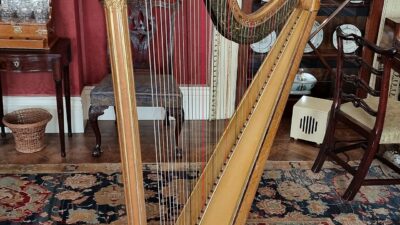
शास्त्र विंग · वाद्य-पट्टिका · Instrument Plate
हार्प
Harp
अन्य नामहार्प · वीणा-यंत्र (पश्चिमी) · पेडल हार्प / कॉन्सर्ट हार्प · Harp (also: Concert Harp, Pedal Harp)
परिचय
Overviewहार्प एक बड़ा त्रिकोणाकार पश्चिमी तार-वाद्य है, जिसके 47 तार उँगलियों से झंकृत किए जाते हैं और सात पेडल पाँवों से स्वर बदलते हैं। हिन्दी फ़िल्म-संगीत में यह कभी प्रमुख धुन-वाहक नहीं रहा, पर स्वर्णयुग के भव्य स्टूडियो-आर्केस्ट्रा में इसकी 'ग्लिसांडो' लहरें स्वप्न-दृश्यों और रोमांटिक इंट्रो में वह जादुई झिलमिलाहट जोड़ती थीं जो आज भी उस दौर की पहचान है।
अंग्रेज़ी में पढ़ें · Read in English
The harp is a large triangular Western string instrument whose 47 strings are plucked with the fingers while seven foot pedals change the pitches. It was never a lead melody-carrier in Hindi film music, but in the grand studio orchestras of the golden age its 'glissando' waves lent dream sequences and romantic intros the magical shimmer that still defines that era.
वर्गीकरण
ClassificationNatya Shastra Category
तत (Tata - stringed instruments)
नाट्यशास्त्र की वर्गीकरण-पद्धति में हार्प 'तत' (तार-वाद्य) वर्ग में आता है, क्योंकि इसकी ध्वनि उँगलियों से तारों को झंकृत (pluck) करने पर उत्पन्न होती है। यह एक पश्चिमी वाद्य है, अतः प्राचीन भारतीय वर्गीकरण में सीधे सम्मिलित नहीं था, किन्तु ध्वनि-उत्पादन के सिद्धांत के अनुसार यह वीणा-कुल (तत-वितत) के 'तत' उपवर्ग से मेल खाता है। उल्लेखनीय है कि प्राचीन भारत में भी 'चाप-वीणा' (धनुषाकार आर्च हार्प) प्रचलित थी, जिसकी झलक अजंता के भित्तिचित्रों तथा तमिल 'याळ' (yazh) में मिलती है।
In the Natya Shastra classification, the harp belongs to the 'Tata' (plucked-string) category, since its sound is produced by plucking strings with the fingers. Being a Western instrument, it was not part of the original ancient Indian taxonomy, but by its sound-production principle it maps to the 'Tata' sub-class of the vina family. Notably, ancient India also had the arched 'chaap-veena' (bow harp), glimpsed in the Ajanta murals and in the Tamil 'yazh'.
Western Category
Plucked string instrument (chordophone)
Western Family
Harp family — an open, triangular frame chordophone whose strings run at an angle to the soundboard (distinct from the lute, zither and lyre families)
Sub Classification
बनावट
PhysicalDescription Hindi
हार्प एक बड़ा, त्रिकोणाकार तार-वाद्य है जिसमें एक घुमावदार 'गर्दन' (neck), एक सीधा 'स्तंभ' (column/pillar) और एक झुका हुआ 'ध्वनि-पटल' (soundboard) मिलकर तिकोना ढाँचा बनाते हैं। तार ऊपर से नीचे तक क्रमशः छोटे से बड़े होते जाते हैं और सीधे उँगलियों से झंकृत किए जाते हैं। कॉन्सर्ट (पेडल) हार्प लगभग 1.8 मीटर ऊँचा और 30–40 किलो भारी होता है।
Description English
The harp is a large, triangular string instrument whose curved 'neck', vertical 'column/pillar' and slanted 'soundboard' together form a triangular frame. Its strings, running longest to shortest, are plucked directly with the fingers. A concert (pedal) harp stands about 1.8 m tall and weighs 30–40 kg.
Body
Triangular frame — soundboard, neck and column meeting at three corners
त्रिकोणाकार ढाँचा — ध्वनि-पटल, गर्दन और स्तंभ तीन कोनों पर मिलते हैं
Wood (soundboard usually spruce; frame of maple/beech), often gilded and carved on concert models
लकड़ी (ध्वनि-पटल प्रायः स्प्रूस; ढाँचा मेपल/बीच), कॉन्सर्ट माडल में अक्सर सोने की पॉलिश और नक्काशी
170-190
Hollow, tapering soundbox beneath the soundboard that amplifies string vibration
Strings
Playing strings spanning six and a half octaves, plucked directly by both hands
The harp has no sympathetic strings — every string is a playing string; its shimmering resonance comes from the large open soundboard, not from tarab strings as on the sarangi or sitar
The harp has no dedicated drone strings; sustained resonance is created by letting struck strings ring on the open soundboard
Bow
कोई नहीं (झंकृत वाद्य)
None (a plucked instrument)
N/A — the harp is played by plucking, not bowing
0
Played with the pads of the fingers and thumbs of both hands (the little finger is not used); the sweeping 'glissando' is made by dragging a finger across many strings
Tuning Pegs
ट्यूनिंग पिन / खूँटियाँ
Tuning pins
Metal tuning pins along the neck adjust the base pitch of each string; a separate tuning key turns them
Bridge
ध्वनि-पटल की डोरी-कीलें
Soundboard eyelets / string ribs
Strings pass through eyelets on the reinforced ribs of the soundboard, transmitting their vibration into the soundbox
Wood soundboard with metal eyelets
Frets
हार्प में फ्रेट नहीं होते, किन्तु सारंगी की तरह मीड भी सम्भव नहीं। इसके सात पेडल (या लीवर) हर स्वर को आधा/पूरा स्वर बदलकर वाद्य को क्रोमैटिक (सभी स्वरों में बजने योग्य) बनाते हैं — यही 'दोहरी-क्रिया पेडल' तंत्र इसकी विशेषता है।
The harp has no frets, but unlike the sarangi it cannot bend pitch (meend). Instead, seven pedals (or levers) each raise a note by a semitone/whole tone, making the instrument fully chromatic — this 'double-action pedal' mechanism is its defining feature.
ध्वनि-चरित्र
SoundTonal Character Hindi
हार्प की ध्वनि कोमल, स्वप्निल और चमकीली होती है — मानो पानी की बूँदें झर रही हों। इसका सबसे पहचाना प्रभाव है 'ग्लिसांडो' — उँगली को तारों पर फिराने से उठती झरने जैसी लहर, जो किसी दृश्य में जादू, स्वप्न या रोमांस का रंग भर देती है।
Tonal Character English
The harp's tone is soft, dreamy and glittering — like falling drops of water. Its most recognisable effect is the 'glissando' — a cascading wave produced by sweeping a finger across the strings, which paints a scene with magic, reverie or romance.
Timbre
Bright, bell-like and resonant in the treble; warm and rounded in the bass; long natural sustain
Range
Six and a half octaves (from C-flat one below the piano's lowest C up to the high treble) — 47 strings
Dynamic Range
Moderate — delicate and intimate by nature; softer than a piano, so in orchestras it is used for colour and cascades rather than as a loud lead
Techniques
सुनने का मार्गदर्शन
The Listening Guideहार्प को पहचानना हो तो पुराने रोमांटिक फ़िल्मी गीतों के इंट्रो और अंतरे गौर से सुनिए। जब कोई 'झरने जैसी' लहर — ऊपर से नीचे या नीचे से ऊपर बिखरती हुई — सुनाई दे, वही हार्प की ग्लिसांडो है। स्वप्न-दृश्य, फ़्लैशबैक और स्वर्गिक क्षणों में इसे ढूँढिए; यह धुन नहीं गाता, वातावरण गढ़ता है।
अंग्रेज़ी में पढ़ें · Read in English
To spot the harp, listen closely to the intros and interludes of golden-age romantic songs. When you hear a 'cascading' wave, top-to-bottom or bottom-to-top — as if drops of water were scattering — that is the harp's glissando. Look for it in dream sequences, flashbacks and 'heavenly' moments. It does not sing a melody; it creates an atmosphere.
परिचय
Identity- Year Of Origin
- 1810
अन्य विवरण
More DetailsTimbre
Bright, bell-like and resonant in the treble; warm and rounded in the bass; long natural sustain
रोचक तथ्य
Margin Notesहाथ बजाते हैं, पाँव स्वर बदलते हैं — कॉन्सर्ट हार्प में सात पेडल होते हैं, हर एक तीन स्थितियों में — इससे वादक बजाते-बजाते पाँवों से स्वरों को आधा/पूरा स्वर बदल देता है। यही 'दोहरी-क्रिया पेडल' तंत्र, जिसे 1810 में एरार ने बनाया, हार्प को सभी स्वरों (क्रोमैटिक) में बजने योग्य बनाता है।
A concert harp has seven pedals, each with three positions — letting the player shift pitches by semitones/whole tones with the feet while playing. This 'double-action pedal' mechanism, built by Érard in 1810, makes the harp fully chromatic.
हार्प क्यों मीड नहीं ले सकता — हार्प के तार निश्चित स्वर पर मिले होते हैं और उन्हें दबाकर 'मीड' (स्लाइड) नहीं किया जा सकता — इसीलिए यह सारंगी या सितार की तरह हिन्दुस्तानी राग-संगीत की सूक्ष्म श्रुतियों को नहीं गा सकता, और शास्त्रीय मंच के बजाय फ़िल्मी 'रंग' तक सीमित रहा।
The harp's strings are set to fixed pitches and cannot be pressed to 'bend' (meend) — which is why, unlike the sarangi or sitar, it cannot sing the fine microtones of Hindustani raga music, and stayed a filmy 'colour' rather than a classical-stage instrument.
गोवा और एंग्लो-इंडियन साज़िंदों की अनसुनी विरासत — स्वर्णयुग के फ़िल्मी आर्केस्ट्रा की पश्चिमी-वाद्य पंक्ति की रीढ़ अक्सर गोवा और एंग्लो-इंडियन साज़िंदे बनते थे। हार्प जैसे पश्चिमी वाद्य बजाने वाले स्टूडियो-संगीतकार प्रायः श्रेय-सूची में नाम पाए बिना ही यह जादुई रंग रचते थे।
The Western-instrument section of golden-age film orchestras was often built on Goan and Anglo-Indian session musicians. The studio players who handled Western instruments like the harp frequently wove this magical colour without ever appearing in the credits.
सवाल-जवाब
Questions & Answersहार्प क्या है?
हार्प एक बड़ा, त्रिकोणाकार पश्चिमी तार-वाद्य है जिसके तार उँगलियों से झंकृत किए जाते हैं। कॉन्सर्ट (पेडल) हार्प में 47 तार और सात पेडल होते हैं, जो पाँवों से दबाकर स्वर बदलते हैं। इसकी सबसे पहचानी ध्वनि 'ग्लिसांडो' है — तारों पर उँगली फिराने से उठती झरने जैसी लहर।
हिन्दी फ़िल्म-संगीत में हार्प का क्या उपयोग था?
स्वर्णयुग (1950–1970) के भव्य स्टूडियो-आर्केस्ट्रा में हार्प एक 'रंग भरने वाला' वाद्य था। इसकी ग्लिसांडो लहरें गीत के इंट्रो, अंतरों, स्वप्न-दृश्यों और रोमांटिक क्षणों में झिलमिलाहट जोड़ती थीं। यह प्रमुख धुन नहीं बजाता था, बल्कि वातावरण और भावना का रंग रचता था।
हार्प हिन्दुस्तानी शास्त्रीय संगीत में क्यों नहीं बजता?
हार्प एक निश्चित-स्वर (fixed-pitch) वाद्य है और इस पर 'मीड' (स्वरों के बीच सहज स्लाइड) तथा सूक्ष्म श्रुतियाँ सम्भव नहीं, जो हिन्दुस्तानी राग-संगीत की आत्मा हैं। इसीलिए यह शास्त्रीय मंच के बजाय फ़िल्मी 'रंग' और फ्यूज़न तक सीमित रहा।
हार्प की झरने जैसी आवाज़ को क्या कहते हैं?
उसे 'ग्लिसांडो' कहते हैं — उँगली को तारों पर तेज़ी से फिराकर उठती झरने जैसी लहर। यह हार्प की सबसे विशेष और सबसे 'फ़िल्मी' तकनीक है, जो स्वप्न और रोमांस के दृश्यों में बहुत प्रयोग हुई।
नमूना-पट्टी
The Specimen Table| नाम | हार्प · Harp |
|---|---|
| अन्य नाम | हार्प · वीणा-यंत्र (पश्चिमी) · पेडल हार्प / कॉन्सर्ट हार्प · Harp (also: Concert Harp, Pedal Harp) |
| उद्गम | 1810 |
| प्रकार | वाद्य · Instruments |
इस वाद्य के गीत
Songs of this Instruments


नमस्ते नरसिंह (ऑर्केस्ट्रल संस्करण)
Namaste Narsimha (Orchestral Version)
अपर्णा हरिकुमार · Mahavatar Narsimha
साझा कीजिए · Share this Plate