सिनेमा विंग · फ़िल्म-पट्टिका · Film Plate
वसीयतनामा
Wasiyatnama
शैलीSocial · Drama · Romance
भाषाhindi प्रकारकथा-चित्र (फ़ीचर)
गीत6 — नीचे पूरी संगीत-सूची
कथा-सार
Synopsis'वसीयतनामा' — यानी वसीयत, अंतिम इच्छापत्र — न्यू थिएटर्स द्वारा बनाया गया बंकिमचंद्र चट्टोपाध्याय के 1878 के बांग्ला उपन्यास 'कृष्णकांतेर उइल' का हिंदी रूपांतर है; यही कथा पहले भी दो बार बांग्ला में फ़िल्माई जा चुकी थी — 1926 में मूक फ़िल्म के रूप में और 1932 में बोलती फ़िल्म के रूप में। बूढ़े ज़मींदार कृष्णकांत राय अपनी जायदाद के बँटवारे की वसीयत लिखते हैं और उसमें अपने ही बेटे हरलाल को छोड़कर भतीजे गोविंदलाल को आगे रखते हैं। हरलाल घर में रहने वाली युवा विधवा रोहिणी से मदद माँगता है और उसे वह दस्तावेज़ बदल देने के लिए राज़ी कर लेता है। रोहिणी को अपने किए पर पछतावा तुरंत हो जाता है — पर तब तक वह स्वयं गोविंदलाल के प्रेम में पड़ चुकी होती है, और जो झगड़ा जायदाद का था वह धीरे-धीरे एक पूरे परिवार के विनाश में बदल जाता है: एक पत्नी हाशिये पर, वसीयत दोबारा लिखी जाती है, और तीन ज़िंदगियाँ उस चाह में बरबाद हो जाती हैं जिसे घर में कोई ज़बान पर नहीं ला सकता। रोहिणी की भूमिका में सुमित्रा देवी हैं — जिन्हें न्यू थिएटर्स ने ठीक एक बरस पहले 'मेरी बहन' में के.एल. सहगल के सामने पेश किया था — और उनके साथ असित बरन; सहयोगी भूमिकाओं में भारती देवी, लतिका बनर्जी, अहींद्र चौधरी, हीरालाल, देवी मुखर्जी और तुलसी चक्रवर्ती हैं।
अंग्रेज़ी में पढ़ें · Read in English
Wasiyatnama — literally 'the will', 'the testament' — is New Theatres' Hindi telling of Krishnakanter Uil, the 1878 Bengali novel by Bankim Chandra Chattopadhyay that had already been filmed twice in Bengali, as a silent in 1926 and as a talkie in 1932. The old zamindar Krishnakanta Ray sets down a will disposing of his estate, and in doing so passes over his own son Haralal in favour of his nephew Govindalal. Haralal turns for help to Rohini, a young widow attached to the household, and persuades her to tamper with the document. Rohini repents the forgery almost as soon as it is done — but by then she has fallen in love with Govindalal himself, and what began as a quarrel over property turns into the slow destruction of a family: a wife displaced, a will rewritten, and three lives ruined by a desire nobody in the household is able to name aloud. Sumitra Devi, whom New Theatres had introduced opposite K.L. Saigal in Meri Bahen only a year earlier, plays Rohini — described in the standard account of her career as the beautiful widow who draws Govindalal away with her — opposite Asit Baran, with Bharati Devi, Latika Bannerji, Ahindra Choudhury, Hiralal, Devi Mukherjee and Tulsi Chakraborty in support.
संगीत-सूची
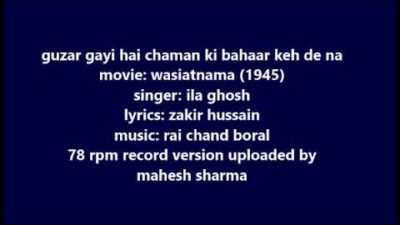
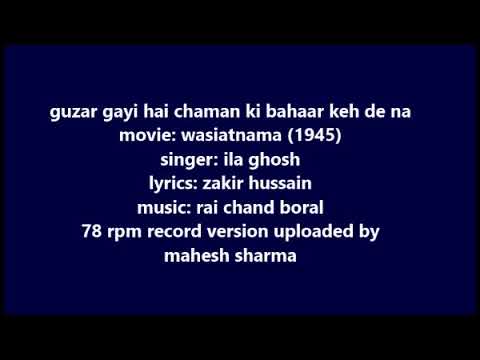
The Soundtrackआर.सी. बोराल ने 'वसीयतनामा' के लिए छह गीत रचे, और सभी के बोल मुंशी ज़ाकिर हुसैन ने लिखे — वही गीतकार जिन्होंने न्यू थिएटर्स की 1945 की दूसरी फ़िल्म, बिमल रॉय की 'हमराही', के हिंदी गीत लिखे थे। संकलन का केंद्र असित बरन हैं — तबला-वादक से अभिनेता बने वे गायक-नायक जो अपने गीत स्वयं गाते थे — और छह में से तीन उन्हीं के हिस्से आए: उल्लास से भरा 'मन फूले नहीं समाए', बेचैन 'काहे मन बेचैन सजनी', और सुमित्रा देवी के साथ युगल 'दुनिया का ग़म भूल जा' — वही इकलौता गीत जिसमें फ़िल्म की नायिका के अपने स्वर का श्रेय दर्ज है। 'सॉन्ग्स ऑफ़ योर' का 1945 सर्वेक्षण 'मन फूले नहीं समाए' को असित बरन और भारती देवी का युगल बताता है, और 'अतुल्स सॉन्ग अ डे' पुष्टि करता है कि रिकॉर्ड पर दूसरा, स्त्री-स्वर सुनाई देता है — पर उसे अनिर्धारित कहता है; हिंदीगीतमाला और माईस्वर केवल असित बरन को श्रेय देते हैं, इसलिए दूसरा स्वर यहाँ दर्ज नहीं किया गया। छह में से दो गीतों पर कोई गायक-श्रेय है ही नहीं। विरह-गीत 'गुज़र गई है चमन की बहार' हिंदी फ़िल्म गीत कोश तथा हिंदीगीतमाला और माईस्वर — तीनों में बिना स्वर के दर्ज है, और प्रचलित शिनाख़्तें आपस में टकराती हैं — 'सॉन्ग्स ऑफ़ योर' का एक पाठक इला घोष को श्रेय देकर इसे वर्ष के महिला एकल गीतों में छठा स्थान देता है, 'अतुल्स सॉन्ग अ डे' कास्ट देखकर सुमित्रा देवी का अनुमान लगाता है, और वहीं एक टिप्पणीकार बताता है कि यूट्यूब पर सुनने वाले उत्पला सेन कहते हैं। संग्राहकों के लिए इस एलबम की दुर्लभता 'गाए जा तू गीत सुहाने' है, जिसे बांग्ला सुगम-शास्त्रीय गायिका उत्पला सेन ने गाया — उन्होंने अपने पूरे कैरियर में केवल पंद्रह-सोलह हिंदी फ़िल्मी गीत गाए, और उनमें से लगभग सभी पंकज मल्लिक के साथ। छठा गीत, उर्दू ग़ज़ल-मुहावरे वाला 'पयाम-ए-मोहब्बत सबा ला रही है', भी बिना गायक के दर्ज है; 'सॉन्ग्स ऑफ़ योर' के 1945 सर्वेक्षण के दो पाठक इसे उत्पला सेन के नाम करते हैं, पर किसी सूची से इसकी पुष्टि नहीं होती। यह मिला-जुला हिंदी-उर्दू दायरा बोराल के उत्तरकालीन न्यू थिएटर्स काम का विशिष्ट लक्षण है: एक हर्ष-गीत, एक बेचैनी का गीत, एक तसल्ली का युगल, एक उजड़े चमन का विलाप, एक दार्शनिक एकल और एक ग़ज़ल।
अंग्रेज़ी में पढ़ें · Read in English
R.C. Boral composed six songs for Wasiyatnama, all of them written by Munshi Zakir Hussain, the lyricist who wrote the Hindi songs for New Theatres' other 1945 release, Bimal Roy's Hamrahi. The score is built around Asit Baran, the tabla-player-turned-actor who sang his own numbers, and who takes three of the six: the exultant 'Man Phoole Nahin Samaye', the restless 'Kahe Mann Bechain Sajni', and the duet 'Duniya Ka Gham Bhool Ja' with Sumitra Devi — the one track on which the film's heroine is credited with her own voice. Songs of Yore's survey of 1945 lists 'Man Phoole Nahin Samaye' as a duet by Asit Baran and Bharati Devi, and Atul's Song A Day confirms a second, female voice is audible on the record while calling it unidentified; hindigeetmala and MySwar credit Asit Baran alone, so the second voice is not entered here. Two of the six carry no singer credit at all. The lament 'Guzar Gayi Hai Chaman Ki Bahaar' is entered without a voice in the Hindi Film Geet Kosh and in both the hindigeetmala and MySwar catalogues, and the attributions in circulation contradict one another — a Songs of Yore reader credits Ila Ghosh and ranks it sixth among the year's female solos, Atul's Song A Day guesses Sumitra Devi from the cast list, and a commenter there reports that listeners on YouTube say Utpala Sen. The album's rarity for collectors is 'Gaye Ja Tu Geet Suhane', sung by the Bengali light-classical singer Utpala Sen, who recorded only fifteen or sixteen Hindi film songs in her whole career and almost all of the others with Pankaj Mullick. The sixth song, the Urdu ghazal-idiom 'Payaam-e-Mohabbat Saba Laa Rahi Hai', is likewise listed without a singer; two readers of Songs of Yore's 1945 survey attribute it to Utpala Sen, but no catalogue confirms it. The set is a mixed Hindi-Urdu brief typical of Boral's late New Theatres work: a joy song, a restlessness song, a consolation duet, a spent-garden lament, a philosophical solo and a ghazal.
- मन फूले नहीं समाए Man Phoole Nahin Samaye स्वर: Asit Baran

- काहे मन बेचैन सजनी Kahe Mann Bechain Sajni स्वर: Asit Baran

- दुनिया का ग़म भूल जा Duniya Ka Gham Bhool Ja स्वर: Asit Baran, सुमित्रा देवी

- गुज़र गई है चमन की बहार Guzar Gayi Hai Chaman Ki Bahaar
- गाए जा तू गीत सुहाने Gaye Ja Tu Geet Suhane स्वर: उत्पला सेन

- पयाम-ए-मोहब्बत सबा ला रही है Payaam-e-Mohabbat Saba Laa Rahi Hai

पट्टिका-लेख
The Monographपर्दे के पीछे Behind the Scenes
निर्देशन सौम्येन मुखर्जी ने न्यू थिएटर्स के लिए किया। पाकिस्तानी फ़िल्म डेटाबेस 'पाकमैग' इसे अपनी भारत-पाक सूची में 1945 की न्यू थिएटर्स की हिंदी/उर्दू फ़िल्म के रूप में दर्ज करता है, 'कलकत्ता में बनी', संगीत आर.सी. बोराल का, और कास्ट में भारती देवी, असित बरन, चौधरी, हीरालाल और देवी मुखर्जी; उसका 'लाहौर में प्रदर्शन की तिथि' वाला ख़ाना ख़ाली छोड़ा गया है, और फ़िल्म की ठीक-ठीक रिलीज़ तिथि कहीं भी दर्ज नहीं मिलती। एक कास्टिंग-विवरण इस फ़िल्म को उसी कथा के परदे-इतिहास से जोड़ता है: बांग्ला रंगमंच के 'नटसूर्य' अहींद्र चौधरी, जो 1945 की कास्ट में हैं, ज्योतिष बनर्जी की 1932 की 'कृष्णकांतेर उइल' में — इस उपन्यास पर बनी पहली बोलती फ़िल्म में — स्वयं कृष्णकांत राय की भूमिका निभा चुके थे। फ़िल्म ने सुमित्रा देवी को ठीक उनके उभार के क्षण में पकड़ा — 'संधि' के लिए उन्हें बीएफ़जेए का सर्वश्रेष्ठ अभिनेत्री पुरस्कार मिल चुका था और वे अभी-अभी 1944 की चौथी सबसे कमाऊ फ़िल्म 'मेरी बहन' की नायिका रही थीं — और सूचियाँ उन्हें इसके छह में से एक गीत, युगल 'दुनिया का ग़म भूल जा', में गाने का श्रेय देती हैं, न कि उसके लिए कोई पार्श्वस्वर दिया गया।
अंग्रेज़ी में पढ़ें · Read in English
Soumyen Mukherjee directed for New Theatres. The Pakistani film database Pakmag carries the picture on its Indo-Pak list as a 1945 New Theatres Hindi/Urdu production 'made in Calcutta', with R.C. Boral as music director and Bharati Devi, Asit Baran, Choudhury, Hiralal and Devi Mukherjee among the cast; its 'released date in Lahore' field is left blank, and no exact release date for the film is documented anywhere reachable. One casting detail links the film back to the story's own screen history: Ahindra Choudhury, the Bengali stage 'Natasurya' who appears in the 1945 cast, had played Krishnakanta Ray himself in Jyotish Bannerjee's 1932 Krishnakanter Will, the first talkie made from the novel. The film also caught Sumitra Devi at the exact moment of her rise — she had won the BFJA Best Actress award for Sandhi and had just been the female lead of Meri Bahen, the fourth highest-grossing film of 1944 — and the catalogues credit her with singing on one of its six songs, the duet 'Duniya Ka Gham Bhool Ja', rather than being given a playback voice for it.
महत्व Significance
इस फ़िल्म का महत्व उसकी उपलब्धि से कम, उसकी जगह से ज़्यादा है। 1945 तक न्यू थिएटर्स वह स्टूडियो नहीं रह गया था जिसने भारतीय सवाक् सिनेमा को गढ़ा था: नितिन बोस जा चुके थे, बिमल रॉय उन्हीं दिनों अपनी पहली हिंदी फ़िल्म निर्देशित कर रहे थे, और आर.सी. बोराल — वही जिन्होंने एक दशक पहले 'धूप छाँव' के ज़रिए हिंदी सिनेमा में पार्श्वगायन को जन्म दिया था — उस वर्ष के 'सॉन्ग्स ऑफ़ योर' सर्वेक्षण के शब्दों में 'न्यू थिएटर्स के स्वर्णकाल को पीछे छोड़ चुके' थे। 'वसीयतनामा' उसी उत्तरकालीन न्यू थिएटर्स का लघु रूप है: बांग्ला साहित्य से ली गई प्रतिष्ठित कृति, एक बंगाली कंपनी की हिंदी-बाज़ार के लिए बनाई फ़िल्म, गायक-नायक की वह परंपरा जिसे पार्श्वगायन पहले ही अप्रचलित कर रहा था, और एक ऐसा संगीतकार जिसके नवाचार उद्योग में इतने घुल चुके थे कि उसका नया काम भी अब ख़बर नहीं लगता था। यह स्टूडियो के मूल विश्वास का भी एक सीधा उदाहरण है — कि बंकिम, शरतचंद्र और रवींद्रनाथ ही लोकप्रिय सिनेमा का सही कच्चा माल हैं — जिसे 1945 तक निर्णायक रूप से बंबई की ओर खिसक चुके हिंदी बाज़ार में ले जाया जा रहा था।
अंग्रेज़ी में पढ़ें · Read in English
The film matters less for what it achieved than for where it sits. By 1945 New Theatres was no longer the studio that had defined Indian sound cinema: Nitin Bose had gone, Bimal Roy was directing his first Hindi feature at the same moment, and R.C. Boral — the man who had put playback singing into Hindi film with Dhoop Chhaon a decade earlier — was, in the phrase used by the Songs of Yore survey of the year, 'past the golden age of the New Theatres'. Wasiyatnama is that late New Theatres in miniature: a prestige literary property from the Bengali canon, a Bengali company's Hindi-market release, an actor-singer hero of the sort that playback was already making obsolete, and a composer whose innovations had been so thoroughly absorbed by the industry that his own new work no longer sounded like news. It is also one of the more direct examples of the studio's founding conviction — that Bankim, Sarat Chandra and Tagore were the right raw material for popular cinema — being carried into a Hindi market that was, by 1945, moving decisively towards Bombay.
विरासत Legacy
'वसीयतनामा' — जिसे दर्ज करने का सबसे ज़्यादा काम जिस ब्लॉग ने किया है, उसी के शब्दों में — 'अब तक भुला दी गई फ़िल्म' है। इसका कोई प्रिंट प्रचलन में ज्ञात नहीं, और जिस ब्लॉग ने इसके गीत डाले हैं वह केवल ऑडियो के सहारे काम करता है; जो बचा है वह 78-आरपीएम रिकॉर्डों का सेट और काग़ज़ी सुराग़ है — हिंदी फ़िल्म गीत कोश की प्रविष्टि, हिंदीगीतमाला की सूची, और छह में से चार गीत जो 2014 से 2025 के बीच 'अतुल्स सॉन्ग अ डे' पर डाले गए, जहाँ पाठकों से आज भी बिना श्रेय वाली आवाज़ों को पहचानने की गुज़ारिश की जा रही है। इनमें से दो गीत — 'मन फूले नहीं समाए' और 'काहे मन बेचैन सजनी' — 'सॉन्ग्स ऑफ़ योर' की 1945 के यादगार गीतों की चुनिंदा सूची में जगह पा सके। भारत के सबसे साहित्यिक स्टूडियो की बंकिम-कृति के लिए यह पतला उत्तरजीवन है, पर विभाजन से ठीक पहले के वर्षों में न्यू थिएटर्स की हिंदी फ़िल्मों के साथ जो हुआ, उसका सही चित्र भी यही है: कलकत्ता स्टूडियो की प्रतिष्ठित फ़िल्में राष्ट्रीय स्मृति से फिसलती गईं और उनकी जगह बंबई ने ले ली, और फ़िल्म-अभिलेखागार नहीं, रिकॉर्ड-कंपनी ही वह इकलौती वजह बची जिससे उन्हें आज भी सुना जा सकता है।
अंग्रेज़ी में पढ़ें · Read in English
Wasiyatnama is, in the words of the blog that has done most to document it, 'by now a forgotten movie'. No print of it is known to be in circulation, and the blog that has posted its songs works only from the audio; what survives is the 78-rpm record set and the paper trail — the Hindi Film Geet Kosh listing, the hindigeetmala catalogue entry, and four of the six songs posted online between 2014 and 2025 by Atul's Song A Day, whose readers are still being asked to identify the uncredited voices. Two of the songs, 'Man Phoole Nahin Samaye' and 'Kahe Mann Bechain Sajni', made it into the Songs of Yore retrospective shortlist of memorable songs of 1945. That is a thin afterlife for a Bankim adaptation from India's most literary studio, but it is also a fair snapshot of what happened to New Theatres' Hindi output in the years just before Partition: the Calcutta studio's prestige productions slipped out of national memory while Bombay's took its place, and the record label, not the film archive, became the only reason anyone can still hear them.
अन्य विवरण
More Details- https://en.wikipedia.org/wiki/List_of_Hindi_films_of_1945
- https://en.wikipedia.org/wiki/Sumitra_Devi_(actress)
- https://en.wikipedia.org/wiki/Krishnakanter_Will_(1932_film)
- https://en.wikipedia.org/wiki/Ahindra_Choudhury
- https://en.wikipedia.org/wiki/Asit_Baran
- https://en.wikipedia.org/wiki/New_Theatres
- https://www.hindigeetmala.net/movie/wasiatnama.htm
- https://myswar.co/album/wasiyatnama-1945
- https://atulsongaday.me/2014/08/18/guzar-gayi-hai-chaman-ki-bahaar/
- https://atulsongaday.me/2014/08/19/payaam-e-mohabbat-saba-laa-rahi-hai/
- https://atulsongaday.me/2017/09/12/gaaye-jaa-tu-geet-suhaane-kaun-kisi-ke-man-ki-jaane/
- https://atulsongaday.me/2025/07/20/man-phoole-naheen-samaaye/
- https://www.songsofyore.com/best-songs-of-1945-and-the-winners-are/
- https://indiancine.ma/EGN/info
- https://pakmag.net/film/predetails.php?pid=2676
- https://en.wikipedia.org/wiki/Hamrahi_(1945_film)
References
नमूना-पट्टी
The Specimen Table| शीर्षक | वसीयतनामा · Wasiyatnama |
|---|---|
| वर्ष · युग | 1945 — Pre Independence |
| निर्देशक | सौम्येन मुखर्जी · Soumyen Mukherjee |
| संगीत-निर्देशक | आर.सी. बोराल · R.C. Boral |
| गीतकार | मुंशी ज़ाकिर हुसैन · Munshi Zakir Hussain |
| कलाकार-मंडली | असित बरन · Asit Baran · सुमित्रा देवी · Sumitra Devi · भारती देवी · Bharati Devi · लतिका बनर्जी · Latika Bannerji · अहींद्र चौधरी · Ahindra Choudhury · हीरालाल · Hiralal · देवी मुखर्जी · Devi Mukherjee · तुलसी · Tulsi |
| निर्माण-गृह | New Theatres, Calcutta |
| शैली | Social · Drama · Romance |
| भाषा | hindi |
| प्रकार | कथा-चित्र (फ़ीचर) |
| गीत | 6 गीत — ऊपर पूरी संगीत-सूची |
जुड़े हुए पन्ने
Connected Plates · The Graph Made Visibleअटलस में कोई पन्ना अकेला नहीं — 'वसीयतनामा' से उसके गीत, कलाकार, राग और युग, सब जुड़े हैं।
इस फ़िल्म के गीत · Songs of this Film
कलाकार · Cast & Crew
युग · The Era
साझा कीजिए · Share this Plate