गीत विंग · गीत-पट्टिका · Song Plate
नैनहीन को राह दिखा प्रभु
Nainheen Ko Raah Dikha Prabhu
एक अंधा संत अपने प्रभु से राह दिखाने की प्रार्थना करता है — और सहगल इस प्रार्थना को तीन मिनट में समूची भक्ति-सी अनुभूति दे देते हैं।
भावभक्ति · Plaintive · आध्यात्मिक
भाषाhindi गतिधीमी स्वरूपएकल पुरुष
श्रेय
The Creditsसूत्र-वाक्य · The Hook
सूत्र-वाक्य
एक अंधा संत अपने प्रभु से राह दिखाने की प्रार्थना करता है — और सहगल इस प्रार्थना को तीन मिनट में समूची भक्ति-सी अनुभूति दे देते हैं।
In EnglishA blind saint asks his Lord to show him the way — and Saigal makes the prayer feel like the whole of bhakti in three minutes.
पट्टिका-लेख
The Monographपरिचय Overview
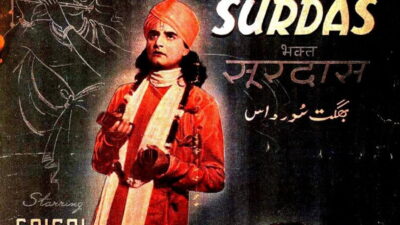
भक्त सूरदास के सर्वाधिक प्रशंसित गीतों में से एक — दृष्टिहीन कवि कृष्ण से अपने पग दिखाने की विनती करता है — यह फ़िल्म की सबसे बड़ी सफलताओं में से एक था और के. एल. सहगल के गायन-जीवन का एक शिखर माना जाता है। यह फ़िल्म की केंद्रीय छवि को साकार करता है: शारीरिक अंधत्व, समर्पण के माध्यम से अंतर्दृष्टि में रूपांतरित।
अंग्रेज़ी में पढ़ें · Read in English
Among the most celebrated songs of Bhakta Surdas, this devotional plea — the sightless poet beseeching Krishna to guide his steps — was one of the film's biggest successes and is considered a high point of K. L. Saigal's singing career. It crystallises the film's central image: physical blindness transformed into inner vision through surrender to the divine.
संगीत The Music
ज्ञान दत्त इस भजन को एक धीमी, भक्तिमय लय में रचते हैं जो सहगल की गंभीर बैरिटोन को हर पद पर ठहरने का अवकाश देती है। संगीत-संयोजन संयमित है — हारमोनियम और हल्की ताल आवाज़ का साथ देते हैं — ताकि भावनात्मक भार पूरी तरह गायक की अंतर्मुखी, लगभग आत्मस्वीकृति-जैसी प्रस्तुति पर टिके, जो उप-शास्त्रीय भजन-परंपरा के अनुरूप है।
अंग्रेज़ी में पढ़ें · Read in English
Gyan Dutt sets the bhajan in a slow, devotional measure that gives Saigal's grave baritone room to linger on each phrase. The arrangement is restrained — harmonium and light percussion supporting the voice — so that the emotional weight rests entirely on the singer's inward, almost confessional delivery, in keeping with the semi-classical bhajan tradition.
काव्य The Poetry
गीत का शीर्षक और आधार — एक दृष्टिहीन व्यक्ति अपने प्रभु से राह दिखाने की प्रार्थना — भक्ति-साहित्य के सबसे पुराने और सबसे गहरे भावों में से एक है। अंधापन एक साथ शारीरिक और आध्यात्मिक है: सूरदास की परंपरा में बाह्य दृष्टि का संसार माया से जुड़ा है, और शारीरिक दृष्टि की हानि अंतर्दृष्टि की शर्त बन जाती है। डी.एन. माधोक का इस फ़िल्म के लिए रूपांतरण इस स्थापित ढाँचे के भीतर काम करता है: प्रार्थना नेत्र-पुनर्प्राप्ति के लिए नहीं, बल्कि आध्यात्मिक मार्गदर्शन के लिए है — अँधेरे में भी चलने का रास्ता। संबोधन की यही सरलता कविता की शक्ति है: कोई रूपकीय परत नहीं, केवल पूर्ण समर्पण की विह्वलता।
अंग्रेज़ी में पढ़ें · Read in English
The song's title and premise — a sightless man asking his Lord to show him the way — is one of the oldest and most resonant motifs in bhakti literature. The blindness is simultaneously physical and spiritual: in the Surdas tradition, the external world of sight is identified with illusion (maya), and the loss of physical vision becomes the precondition for inner sight. D.N. Madhok's adaptation for the film works within this established frame without departing from it: the prayer asks not for restored eyesight but for spiritual guidance, a path to walk even in darkness. The lyrics (withheld on copyright grounds, Madhok d.1982) are consistent, by all accounts, with the Braj-bhasha prayer tradition — direct, unornamented, the devotee positioned as wholly dependent on divine mercy. This simplicity of address is the poem's power: there is no metaphoric overlay, only the vulnerability of complete surrender.
कहानी The Story
भक्त सूरदास (1942) पहली फ़िल्म थी जो के.एल. सहगल ने न्यू थिएटर्स, कलकत्ता — जहाँ वे दीर्घकालिक अनुबंध में थे — छोड़कर बंबई के रणजीत स्टूडियो से जुड़ने के बाद बनाई। चतुर्भुज दोशी के निर्देशन में, फ़िल्म ने सहगल को 16वीं सदी के अंधे संत-कवि सूरदास के रूप में प्रस्तुत किया — एक भूमिका जिसने उनकी गहरी, गंभीर बैरिटोन को उसके सबसे अंतर्मुखी, चिंतनशील स्वर के लिए नाटकीय औचित्य दिया। 'नैनहीन को राह दिखा प्रभु' उन दो गीतों में से एक था (दूसरा 'कदम चले आगे मन पाछे भागे') जिन्हें संगीतकार ज्ञान दत्त ने फ़िल्म के भावनात्मक केंद्र के रूप में रचा। फ़िल्म 1942 की तीसरी सर्वाधिक कमाई करने वाली भारतीय रिलीज़ बनी।
अंग्रेज़ी में पढ़ें · Read in English
Bhakta Surdas (1942) was the first film K.L. Saigal made after leaving New Theatres, Calcutta — where he had been under a long-term contract — to join Ranjit Studios in Bombay. Directed by Chaturbhuj Doshi, the film cast Saigal as the 16th-century blind sant-poet Surdas, a role that gave his low, grave baritone a dramatic justification for its most inward, reflective register. 'Nainheen Ko Raah Dikha Prabhu' was one of the two songs (with 'Kadam Chale Aage Man Pachhe Bhage') that music director Gyan Dutt composed as the film's emotional centrepieces. The film became the third highest-grossing Indian release of 1942 — extraordinary for a devotional subject — confirming that a Saigal vehicle built entirely around classical-style bhajans could outperform commercial entertainments.
विरासत The Legacy
सहगल की 'नैनहीन को राह दिखा प्रभु' की गायकी को हिंदी फ़िल्म संगीत के विद्वानों द्वारा भक्ति-भजन के व्यावसायिक सिनेमा में समावेश के निर्णायक क्षणों में से एक माना जाता है। गीत की विशेष उपलब्धि यह है कि यह 'फ़िल्मी भजन' नहीं लगता — यह किसी वास्तविक संत की प्रार्थना की रिकॉर्डेड प्रस्तुति की तरह सुनाई देता है, जो रिकॉर्डेड शास्त्रीय परंपरा और फ़िल्म-संगीत उद्योग के बीच सेतु बनाता है। ज्ञान दत्त के सुकाए हुए संगीत-संयोजन ने सुनिश्चित किया कि भावनात्मक ध्यान पूरी तरह सहगल की आवाज़ और अदायगी पर केंद्रित रहे — बाद के भक्ति गीतों के लिए एक साँचा।
अंग्रेज़ी में पढ़ें · Read in English
Saigal's rendering of 'Nainheen Ko Raah Dikha Prabhu' is treated in Hindi film music scholarship as one of the defining moments of the bhakti-bhajan's incorporation into commercial cinema. The song's particular achievement is that it does not sound like a 'film bhajan' — it sounds like a recorded performance of an actual saint's prayer, bridging the recorded classical tradition and the film-music industry. Gyan Dutt's stripped-down arrangement ensured that the emotional focus remained entirely on Saigal's voice and delivery, setting a template for later devotional film songs — from Meera's bhajans in Vijay Bhatt's productions to the composed bhajans of Bharat Bhushan — in which the song must feel less composed than received.
वर्गीकरण
Classification- Tempo
- Slow
Genre
अन्य विवरण
More Details- https://en.wikipedia.org/wiki/Bhakta_Surdas
- https://www.hindigeetmala.net/movie/bhakt_surdas.htm
- https://en.wikipedia.org/wiki/K._L._Saigal
- https://www.imdb.com/title/tt0213510/
References
रोचक तथ्य
Margin Notesभक्त सूरदास (1942) के.एल. सहगल की न्यू थिएटर्स, कलकत्ता — वह कलकत्ता स्टूडियो जहाँ उन्होंने अपना नाम बनाया था — छोड़ने के बाद की पहली बॉम्बे फ़िल्म थी; रणजीत स्टूडियो में यह संक्रमण 1940 के दशक के हिंदी सिनेमा के सबसे महत्वपूर्ण स्टूडियो-परिवर्तनों में से एक था।
अंग्रेज़ी में पढ़ें · Read in English
Bhakta Surdas (1942) was K.L. Saigal's first Bombay film after leaving New Theatres, Calcutta — the Calcutta studio where he had made his name; the transition to Ranjit Studios represented one of the most significant studio crossings in 1940s Hindi cinema.
फ़िल्म का निर्देशन चतुर्भुज दोशी ने रणजीत स्टूडियो के लिए किया और यह 1942 की तीसरी सबसे अधिक कमाई करने वाली भारतीय फ़िल्म बनी, जिसने साबित किया कि शास्त्रीय-शैली के भजनों वाला एक विशुद्ध भक्ति-विषय बॉक्स-ऑफ़िस पर व्यावसायिक मनोरंजन फ़िल्मों से बेहतर प्रदर्शन कर सकता है।
अंग्रेज़ी में पढ़ें · Read in English
The film was directed by Chaturbhuj Doshi for Ranjit Studios and became the third highest-grossing Indian film of 1942, demonstrating that a purely devotional subject with classical-style bhajans could outperform commercial entertainments at the box office.
सूरदास (लगभग 1478–1583), वह नेत्रहीन संत-कवि जिनकी कथा को फ़िल्म नाटकीय रूप देती है, को परंपरागत रूप से ब्रजभाषा बोली में एक लाख से अधिक रचनाओं का श्रेय दिया जाता है, जो सभी मौखिक परंपरा में संरक्षित रहीं — शारीरिक नेत्रहीनता द्वारा अंतर्दृष्टि को संभव बनाने की फ़िल्म की मूल अवधारणा इसी ऐतिहासिक जीवनी में निहित है।
अंग्रेज़ी में पढ़ें · Read in English
Surdas (c.1478–1583), the blind sant-poet whose story the film dramatises, is traditionally credited with more than a hundred thousand compositions in the Braj-bhasha dialect, all maintained in oral tradition — the film's premise of physical blindness enabling inner vision is rooted in this historical biography.
ज्ञान दत्त ने भक्त सूरदास का संगीत सहगल की बैरिटोन-प्रधान शास्त्रीय गायन-शैली के अनुरूप रचा, जिसने 'भक्ति-भजन फ़िल्म' उपविधा के लिए एक ऐसा प्रारूप गढ़ा, जिसे 1950 और 1960 के दशकों में विजय भट्ट सहित निर्देशकों ने पुनर्जीवित किया।
अंग्रेज़ी में पढ़ें · Read in English
Gyan Dutt composed the Bhakta Surdas score to suit Saigal's baritone-centred classical singing style, creating a template for the 'bhakti-bhajan film' sub-genre that would be revived in the 1950s and 1960s by directors including Vijay Bhatt.
नमूना-पट्टी
The Specimen Table| शीर्षक | नैनहीन को राह दिखा प्रभु · Nainheen Ko Raah Dikha Prabhu |
|---|---|
| फ़िल्म | भक्त सूरदास · 1942 |
| वर्ष · युग | 1942 |
| गायक | K.L. Saigal |
| गीतकार | D. N. Madhok |
| संगीतकार | Gyan Dutt |
| स्वरूप | एकल पुरुष |
| गति | धीमी |
| भाषा | hindi |
| भाव | भक्ति · Plaintive · आध्यात्मिक |
| लोकप्रियता | Very_popular |
| बोल-स्थिति | केवल झलक |
जुड़े हुए पन्ने
Connected Plates · The Graph Made Visibleअटलस में कोई पन्ना अकेला नहीं — इस गीत से जुड़े गीत, कलाकार, फ़िल्म, राग-ताल-विधा, सब यहाँ से खुलते हैं।
मिलते-जुलते गीत · Related Songs
कलाकार · The Artists
फ़िल्म · The Film
साझा कीजिए · Share this Plate