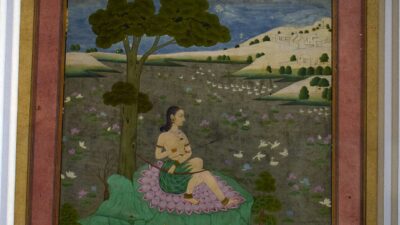
शास्त्र विंग · राग-पट्टिका · Raag Plate
देशि
Deshi
एक श्रृंगार Hindustani राग · A Romance Hindustani Raag
भावRomantic · Playful · Light
ऊर्जामध्यम
स्वर-चित्र · The Swara Panel
आरोह — अवरोह · The Ascent and the Descent
पकड़ · पहचान वाक्यांश
स रे म प, नि(क) ध प, म ग रे स
S R M P, N(k) D P, M G R S
The characteristic movement rises from Sa through Re to Ma and Pa, then descends through komal Ni and Dha back to Pa before settling via Ga and Re to Sa. This oscillating komal Nishad (andolan) in descent is the raag's chief identifier, distinguishing it from Khamaj and the closely related Tilang.
वादी–संवादी टिप्पणी · Vadi–Samvadi note
Vadi — The vadi (primary) note provides the tonal center of Raag Deshi.
Samvadi — Ni (Nishad) is the samvadi, complementing the vadi note.
समय और भाव
Time Theory & Moodसमय-सिद्धांत · Time Theory
संध्या काल
परंपरागत रूप से संध्या काल (4:00 PM - 7:00 PM) में गाया जाता है।
Traditionally performed during evening/twilight hours (4:00 PM - 7:00 PM), when day transitions to night.
भाव और गति · Mood & Tempo
श्रृंगार · Romance/Beauty
प्रेम, सौंदर्य और भक्ति का रस। रोमांटिक तड़प, सौंदर्यपरक आनंद और गहरे भावनात्मक जुड़ाव को जगाता है।
ऊर्जा · Energyमध्यम
स्तर · Leveladvanced — राग Deshi के लिए इसके मूल ठाट की समझ और मींड, गमक, आंदोलन के माध्यम से इसके अद्वितीय चरित्र को उभारने की क्षमत…
पट्टिका-लेख
The Monographपरिचय Introduction
राग Deshi हिंदुस्तानी शास्त्रीय संगीत का एक राग है जो Khamaj ठाट से संबंधित है। इसका प्रमुख रस श्रृंगार (Romance/Beauty) है। यह परंपरागत रूप से संध्या काल (4:00 PM - 7:00 PM) में गाया जाता है। गाया जाता है।
अंग्रेज़ी में पढ़ें · Read in English
Raag Deshi is a complete scale with all 7 notes in both ascent and descent raga in Hindustani classical music belonging to the Khamaj thaat. This raag embodies the Romance/Beauty (श्रृंगार) rasa, creating an atmosphere of romantic, playful emotion. It is traditionally performed during evening hours. The raag offers rich melodic possibilities through its characteristic phrases and ornamentations, making it a rewarding subject for both khayal and instrumental performance.
सांस्कृतिक महत्व Cultural Significance
भारतीय शास्त्रीय संगीत की समृद्ध परंपरा के अंग के रूप में, राग Deshi Hindustani परंपरा को परिभाषित करने वाले स्वर संरचना और भावनात्मक अभिव्यक्ति के बीच गहरे संबंध का प्रतिनिधित्व करता है।
अंग्रेज़ी में पढ़ें · Read in English
As part of the rich tapestry of Indian classical music, Raag Deshi represents the deep connection between melodic structure and emotional expression that defines the Hindustani tradition.
ऐतिहासिक महत्व Historical Significance
राग देशी (जिसे देश या देसी भी कहते हैं) हिंदुस्तानी शास्त्रीय संगीत के खमाज ठाट का एक अत्यंत लोकप्रिय राग है। 'देशी' शब्द का अर्थ है 'देश से संबंधित' अथवा 'लोक परंपरा में रचा-बसा,' और यह राग मध्ययुगीन 'देशी संगीत' परंपराओं से उपजा है जो मार्ग संगीत से बाहर की जनसामान्य संगीत धाराओं में विकसित हुई। मध्यकालीन संगीत ग्रंथों में इसका उल्लेख मिलता है। यह राग किराना, जयपुर-अत्राउली, आगरा और ग्वालियर सभी प्रमुख घरानों में समान रूप से गाया-बजाया जाता है। आरोह में सातों शुद्ध स्वर लगते हैं जबकि अवरोह में कोमल निषाद आता है और गंधार-धैवत छोड़े जाते हैं, जिससे राग को एक विशेष असमान किंतु प्रवाहमान स्वरूप मिलता है। कोमल निषाद पर आंदोलन (कंपन) इस राग की पहचान है। वादी स्वर मध्यम और संवादी षडज हैं। पं. भीमसेन जोशी, उस्ताद अमीर खाँ और पं. जसराज ने देशी में यादगार रचनाएँ गाई हैं। संध्या काल में इसे गाने की परंपरा है। ठुमरी और दादरा में भी यह अत्यंत प्रचलित है।
अंग्रेज़ी में पढ़ें · Read in English
Raag Deshi (also spelled Desh or Desi) is one of the most widely loved raags of the Khamaj thaat in Hindustani classical music. The name literally means 'of the land' or 'national,' and the raag has ancient roots in the deshi sangeet traditions that developed outside the formal marg (courtly/Vedic) streams. It is mentioned in medieval music texts and has been cultivated across all major gharanas — Kirana, Jaipur-Atrauli, Agra, and Gwalior. Its scale uses all seven shuddha notes in ascent, while the descent introduces komal Ni (Nishad) and omits Ga and Dha, giving it a characteristically asymmetric, flowing quality. The andolan (oscillation) on komal Ni is considered the raag's soul. The vadi (primary note) is Ma (Madhyam) and samvadi is Sa; this emphasis on the subdominant gives the raag warmth and an earthy, romantic character. Pandit Bhimsen Joshi, Ustad Amir Khan, and Pandit Jasraj have all left major recordings in Deshi. It is performed at evening (sandhya kaal), typically in light-classical and semi-classical forms such as thumri and dadra as well as full khayal. In instrumental tradition, Ravi Shankar and Vilayat Khan rendered memorable Desh-family performances.
शिक्षा
Teaching & LearningStart with aaroha-avaroha practice with tanpura
Focus on the pakad (catch phrase) to establish the raag's identity
Practice alap in vilambit (slow) laya to internalize the mood
Gradually build speed through jod and jhala patterns
Confusing this raag with similar-sounding raags
Not giving enough weight to the vadi and samvadi swaras
Using inappropriate meend or gamak patterns
प्रस्तुति
Performance- Description
- परंपरागत रूप से संध्या काल (4:00 PM - 7:00 PM) में गाया जाता है। Traditionally performed during evening/twilight hours (4:00 PM - 7:00 PM), when day transitions to night.
- Prahar Number
- 5
- Prahar Name
- संध्या काल Sandhya Kaal
- Time Start
- 16:00
- Time End
- 19:00
- Time Flexibility
- flexible
Time
और जानें
More to KnowIn Film Music
Raag Deshi has had a rich presence in Hindi film music — more than most classical raags. Its romantic, accessible quality made it a favourite among Golden Era composers. Roshan used a Desh-based melodic structure for several compositions, and Naushad drew on the raag's evening character extensively. The immortal 'Vande Mataram' as filmed in Anand Math (1952, music: Hemant Kumar) employs Desh-family swaras. S. D. Burman's compositions in Bandini (1963) also draw on Desh's ascending motion. Because Deshi and Desh share nearly identical note-sets, the two names are often used interchangeably in film music contexts.
सीखने के लिए
For Learners- Difficulty Level
- advanced
अन्य विवरण
More Details- Indian_Music_Raga_Encyclopedia_v2.xlsx
- Bhatkhande, V.N. — Hindustani Sangeet Paddhati (Khamaj thaat section)
- Joep Bor (ed.) — The Raga Guide, Vol. 2 (Nimbus Records / Rotterdam Conservatory, 1999)
References
नमूना-पट्टी
The Specimen Table| नाम | देशि · Deshi |
|---|---|
| थाट | Khamaj |
| पकड़ | स रे म प, नि(क) ध प, म ग रे स |
| जाति | संपूर्ण-संपूर्ण · Sampurna-Sampurna |
| समय | संध्या काल |
| ऊर्जा | मध्यम |
| परिवार | Deshi |
| स्तर | advanced |
| लोकप्रियता | Obscure |
जुड़े हुए पन्ने
Connected Plates · The Graph Made Visibleअटलस में कोई पन्ना अकेला नहीं — इस राग से गीत, प्रस्तुतियाँ, कलाकार, ताल, घराने और मिलते-जुलते राग, सब यहाँ से खुलते हैं।
ताल-साथी · Taal Pairings
शास्त्र-सूत्र · Shastra Threads
श्रवण-कक्ष · The Listening Room
सुनिए — देशि · Hear the Raag
Raag Desi | Pt. Venkatesh Kumar | Hindustani Classical Kirana Gharana Vocal | Part 4/7
प्रश्नोत्तर
Questions & Answersराग Deshi क्या है?
राग Deshi Hindustani शास्त्रीय संगीत का एक राग है।
अंग्रेज़ी में पढ़ें · Read in English
What is Raag Deshi? — Raag Deshi is a raag in Hindustani classical music.
साझा कीजिए · Share this Plate