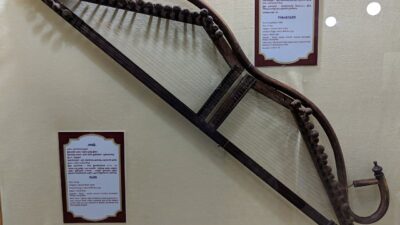
शास्त्र विंग · वाद्य-पट्टिका · Instrument Plate
याष़
Yazh
अन्य नामयाष़ · याल · याऴ् (Tamil: யாழ்) · Yaazh
परिचय
Overviewयाष़ प्राचीन तमिऴकम् की नौका-आकार वाली वीणा है — भारत के प्राचीनतम प्रलेखित तार-वाद्यों में से एक, जिसे संगम-युग के 'पाणर्' यायावर गायक बजाते थे। इसकी घुमावदार आबनूस-गर्दन के सिरे पर 'याली' उकेरा जाता, बकरी की खाल का पटल इमली-गोंद से चिपकाया जाता, और सात से इक्कीस तक बकरी-आँत की खुली तारें एक-एक स्वर देतीं। सातवीं सदी में दंड-वीणाओं के आगे मौन हो गई यह याष़, स्वामी विपुलानंद के 'याऴ् नूल्' और चेन्नई के तरुण शेखर की छेनी से दो हज़ार वर्ष बाद फिर से बोल उठी।
अंग्रेज़ी में पढ़ें · Read in English
The yazh is the boat-shaped harp of ancient Tamilakam — one of India's oldest documented string instruments, played by the wandering 'panar' bards of the Sangam age. A 'yali' was carved at the tip of its curved ebony neck, a goatskin soundboard was glued down with tamarind paste, and between seven and twenty-one open goat-gut strings each sang a single note. Silenced in the 7th century before the rise of stick-zither veenas, the yazh spoke again two thousand years later through Swami Vipulananda's 'Yaazh Nool' and the chisel of Chennai's Tharun Sekar.
वर्गीकरण
ClassificationNatya Shastra Category
तत (Tata - stringed instruments)
तत वर्ग में याष़ एक प्राचीन वीणा-कुल का ताल-रहित तार-वाद्य है, जो प्रत्येक खुली तार को उँगली से मीटकर (झंकृत कर) स्वर उत्पन्न करता है। यह भारत के प्राचीनतम धनुष-आकृति (arched harp) वाद्यों में से एक है, जो गज़ (धनुष) से नहीं बल्कि उँगलियों से बजाया जाता है।
In the Tata (stringed) category, the yazh is an ancient harp-class open-string instrument that produces each note by plucking a separate open string with the fingers. It is one of India's oldest arched-harp chordophones — played not with a bow but by plucking, with one string dedicated to each swara.
Western Category
Plucked harp (open-string chordophone)
Western Family
Arched/bow harp family (structurally akin to the ancient Egyptian and Burmese saung harps, distinct from the later stick-zither veena)
Sub Classification
बनावट
PhysicalDescription Hindi
याष़ एक नौका (नाव) या द्रोणी के आकार की काष्ठ-अनुनादिका (resonator) वाला प्राचीन तमिल वीणा-वाद्य है, जिसकी एक घुमावदार आबनूस (ebony) की गर्दन धनुष की भाँति ऊपर उठती है। तारें गर्दन के ऊपरी सिरे से अनुनादिका तक फैली रहती हैं, और प्रत्येक तार एक ही स्वर के लिए निश्चित होती है। वाद्य 1 से 3 फुट ऊँचा होता था और इसकी गर्दन के सिरे पर पौराणिक जीव 'याली' (यालि) का मुख उकेरा जाता था — इसी 'याली' से 'याष़' नाम व्युत्पन्न माना जाता है।
Description English
The yazh is an ancient Tamil harp with a boat- or trough-shaped wooden resonator from which a curved ebony neck rises like an archer's bow. Strings run from the top of the neck down to the resonator, each string fixed to a single note. The instrument stood 1 to 3 feet tall, and the head of the mythical creature 'yali' (yaali) was carved at the tip of its neck — the name 'yazh' is believed to derive from this 'yali'.
Body
Boat / trough-shaped resonator with a curved arched neck (bow-form)
नौका या द्रोणी के आकार की अनुनादिका, ऊपर धनुष-सी घुमावदार गर्दन
Local hardwoods — emmaram (red wood) or pala maram (jackfruit wood); modern recreations use red cedar
स्थानीय काष्ठ — 'एम्मरम्' (रक्तवर्णी लकड़ी) या 'पला मरम्' (कटहल की लकड़ी); आधुनिक पुनर्निर्माण में रेड सीडर
30-90
Hollowed wooden trough whose open face is covered by a goatskin soundboard, glued down with a paste made from tamarind seeds
Strings
Open melody strings — one string per note, plucked directly; no fretting or string-stopping
The classical yazh is a pure open-string harp and traditionally carries NO sympathetic (tarab) strings — unlike the later sarangi or sitar. Its resonance comes entirely from the skin soundboard and hollow trough.
No dedicated drone strings; the yazh is melodic, sounding one note per plucked string
Bow
लागू नहीं (मीट्टु — उँगली से झंकार)
None — plucked, not bowed (meettu, finger-plucking)
The yazh has no bow; strings are plucked with the fingers of both hands, harp-fashion
0
Fingers pluck the open strings directly (meettu); the left and right hands share the string bank
Tuning Pegs
तिवावु / मेऴ्कोल् (स्वर-दंड)
Tivavu / string-bar (melkol)
Instead of geared pegs, the yazh's strings were tied to a tuning bar (string-bar) pierced with holes, and secured with a natural lacquer called Arakku; pitch was set by adjusting each string's tension at this bar
Bridge
पालम् (सेतु)
String-bridge (palam)
The strings pass over the skin soundboard and are anchored to the string-bar beneath it, transmitting vibration into the trough resonator
Wood, over a goatskin membrane
Frets
याष़ में न परदे होते हैं, न तार दबाई जाती है — प्रत्येक स्वर की अपनी अलग खुली तार होती है, बिल्कुल पश्चिमी वीणा (हार्प) की तरह। मींड इसमें नहीं होती; स्वर 'सोपानिक' (एक-एक तार से) निकलते हैं।
The yazh has no frets and no string-stopping — every note has its own separate open string, exactly like a Western harp. It cannot glide a meend; notes emerge discretely, one plucked string at a time.
ध्वनि-चरित्र
SoundTonal Character Hindi
याष़ की ध्वनि कोमल, स्पष्ट और मणि-सी झंकृत होती है — गूँजती हुई, किंतु शीघ्र क्षय होने वाली, जैसे किसी शांत मंदिर-प्रांगण में जल-बूँद टपकती हो। चर्म-पटल इसे एक गर्म, जैविक (organic) अनुनाद देता है, जो आधुनिक धातु-तार वीणाओं की तुलना में अधिक मृदु और प्राचीन प्रतीत होती है।
Tonal Character English
The yazh's tone is soft, crystalline and bell-like — resonant yet quick to decay, like water drops falling in a still temple courtyard. Its skin soundboard lends a warm, organic resonance that sounds gentler and more archaic than modern metal-strung veenas.
Timbre
Warm, plucked-harp shimmer with a short sustain (gut-on-skin), rounder and softer than a metal-strung sitar or veena
Range
Roughly two octaves in the Periyazh (21 strings); about one octave in the seven-stringed Sengotti/Siriyazh
Dynamic Range
Intimate to moderate — a chamber and court instrument, not a projecting concert one; suited to voice accompaniment and recitation
Techniques
सुनने का मार्गदर्शन
The Listening Guideयाष़ का रस लेना हो तो याद रखिए — यह मींड-रहित, खुली-तार वाली प्राचीन वीणा (हार्प) है; हर स्वर अलग, स्पष्ट और मणि-सा बजता है। पहले 'द साउंड ऑफ़ याष़' जैसा संक्षिप्त पुनरुद्धार-प्रदर्शन सुनिए, जहाँ सेंगोट्टि याष़ की बूँद-बूँद टपकती ध्वनि खुलती है; फिर तरुण शेखर के वृत्तचित्र में इसके निर्माण और इतिहास को समझिए। सारंगी की रोती मींड की अपेक्षा यहाँ शांत, पवित्र, प्राचीन झंकार खोजिए — यह किसी संग्रहालय से लौटी हुई आवाज़ है।
अंग्रेज़ी में पढ़ें · Read in English
When you listen to the yazh, remember it is a meend-less, open-string harp — each note rings separately and clearly. Begin with short revival demonstrations like 'The Sound of Yazh', where the Sengotti yazh's bell-like tone opens up; then hear panar-style vocal accompaniment, the strings cascading behind the singer's line. Rather than the sarangi's weeping meend, seek here a calm, drop-by-drop sacredness.
परिचय
Identity- Year Of Origin
- -600
अन्य विवरण
More DetailsTimbre
Warm, plucked-harp shimmer with a short sustain (gut-on-skin), rounder and softer than a metal-strung sitar or veena
रोचक तथ्य
Margin Notesचार याष़, चार आकार — शिलप्पदिकारम् एवं पत्तुप्पाट्टु चार प्रमुख याष़ों का वर्णन करते हैं: पेरियाष़ (21 तार), मकरयाष़ (19 तार, मकर-जीव के नाम पर), सकोट्टु/चकोट याष़ (14 तार) और सेंगोट्टि/सिरियाष़ (केवल 7 तार)। तार-संख्या ही प्रत्येक याष़ की पहचान थी।
The Silappatikaram and Pathuppattu describe four principal yazhs: Periyazh (21 strings), Makarayazh (19, named for the makara creature), Sakottu/Cakota yazh (14) and Sengotti/Siriyazh (just 7). String-count was each yazh's defining identity.
तमरिंद-बीज का गोंद और बकरी की खाल — याष़ का ध्वनि-पटल बकरी की खाल का बनता था, जिसे इमली के बीजों से बने लेप से काष्ठ-देह पर चिपकाया जाता था; तारें बकरी की आँत से बनतीं और गर्दन आबनूस की होती। प्रकृति से सीधे तराशा गया यह वाद्य पूर्णतः जैविक था।
The yazh's soundboard was goatskin, fixed to the wooden body with a paste of tamarind seeds; the strings were goat-gut and the neck was ebony. Carved straight from nature, it was an entirely organic instrument.
याष़ से वीणा तक — संगीत-इतिहासकार मानते हैं कि लगभग सातवीं शताब्दी में जब दंड-आधारित (stick-zither) वीणाएँ उभरीं, तब खुली-तार वाली याष़ और प्राचीन हार्प-वीणा दोनों का ह्रास हुआ। परदे वाली वीणा में एक ही तार पर अनेक स्वर संभव थे — यही लचीलापन याष़ पर भारी पड़ा।
Music historians hold that around the 7th century, as stick-zither veenas emerged, both the open-string yazh and the ancient harp-veena declined. A fretted veena could sound many notes on one string — a flexibility the one-note-per-string yazh could not match.
स्वामी विपुलानंद का 'याऴ् नूल्' — श्रीलंकाई तमिल विद्वान स्वामी विपुलानंद (1892–1947) ने अपने ग्रंथ 'याऴ् नूल्' में प्राचीन साहित्यिक वर्णनों से याष़ की तार-व्यवस्था, प्रकार और स्वर-गणित का पुनर्निर्माण किया। यही ग्रंथ आधुनिक पुनरुद्धार-प्रयासों की आधारशिला बना।
The Sri Lankan Tamil scholar Swami Vipulananda (1892–1947), in his treatise 'Yaazh Nool', reconstructed the yazh's stringing, types and tonal mathematics from ancient literary descriptions. That work became the cornerstone of modern revival efforts.
सवाल-जवाब
Questions & Answersयाष़ (याल) क्या है?
याष़ प्राचीन तमिल संगीत का एक हार्प (वीणा) वाद्य है, जिसकी नौका-आकार की काष्ठ-अनुनादिका और धनुष-सी घुमावदार गर्दन होती है। यह 2000 वर्षों से भी पुराना है और संगम-काल में 'पाणर्' यायावर गायक इसे बजाते थे। प्रत्येक खुली तार एक स्वर देती है।
याष़ के कितने प्रकार होते हैं और कितनी तारें होती हैं?
प्राचीन ग्रंथ चार प्रमुख प्रकार बताते हैं: पेरियाष़ (21 तार), मकरयाष़ (19 तार), सकोट्टु/चकोट याष़ (14 तार) और सेंगोट्टि/सिरियाष़ (7 तार)। तार-संख्या ही प्रत्येक याष़ की पहचान थी।
याष़ लुप्त क्यों हो गया?
लगभग सातवीं शताब्दी से दंड-आधारित (परदेदार) वीणाओं के उदय के साथ याष़ का ह्रास हुआ। परदेदार वीणा में एक ही तार पर अनेक स्वर संभव थे, जबकि याष़ में हर स्वर के लिए अलग खुली तार चाहिए थी — यही लचीलेपन की कमी और बदलती संगीत-रुचि इसके पतन का कारण बनी।
क्या याष़ को आज पुनः जीवित किया गया है?
हाँ। 20वीं सदी में स्वामी विपुलानंद ने अपने ग्रंथ 'याऴ् नूल्' में इसका शास्त्रीय पुनर्निर्माण किया, और 21वीं सदी में चेन्नई के तरुण शेखर ('ऊरु कस्टम इंस्ट्रूमेंट्स') ने प्राचीन तमिल ग्रंथों के आधार पर वादन-योग्य याष़ बनाकर लगभग 2000 वर्षों बाद इसकी ध्वनि पुनः जीवित की।
जाफ़ना का नाम याष़ से कैसे जुड़ा है?
श्रीलंका का जाफ़ना नगर तमिल में 'याष़्पाणम्' कहलाता है, जिसका अर्थ है 'याष़-वादक की नगरी'। लोक-कथा के अनुसार एक अंधे याष़-वादक के अद्भुत वादन से प्रसन्न होकर राजा ने उसे यह भूमि दान दी थी।
नमूना-पट्टी
The Specimen Table| नाम | याष़ · Yazh |
|---|---|
| अन्य नाम | याष़ · याल · याऴ् (Tamil: யாழ்) · Yaazh · Yaal · Yāḻ |
| उद्गम | -600 |
| प्रकार | वाद्य · Instruments |
साझा कीजिए · Share this Plate