शास्त्र विंग · वाद्य-पट्टिका · Instrument Plate
अंडेलु
Andelu
अन्य नामअंडेल्लु · अंडेल (एकवचन) · అండెలు (Telugu) · Andelu (also: Andellu)
परिचय
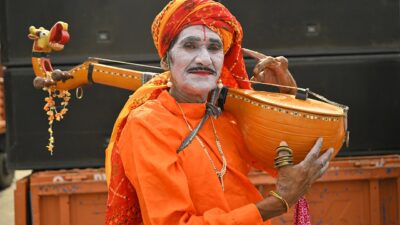
Overviewअंडेलु दक्षिण भारत की कथा-परंपरा की धड़कन है — पीतल की दो नन्ही खोखली अँगूठियाँ, जिनके भीतर भरे दाने हिलते ही घुंघरू-सी झनकार छेड़ देते हैं। बुर्राकथा के मंच पर मुख्य कथावाचक एक हाथ में तम्बूरा थामे कथा बुनता है और दूसरे हाथ की उँगलियों में चमकते अंडेलु से हर तुक और हर नाटकीय मोड़ को लय देता है। यह स्वर का नहीं, समय और उत्साह का वाद्य है।
अंग्रेज़ी में पढ़ें · Read in English
The andelu is the heartbeat of South India's storytelling tradition — two small hollow brass rings whose inner pellets break into a ghungroo-like jingle at the slightest movement. On the Burrakatha stage the chief narrator weaves the tale with a tambura in one hand while the andelu glinting on the fingers of the other lend rhythm to every rhyme and dramatic turn. It is an instrument not of melody but of time and momentum.
वर्गीकरण
ClassificationNatya Shastra Category
घन (Ghana - solid/idiophonic instruments)
घन वर्ग में अंडेलु एक ठोस धातु का इडियोफोन है — इसकी अपनी ही देह के कंपन से ध्वनि उत्पन्न होती है, किसी तनी हुई खाल या तार की आवश्यकता नहीं। यह पीतल की खोखली अँगूठियों की जोड़ी है जिनके भीतर धातु के दाने भरे रहते हैं।
In the Ghana (solid/idiophone) category of Natya Shastra, the andelu is a solid metal idiophone — sound arises from the vibration of its own body, requiring neither a stretched membrane nor a string. It is a pair of hollow brass rings holding metal pellets inside.
Western Category
Idiophone — pellet-rattle / clapper ring
Western Family
Rattle family (shaken and struck concussion idiophone; kin to jingle-bells and pellet bells, distinct from ankle-worn ghungroo)
Sub Classification
बनावट
PhysicalDescription Hindi
अंडेलु पीतल की दो खोखली छल्लेनुमा (टोरॉइड) अँगूठियों की एक जोड़ी है, प्रत्येक का व्यास लगभग डेढ़ से दो इंच (करीब 4–5 सेंटीमीटर) होता है। प्रत्येक छल्ला भीतर से खोखला होता है और उसकी परिधि पर एक झिरी (दरार) होती है; इस खोखलेपन में धातु के छोटे-छोटे दाने भरे रहते हैं जो हिलने पर आपस में टकराकर घुंघरू जैसी झनझनाहट पैदा करते हैं। जब दोनों छल्लों को आपस में ठोका जाता है तो एक तीक्ष्ण धात्विक 'खनक' भी सुनाई देती है।
Description English
The andelu is a pair of hollow, ring-shaped (toroidal) brass loops, each roughly one-and-a-half to two inches (about 4–5 cm) in diameter. Each ring is hollow with a split around its rim; inside the hollow are small metal pellets that rattle against one another when shaken, producing a bell-like jingle. When the two rings are struck together they also yield a sharp metallic clang.
Body
Two matched toroids (closed rings), hollow, with a slit around the rim
दो समान टोरॉइड (बंद छल्ले), खोखले, परिधि पर झिरी सहित
Brass (occasionally bronze / bell-metal)
पीतल (कभी-कभी कांसा / घंटा-धातु)
diameter 4-5 (approx 1.5-2 inches each ring)
The hollow interior of each ring acts as the resonating cavity; the loose metal pellets sealed inside are the sounding elements
Strings
Not a stringed instrument — the andelu has no strings
None — resonance comes from the loose metal pellets inside the hollow ring, not sympathetic strings
No drone element
Bow
लागू नहीं
None
N/A — the andelu is not bowed; it is shaken and struck by hand
0
Played entirely with the fingers and thumb — no bow, no plectrum
Tuning Pegs
लागू नहीं
None
The andelu is a non-pitched rhythm idiophone and has no tuning mechanism
Bridge
लागू नहीं
None
No bridge — sound is generated within the ring itself
N/A
Frets
अंडेलु में फ्रेट या स्वर-स्थान नहीं होते — यह अस्वरित ताल वाद्य है जो केवल लय देता है, राग नहीं।
The andelu has no frets or pitch positions — it is a non-pitched rhythm instrument that supplies time-keeping, not melody.
ध्वनि-चरित्र
SoundTonal Character Hindi
अंडेलु की ध्वनि उजली, धात्विक और झिलमिलाती है — घुंघरू की-सी निरंतर झनझनाहट, जिसके बीच-बीच में दो छल्लों के टकराने से तीखी 'खन-खन' उभरती है। यह मधुर स्वर नहीं देता बल्कि कथावाचन की लय को गति और चमक प्रदान करता है।
Tonal Character English
The andelu's sound is bright, metallic and shimmering — a continuous ghungroo-like jingle punctuated by the sharp 'khan-khan' of the two rings clashing. It gives no melodic pitch; instead it lends drive and sparkle to the rhythm of the storytelling.
Timbre
Bright, jingling, metallic; a granular rattle overlaid with occasional sharp clangs
Range
Non-pitched (percussive/idiophonic) — no defined musical range
Dynamic Range
Moderate — from a soft shimmering hiss (gentle shake) to a crisp accented clang (firm strike)
Techniques
सुनने का मार्गदर्शन
The Listening Guideअंडेलु को सुनना हो तो किसी बुर्राकथा प्रस्तुति में डूब जाइए। कान को कथावाचक के हाथ की ओर मोड़िए — कथा जब तेज़ होती है, वहाँ अंडेलु की झनकार सघन होकर गति भरती है; हास्य के क्षण पर एक तीखी खनक चोट करती है; और 'तांदना ताने' की टेक पर वह सहकलाकारों के गुम्मेटा के साथ मिलकर लय की लहर बनाती है।
अंग्रेज़ी में पढ़ें · Read in English
To hear the andelu, immerse yourself in a Burrakatha performance. Turn your ear toward the narrator's hand — when the tale quickens, the andelu's jingle thickens and drives it forward; at a comic beat a sharp clang lands the joke; and on the 'tandana tane' refrain it locks with the co-performers' gummeta into a wave of rhythm. It is the small instrument behind the words that keeps the whole story dancing.
अन्य विवरण
More DetailsTimbre
Bright, jingling, metallic; a granular rattle overlaid with occasional sharp clangs
रोचक तथ्य
Margin Notes'बुर्रा' का अर्थ — बुर्राकथा नाम में 'बुर्रा' तम्बूरे (एकतार-जैसे खोखले खोल वाले वाद्य) को इंगित करता है और 'कथा' का अर्थ कहानी। इसी मंडली में अंडेलु लय सँभालता है — यानी नाम भले तम्बूरे पर हो, ताल अंडेलु देता है।
In the name Burrakatha, 'burra' points to the tambura (a hollow-shelled drone lute) and 'katha' means story. Within that same act the andelu carries the rhythm — so while the name honours the tambura, it is the andelu that keeps the beat.
अकेले कलाकार की पूरी लय-व्यवस्था — अंडेलु की सबसे चतुर बात यह है कि यह एक ही हाथ की उँगलियों-अँगूठे में समा जाता है, जिससे कथावाचक का दूसरा हाथ तम्बूरा बजाने के लिए स्वतंत्र रहता है। इस तरह एक ही व्यक्ति एक साथ गाथा, ताल और सुर-आधार — तीनों सँभाल लेता है।
The cleverest thing about the andelu is that it fits onto the fingers and thumb of a single hand, leaving the narrator's other hand free for the tambura. In this way one person handles the tale, the rhythm and the drone-foundation all at once.
घन वर्ग का दुर्लभ रूप — अधिकांश भारतीय घन (धातु-ताल) वाद्य या तो टकराने वाली तश्तरियाँ हैं (मंजीरा, झांझ) या बँधी हुई घंटियाँ (घुंघरू)। अंडेलु दोनों को मिला देता है — एक खोखली अँगूठी जो भीतर के दानों से झनझनाती भी है और बाहर से टकराने पर बजती भी है।
Most Indian Ghana (metal-percussion) instruments are either clashed discs (manjira, jhanjh) or tied bells (ghungroo). The andelu fuses both — a hollow ring that rattles from the pellets within and rings when struck from without.
बैलों की लोरी — संगीत के अतिरिक्त अंडेलु का एक व्यावहारिक उपयोग भी था: बैलगाड़ी में इसे बाँध दिया जाता, और चलते समय इसकी नियमित 'छन-छन' बैलों को शांत व सजग रखती, उन्हें अचानक की आवाज़ों से चौंकने से रोकती।
Beyond music, the andelu had a practical use: tied to a bullock cart, its steady 'ching-ching' as the cart rolled kept the oxen calm and settled, preventing them from bolting at sudden sounds.
सवाल-जवाब
Questions & Answersअंडेलु क्या है?
अंडेलु पीतल की दो खोखली छल्लेनुमा अँगूठियों की एक जोड़ी है जिनके भीतर धातु के दाने भरे रहते हैं। हिलाने पर ये घुंघरू-सी झनझनाहट और आपस में टकराने पर तीखी खनक देती हैं। यह दक्षिण भारत की बुर्राकथा लोक-कथा परंपरा का प्रमुख ताल वाद्य है।
अंडेलु कैसे बजाया जाता है?
एक छल्ला अँगूठे में और दूसरा उसी हाथ की उँगलियों में पहना जाता है, फिर उन्हें आपस में ठोककर लय दी जाती है; या दोनों छल्ले एक ही अँगूठे में चढ़ाकर उँगलियों से बजाए जाते हैं। इससे कथावाचक का दूसरा हाथ तम्बूरा बजाने के लिए स्वतंत्र रहता है।
अंडेलु और घुंघरू में क्या अंतर है?
घुंघरू पैर के टखने में बँधी अनेक छोटी गोल घंटियाँ हैं जो नर्तक के पैरों से बजती हैं। अंडेलु उँगली में पहनी जाने वाली दो बड़ी खोखली अँगूठियाँ हैं जिनके भीतर दाने भरे होते हैं और जिन्हें हाथ से बजाया जाता है। दोनों घन वर्ग के हैं पर रूप और वादन अलग हैं।
अंडेलु किस क्षेत्र का वाद्य है और कहाँ बजता है?
अंडेलु दक्षिण भारत के तेलुगु भाषी क्षेत्र — आंध्र प्रदेश और तेलंगाना — का लोक वाद्य है। यह मुख्यतः बुर्राकथा (तांदना कथा) नामक गाथा-कथन विधा में बजता है, जहाँ मुख्य कथावाचक इसे अपने हाथ की लय के रूप में प्रयोग करता है।
नमूना-पट्टी
The Specimen Table| नाम | अंडेलु · Andelu |
|---|---|
| अन्य नाम | अंडेल्लु · अंडेल (एकवचन) · అండెలు (Telugu) · Andelu (also: Andellu) |
| प्रकार | वाद्य · Instruments |
साझा कीजिए · Share this Plate