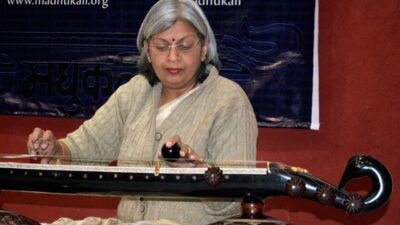
शास्त्र विंग · वाद्य-पट्टिका · Instrument Plate
विचित्र वीणा
Vichitra Veena
अन्य नामविचित्र वीणा · बत्ता बीन (batta been) · Vichitra Vina · Vichitra Veen
परिचय
Overviewविचित्र वीणा भारतीय संगीत का वह अद्भुत वाद्य है जिसमें एक भी परदा नहीं होता — स्वर बायें हाथ में पकड़े काँच के गोले (बत्ता) को नारियल-तेल से चिकनाई तारों पर सरकाकर निकाले जाते हैं, जबकि दाहिने हाथ की दो अंगुलियों की मिज़राब तारों को झंकृत करती हैं। दो कद्दू के तुम्बे और लगभग तेरह तरब तार मिलकर पाँच सप्तक तक फैली, गायन-सी अटूट मीड रचते हैं। प्राचीन एकतंत्री वीणा की यह जीवित कड़ी पंडित लालमणि मिश्र और पंडित गोपाल कृष्ण जैसे साधकों के हाथों पुनर्जीवित हुई और आज विश्व के गिने-चुने वादकों में बची है।
अंग्रेज़ी में पढ़ें · Read in English
The vichitra veena is that wonderful Indian instrument with not a single fret — notes are produced by sliding a glass ball (batta) held in the left hand over coconut-oiled strings, while two mizrabs on the right-hand fingers pluck the strings. Two gourd resonators and some thirteen sympathetic strings together create an unbroken, singing meend spanning five octaves. This living link to the ancient Ekatantri Veena was revived by devotees such as Pandit Lalmani Misra and Pandit Gopal Krishan, and today survives among only a handful of players worldwide.
वर्गीकरण
ClassificationNatya Shastra Category
तत (Tata - stringed instruments)
तत वर्ग में विचित्र वीणा एक फ्रेट-रहित तार-वाद्य है। इसमें ध्वनि तारों को नखी (मिज़राब) से झंकृत कर और बायें हाथ में पकड़े काँच या पत्थर के गोले (बत्ता) को तारों पर सरकाकर उत्पन्न होती है — किसी भी अंगुली से तार को दबाया नहीं जाता।
Within the Tata (stringed) category, the vichitra veena is a fretless chordophone. Sound is produced by plucking the strings with plectrums (mizrab) worn on the right hand while a glass or stone ball (batta) held in the left hand is slid along the strings — the strings are never stopped with a finger.
Western Category
Fretless stick-zither (slide-played plucked chordophone)
Western Family
Zither / slide-string family (conceptually related to the Hawaiian lap-steel guitar and to the Carnatic chitravina, but distinctly Hindustani in tuning and repertoire)
Sub Classification
बनावट
PhysicalDescription Hindi
विचित्र वीणा एक बड़ा, फ्रेट-रहित तार-वाद्य है। इसका मुख्य भाग एक चौड़ा, चपटा, क्षैतिज दंड (डांड) है जो लगभग तीन फुट लंबा और छह इंच चौड़ा होता है। दंड के दोनों सिरों के नीचे दो बड़े कद्दू के तुम्बे (गुँजायमान गोले) लगे रहते हैं जो ध्वनि को गुँजाते हैं। इसमें कोई परदे (फ्रेट) नहीं होते — पूरा स्वर बायें हाथ में पकड़े काँच के गोले 'बत्ता' को सरकाकर निकाला जाता है।
Description English
The vichitra veena is a large, fretless string instrument. Its main body is a broad, flat, horizontal bar (dand) about three feet long and six inches wide. Two large gourd resonators (tumba) are fixed below each end of the bar to amplify the sound. It has no frets at all — the entire melody is drawn out by sliding a glass ball ('batta') held in the left hand along the strings.
Body
Broad flat horizontal crossbar (dand) with two gourd resonators mounted below the ends; played resting horizontally in front of the seated musician
चौड़ा चपटा क्षैतिज दंड, जिसके सिरों के नीचे दो तुम्बे लगे होते हैं; वादक इसे सामने रखकर बैठकर बजाता है
Hardwood bar (teak / tun / rosewood) with two large dried-gourd (tumba) resonators
कठोर लकड़ी का दंड (सागवान / तून / शीशम) और सूखे कद्दू के दो तुम्बे
Bar approx. 90 cm long, 15 cm wide
Two gourd resonators (tumba) beneath the crossbar provide a deep, sustained, humming resonance
Strings
Main melody strings, played by sliding the batta over them
Sympathetic (taraf) strings tuned to the notes of the chosen raag, running beneath the main strings and resonating on their own
Chikari (rhythm/drone strings) struck to keep time and sound the tonic, plucked between melodic phrases
Bow
बत्ता (काँच का गोला) एवं मिज़राब
Batta (glass ball) and mizrab (plectrums)
A smooth ball of glass, crystal or polished stone (batta) for the left hand; two wire plectrums (mizrab) worn on the right index and middle fingers
Batta approx. 4-5 cm diameter
There is NO bow. The right hand plucks with the two mizrabs while the left hand slides the batta along the strings to shape the melody; the strings are lubricated with coconut oil so the batta glides smoothly.
Tuning Pegs
खूँटी
Khunti
Wooden tuning pegs at the head for the main strings, plus rows of small pegs for the sympathetic strings
Bridge
घुड़च / जवारी
Ghudach / Javari bridge
A flat, wide bridge (with javari, the grazing curve that gives Indian string instruments their buzzing overtone-rich tone) that carries string vibration to the gourd resonators
Bone or hardwood, sometimes with a metal wear-plate
Frets
विचित्र वीणा पूर्णतः फ्रेट-रहित है — यही इसकी आत्मा है। स्वर उँगली से नहीं, बल्कि काँच के गोले (बत्ता) को तारों पर सरकाकर निकाला जाता है, जिससे एक स्वर से दूसरे स्वर तक अटूट, निरंतर मीड (ग्लिसांडो) संभव होती है — मानो गायक की आवाज़ फिसल रही हो।
The vichitra veena is completely fretless — this is its very soul. Notes are produced not by fingering but by sliding a glass ball (batta) along the strings, allowing unbroken, continuous meend (glissando) from one note to the next — as if a singer's voice were gliding.
ध्वनि-चरित्र
SoundTonal Character Hindi
विचित्र वीणा की ध्वनि गहरी, गूँजती और भावपूर्ण है — तुम्बों की गंभीर अनुगूँज और तरब तारों की झिलमिलाहट मिलकर एक रहस्यमय, ध्यानमग्न स्वर रचती है। बत्ता की अटूट सरकन के कारण इसका हर स्वर गायन-सा बहता है, बिना किसी झटके के।
Tonal Character English
The vichitra veena's tone is deep, resonant and expressive — the grave hum of the gourds and the shimmer of the sympathetic strings combine into a mysterious, meditative voice. Because the batta slides without a break, every note flows like singing, with no jump between pitches.
Timbre
Rich, glassy, sustained; deeper and more resonant than the sitar, with a long singing decay
Range
Up to five octaves — one of the widest ranges of any Indian string instrument
Dynamic Range
Wide — from the softest gliding whisper of an alap to the ringing cascade of a jhala
Techniques
सुनने का मार्गदर्शन
The Listening Guideविचित्र वीणा का रस लेना हो तो धैर्य रखिए। किसी शांत क्षण में एक धीमे आलाप से शुरुआत कीजिए और सुनिए कि बत्ता कैसे एक स्वर से दूसरे तक बिना किसी झटके के फिसलता है। तुम्बों की गहरी गूँज और तरब तारों की झिलमिलाहट पर ध्यान दीजिए। पंडित गोपाल कृष्ण की आकाशवाणी रिकॉर्डिंग सबसे अच्छा आरंभ है।
अंग्रेज़ी में पढ़ें · Read in English
Appreciating the vichitra veena takes patience. In a quiet moment, begin with a slow alap and listen to how the batta glides from note to note without a break — never a jump. Attend to the deep hum of the gourds and the shimmer of the sympathetic strings. Start with Pandit Gopal Krishan's All India Radio recordings; then hear a dhrupad-style rendering, where the instrument opens its soul.
परिचय
Identity- Year Of Origin
- 1900
अन्य विवरण
More DetailsTimbre
Rich, glassy, sustained; deeper and more resonant than the sitar, with a long singing decay
रोचक तथ्य
Margin Notesअद्भुत नाम, अद्भुत वाद्य — 'विचित्र' का अर्थ 'अद्भुत' या 'विलक्षण' है — यह नाम इसके विलक्षण वादन-ढंग को दर्शाता है, जहाँ स्वर उँगली से नहीं बल्कि सरकते काँच के गोले से निकलते हैं। इसे प्राचीन एकतंत्री वीणा का आधुनिक अवतार माना जाता है।
'Vichitra' means 'wonderful' or 'curious' — a name that reflects its extraordinary manner of play, where notes come not from a finger but from a sliding glass ball. It is regarded as the modern incarnation of the ancient Ekatantri Veena.
मिश्र घराने की तपस्या — पंडित लालमणि मिश्र (1924–1979) ने विचित्र वीणा को विलुप्ति से बचाया — उन्होंने इसके लिए नयी तकनीकें और नए राग रचे। उनके पुत्र गोपाल शंकर मिश्र (1957–1999) ने इस परंपरा को अगली पीढ़ी तक पहुँचाया।
Pandit Lalmani Misra (1924–1979) rescued the vichitra veena from extinction — devising new techniques and composing new ragas for it. His son Gopal Shankar Misra (1957–1999) carried the tradition to the next generation.
पाँच सप्तक की वीणा — विचित्र वीणा का स्वर-विस्तार लगभग पाँच सप्तक तक जाता है — भारतीय तार-वाद्यों में सबसे व्यापक विस्तारों में से एक। लगभग तेरह तरब तार हर वादन से पहले चुने गए राग के स्वरों पर मिलाए जाते हैं।
The vichitra veena's range spans nearly five octaves — one of the widest of any Indian string instrument. About thirteen sympathetic strings are re-tuned before every performance to the notes of the chosen raga.
स्त्री-स्वर की एक कड़ी — राधिका वीणा साधिका को 'विश्व की पहली महिला विचित्र वीणा वादिका' कहा जाता है, और रागिनी त्रिवेदी भी इस विरल परंपरा की समकालीन ध्वजवाहक हैं — एक ऐसे वाद्य में स्त्री-उपस्थिति जो सदा पुरुष-प्रधान रहा।
Radhika Veena Sadhika is called the 'world's first woman vichitra veena player', and Ragini Trivedi too is a contemporary standard-bearer of this rare tradition — a female presence in an instrument that has long been male-dominated.
सवाल-जवाब
Questions & Answersविचित्र वीणा क्या है?
विचित्र वीणा एक बड़ा, फ्रेट-रहित भारतीय तार-वाद्य है, जिसमें स्वर उँगली से नहीं बल्कि बायें हाथ में पकड़े काँच के गोले (बत्ता) को तारों पर सरकाकर निकाले जाते हैं। यह हिंदुस्तानी शास्त्रीय संगीत का एक दुर्लभ एकल वाद्य है।
विचित्र वीणा कैसे बजाई जाती है?
दाहिने हाथ की दो अंगुलियों में पहने मिज़राब तारों को झंकृत करते हैं, जबकि बायें हाथ में पकड़ा काँच का गोला (बत्ता) तारों पर सरककर स्वर बनाता है। तारों पर नारियल तेल लगाया जाता है ताकि बत्ता आसानी से फिसल सके। कोई परदा न होने से एक स्वर से दूसरे तक अटूट मीड संभव होती है।
विचित्र वीणा में कितने तार होते हैं?
विचित्र वीणा में आमतौर पर चार मुख्य वादन तार, लगभग पाँच चिकारी (लय/द्रोण) तार और लगभग तेरह तरब (अनुनाद) तार होते हैं। इसका स्वर-विस्तार लगभग पाँच सप्तक तक जाता है।
विचित्र वीणा के प्रसिद्ध वादक कौन हैं?
पंडित लालमणि मिश्र (1924–1979) ने इस वाद्य को पुनर्जीवित किया; पंडित गोपाल कृष्ण (1926–2004) ने इसे व्यापक श्रोताओं तक पहुँचाया। गोपाल शंकर मिश्र, रागिनी त्रिवेदी और राधिका वीणा साधिका इस दुर्लभ परंपरा के अन्य प्रमुख नाम हैं।
क्या विचित्र वीणा फ़िल्म संगीत में इस्तेमाल होती है?
नहीं, विचित्र वीणा मुख्यतः शास्त्रीय मंच और साधना का वाद्य है और फ़िल्म संगीत में लगभग अनुपस्थित रही है। इसकी फिसलती, गायन-सी स्लाइड ध्वनि उसी सौंदर्य से जुड़ी है जिसे बॉलीवुड ने कभी-कभी हवाइयन/स्लाइड गिटार से पाने का प्रयास किया।
नमूना-पट्टी
The Specimen Table| नाम | विचित्र वीणा · Vichitra Veena |
|---|---|
| अन्य नाम | विचित्र वीणा · बत्ता बीन (batta been) · Vichitra Vina · Vichitra Veen |
| उद्गम | 1900 |
| प्रकार | वाद्य · Instruments |
साझा कीजिए · Share this Plate