शास्त्र विंग · वाद्य-पट्टिका · Instrument Plate
वेणु
Venu
अन्य नामपुल्लांगुळल (तमिळ / Pullanguzhal) · पिल्लनग्रोवि (तेलुगु / Pillana grovi) · कोळलु / मुरळी (कन्नड / Kolalu, Murali) · ऊदकुळल (मलयालम / Oodakuzhal)
परिचय
Overviewवेणु दक्षिण भारत की कर्नाटक बाँसुरी है — एक ही सूखे बाँस से तराशी, आठ छिद्रों वाली, बिना किसी चाबी की अनुप्रस्थ वंशी। इसका स्वर स्वच्छ, गोल और गायकी के इतने निकट है कि यह मानो गा उठती है। नाट्यशास्त्र में वर्णित और कृष्ण की मुरली के रूप में पूजित यह वाद्य, शरभ शास्त्री, पल्लडम संजीव राव, टी. आर. महालिंगम 'मालि' और एन. रमणी की परंपरा से होते हुए आज भी कर्नाटक मंच का हृदय बनी हुई है।
अंग्रेज़ी में पढ़ें · Read in English
The venu is South India's Carnatic flute — a keyless, eight-hole transverse flute carved from a single piece of seasoned bamboo. Its tone is clear, round and so close to gayaki that it seems to sing. Described in the Natya Shastra and revered as Krishna's murali, the instrument — through the lineage of Sarabha Sastri, Palladam Sanjiva Rao, T. R. Mahalingam 'Mali' and N. Ramani — remains the heart of the Carnatic stage today.
वर्गीकरण
ClassificationNatya Shastra Category
सुषिर (Sushira - wind/hollow instruments)
सुषिर वर्ग में वेणु एक फूँक-आधारित खोखला वाद्य यंत्र है जो बाँस की नली के भीतर वायु-स्तंभ के कंपन से ध्वनि उत्पन्न करता है। सुषिर का अर्थ ही है 'छिद्रयुक्त' या 'खोखला'।
In the Sushira (wind/hollow) category of the Natya Shastra, the venu is a blown instrument that produces sound through the vibration of an air column inside a bamboo tube. The word 'sushira' itself means 'hollow' or 'perforated'.
Western Category
Woodwind — side-blown (transverse) flute
Western Family
Flute family (transverse bamboo flute; the southern, Carnatic counterpart of the Hindustani bansuri)
Sub Classification
बनावट
PhysicalDescription Hindi
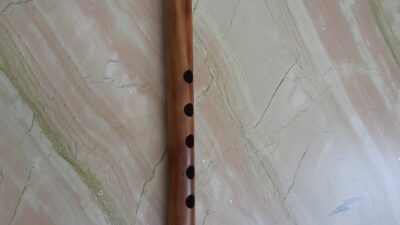
वेणु एक अनुप्रस्थ (आड़ी पकड़ी जाने वाली) बाँस की वंशी है जिसे एक ही सूखे बाँस के टुकड़े से बनाया जाता है। इसमें एक फूँक-छिद्र और आठ पास-पास बने स्वर-छिद्र होते हैं, कोई चाबी या यांत्रिक कल-पुर्ज़ा नहीं। उत्तर की बाँसुरी की तुलना में दक्षिणी वेणु अपेक्षाकृत मोटी, सघन दीवार वाले बाँस से बनती है, जिससे इसका स्वर स्पष्ट और मधुर-गोल होता है।
Description English
The venu is a transverse (side-held) bamboo flute made from a single piece of seasoned bamboo. It has one blow-hole and eight closely-spaced finger-holes, with no keys or mechanical parts. Compared with the northern bansuri, the southern venu is made from thicker, denser-walled bamboo, giving it a clear and mellow, rounded tone.
Body
Straight cylindrical open tube, closed at the blowing end
सीधी बेलनाकार खुली नली, फूँक वाले सिरे पर बंद
Single piece of seasoned bamboo (traditionally the dense Nilambur variety from the forests of Kerala and southern Tamil Nadu)
एक ही सूखे बाँस का टुकड़ा (परंपरागत रूप से केरल एवं दक्षिणी तमिलनाडु के वनों का सघन नीलांबूर बाँस)
35-60 (varies with pitch; lower-pitched concert flutes are longer)
The hollow bamboo bore itself acts as the resonating air column; the closed cork/wax plug near the blow-hole reflects the air column
Blow Hole
मुख-रंध्र / फूँक-छिद्र
Mukha-randhra (embouchure hole)
फूँक वाले सिरे के पास स्थित बड़ा छिद्र जिसकी धार पर हवा टकराकर ध्वनि उत्पन्न करती है। इसके ठीक ऊपर बाँस मोम या काग से बंद रहता है।
A larger hole near the closed end across whose edge the player blows a stream of air to set the air column vibrating. Just above it the tube is sealed with a cork or wax plug.
The edge of the bamboo itself; plug of cork or beeswax
Finger Holes
8
स्वर-रंध्र / अंगुली-छिद्र
Swara-randhra (finger holes)
आठ पास-पास बने छिद्र, जिनमें से सात मुख्य रूप से स्वर बनाने के लिए और आठवाँ प्रायः सुर मिलाने/निचले स्वर के लिए प्रयुक्त होता है। छिद्रों को पूर्ण या आंशिक रूप से ढककर तथा क्रॉस-फ़िंगरिंग से सूक्ष्म श्रुतियाँ निकाली जाती हैं।
Eight closely-placed holes; seven are used chiefly for melody and the eighth largely for tuning and the lower register. By covering holes fully or partially and using cross-fingering, the player produces the microtones (srutis) of Carnatic music.
Bore
नली-गुहा
Bore
Cylindrical inner channel of the bamboo; open at the distal (far) end and stopped at the blowing end, so it overblows at the octave
Natural bamboo internode, cleared of pith
Tuning
सुर-मिलान
Tuning
वेणु की लंबाई और छिद्रों की स्थिति उसके मूल स्वर (सा) को निर्धारित करती है; कर्नाटक संगीत में प्रायः 'E' को षड्ज (सा) माना जाता है। लगभग ढाई सप्तक का विस्तार ओवर-ब्लोइंग तथा क्रॉस-फ़िंगरिंग से मिलता है।
The length of the venu and the placement of its holes fix its tonic (sa); in Carnatic practice 'E' is commonly taken as shadja (sa). A range of about two and a half octaves is achieved through over-blowing and cross-fingering.
Decoration
अलंकरण
Ornamentation
सिरों पर धागे या धातु के छल्ले लपेटे जाते हैं ताकि बाँस चटके नहीं; कुछ वादक सिरे पर नक़्क़ाशी या रंगीन धागा भी बाँधते हैं।
The ends are often bound with thread or metal rings to keep the bamboo from splitting; some makers add carving or coloured thread wrapping at the ends.
Frets
वेणु में न कोई फ्रेट होता है, न कोई चाबी — स्वर पूर्णतः अंगुलियों से छिद्रों को ढककर, फूँक की तीव्रता बदलकर तथा वंशी को हल्का घुमाकर साधे जाते हैं, जिससे कर्नाटक गमक और मींड संभव होते हैं।
The venu has neither frets nor keys — pitch is controlled entirely by the fingers covering the holes, by breath pressure, and by slight rolling of the flute, enabling Carnatic gamakas (oscillations) and glides.
ध्वनि-चरित्र
SoundTonal Character Hindi
वेणु का स्वर स्वच्छ, गोल और मधुर होता है — बाँस के सघन होने के कारण इसमें एक भरी-पूरी, शांत-सी गूँज रहती है। यह मानव कंठ के 'गायकी' अंदाज़ की सबसे निकट नकल कर सकती है, इसीलिए इसे 'बजती हुई आवाज़' कहा जाता है।
Tonal Character English
The venu's tone is clear, round and mellow — the density of the bamboo gives it a full, serene resonance. It can imitate the 'gayaki' (vocal) style of the human voice more closely than almost any other instrument, which is why it is called a 'singing' flute.
Timbre
Warm, breathy, woody and pure; softer and more rounded than a metal Western flute
Range
About two and a half octaves (extended by over-blowing and cross-fingering)
Dynamic Range
Gentle and intimate to bright and penetrating, though naturally soft — traditionally an un-amplified concert instrument
Techniques
सुनने का मार्गदर्शन
The Listening Guideवेणु का रस लेना हो तो कोई कर्नाटक कच्छेरी की एकल प्रस्तुति चुनिए। पहले राग-आलापन सुनिए — जहाँ बिना ताल के वेणु राग की आत्मा खोलती है; फिर किसी कृति में देखिए कि कैसे वेणु शब्दों की छाया को स्वर में उतारती है। गमक और गायकी पर ध्यान दीजिए — यही वेणु को उत्तर की बाँसुरी से अलग करता है।
अंग्रेज़ी में पढ़ें · Read in English
To appreciate the venu, choose a solo Carnatic kutcheri performance. First hear the raga alapana, where the venu opens the soul of the raga without rhythm; then, in a kriti, watch how the venu traces the shadow of the lyrics in sound. Attend to the gamaka and the gayaki — this is what separates the venu from the northern bansuri. Begin with N. Ramani.
परिचय
Identity- Year Of Origin
- -200
अन्य विवरण
More Details- Name English
- Tuning
- Description English
- The length of the venu and the placement of its holes fix its tonic (sa); in Carnatic practice 'E' is commonly taken as shadja (sa). A range of about two and a half octaves is achieved through over-blowing and cross-fingering.
- Name
- सुर-मिलान
- Description
- वेणु की लंबाई और छिद्रों की स्थिति उसके मूल स्वर (सा) को निर्धारित करती है; कर्नाटक संगीत में प्रायः 'E' को षड्ज (सा) माना जाता है। लगभग ढाई सप्तक का विस्तार ओवर-ब्लोइंग तथा क्रॉस-फ़िंगरिंग से मिलता है।
Tuning
Timbre
Warm, breathy, woody and pure; softer and more rounded than a metal Western flute
रोचक तथ्य
Margin Notesकृष्ण की वेणु — वेणुगोपाल — भारतीय कला और भक्ति में वेणु भगवान कृष्ण का चिरस्थायी प्रतीक है। कृष्ण को 'वेणुगोपाल' और 'मुरलीमनोहर' कहा जाता है — वे बाँस की इसी वंशी से समस्त प्रकृति और गोपियों को मोहित करते हैं। यही आध्यात्मिक छवि वेणु को केवल वाद्य नहीं, दिव्य नाद का प्रतीक बना देती है।
In Indian art and devotion the venu is Lord Krishna's enduring emblem. Krishna is called 'Venugopala' and 'Murali Manohar' — with this very bamboo flute he enchants all of nature and the gopis. This spiritual image makes the venu not merely an instrument but a symbol of divine sound.
आठ छिद्रों की कर्नाटक बाँसुरी — आधुनिक वेणु में आठ पास-पास बने छिद्र होते हैं, जिनमें से सात स्वर के लिए और आठवाँ प्रायः निचले स्वर/सुर-मिलान के लिए। 19वीं सदी में शरभ शास्त्री ने इस आठ-छिद्र डिज़ाइन को कर्नाटक एकल-वादन के लिए प्रतिष्ठित किया — यही इसे छह-सात छिद्रों वाली उत्तरी बाँसुरी से अलग करता है।
The modern venu has eight closely-placed holes, seven for melody and the eighth largely for the lower register and tuning. In the 19th century Sarabha Sastri established this eight-hole design for Carnatic solo playing — this is what distinguishes it from the six-to-seven-hole northern bansuri.
केरल के नीलांबूर बाँस से — श्रेष्ठ वेणु केरल एवं दक्षिणी तमिलनाडु के वनों के सघन नीलांबूर बाँस से बनती है, जिसे उसकी सीधाई, समान मोटाई और प्राकृतिक गूँज के लिए चुना जाता है। यही सघनता वेणु को उसका स्वच्छ, मधुर-गोल स्वर देती है।
The finest venus are made from the dense Nilambur bamboo of the forests of Kerala and southern Tamil Nadu, chosen for its straightness, uniform thickness and natural resonance. This density gives the venu its clear, mellow-rounded tone.
मालि से रमणी तक — गायकी की परंपरा — टी. आर. महालिंगम 'मालि' (1926–1986) ने वेणु-वादन को गायन की तरह अभिव्यंजक बनाया। उनके शिष्य एन. रमणी (1934–2015) ने एक लंबी वेणु प्रचलित की जो निचले सप्तक को अधिक गहराई से बजाती थी — 'बाँसुरी रमणी' के रूप में वे कर्नाटक बाँसुरी के पर्याय बन गए।
T. R. Mahalingam 'Mali' (1926–1986) made venu playing as expressive as singing. His disciple N. Ramani (1934–2015) popularised a longer venu that sounded the lower octave more deeply — as 'Flute Ramani' he became synonymous with the Carnatic flute.
सवाल-जवाब
Questions & Answersवेणु क्या है?
वेणु दक्षिण भारत की कर्नाटक बाँसुरी है — एक ही सूखे बाँस से बनी, आठ छिद्रों वाली, बिना चाबी की अनुप्रस्थ (आड़ी) वंशी। यह कर्नाटक शास्त्रीय संगीत का प्रमुख एकल एवं संगत वाद्य है और इसका स्वर मानव कंठ की गायकी के बहुत निकट माना जाता है।
वेणु और बाँसुरी में क्या अंतर है?
दोनों एक ही प्रकार की अनुप्रस्थ बाँस-वंशी हैं। वेणु दक्षिण भारत की कर्नाटक शैली की है — सघन बाँस, आठ छिद्र और गमक-प्रधान वादन; बाँसुरी उत्तर भारत की हिंदुस्तानी शैली की है — पतली दीवार वाला असमी बाँस, छह-सात छिद्र और मींड-प्रधान वादन।
वेणु में कितने छिद्र होते हैं?
आधुनिक कर्नाटक वेणु में एक फूँक-छिद्र और आठ पास-पास बने स्वर-छिद्र होते हैं, जिनमें से सात मुख्यतः स्वर बनाने के लिए और आठवाँ प्रायः निचले स्वर व सुर-मिलान के लिए प्रयुक्त होता है।
वेणु का कृष्ण से क्या संबंध है?
वेणु भगवान कृष्ण की मुरली है। कृष्ण को 'वेणुगोपाल' और 'मुरलीमनोहर' कहा जाता है — वे इसी बाँस की वंशी से समस्त प्रकृति और गोपियों को मोहित करते हैं। इसीलिए वेणु भारतीय भक्ति-कला में दिव्य नाद का प्रतीक है।
वेणु के सबसे प्रसिद्ध वादक कौन हैं?
19वीं सदी में शरभ शास्त्री ने वेणु को कर्नाटक एकल वाद्य के रूप में प्रतिष्ठित किया; पल्लडम संजीव राव ने परंपरा बढ़ाई; टी. आर. महालिंगम 'मालि' ने वादन-शैली में क्रांति लाई; और एन. रमणी 'बाँसुरी रमणी' के रूप में विश्व-विख्यात हुए। समकालीन कलाकारों में शशांक सुब्रमण्यम प्रमुख हैं।
नमूना-पट्टी
The Specimen Table| नाम | वेणु · Venu |
|---|---|
| अन्य नाम | पुल्लांगुळल (तमिळ / Pullanguzhal) · पिल्लनग्रोवि (तेलुगु / Pillana grovi) · कोळलु / मुरळी (कन्नड / Kolalu, Murali) · ऊदकुळल (मलयालम / Oodakuzhal) · कर्नाटक बाँसुरी (Carnatic flute) · वेणुवु (Venuvu) |
| उद्गम | -200 |
| प्रकार | वाद्य · Instruments |
साझा कीजिए · Share this Plate