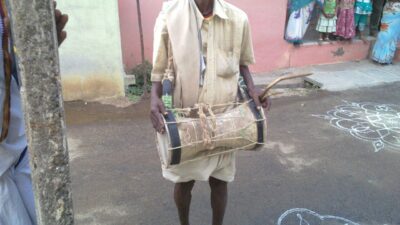
शास्त्र विंग · वाद्य-पट्टिका · Instrument Plate
उरुमी
Urumi
अन्य नामउरुमी मेळम (Urumi Melam — ensemble name) · उरुमी (Urumee — alternate romanization) · உருமி (Tamil script)
परिचय
Overviewउरुमी तमिलनाडु का दुमुखी, कमर से पतला (hourglass) लोक-ढोल है, जिसे कंधे पर आड़ा लटकाकर दो डंडियों से बजाया जाता है — और जिसकी असली पहचान इसका घर्षण-स्वर है, जब एक घुमावदार डंडी से चमड़े को रगड़कर वह गुर्राती-कराहती आवाज़ निकलती है। 'उरुमी मेळम' मंडली में यह अम्मन उत्सव, कावडी और थाईपुसम के जुलूसों की धड़कन है, और तमिल प्रवासी समुदायों ने इसे समुद्र-पार जीवित रखा है।
अंग्रेज़ी में पढ़ें · Read in English
The urumi is Tamil Nadu's double-headed, waisted (hourglass) folk drum, played horizontally on a shoulder strap with two sticks — its true identity being its friction voice, when a curved stick rubbing the skin draws out that growling, moaning cry. Within the 'urumi melam' ensemble it is the heartbeat of Amman festivals, kavadi and Thaipusam processions, and Tamil diaspora communities have kept it alive across the seas.
वर्गीकरण
ClassificationNatya Shastra Category
अवनद्ध (Avanaddha - membranophones / drums)
नाट्यशास्त्र की चार वाद्य-श्रेणियों में उरुमी 'अवनद्ध वाद्य' है — अर्थात चमड़े से मढ़ा हुआ ताल-वाद्य। यह घर्षण (friction) से गूँज उत्पन्न करने वाला एक विशेष दुमुखी डमरू-नुमा (hourglass) ढोल है।
Among the four instrument categories of the Natya Shastra, the urumi is an 'Avanaddha vadya' — a skin-covered percussion instrument. It is a distinctive double-headed hourglass drum that produces its signature growl through friction rather than a plain struck stroke.
Western Category
Friction drum / hourglass-shaped double-headed membranophone
Western Family
Friction-drum family (a struck-and-r믭 drum, related in principle to the European rommelpot and cuíca, but uniquely Tamil in form and technique)
Sub Classification
बनावट
PhysicalDescription Hindi
उरुमी एक दुमुखी, कमर से पतली (hourglass/डमरू जैसी) लकड़ी की ढोल है जिसके दोनों मुख चमड़े से मढ़े होते हैं। इसे कंधे पर कपड़े की पट्टी से लटकाकर आड़ा (horizontal) पकड़ा जाता है, ताकि वादक खड़े-खड़े या जुलूस में चलते हुए बजा सके। इसकी असली पहचान इसका घर्षण-स्वर है — एक लंबी घुमावदार डंडी से बाएँ चमड़े को रगड़ने पर यह किसी जानवर की गुर्राहट या 'बोलती' आवाज़ जैसी गूँज देती है।
Description English
The urumi is a double-headed, waisted (hourglass) wooden drum with both faces covered in skin. It is slung across the shoulder on a cloth strap and held horizontally so the player can perform standing or while walking in procession. Its true signature is its friction voice — rubbing the left head with the edge of a long curved stick produces a growling, almost 'talking' resonance quite unlike an ordinary struck drum.
Body
Hourglass / waisted cylindrical shell (narrower at the middle)
बीच से पतली, डमरू-नुमा (hourglass) बेलनाकार खोल
Hollow carved wood — preferably jackwood (palamaram); rosewood is sometimes substituted
खोखली तराशी हुई लकड़ी — मुख्यतः कटहल की लकड़ी (पलामरम्); कभी-कभी शीशम/रोज़वुड भी
approx. 30-45 (a compact, portable processional drum)
The waisted wooden shell acts as the resonator; the two opposing heads couple through the hollow body to give the drum its penetrating, carrying tone
Strings
None — the urumi is a membranophone (skin drum), not a stringed instrument
None
None
Heads
2 (double-headed)
दो (दुमुखी)
Tensioning
V-आकार की डोरी और कसने वाली कुंडलियाँ
V-lacing and sliding tension coils
दोनों मुखों को एक सतत रस्सी से V-आकार में गूँथकर बाँधा जाता है। रस्सी पर डोरी या धातु की छोटी कुंडलियाँ खिसकाकर तनाव घटाया-बढ़ाया जाता है — विशेषकर बरसात में जब चमढ़ा ढीला पड़ जाता है।
Both heads are bound by a single continuous rope woven in a V-shape around the waist. Small coils of string or metal slide along the rope to raise or lower tension — especially useful in the monsoon when the skins slacken.
Sticks
उरुमी डंडियाँ (एक लंबी घुमावदार + एक सीधी)
Urumi sticks (one long curved, one straight)
उरुमी को दो डंडियों से बजाया जाता है। एक लंबी घुमावदार डंडी बाएँ चमड़े को रगड़कर घर्षण-गूँज पैदा करती है; दूसरी डंडी दायें मुख पर प्रहार करती है।
The urumi is played with two sticks. One long, curved stick rubs the left head to produce the friction growl; the other strikes the right head.
Carrying
कंधे की पट्टी
Shoulder strap
एक कपड़े की पट्टी से ढोल कंधे पर आड़ा लटकाया जाता है, जिससे वादक जुलूस में चलते-चलते बजा सके।
A cloth strap suspends the drum horizontally across the shoulder, letting the player perform on the move during processions.
Frets
उरुमी एक ताल-वाद्य है — इसमें फ्रेट या स्वर-स्थान नहीं होते। इसका 'बोलना' प्रहार और घर्षण की तकनीक तथा रस्सी को दबाने-छोड़ने से होता है।
As a percussion instrument, the urumi has no frets or pitch positions. Its 'speech' comes from strike-and-friction technique and from squeezing and releasing the lacing rope.
ध्वनि-चरित्र
SoundTonal Character Hindi
उरुमी की ध्वनि तीखी, गहरी और भेदक है — एक गुर्राती, गूँजती 'गड़गड़ाहट' जो दूर तक जाती है। घर्षण से उत्पन्न यह स्वर किसी जीवित प्राणी की पुकार जैसा लगता है, इसीलिए इसे भक्ति और 'देवी की सवारी' के उन्माद (trance) से जोड़ा जाता है।
Tonal Character English
The urumi's sound is piercing, deep and penetrating — a growling, resonant rumble that carries across open ground. Because the friction tone resembles the cry of a living creature, it is bound up with devotion and the trance of a deity's procession.
Timbre
Buzzing, growling, vocal — a friction-driven moan layered over sharp struck attacks
Range
Non-melodic; a broad band of low-to-mid rumble with pitch-bends produced by rope pressure
Dynamic Range
Very loud and carrying by design — built to cut through crowds, firecrackers and open-air processions without amplification
Techniques
सुनने का मार्गदर्शन
The Listening Guideउरुमी को समझने के लिए एकल-रिकॉर्डिंग नहीं, पूरे 'मेळम' को सुनिए। पहले साफ़ खुली चोट पकड़िए, फिर उसके नीचे बहती घर्षण-गूँज को — वही उरुमी की आत्मा है। किसी अम्मन-उत्सव या कावडी-जुलूस के वीडियो से शुरुआत कीजिए।
अंग्रेज़ी में पढ़ें · Read in English
To understand the urumi, don't look for a solo recording — listen to the whole 'melam'. First pick out the clear open strokes, then the friction-moan flowing beneath them — that is the urumi's soul. Notice how squeezing the rope makes the tone 'bend and talk'. Start with a video of an Amman festival or a kavadi procession, where sound and devotion peak together.
अन्य विवरण
More DetailsTimbre
Buzzing, growling, vocal — a friction-driven moan layered over sharp struck attacks
रोचक तथ्य
Margin Notesघर्षण-ढोल की दुर्लभ जाति — अधिकांश ढोल केवल पीटे जाते हैं, पर उरुमी 'घर्षण-ढोल' है — बाएँ चमड़े को घुमावदार डंडी से रगड़कर बजाया जाता है। घर्षण-ढोल दुनिया में गिने-चुने हैं (जैसे यूरोप का रोमेल्पॉट, ब्राज़ील का कुईका), और भारत में उरुमी इनका सबसे प्रमुख उदाहरण है।
Most drums are only struck, but the urumi is a 'friction drum' — its left head is r믭 with a curved stick. Friction drums are few in the world (like Europe's rommelpot or Brazil's cuíca), and in India the urumi is their foremost example.
पाँच मूल स्वर, दो डंडियाँ — उरुमी पर मुख्यतः पाँच स्वर निकलते हैं: खुली चोट, घर्षण-कराह, रस्सी दबाकर 'बोलती' चोट, और दो बंद (दबी) चोटें। यह सब केवल दो डंडियों और बाएँ हाथ के रस्सी-नियंत्रण से किया जाता है।
The urumi yields five basic sounds: an open stroke, the friction moan, a rope-squeezed 'talking' stroke, and two closed (muted) strokes — all from just two sticks and the left hand's control of the rope.
कटहल की लकड़ी और बरसात की चुनौती — उरुमी की देह पारंपरिक रूप से कटहल (पलामरम्) की लकड़ी से तराशी जाती है। बरसात में चमड़ा नम होकर ढीला पड़ जाता है, इसलिए वादक रस्सी पर खिसकने वाली कुंडलियों से तनाव को तुरंत सँभालते हैं।
The urumi's body is traditionally carved from jackwood (palamaram). In the monsoon the skins absorb moisture and slacken, so players quickly manage tension with coils that slide along the lacing rope.
समुद्र-पार गूँजती परंपरा — तमिल प्रवासी समुदायों — मलेशिया और सिंगापुर — की उरुमी मेळम मंडलियाँ आज YouTube पर लाखों दर्शकों तक पहुँचती हैं। एक ग्रामीण मंदिर-वाद्य इस तरह वैश्विक तमिल पहचान का प्रतीक बन गया है।
Urumi melam troupes of the Tamil diaspora — in Malaysia and Singapore — now reach millions on YouTube. A rural temple drum has become an emblem of global Tamil identity.
सवाल-जवाब
Questions & Answersउरुमी क्या है?
उरुमी तमिलनाडु का एक दुमुखी, कमर से पतला (hourglass) लोक-ढोल है। यह एक 'घर्षण-ढोल' है — एक घुमावदार डंडी से चमड़े को रगड़कर इसकी गुर्राती-कराहती आवाज़ निकाली जाती है। इसे 'उरुमी मेळम' मंडली में बजाया जाता है।
उरुमी किस श्रेणी का वाद्य है?
नाट्यशास्त्र के अनुसार उरुमी 'अवनद्ध वाद्य' यानी चमड़े से मढ़ा ताल-वाद्य (membranophone) है। पश्चिमी वर्गीकरण में यह एक घर्षण-ढोल (friction drum) है।
उरुमी कहाँ बजाई जाती है?
उरुमी मुख्यतः तमिलनाडु में ग्राम-देवता (अम्मन, कारुप्पसामी) की पूजा, कावडी और थाईपुसम के जुलूसों, विवाह-स्वागत और अंत्येष्टि-जुलूसों में बजती है। मलेशिया और सिंगापुर के तमिल प्रवासी समुदायों में भी यह अत्यंत लोकप्रिय है।
उरुमी की आवाज़ इतनी अलग क्यों होती है?
क्योंकि इसे केवल पीटा नहीं जाता — एक लंबी घुमावदार डंडी से बायें चमड़े को रगड़ा जाता है, जिससे घर्षण (friction) से गुर्राती-कराहती गूँज पैदा होती है। रस्सी दबाने से स्वर 'मुड़कर' बोलती-ढोल जैसा भी लगता है।
नमूना-पट्टी
The Specimen Table| नाम | उरुमी · Urumi |
|---|---|
| अन्य नाम | उरुमी मेळम (Urumi Melam — ensemble name) · उरुमी (Urumee — alternate romanization) · உருமி (Tamil script) |
| प्रकार | वाद्य · Instruments |
साझा कीजिए · Share this Plate