शास्त्र विंग · वाद्य-पट्टिका · Instrument Plate
उडुक्कै
Udukai
अन्य नामउडुक्कु · उडुक्कै (Udukkai) · उटुक्कै (Utukkai) · உடுக்கை (Tamil)
परिचय
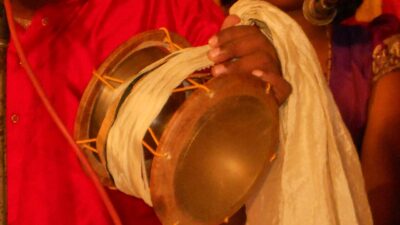
Overviewउडुक्कै तमिलनाडु की लोक और मंदिर परंपरा का रेत-घड़ी आकार का नन्हा हस्त-मृदंग है — डमरू और केरल के इडक्का का सजातीय। लकड़ी, पीतल या ताँबे के कमरदार खोल पर दो चमड़े की झिल्लियाँ मढ़ी होती हैं और बीच लिपटी सूती डोरी को दबाकर स्वर चढ़ाया-उतारा जाता है, जिससे यह 'बोलता' सुनाई देता है। विल्लुपाट्टु, करगाट्टम, कावडि और अम्मन-मुरुगन मंदिर-अनुष्ठानों में इसकी तीखी, दैवी थाप देव-आवाहन और शकुन-कथन का माध्यम बनती है।
अंग्रेज़ी में पढ़ें · Read in English
The udukai is a tiny hourglass hand-drum of Tamil Nadu's folk and temple tradition — kin of the damaru and Kerala's idakka. Two skin heads sit on a waisted shell of wood, brass or copper, and the cotton cord wound between them is squeezed to raise and lower the pitch, giving it a 'talking' voice. In villuppattu, karagattam, kavadi and Amman-Murugan temple ritual, its sharp, divine beat becomes a medium of deity-invocation and omen-telling.
वर्गीकरण
ClassificationNatya Shastra Category
अवनद्ध (Avanaddha - covered / membrane instruments / drums)
उडुक्कै नाट्यशास्त्र की अवनद्ध श्रेणी का वाद्य है — अर्थात् चमड़े से मढ़ा हुआ ताल-वाद्य। रेत-घड़ी (डमरू) के आकार का यह छोटा हस्त-मृदंग दोनों ओर चमड़े की झिल्ली रखता है और बीच की डोरी को दबाकर स्वर बदला जाता है।
The udukai belongs to the Avanaddha (covered / membranophone) category of the Natya Shastra — a percussion instrument with skin membranes. It is a small hourglass (damaru-shaped) hand drum with two skin heads, whose pitch is altered by squeezing the tension lacing at the waist.
Western Category
Hourglass tension drum (variable-pitch membranophone)
Western Family
Waisted / hourglass drum family (kindred to the North Indian damaru and Kerala idakka)
Sub Classification
बनावट
PhysicalDescription Hindi
उडुक्कै एक छोटा, हल्का, रेत-घड़ी के आकार का दुमुँहा हस्त-वाद्य है। लकड़ी, पीतल, ताँबे या पक्की मिट्टी से बना इसका खोखला शरीर बीच में पतला (कमर) होता है और दोनों सिरों पर चमड़े की झिल्ली मढ़ी होती है। कमर पर लिपटी सूती डोरियों को हथेली से दबाने या ढीला छोड़ने से खिंचाव बदलता है और स्वर ऊँचा-नीचा होता है — यही इसकी 'बोलती' विशेषता है।
Description English
The udukai is a small, light, hourglass-shaped double-headed hand drum. Its hollow body — made of wood, brass, copper or terracotta — narrows at the waist and carries a stretched skin membrane at each end. Cotton lacing wound around the waist is squeezed or released by the palm to change tension and therefore pitch — the source of its 'talking' quality.
Body
Hourglass / waisted (damaru-like)
रेत-घड़ी / डमरू जैसा कमरदार आकार
Wood, brass, copper, or terracotta (hollow turned shell)
लकड़ी, पीतल, ताँबा या पक्की मिट्टी (खोखला मुड़ा हुआ खोल)
15-25
Twin skin heads over a narrow-waisted hollow shell; the small enclosed air column gives a sharp, penetrating tone
Strings
Two circular skin heads, one at each end of the hourglass shell
Cotton (sometimes leather) lacing threaded through holes and looped around the waist; the player squeezes it to raise pitch, releases it to lower pitch
Bow
हाथ / उँगलियाँ (कोई गज नहीं)
Bare hand / fingers (no bow)
None — struck directly
0
The right hand fingers strike one head to produce open (thom) and closed (tha) strokes; the left hand grips and squeezes the waist lacing to sustain and bend the pitch
Tuning Pegs
कमर की डोरी (खूँटी नहीं)
Waist lacing (no pegs)
The udukai has no tuning pegs; tuning is achieved dynamically by hand pressure on the tension cords, and base tuning by adjusting the lacing knots
Bridge
लागू नहीं
Not applicable
As a membranophone the udukai has no bridge; the shell waist and skin heads shape the sound
N/A
Frets
उडुक्कै एक ताल-वाद्य है — इसमें फ्रेट या तार नहीं; स्वर-परिवर्तन कमर की डोरी पर दबाव से होता है, जिससे यह डमरू और इडक्का की भाँति 'बोलने' वाला मृदंग बन जाता है।
The udukai is a drum — it has no frets or strings; pitch change comes from pressure on the waist lacing, making it a 'talking' drum in the manner of the damaru and idakka.
ध्वनि-चरित्र
SoundTonal Character Hindi
उडुक्कै की ध्वनि तीखी, गूँजदार और भेदक है — छोटे आकार के बावजूद दूर तक पहुँचती है। कमर की डोरी दबाने-छोड़ने से यह 'डुम्-डक्-डिं' के साथ मानो पुकारती-गाती-सी जान पड़ती है, इसलिए इसे देव-आवाहन और नाड़ी-भविष्य (शकुन) के अनुष्ठानों में शुभ माना जाता है।
Tonal Character English
The udukai's tone is sharp, resonant and penetrating — carrying far despite its small size. Squeezing and releasing the waist lacing makes it seem to call and sing, which is why it is considered auspicious in deity-invocation and oracular (omen) rituals.
Timbre
Bright, buzzing, vocal — a dry 'talking' snap that glides in pitch
Range
Narrow but continuously bendable pitch band controlled by hand pressure; primarily a rhythmic-melodic drone-percussion voice
Dynamic Range
Wide for its size — from a soft ritual pulse to a piercing festival call, entirely acoustic
Techniques
सुनने का मार्गदर्शन
The Listening Guideउडुक्कै को सुनना हो तो किसी अम्मन मंदिर-उत्सव या नाट्टुपुरपाट्टु मंडली की कल्पना कीजिए। ध्यान दीजिए कि एक ही नन्हा ढोल कैसे 'तोम्-त-तोम्-त' के बीच अचानक स्वर ऊपर सरका देता है — यही बाएँ हाथ के डोरी-दबाव का कमाल है। पहले धीमी देव-आवाहन लय, फिर करगाट्टम की तेज़ नृत्य-ताल सुनिए — एक ही वाद्य के दो चेहरे खुलेंगे।
अंग्रेज़ी में पढ़ें · Read in English
To appreciate the udukai, picture a temple festival or a nattupurapattu performance. Notice how a single small drum suddenly slides its pitch upward between brisk 'thom-tha' strokes — that is the magic of the lacing squeeze. Hear first the slow deity-invocation pulse, then the fast dance beat of karagattam; both reveal two faces of one instrument.
परिचय
Identity- Year Of Origin
- 1200
अन्य विवरण
More DetailsTimbre
Bright, buzzing, vocal — a dry 'talking' snap that glides in pitch
रोचक तथ्य
Margin Notesएक ढोल, अनेक नाम — इसी वाद्य को तमिल में उडुक्कै/उटुक्कै/उडुक्कु, उत्तर भारत में हुडुक्का/हुरुक, और उत्तराखंड-नेपाल में हुड्को कहा जाता है। सबका मूल एक ही रेत-घड़ी आकार का दबाव-मृदंग है, जो शिव के डमरू का लोक-रूप माना जाता है।
The same instrument is called udukkai/utukkai/udukku in Tamil, hudukka/huruk in North India, and hudko in Uttarakhand-Nepal. All descend from one hourglass pressure-drum, regarded as a folk form of Shiva's damaru.
पम्बै का जोड़ीदार — तमिल मंदिर-अनुष्ठानों में उडुक्कै अक्सर 'पम्बै' (दुहरे बेलनाकार ढोल) के साथ जोड़ी में बजता है — पम्बै गहरी लय देता है और उडुक्कै तीखी, स्वर-चढ़ती आवाज़, जिससे देव-आवाहन का पूर्ण ताल बनता है।
In Tamil temple ritual the udukai often plays paired with the 'pambai' (a double cylindrical drum) — the pambai gives the deep pulse and the udukai the sharp, pitch-bending voice, together forming the complete rhythm of deity invocation.
बनाने की कारीगरी — एक अच्छा उडुक्कै हाथ से खराद पर मोड़े गए ठोस लकड़ी (या ढले पीतल/ताँबे) के खोल से बनता है; दोनों मुखों पर बकरी का चमड़ा मढ़ा जाता है और छह छेदों से सूती डोरी पिरोई जाती है। कारीगर चमड़े का खिंचाव और डोरी का तनाव इतनी बारीकी से साधता है कि वाद्य 'गाने' लगे।
A good udukai is turned by hand from solid wood (or cast brass/copper); goat skin is stretched over both heads and cotton cord threaded through six holes. The craftsman balances the skin's tension and the lacing so finely that the instrument begins to 'sing'.
सवाल-जवाब
Questions & Answersउडुक्कै क्या है?
उडुक्कै (उडुक्कु) तमिलनाडु का रेत-घड़ी आकार का छोटा दुमुँहा हस्त-मृदंग है, जो अवनद्ध (चमड़े से मढ़े) ताल-वाद्यों में आता है। बीच की सूती डोरी दबाकर इसका स्वर बदला जा सकता है, इसलिए इसे 'बोलता ढोल' कहते हैं। यह मुख्यतः लोक संगीत और मंदिर-अनुष्ठानों में बजता है।
उडुक्कै किस चीज़ से बनता है?
उडुक्कै का कमरदार खोल लकड़ी, पीतल, ताँबे या पक्की मिट्टी से बनता है, और इसके दोनों मुखों पर बकरी या गाय के चमड़े की झिल्ली मढ़ी जाती है। कमर पर लिपटी सूती डोरियाँ खिंचाव और स्वर को नियंत्रित करती हैं।
उडुक्कै कैसे बजाया जाता है?
दाएँ हाथ की उँगलियाँ एक मुख पर खुले (तोम्) और बंद (त) आघात बनाती हैं, जबकि बायाँ हाथ कमर की डोरी को दबाकर या ढीला छोड़कर स्वर ऊँचा-नीचा करता है। इसी दबाव से इसकी 'बोलती', स्वर-चढ़ती ध्वनि निकलती है।
उडुक्कै और डमरू में क्या संबंध है?
दोनों रेत-घड़ी आकार के दबाव-ढोल हैं और शिव से जुड़े हैं। डमरू छोटा और उत्तर भारतीय है, उडुक्कै बड़ा और तमिल लोक-मंदिर परंपरा का है। केरल का इडक्का भी इसी परिवार का सजातीय है।
उडुक्कै मंदिरों में क्यों महत्वपूर्ण है?
तमिलनाडु के अम्मन और मुरुगन मंदिरों में पूसारी उडुक्कै बजाकर देवता का आवाहन करता है और भक्तों को शकुन (नाड़ी-भविष्य) बताता है। यह विल्लुपाट्टु, करगाट्टम और कावडि जैसे लोक-रूपों का भी प्रमुख ताल-वाद्य है।
नमूना-पट्टी
The Specimen Table| नाम | उडुक्कै · Udukai |
|---|---|
| अन्य नाम | उडुक्कु · उडुक्कै (Udukkai) · उटुक्कै (Utukkai) · உடுக்கை (Tamil) · Udukku / Udukkai / Utukkai |
| उद्गम | 1200 |
| प्रकार | वाद्य · Instruments |
साझा कीजिए · Share this Plate