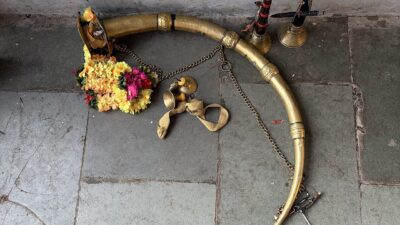
शास्त्र विंग · वाद्य-पट्टिका · Instrument Plate
तुतारी
Tutari
अन्य नामतुतारी · तुर्ही / तुरही (turha, closely related herald trumpet) · रणशिंग / रणशिंगा (ranshing — the martial war-horn cousin) · Tutari (also romanised Toutari, Tutti)
परिचय
Overviewतुतारी महाराष्ट्र की पीतल-आवाज़ है — एक लंबी, चमकती नैसर्गिक तुरही, जो राग नहीं गाती बल्कि उद्घोष करती है। शिवाजी के गढ़-किलों की सलामी और युद्ध-संकेत से लेकर गणेशोत्सव के ढोल-ताशा पथकों तक, और केशवसुत की 1893 की क्रांति-कविता से लेकर 2024 के 'तुतारी फुंकणारा माणूस' चुनाव-चिह्न तक, इसकी भेदती पुकार सदियों से एक ही बात कहती आई है — उठो, जागो, आगे बढ़ो।
अंग्रेज़ी में पढ़ें · Read in English
The tutari is the brass voice of Maharashtra — a long, gleaming natural trumpet that does not sing a raga but proclaims. From the salutes and battle-signals of Shivaji's forts to the dhol-tasha pathaks of Ganeshotsav, and from Keshavsut's 1893 revolutionary poem to the 2024 'man blowing the tutari' election symbol, its piercing call has for centuries said one thing — rise, awaken, march on.
वर्गीकरण
ClassificationNatya Shastra Category
सुषिर (Sushira — wind / hollow instruments / aerophones)
तुतारी सुषिर वर्ग का वाद्य है — जिसमें ध्वनि हवा के प्रवाह से उत्पन्न होती है। यह एक 'नैसर्गिक' (बिना छिद्र, बिना वाल्व, बिना रीड की) तुरही है, जिसमें वादक अपने होठों के कंपन (embouchure) से ही स्वर निकालता है।
The tutari belongs to the Sushira (wind/aerophone) category of the Natya Shastra classification, where sound is produced by the movement of air. It is a 'natural' trumpet (no finger-holes, no valves, no reed) in which the player produces tone purely through the buzzing of the lips (embouchure).
Western Category
Lip-reed aerophone — natural (valveless) trumpet / herald horn
Western Family
Brass / labrosone family — kin to the bugle, fanfare trumpet, alphorn and the Indian karnal, ranasingha and shringa; melody is limited to the natural harmonic series
Sub Classification
बनावट
PhysicalDescription Hindi
तुतारी एक लंबी, चमकीली धातु की तुरही है जो अपने तेज़, दूर तक पहुँचने वाले 'क्लैरियन' नाद के लिए जानी जाती है। परंपरागत रूप से यह बैल या भैंस के सींग से बनती थी; समय के साथ अब यह पीतल या ताँबे की चादर को पीट-ढालकर बनाई जाती है, अक्सर चाँदी की नक्काशी के साथ। इसके दो मुख्य रूप हैं — लंबी 'S' आकार की तुतारी और अर्धचंद्राकार 'C' आकार का शिंग। इसमें न कोई छिद्र होता है, न वाल्व, न रीड — पूरी ध्वनि होठों की फूँक से निकलती है।
Description English
The tutari is a long, gleaming metal trumpet celebrated for its bright, far-carrying clarion call. Traditionally fashioned from bullock or buffalo horn, it is today beaten and shaped from brass or copper sheet, often with silver ornamentation. It exists in two principal forms — the long S-curved tutari and the crescent 'C'-shaped horn. It has no finger-holes, no valves and no reed; the entire tone is produced by the blowing of the lips.
Body
Long S-curve or crescent 'C', ending in a widely flared bell
लंबी 'S' मोड़ वाली या अर्धचंद्राकार 'C' आकृति, जो अंत में चौड़े फैले हुए घंटानुमा मुख (bell) पर खुलती है
Brass or copper sheet (beaten and joined); traditionally bullock/buffalo horn; sometimes silver-ornamented
पीतल या ताँबे की चादर (पीट-जोड़कर बनी); परंपरागत रूप से बैल/भैंस का सींग; कभी-कभी चाँदी की नक्काशी सहित
approx. 90-150 (long straight/S form); the curved horn form is shorter
A single conical/cylindrical air-column ending in a flared bell that projects and amplifies the sound in the open air
Blowing End
मुखरी / फूँकने का सिरा
Mouthpiece end
पतला सिरा जहाँ वादक होठ रखकर फूँकता है। परंपरागत तुतारी में अलग से जड़ा हुआ 'कप' माउथपीस नहीं होता — वादक होठों के कंपन (buzz) से ही नाद जगाता है।
The narrow end where the player sets the lips and blows. The traditional tutari has no separate detachable cup mouthpiece — the player awakens the tone purely by buzzing the lips.
Bell
मुख / घंटा
Bell (flared mouth)
दूसरे सिरे पर चौड़ा फैला हुआ मुख, जो ध्वनि को खुले मैदान में दूर तक फेंकता है। इसी फैलाव से तुतारी को उसका शाही, गूँजता हुआ स्वर मिलता है।
The wide flared mouth at the far end that throws the sound far across open ground. This flare gives the tutari its regal, resonant voice.
Construction
बनावट
Construction
पीतल या ताँबे की चादर को हथौड़े से पीटकर नली का आकार दिया जाता है और जोड़ों पर टाँका लगाया जाता है। लंबी तुतारी अक्सर दो-तीन जुड़ने वाले हिस्सों में बनती है ताकि उसे ले जाना और जोड़ना आसान हो।
Brass or copper sheet is hammered into a tube and soldered at the seams. The long tutari is often made in two or three fitted sections so it can be carried and assembled easily.
Holes Valves Reed
तुतारी में न छिद्र होते हैं, न वाल्व, न रीड। इसलिए यह केवल अपने मूल स्वर (षड्ज) और उसकी नैसर्गिक सुरावली (harmonics — जैसे पंचम, ऊपरी षड्ज) को ही बजा सकती है; यह पूरा राग नहीं गा सकती।
The tutari has no holes, valves or reed. It can therefore sound only its fundamental (tonic) and its natural overtones (harmonics such as the fifth and the upper octave); it cannot render a full raga.
ध्वनि-चरित्र
SoundTonal Character Hindi
तुतारी का नाद तेज़, चमकीला और आदेश देता हुआ है — एक 'क्लैरियन' पुकार जो मैदानों और किलों के आर-पार दूर तक गूँजती है। इसमें वीर रस बसता है: यह जगाती है, ललकारती है, और उपस्थिति की घोषणा करती है। यह मधुर गान का वाद्य नहीं, बल्कि उद्घोष का वाद्य है।
Tonal Character English
The tutari's tone is bright, piercing and commanding — a clarion call that rings far across fields and forts. It carries the veer rasa (heroic sentiment): it rouses, it challenges, it announces presence. It is not an instrument of gentle song but of proclamation.
Timbre
Brassy, ringing, metallic and open — a loud fanfare colour with a long, sustained blast
Range
Limited to the natural harmonic series of one fundamental (like a bugle) — the tonic and a few overtones; not chromatic, not melodic in the raga sense
Dynamic Range
Overwhelmingly loud and projecting — built for open-air signalling and processions, audible over drums and crowds without amplification
Techniques
सुनने का मार्गदर्शन
The Listening Guideतुतारी को समझना हो तो शांति नहीं, शक्ति खोजिए। गणेश-विसर्जन के किसी जुलूस का वीडियो चलाइए और देखिए कैसे तुतारी की एक लंबी फूँक पूरी भीड़ को झकझोर देती है। फिर किसी अकेले वादक की डेमो सुनिए — दो-तीन नैसर्गिक स्वरों में ही उसकी सारी आग बसी है।
अंग्रेज़ी में पढ़ें · Read in English
To understand the tutari, do not look for a quiet raga — hear it in its power. Play a video of a Ganesh visarjan procession and notice how a single long blast of the tutari jolts an entire crowd. Then hear a solo player's demo — see how much energy and command can pour from just two or three natural notes.
परिचय
Identity- Year Of Origin
- 1650
अन्य विवरण
More Details- Name English
- Construction
- Description English
- Brass or copper sheet is hammered into a tube and soldered at the seams. The long tutari is often made in two or three fitted sections so it can be carried and assembled easily.
- Name
- बनावट
- Description
- पीतल या ताँबे की चादर को हथौड़े से पीटकर नली का आकार दिया जाता है और जोड़ों पर टाँका लगाया जाता है। लंबी तुतारी अक्सर दो-तीन जुड़ने वाले हिस्सों में बनती है ताकि उसे ले जाना और जोड़ना आसान हो।
Construction
Timbre
Brassy, ringing, metallic and open — a loud fanfare colour with a long, sustained blast
रोचक तथ्य
Margin Notesदो रूप — 'S' और 'C' — तुतारी दो प्रमुख आकारों में मिलती है: लंबी 'S' मोड़ वाली तुतारी और अर्धचंद्राकार 'C' आकार का शिंग। दोनों ही नैसर्गिक तुरहियाँ हैं और एक ही सिद्धांत पर बजती हैं — केवल होठों की फूँक से।
The tutari comes in two principal shapes: the long S-curved tutari and the crescent 'C'-shaped horn. Both are natural trumpets and sound on the same principle — the buzzing of the lips alone.
रणशिंग का जुड़वाँ — तुतारी को अक्सर उसके निकट-संबंधी 'रणशिंग' (युद्ध-शिंग) और 'तुर्ही' (turha) के साथ जोड़ा जाता है। ये सभी महाराष्ट्र और उत्तर भारत की नैसर्गिक धातु-तुरहियों के एक ही परिवार से हैं, जो कभी युद्ध-भूमि की भाषा थीं।
The tutari is often paired with its close relatives, the 'ranshing' (war-horn) and the 'turha'. All belong to the same family of natural metal trumpets of Maharashtra and North India that once formed the language of the battlefield.
शिवाजी के किलों की भाषा — छत्रपति शिवाजी महाराज के पहाड़ी गढ़-किलों की दुनिया में, जहाँ एक चोटी से दूसरी चोटी तक संदेश पहुँचाना ज़रूरी था, तुतारी की भेदती हुई पुकार एक अनमोल संचार-साधन थी — सलामी, चेतावनी और कूच, तीनों की घोषणा एक ही नाद से।
In the world of Chhatrapati Shivaji Maharaj's hill-forts, where messages had to leap from peak to peak, the tutari's piercing call was a priceless means of communication — salute, warning and march all proclaimed by a single blast.
बाज़ार में आज भी — तुतारी कोई संग्रहालय की वस्तु नहीं — यह आज भी पुणे और महाराष्ट्र के अन्य शहरों में बनती और बिकती है, प्रायः दो से चार हज़ार रुपये के बीच, गणेशोत्सव और विवाह-मौसम के लिए तैयार।
The tutari is no museum piece — it is still made and sold in Pune and other Maharashtra towns, typically for two to four thousand rupees, ready for the Ganeshotsav and wedding seasons.
सवाल-जवाब
Questions & Answersतुतारी क्या है?
तुतारी महाराष्ट्र की एक लंबी, पीतल या ताँबे की नैसर्गिक तुरही है, जो अपने तेज़, दूर तक पहुँचने वाले 'क्लैरियन' नाद के लिए जानी जाती है। इसमें छिद्र, वाल्व या रीड नहीं होते; वादक केवल होठों की फूँक से नाद निकालता है। इसका उपयोग उद्घोष, जुलूस और समारोहों में होता है।
क्या तुतारी पर राग बजाया जा सकता है?
नहीं। नैसर्गिक तुरही होने के कारण तुतारी केवल अपने मूल स्वर और कुछ नैसर्गिक सुरावलियों (जैसे षड्ज, पंचम, ऊपरी षड्ज) तक सीमित है — ठीक बिगुल की तरह। यह पूरा राग नहीं बजा सकती; इसका काम धुन नहीं, उद्घोष है।
तुतारी का शिवाजी और मराठा काल से क्या संबंध है?
मराठा युग (17वीं शताब्दी) में, छत्रपति शिवाजी महाराज के काल में, तुतारी दरबारी सलामी और गढ़-किलों के बीच संकेत-संचार का साधन थी। इसकी भेदती हुई पुकार राजाओं के आगमन, सेनाओं के कूच और युद्ध के आरंभ की घोषणा करती थी।
तुतारी चुनाव-चिह्न किसका है?
2023-24 में 'तुतारी फुंकणारा माणूस' (तुतारी बजाता हुआ आदमी) शरद पवार के राष्ट्रवादी कांग्रेस पार्टी (शरदचंद्र पवार) गुट का चुनाव-चिह्न बना, जिसे उन्होंने 2024 के लोकसभा चुनाव से पहले रायगड किले पर अनावृत किया। चुनाव आयोग ने इसे आधिकारिक रूप से 'trumpet' कहा।
केशवसुत की कविता 'तुतारी' का क्या महत्व है?
1893 में मराठी कवि केशवसुत ने 'तुतारी' शीर्षक कविता लिखी, जिसमें उन्होंने पुराने रूढ़िवाद को तोड़ने और नए युग को जगाने की ललकार दी। इसके बाद से तुतारी मराठी साहित्य में सामाजिक क्रांति और जागरण की पुकार का स्थायी प्रतीक बन गई।
नमूना-पट्टी
The Specimen Table| नाम | तुतारी · Tutari |
|---|---|
| अन्य नाम | तुतारी · तुर्ही / तुरही (turha, closely related herald trumpet) · रणशिंग / रणशिंगा (ranshing — the martial war-horn cousin) · Tutari (also romanised Toutari, Tutti) |
| उद्गम | 1650 |
| प्रकार | वाद्य · Instruments |
साझा कीजिए · Share this Plate