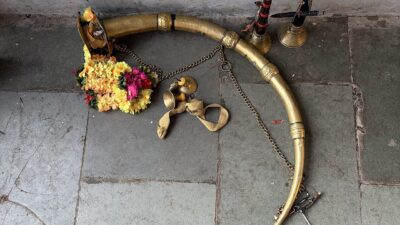
शास्त्र विंग · वाद्य-पट्टिका · Instrument Plate
तुरी
Turi
अन्य नामतुतारी (Tutari) · रणसिंगा / रणसिंघा (Ransingha) · मुगलसिंगा (Mugalsingha) · सिंगी / शृंगी (Singhi / Shringi)
परिचय
Overviewतुरी मध्य व उत्तर भारत की जनजातीय-लोक पीतल तुरही है — बिना वाल्व की एक सीधी-सादी नली, जिसकी भेदक, दूरगामी पुकार जुलूसों, जात्राओं व उत्सवों में सामूहिकता की धड़कन बनती है। बस्तर के ढोकरा-शिल्पियों की ढली हुई छोटी तुरी से लेकर छत्रपति शिवाजी के रण में गूँजे रणसिंगा तक, यह वाद्य शक्ति, वीरता और उल्लास का पर्याय है।
अंग्रेज़ी में पढ़ें · Read in English
The turi is the tribal-folk brass horn of Central and North India — a plain valveless tube whose piercing, far-carrying call becomes the pulse of togetherness at processions, jatras and festivals. From the small cast turi of Bastar's dhokra smiths to the ransingha that once rang across Chhatrapati Shivaji's battlefields, it is a byword for power, valour and exhilaration.
वर्गीकरण
ClassificationNatya Shastra Category
सुषिर (Sushira - wind / hollow instruments)
नाट्यशास्त्र की चार वाद्य-कोटियों (तत, सुषिर, अवनद्ध, घन) में तुरी 'सुषिर' वर्ग का वाद्य है — अर्थात् खोखली नली में फूँक व होंठों के कम्पन से ध्वनि उत्पन्न करने वाला वायु-वाद्य। इसमें न तार होते हैं, न झिल्ली।
Among the Natya Shastra's four instrument categories (Tata/string, Sushira/wind, Avanaddha/membrane, Ghana/solid), the turi belongs to 'Sushira' — a hollow-tube wind instrument sounded by breath and lip vibration. It has no strings and no membrane.
Western Category
Natural (valveless) brass horn / labrophone — lip-vibrated aerophone
Western Family
Horn-and-trumpet family; closest Western analogues are the natural bugle, the war-horn and the alphorn (no valves, keys or slides — sound restricted to the natural harmonic series)
Sub Classification
बनावट
PhysicalDescription Hindi
तुरी एक लंबा, पीतल या ताँबे से बना बिना-वाल्व का लोक तुरही-वाद्य है। इसका शरीर एक सतत नली होती है जो एक सिरे पर पतले मुख-भाग (मुखनाल) से आरम्भ होकर दूसरे सिरे पर चौड़े प्याले (घंटी/bell) में खुलती है। बस्तर की तुरी अपेक्षाकृत छोटी (लगभग 40 से.मी.) ढली हुई पीतल की होती है, जबकि महाराष्ट्र की तुतारी/रणसिंगा प्रायः लंबी, घुमावदार (C या S आकार) होती है ताकि उसकी ध्वनि दूर तक पहुँचे।
Description English
The turi is a long, valveless folk trumpet-horn of brass or copper. Its body is a single continuous tube that begins in a narrow mouthpiece at one end and flares into a wide bell at the other. The Bastar turi is a comparatively small (about 40 cm) cast-brass horn, while the Maharashtrian tutari/ransingha is often a long, curved (C- or S-shaped) horn built so its sound carries across great distances.
Body
Long tube, straight or curved into a C / S shape, widening into a flared bell; the Bastar turi is a shorter side-blown horn
लंबी नली — सीधी या C/S आकार में मुड़ी हुई, अंत में चौड़ी घंटी; बस्तर की तुरी छोटी, पार्श्व-फूँक वाली
Cast brass or beaten copper (historically animal horn — buffalo or cattle — with a fashioned mouthpiece)
ढला हुआ पीतल या पीटा हुआ ताँबा (प्राचीन रूप पशु-शृंग — भैंस या बैल के सींग — का, जिसके सिरे को मुख-भाग बनाया जाता था)
40 (Bastar turi) to 90-150 (Maharashtrian tutari / ransingha)
The conical bore and flaring bell act as the resonating/amplifying chamber; no separate soundbox
Mouthpiece
मुखनाल
Mouthpiece (mukhnaal)
एक पतला कीप/प्याला जिसमें वादक होंठ रखकर उन्हें कम्पित करता है; यही कम्पन नली में ध्वनि उत्पन्न करता है।
A narrow funnel/cup against which the player buzzes the lips; this lip vibration generates the sound inside the tube.
Bell
घंटी / प्याला
Bell (flared end)
नली का चौड़ा खुला सिरा जो ध्वनि को प्रक्षेपित करता है और उसे भेदक व दूरगामी बनाता है।
The wide open end of the tube that projects the sound and makes it piercing and far-carrying.
Same brass/copper as the body, often widened by hammering
Construction
बस्तर में तुरी परंपरागत रूप से घड़वा/घसिया धातु-शिल्पियों द्वारा 'ढोकरा' (लुप्त-मोम) व ढलाई विधि से बनाई जाती है। महाराष्ट्र व उत्तराखंड में ताम्रकार/कसार पीतल-ताँबे की चादर को मोड़-जोड़कर लंबी घुमावदार नली बनाते हैं; बड़ी तुतारी कई खंडों में जुड़ी होती है।
In Bastar the turi is traditionally made by Ghadwa/Ghasia metal-smiths using cast and lost-wax (dhokra) techniques. In Maharashtra and Uttarakhand braziers roll and braze sheet brass/copper into a long curved tube; larger tutaris are joined from several sections.
Valves Keys
तुरी में कोई वाल्व, चाबी या स्लाइड नहीं होती। इसलिए यह केवल नैसर्गिक संनादी-श्रेणी (natural harmonics) के कुछ ही स्वर बजा सकती है — यह धुन-वाद्य कम, उद्घोष/संकेत-वाद्य अधिक है।
The turi has no valves, keys or slides. It can therefore sound only a few notes of the natural harmonic series — it is less a melodic instrument than a signalling / announcing horn.
ध्वनि-चरित्र
SoundTonal Character Hindi
तुरी की ध्वनि तेज़, भेदक और गूँजदार होती है — पीतल की चमकीली, धातुई पुकार जो खुले मैदानों, जंगलों और पहाड़ी घाटियों में मीलों दूर तक पहुँचती है। यह मधुर धुन के लिए नहीं, वरन् उद्घोष, उत्साह और सामूहिक आह्वान के लिए है।
Tonal Character English
The turi's sound is loud, piercing and resonant — a bright, metallic brass call that carries for miles across open fields, forests and hill valleys. It is made not for sweet melody but for announcement, exhilaration and collective summons.
Timbre
Bright, brassy, slightly raw and buzzing; a bold outdoor voice with strong overtones
Range
Very limited — a handful of notes from the natural harmonic series (typically a fundamental and 2-4 upper partials); no chromatic capability
Dynamic Range
Overwhelmingly loud and projecting; designed for open-air processions rather than intimate settings — minimal soft dynamics
Techniques
सुनने का मार्गदर्शन
The Listening Guideतुरी को मंच पर नहीं, खुले में सुनिए — किसी जुलूस, जात्रा या दशहरा के बीच, जहाँ ढोल-नगाड़ा की धमक पर इसकी भेदक टेर उठती है। ध्यान दीजिए कैसे यह मधुर धुन नहीं, बल्कि एक 'हाँक' है — पुकार, आह्वान, उल्लास का स्वर। इसकी सीमित स्वर-संख्या ही इसकी शक्ति है।
अंग्रेज़ी में पढ़ें · Read in English
Do not listen for the turi on a stage but in the open — amid a procession, jatra or Dussehra, where its piercing call rises over the thump of dhol and nagara. Notice that it is not a melody but a hail — a call, a summons, a sound of exhilaration. Its very limitation of notes is its power: one call, but meant for a whole community.
परिचय
IdentityYear Of Origin
प्राचीन / ancient — प्रागैतिहासिक शृंग-परंपरा (मध्य भारत के शैलचित्रों में शृंग-वादक अंकित); प्रलेखित पीतल-रूप 18वीं–19वीं शताब्दी
अन्य विवरण
More Details- Hindi
- बस्तर में तुरी परंपरागत रूप से घड़वा/घसिया धातु-शिल्पियों द्वारा 'ढोकरा' (लुप्त-मोम) व ढलाई विधि से बनाई जाती है। महाराष्ट्र व उत्तराखंड में ताम्रकार/कसार पीतल-ताँबे की चादर को मोड़-जोड़कर लंबी घुमावदार नली बनाते हैं; बड़ी तुतारी कई खंडों में जुड़ी होती है।
- English
- In Bastar the turi is traditionally made by Ghadwa/Ghasia metal-smiths using cast and lost-wax (dhokra) techniques. In Maharashtra and Uttarakhand braziers roll and braze sheet brass/copper into a long curved tube; larger tutaris are joined from several sections.
Construction
Timbre
Bright, brassy, slightly raw and buzzing; a bold outdoor voice with strong overtones
रोचक तथ्य
Margin Notesएक नाम, अनेक रूप — तुरी, तुतारी, रणसिंगा, मुगलसिंगा, सिंगी, नरसिंगा, कोंबु — ये सभी भारत की एक ही पीतल/ताँबे की शृंग-तुरही परंपरा के क्षेत्रीय नाम व रूप हैं, जो उत्तर, मध्य, पश्चिम व दक्षिण भारत में फैले हैं।
Turi, tutari, ransingha, mugalsingha, singi, narsingha, kombu — these are all regional names and forms of the same brass/copper horn-trumpet tradition of India, spread across the North, Central, West and South.
सीमा ही शक्ति — क्योंकि तुरी में वाल्व नहीं होते, वह जटिल धुन नहीं बजा सकती — पर यही सीमा उसे एक शक्तिशाली, स्पष्ट, दूरगामी संकेत-वाद्य बनाती है, जिसे शोर-भरे जुलूस में भी सब सुन लेते हैं।
Because the turi has no valves it cannot play complex tunes — yet this very limitation makes it a powerful, unmistakable, far-carrying signal instrument, heard by all even amid a noisy procession.
संग्रहालय में बस्तर की तुरी — बस्तर की दो ढली हुई पीतल की पार्श्व-फूँक तुरियों (लगभग 40 से.मी., 19वीं शताब्दी) की एक जोड़ी न्यूयॉर्क के मेट्रोपॉलिटन म्यूज़ियम ऑफ़ आर्ट के संग्रह (परिग्रहण 2022.303) में है — जो इस लोक-वाद्य की वैश्विक सांस्कृतिक महत्ता दर्शाती है।
A pair of cast-brass side-blown turis from Bastar (about 40 cm, 19th century) is held in the collection of The Metropolitan Museum of Art, New York (accession 2022.303) — reflecting this folk instrument's global cultural importance.
ध्वनि से पहचान तक — महाराष्ट्र में तुतारी की राज-सैनिक विरासत इतनी गहरी है कि यह आधुनिक समय में एक सुपरिचित राजनीतिक-सांस्कृतिक प्रतीक बन गई — जहाँ इसकी पुकार अब भी आह्वान व शक्ति की भाषा बोलती है।
In Maharashtra the tutari's royal-martial heritage runs so deep that in modern times it became a well-known political-cultural symbol — where its call still speaks the language of summons and strength.
सवाल-जवाब
Questions & Answersतुरी क्या है?
तुरी एक लंबी, बिना-वाल्व की पीतल या ताँबे की लोक तुरही है जिसे फूँक व होंठों के कम्पन से बजाया जाता है। यह मध्य व उत्तर भारत (विशेषतः बस्तर, छत्तीसगढ़ व महाराष्ट्र) की जनजातीय-लोक परंपरा का वाद्य है, जिसे जुलूस, जात्रा, उत्सव व घोषणा में बजाया जाता है। इसे तुतारी व रणसिंगा भी कहते हैं।
क्या तुरी राग बजा सकती है?
नहीं। तुरी में वाल्व या चाबी नहीं होती, इसलिए यह केवल कुछ ही नैसर्गिक संनादी स्वर बजा सकती है। यह राग-विस्तार का नहीं, बल्कि उद्घोष, संकेत व सामूहिक आह्वान का वाद्य है।
तुरी, तुतारी और रणसिंगा में क्या अंतर है?
ये मुख्यतः एक ही पीतल/ताँबे की शृंग-तुरही परंपरा के क्षेत्रीय नाम व रूप हैं। बस्तर में 'तुरी' प्रायः एक छोटी ढली पार्श्व-फूँक हॉर्न है; महाराष्ट्र में 'तुतारी/रणसिंगा' प्रायः लंबी घुमावदार तुरही है, जो शिवाजी की सैन्य परंपरा में 'रणसिंगा' (युद्ध-शृंग) कहलाई।
तुरी कहाँ बजाई जाती है?
तुरी बस्तर दशहरा व जनजातीय देवी-जात्राओं, मराठी-गोवा के मंदिर जुलूसों, विवाह-अंत्येष्टि, तथा हिमालयी गाँवों के उत्सवों में बजाई जाती है — प्रायः ढोल, नगाड़ा व ताशा के साथ।
नमूना-पट्टी
The Specimen Table| नाम | तुरी · Turi |
|---|---|
| अन्य नाम | तुतारी (Tutari) · रणसिंगा / रणसिंघा (Ransingha) · मुगलसिंगा (Mugalsingha) · सिंगी / शृंगी (Singhi / Shringi) · Turi / Tutari / Ransingha (folk brass horn) |
| प्रकार | वाद्य · Instruments |
साझा कीजिए · Share this Plate