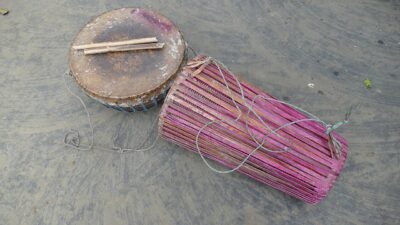
शास्त्र विंग · वाद्य-पट्टिका · Instrument Plate
तुमदाक
Tumdak
अन्य नामतुमदाह · मादल / मांदल (ग़ैर-आदिवासी नाम) · Tumdak' (Santali, with glottal stop) · Tumdah
परिचय
Overviewतुमदाक संथाल आदिवासी समाज का मिट्टी से गढ़ा दो-मुँहा हस्त-ढोल है — कुम्हार के पहिये पर जन्मी टेराकोटा काया, जिसके चौड़े बाएँ और छोटे दाएँ चर्म-मुख गाय के चमड़े से मढ़े होते हैं। गले में डोरी से लटकाकर, नाचते हुए इसे बजाया जाता है, और विशाल तमक के साथ इसकी जोड़ी सोहराय व बाहा जैसे संथाल पर्वों की धड़कन बन जाती है। यह किसी दरबार-राग का वाद्य नहीं, बल्कि धरती, फ़सल और समुदाय से सीधे जुड़ा जीवंत लोक-वाद्य है।
अंग्रेज़ी में पढ़ें · Read in English
The tumdak is the Santhal community's clay-moulded, double-headed hand-drum — a terracotta body born on the potter's wheel, its broad left and smaller right heads covered in cowhide. Slung from the neck on a cord, it is played while dancing, and paired with the great tamak it becomes the heartbeat of Santhal festivals like Sohrai and Baha. This is no instrument of court and raga, but a living folk-drum bound directly to earth, harvest and community.
वर्गीकरण
ClassificationNatya Shastra Category
अवनद्ध (Avanaddha - covered/membrane percussion instruments)
नाट्यशास्त्र की चतुर्विध वाद्य-वर्गीकरण प्रणाली में तुमदाक 'अवनद्ध वाद्य' है — अर्थात चमड़े से मढ़ा हुआ ताल-वाद्य, जिसकी ध्वनि खिंचे हुए चर्म-मुख (झिल्ली) के कंपन से उत्पन्न होती है। यह तत (तार), सुषिर (फूँक) और घन (ठोस) वर्गों से भिन्न है।
In the fourfold Natya Shastra classification of instruments, the tumdak is an 'Avanaddha vadya' — a skin-covered percussion instrument whose sound is produced by the vibration of stretched membrane heads. It stands apart from the Tata (stringed), Sushira (wind) and Ghana (solid/idiophone) families.
Western Category
Double-headed membranophone (hand drum)
Western Family
Barrel/conical two-headed hand drum family (kin to the dholak and mridangam in form, but with a burnt-clay shell rather than wood)
Sub Classification
बनावट
PhysicalDescription Hindi
तुमदाक एक दो-मुँहा हस्त-वादित ढोल है जिसका खोल पकी हुई मिट्टी (टेराकोटा) से बनता है। यह लगभग साठ सेंटीमीटर लंबा और हल्का शंक्वाकार होता है — एक सिरा दूसरे से चौड़ा। दोनों मुख गाय के चमड़े से मढ़े जाते हैं; बायाँ (चौड़ा) मुख गहरी, गूँजती ध्वनि देता है और दायाँ (कुछ छोटा) मुख तीखी, ऊँची थाप। यह संथाल संगीत का हृदय-वाद्य है, जिसे कंधे या गले में डोरी से लटकाकर नाचते-नाचते बजाया जाता है।
Description English
The tumdak is a two-headed, hand-played drum whose shell is made from burnt clay (terracotta). It is roughly sixty centimetres long and gently conical — one end wider than the other. Both faces are covered with cowhide; the broader left head gives a deep, resonant boom while the slightly smaller right head gives a sharper, higher slap. It is the heart-drum of Santhal music, slung from the shoulder or neck on a cord and played while dancing.
Body
Elongated, gently conical (tapering) clay barrel — wider at one end
लंबा, हल्का शंक्वाकार मिट्टी का ढाँचा — एक सिरे पर चौड़ा
Burnt clay / terracotta shell (thrown by potters), reinforced with white earth, cloth strips and khori-mati clay layers
पकी हुई मिट्टी (टेराकोटा) का खोल, जिसे कुम्हार गढ़ते हैं; ऊपर सफ़ेद मिट्टी, पुराने कपड़े की पट्टियाँ और खोरी-माटी की परतें चढ़ाकर मज़बूत किया जाता है
≈60
wider head ≈30 cm across
Single hollow clay body sealed by two hide heads; the enclosed air column between the broad and narrow heads gives the drum its warm, rounded resonance
Heads
2 (double-headed)
बायाँ मुख अधिक चौड़ा होता है और गहरी, मंद्र (बास) ध्वनि उत्पन्न करता है।
The left head is broader and produces the deep, bass tone.
दायाँ मुख कुछ छोटा होता है और तीखी, तार (ऊँची) थाप देता है।
The right head is slightly smaller and gives the sharper, higher-pitched stroke.
Cowhide (गाय का चमड़ा) stretched and laced over both openings
प्रत्येक मुख के केंद्र में एक गोल स्वर-लेप (ट्यूनिंग पेस्ट) लगाया जाता है जो ध्वनि को गहराई और स्पष्टता देता है — यह तबले/ढोलक की 'स्याही' जैसा कार्य करता है।
A round patch of tuning paste is applied at the centre of each head, deepening and clarifying the tone — functionally similar to the 'syahi' of the tabla and dholak.
Lacing
बंधन / पट्टी
Lacing / bracing
दोनों चर्म-मुखों को रंगीन चमड़े या बेंत (कैन) की पट्टियों से खोल के चारों ओर कसकर बाँधा जाता है; इन्हीं पट्टियों को खींचकर या ढीला करके स्वर मिलाया जाता है।
Both hide heads are laced tightly around the shell with strips of coloured leather or cane; tightening or loosening this bracing tunes the drum.
Carrying Strap
गले की डोरी
Neck cord / strap
नृत्य के समय वादक तुमदाक को गले या कंधे में एक डोरी या चमड़े की पट्टी से लटका लेता है, ताकि वह चलते-नाचते दोनों हाथों से बजा सके।
For dance, the player suspends the tumdak around the neck or shoulder on a cord or leather strap so it can be struck with both hands while moving.
Construction Process
बनाने की विधि सामुदायिक है: पहले कुम्हार पहिये पर खोखला मिट्टी का खोल गढ़ता है। फिर वाद्य-निर्माता उस पर स्थानीय सफ़ेद मिट्टी की परत चढ़ाता है, ऊपर पुराने कपड़े की पट्टियाँ चिपकाता है, फिर खोरी-माटी की एक और परत लगाता है, और अंत में पूरे ढोल को रंगीन चमड़े या बेंत की पट्टियों से लपेट देता है। तत्पश्चात दोनों मुख गाय के चमड़े से मढ़े और कसे जाते हैं।
The making is a communal craft: first the potter throws a hollow clay shell on the wheel. The drum-maker then coats it with local white earth, pastes strips of old cloth over it, adds a further layer of khori-mati clay, and finally wraps the whole body in strips of coloured leather or cane. The two cowhide heads are then mounted and laced taut.
Frets
यह एक ताल-वाद्य है, अतः इसमें फ्रेट या तार नहीं होते — स्वर केवल दो मुखों की थाप, हथेली-अँगुली की स्थिति और मढ़ाई के कसाव से बदलता है।
Being a percussion instrument, it has no frets or strings — its 'pitch' shifts only through the two heads, hand-and-finger placement, and the tautness of the lacing.
ध्वनि-चरित्र
SoundTonal Character Hindi
तुमदाक की ध्वनि गहरी, मिट्टी-सी गर्म और धरती से जुड़ी हुई है। चौड़े बाएँ मुख से मंद्र 'धुम' और छोटे दाएँ मुख से खनकती 'तिन/ना' थाप मिलकर एक झूमने वाली, नृत्य-प्रेरक लय बुनती है। जब यह तमक (बड़े कड़ाही-नगाड़े) के साथ बजता है, तो पूरा माहौल थिरकने लगता है।
Tonal Character English
The tumdak's voice is deep, earthen-warm and rooted to the ground. The broad left head gives a low 'dhum' and the smaller right head a ringing 'tin/na' slap; together they weave a swaying, dance-driving pulse. Paired with the tamak (the large kettledrum), it sets a whole gathering in motion.
Timbre
Warm, rounded, woody-earthen boom with a bright fingered slap — the clay shell gives a softer, more 'closed' resonance than a wooden dholak
Range
Two contrasting registers only — low bass (broad head) and higher slap (narrow head); a rhythm rather than a melody instrument
Dynamic Range
From a soft ceremonial pulse to full open-air projection loud enough to drive a village dance-circle without amplification
Techniques
सुनने का मार्गदर्शन
The Listening Guideतुमदाक को समझना हो तो किसी संथाल पर्व-नृत्य को देखिए और कान की जगह पैरों से सुनिए। पहले बड़े तमक की भारी गर्जना पकड़िए, फिर उस पर तुमदाक की बारीक नाचती लय अलग कीजिए — चौड़े मुख का गहरा 'धुम' और छोटे मुख की खनकती थाप। वादक स्वयं नाचते हुए बजाता है; यहाँ संगीत थिरकने की चीज़ है, केवल सुनने की नहीं।
अंग्रेज़ी में पढ़ें · Read in English
To understand the tumdak, watch a video of a Santhal festival-dance and listen not with the ears but with the feet. First catch the heavy boom of the big tamak, then pick out the finer, dancing rhythm of the tumdak upon it: the deep 'dhum' of the broad head and the ringing slap of the smaller one. Notice that the player is himself dancing as he plays — here music is not something to be heard but something to be moved to.
अन्य विवरण
More DetailsTimbre
Warm, rounded, woody-earthen boom with a bright fingered slap — the clay shell gives a softer, more 'closed' resonance than a wooden dholak
रोचक तथ्य
Margin Notesएक नाम, दो पहचान — संथाल इसे अपनी भाषा में 'तुमदाक' (Tumdak', कण्ठ्य विराम के साथ) कहते हैं, जबकि ग़ैर-आदिवासी इसे 'मादल' या 'मांदल' कहकर बुलाते हैं। एक ही वाद्य के दो नाम आदिवासी और ग़ैर-आदिवासी दृष्टि के अंतर को दर्शाते हैं।
The Santhal call it 'tumdak' in their own language (Tumdak', with a glottal stop), while non-tribal neighbours call it 'madol' or 'mandal'. The two names for one drum reflect the gap between tribal and non-tribal perspectives.
कुम्हार का ढोल — अधिकांश ढोल लकड़ी तराशकर बनते हैं, पर तुमदाक का जन्म कुम्हार के पहिये पर होता है। खोखला मिट्टी का खोल बनने के बाद उस पर सफ़ेद मिट्टी, कपड़े की पट्टियाँ और खोरी-माटी की परतें चढ़ाई जाती हैं — यह मिट्टी और चमड़े दोनों का शिल्प है।
Most drums are carved from wood, but the tumdak is born on a potter's wheel. Once the hollow clay shell is thrown, it is coated with white earth, cloth strips and layers of khori-mati clay — a craft of both clay and hide.
गले में ढोल, पैरों में नृत्य — तुमदाक को केवल बैठकर नहीं बजाया जाता — वादक इसे गले या कंधे में डोरी से लटकाकर नाचते-नाचते बजाता है। इसीलिए इसकी लय शरीर की गति से अलग नहीं की जा सकती।
The tumdak is not merely played seated — the performer slings it from the neck or shoulder and plays while dancing. That is why its rhythm cannot be separated from bodily movement.
तमक और तुमदाक की जोड़ी — संथाल संगीत में तुमदाक अकेला नहीं चलता — वह विशाल कड़ाही-नुमा 'तमक' के साथ जुड़कर बजता है। तमक भारी नींव देता है, तुमदाक उस पर नाचती लय बुनता है, और इन दोनों की जुगलबंदी ही हर संथाल नृत्य का ताल तय करती है।
In Santhal music the tumdak never travels alone — it plays alongside the huge kettle-shaped 'tamak'. The tamak lays the heavy foundation, the tumdak weaves the dancing rhythm above it, and the interplay of the two sets the beat of every Santhal dance.
सवाल-जवाब
Questions & Answersतुमदाक क्या है?
तुमदाक संथाल आदिवासी समाज का एक दो-मुँहा हस्त-वादित ढोल है जिसका खोल पकी हुई मिट्टी (टेराकोटा) का होता है और दोनों मुख गाय के चमड़े से मढ़े होते हैं। यह पूर्वी भारत (झारखंड, पश्चिम बंगाल, ओडिशा, बिहार) और बांग्लादेश की संथाल बस्तियों का प्रमुख लोक-वाद्य है। इसे प्रायः 'मादल' भी कहा जाता है।
तुमदाक किस चीज़ से बनता है?
तुमदाक का खोल कुम्हार द्वारा गढ़ी पकी हुई मिट्टी का होता है, जिस पर सफ़ेद मिट्टी, पुराने कपड़े की पट्टियाँ और खोरी-माटी की परतें चढ़ाकर उसे मज़बूत किया जाता है और अंत में रंगीन चमड़े या बेंत से लपेटा जाता है। दोनों मुख गाय के चमड़े से मढ़े जाते हैं और प्रत्येक के केंद्र में एक गोल स्वर-लेप होता है।
तुमदाक और तमक में क्या संबंध है?
तुमदाक और तमक संथाल संगीत की अभिन्न जोड़ी हैं। तमक एक बड़ा कड़ाही-नुमा नगाड़ा है जो भारी नींव-ताल देता है, जबकि तुमदाक उस पर बारीक, नाचती लय बुनता है। इन्हीं दोनों की लय संथाल नृत्यों का मूल ताल-पैटर्न तय करती है।
तुमदाक किन अवसरों पर बजाया जाता है?
तुमदाक मुख्यतः संथाल धार्मिक अनुष्ठानों और ऋतु-पर्वों में बजाया जाता है — जैसे सोहराय (फ़सल-कटाई), बाहा (वसंत/फूल-पर्व) और दोंग/बापला (विवाह)। इसे गले में डोरी से लटकाकर नाचते हुए बजाया जाता है, और परंपरागत रूप से इसे लगभग सदा पुरुष ही बजाते हैं।
क्या तुमदाक हिंदुस्तानी शास्त्रीय संगीत का वाद्य है?
नहीं। तुमदाक राग-आधारित शास्त्रीय या दरबारी परंपरा से बाहर एक विशुद्ध लोक/आदिवासी ताल-वाद्य है। इसका स्थान मंच नहीं, संथाल गाँव का नृत्य-अखाड़ा है, और यह किसी राग नहीं बल्कि नृत्य-लय के साथ जुड़ा है।
नमूना-पट्टी
The Specimen Table| नाम | तुमदाक · Tumdak |
|---|---|
| अन्य नाम | तुमदाह · मादल / मांदल (ग़ैर-आदिवासी नाम) · Tumdak' (Santali, with glottal stop) · Tumdah · Madol / Mandar (non-tribal name) |
| प्रकार | वाद्य · Instruments |
साझा कीजिए · Share this Plate