शास्त्र विंग · वाद्य-पट्टिका · Instrument Plate
ट्यूबलर बेल्स
Tubular Bells
अन्य नामऑर्केस्ट्रल चाइम्स · चाइम्स · ट्यूबलर बेल्स · Chimes
परिचय
Overviewट्यूबलर बेल्स, यानी ऑर्केस्ट्रल चाइम्स, पीतल की लंबी नलियों का एक ऊँचा फ्रेम है जिसे हथौड़े से ठोंकने पर गिरजाघर की घंटी-सी गूँज उठती है। 19वीं सदी के इंग्लैंड में भारी ढलवाँ घंटियों के हल्के विकल्प के रूप में जन्मा यह वाद्य ऑर्केस्ट्रा और फ़िल्म-पार्श्वसंगीत में 'घंटी के भ्रम' का सबसे व्यावहारिक साधन बन गया। हिंदी सिनेमा में इसका काम छोटा पर तीखा है — पूजा, घड़ी, स्वप्न या रहस्य के क्षण को एक ही स्वर से भर देना।
अंग्रेज़ी में पढ़ें · Read in English
Tubular bells, or orchestral chimes, are a tall frame of long brass tubes that, struck with a mallet, ring like a church bell. Invented in 19th-century England as a lightweight substitute for heavy cast bells, the instrument became the most practical way to create the 'illusion of a bell' in the orchestra and in film scoring. In Hindi cinema its role is small but sharp — filling a moment of prayer, a clock, a dream or mystery with a single tone.
वर्गीकरण
ClassificationNatya Shastra Category
घन (Ghana - solid/struck idiophones)
यह एक पश्चिमी वाद्य है, अतः नाट्यशास्त्र की चार श्रेणियों (तत, सुषिर, अवनद्ध, घन) में इसका पारंपरिक स्थान नहीं है। किंतु ध्वनि-उत्पत्ति की दृष्टि से ट्यूबलर बेल्स ठोस धातु की नलियों पर आघात से बजने वाला 'घन' वर्ग का वाद्य है — मंजीरा, जलतरंग और घंटी की भाँति, जहाँ स्वयं वाद्य-द्रव्य ही कंपन करके नाद उत्पन्न करता है।
This is a Western instrument and therefore has no traditional place in the four Natya Shastra categories (Tata, Sushira, Avanaddha, Ghana). By its sound-production principle, however, tubular bells belong conceptually to the Ghana (solid/struck idiophone) class — like the manjira, jaltarang and temple bell — where the body of the instrument itself vibrates to produce the tone.
Western Category
Pitched percussion — struck idiophone (metallophone)
Western Family
Idiophone family; tuned metal percussion, kin to the glockenspiel, vibraphone and church bells
Sub Classification
बनावट
PhysicalDescription Hindi
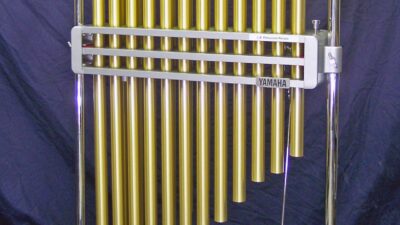
ट्यूबलर बेल्स धातु (प्रायः पीतल) की खोखली नलियों का एक समूह है, जो अलग-अलग लंबाई में एक ऊँचे धातु के फ्रेम से लंबवत लटकी रहती हैं। नलियाँ पियानो के कीबोर्ड की तरह क्रमबद्ध होती हैं — सामने की पंक्ति में शुद्ध स्वर और पीछे की पंक्ति में तीव्र/कोमल स्वर। ऊपरी सिरे पर लगी टोपी को हथौड़े से ठोंककर गिरजाघर की घंटी जैसी गूँजती ध्वनि पैदा की जाती है।
Description English
Tubular bells are a set of hollow metal (usually brass) tubes of graded lengths hung vertically from a tall metal frame. The tubes are laid out like a piano keyboard — naturals in the front row, sharps and flats in the back — and are struck on a cap at the top with a mallet to produce a resonant, church-bell-like tone.
Body
A rack of long vertical cylindrical tubes suspended in two rows on a tall rectangular frame
ऊँचे आयताकार फ्रेम पर दो पंक्तियों में लटकी लंबी बेलनाकार नलियों का ढाँचा
Chrome- or gold-lacquered brass tubes (steel in some models); steel or aluminium frame
क्रोम या सुनहरे लाख से मढ़ी पीतल की नलियाँ (कुछ मॉडलों में स्टील); स्टील या एल्युमिनियम का फ्रेम
Frame roughly 180-200 (about 6 feet); longest low tubes up to ~150 cm
Each tube is itself the resonator — the closed metal column vibrates as an air-and-metal cavity; no separate sound box
Strings
Tuned metal tubes — the sounding elements (analogous to strings on a chordophone)
Tubular bells have no sympathetic strings; the rich, shimmering 'halo' comes from the tube's own inharmonic overtones
No drone element; a sustain (damper) pedal, not a drone, governs the ringing
Bow
हथौड़ा / चाइम-मैलेट
Chime hammer / mallet
Rawhide- or hard plastic (nylon)-headed mallet with a wooden or fibreglass handle; softer heads for a mellow tone, harder for a bright attack
Head about 5-6, handle about 25-30
The tube is struck squarely on the metal cap at its very top edge (not the middle), where the strike tone speaks most cleanly
Tuning Pegs
नली की लंबाई (कटाई से स्वर-निर्धारण)
Fixed by tube length (cut-to-pitch)
Pitch is fixed at manufacture by the length and wall of each tube; there are no tuning pegs — the instrument is not retuned by the player
Bridge
लटकाव-रस्सी व फ्रेम
Suspension cord and frame
Each tube hangs from a cord threaded through a hole near its top so it can vibrate freely; the frame carries and spaces the tubes
Nylon/gut cord on a metal frame
Frets
फ्रेट का प्रश्न ही नहीं उठता — प्रत्येक नली एक निश्चित स्वर देती है, अतः यह एक 'डिस्क्रीट-पिच' (पृथक-स्वर) वाद्य है, जैसे पियानो; मीड/ग्लाइड संभव नहीं।
The concept of frets does not apply — each tube sounds one fixed pitch, making this a discrete-pitch instrument like the piano; continuous glide/meend is not possible.
ध्वनि-चरित्र
SoundTonal Character Hindi
ट्यूबलर बेल्स की ध्वनि गिरजाघर या मंदिर की घंटी जैसी — गूँजती, शुद्ध और भव्य। एक ही प्रहार से लंबी, तैरती हुई गूँज उठती है जो शांति, पवित्रता, रहस्य या नाटकीय क्षण का भाव जगाती है।
Tonal Character English
The tone of tubular bells is that of a church or temple bell — resonant, pure and majestic. A single strike releases a long, floating ring that evokes serenity, sanctity, mystery or a moment of high drama.
Timbre
Bright, metallic, bell-like with a long sustain and a complex, slightly inharmonic overtone cloud that gives it its 'shimmer'
Range
About 1½ octaves, chromatic (commonly notated in the treble staff, sounding an octave higher than written)
Dynamic Range
Wide — from a soft, distant chime to a ringing fortissimo peal that can cut through a full orchestra
Techniques
सुनने का मार्गदर्शन
The Listening Guideट्यूबलर बेल्स को पहचानना हो तो फ़िल्मों के उन दृश्यों पर कान लगाइए जहाँ मंदिर या गिरजा, घड़ी, स्वप्न या रहस्य आता है — पृष्ठभूमि में उठती वह लंबी, तैरती घंटी-गूँज प्रायः यही वाद्य है। एक बार माइक ओल्डफील्ड का 'ट्यूबलर बेल्स' और चाइकोव्स्की का '1812 ओवरचर' सुन लीजिए; फिर यह ध्वनि आपको हर जगह पहचान में आने लगेगी।
अंग्रेज़ी में पढ़ें · Read in English
To recognise tubular bells, listen at film moments showing a temple/church, a clock, a dream or a mystery — that long, floating bell-ring rising in the background is usually the tubular bells. In Western music, Tchaikovsky's '1812 Overture' and Mike Oldfield's 'Tubular Bells' are its purest examples.
परिचय
Identity- Year Of Origin
- 1885
अन्य विवरण
More DetailsTimbre
Bright, metallic, bell-like with a long sustain and a complex, slightly inharmonic overtone cloud that gives it its 'shimmer'
रोचक तथ्य
Margin Notesइतालवी नाम 'कम्पाने' — ऑर्केस्ट्रा के स्वरांकनों में ट्यूबलर बेल्स को प्रायः उनके इतालवी नाम 'campane', जर्मन में 'Röhrenglocken' और फ्रेंच में 'cloches' से पुकारा जाता है — तीनों का अर्थ 'घंटियाँ' है।
In orchestral scores tubular bells are often called by their Italian name 'campane', German 'Röhrenglocken' and French 'cloches' — all meaning 'bells'.
पियानो जैसा कीबोर्ड विन्यास — नलियाँ पियानो के कीबोर्ड की तरह सजी होती हैं — शुद्ध स्वर सामने की पंक्ति में, तीव्र/कोमल स्वर पीछे की पंक्ति में — जिससे परकशन-वादक स्वर तुरंत ढूँढ लेता है।
The tubes are arranged like a piano keyboard — naturals in the front row, sharps/flats in the back — so the percussionist can find pitches at a glance.
भारतीय समतुल्य — मंदिर की घंटी — ध्वनि-सिद्धांत की दृष्टि से ट्यूबलर बेल्स 'घन' वर्ग का वाद्य है, ठीक जैसे भारतीय मंदिर की घंटी (घंटा), मंजीरा और जलतरंग — जहाँ धातु स्वयं कंपित होकर नाद देती है, किसी तार या झिल्ली से नहीं।
By its sound principle, tubular bells belong to the 'Ghana' idiophone class, just like the Indian temple bell (ghanta), manjira and jaltarang — where the metal itself vibrates to sound, not a string or membrane.
फ़िल्म में 'प्रभाव' का वाद्य — हिंदी फ़िल्म-संगीत में ट्यूबलर बेल्स प्रायः मुख्य धुन नहीं, बल्कि एक 'रंग' होते हैं — पूजा, घड़ी, स्वप्न या रहस्य के क्षण को एक-दो आघातों से रेखांकित करने वाला उपकरण।
In Hindi film music tubular bells are usually not a lead melody but a 'colour' — a device that underlines a moment of prayer, a clock, a dream or mystery with one or two strikes.
सवाल-जवाब
Questions & Answersट्यूबलर बेल्स क्या हैं?
ट्यूबलर बेल्स (ऑर्केस्ट्रल चाइम्स) पीतल की लंबी नलियों का एक समूह है जो एक ऊँचे फ्रेम से लटकी रहती हैं और हथौड़े से ठोंकने पर गिरजाघर की घंटी जैसी गूँजती ध्वनि देती हैं। यह एक पश्चिमी स्वरबद्ध परकशन (घन) वाद्य है।
हिंदी फ़िल्म-संगीत में ट्यूबलर बेल्स का उपयोग कैसे होता है?
हिंदी फ़िल्मों में ये प्रायः पार्श्व-संगीत का एक 'रंग' होते हैं — मंदिर/गिरजे की घंटी का वातावरण, घड़ी की टन-टन, स्वप्न-दृश्य और रहस्य/तनाव के क्षण को एक-दो आघातों से रेखांकित करने के लिए यदा-कदा उपयोग किए जाते हैं, न कि मुख्य धुन के रूप में।
ट्यूबलर बेल्स कैसे बजाए जाते हैं?
प्रत्येक नली को उसके ऊपरी सिरे की टोपी पर रॉहाइड या प्लास्टिक-मढ़े हथौड़े से ठोंका जाता है। एक पैर-चालित डैम्पर पेडल, पियानो की तरह, गूँज को रोकता या छोड़ता है। हथौड़े को नलियों पर सरकाकर ग्लिसांडो भी बजाया जा सकता है।
ट्यूबलर बेल्स का आविष्कार कब और क्यों हुआ?
19वीं शताब्दी के उत्तरार्ध में इंग्लैंड में, भारी ढलवाँ चर्च-घंटियों के हल्के, वहनीय विकल्प के रूप में इनका विकास हुआ। कॉवेंट्री के जॉन हैम्प्टन को 1880 के दशक में स्वरबद्ध धातु-नलियों के पेटेंट का श्रेय दिया जाता है।
ट्यूबलर बेल्स को इतना प्रसिद्ध किसने बनाया?
1973 में माइक ओल्डफील्ड के एल्बम 'ट्यूबलर बेल्स' ने; इसका आरंभिक अंश हॉरर फ़िल्म 'द एक्सॉर्सिस्ट' का थीम-संगीत बना, जिससे इस वाद्य की ध्वनि विश्वभर में रहस्य और भय की पहचान बन गई।
नमूना-पट्टी
The Specimen Table| नाम | ट्यूबलर बेल्स · Tubular Bells |
|---|---|
| अन्य नाम | ऑर्केस्ट्रल चाइम्स · चाइम्स · ट्यूबलर बेल्स · Chimes · Orchestral chimes · Campane (Italian) |
| उद्गम | 1885 |
| प्रकार | वाद्य · Instruments |
साझा कीजिए · Share this Plate