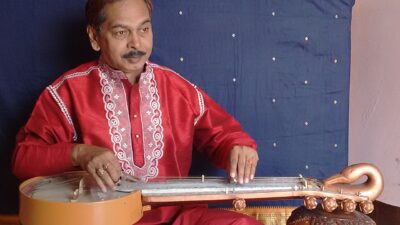
शास्त्र विंग · वाद्य-पट्टिका · Instrument Plate
त्रिवेणी वीणा
Triveni Veena
अन्य नामत्रिवेणी वीणा · Triveni Veena (also spelt Trivenee Veena)
परिचय
Overviewत्रिवेणी वीणा एक विरल, आधुनिक आविष्कृत वाद्य यंत्र है — धातु, लकड़ी और चमड़े से बना, स्टील स्लाइड से बजाया जाने वाला। पंडित निरंजन हलदार और पंडित कमल कमले की यह रचना सरोद, वीणा और गिटार की ध्वनियों का त्रिवेणी-संगम प्रस्तुत करती है, जो हिंदुस्तानी शास्त्रीय राग-प्रस्तुति की परंपरा में एक अनूठा प्रयोग है।
अंग्रेज़ी में पढ़ें · Read in English
The Triveni Veena is a rare, modern invented instrument — built from metal, wood and leather, played with a steel slide. This creation of Pandit Niranjan Haldar and Pandit Kamal Kamle presents a Triveni (three-river) confluence of the sounds of sarod, veena and guitar, a unique experiment within the Hindustani classical raga-presentation tradition.
वर्गीकरण
ClassificationNatya Shastra Category
तत (Tata - stringed instruments)
त्रिवेणी वीणा तत वर्ग का एक आधुनिक आविष्कृत वाद्य यंत्र है, जिसे स्टील स्लाइड (गज़ के स्थान पर धातु की छड़) से बजाया जाता है, हवाईयन गिटार की भाँति।
The Triveni Veena belongs to the Tata (stringed) category as a modern invented instrument, played with a steel slide bar rather than a bow, in the manner of a Hawaiian guitar.
Western Category
Plucked slide chordophone
Western Family
Lap-slide guitar / veena family (akin to Hawaiian guitar and Mohan Veena)
Sub Classification
बनावट
PhysicalDescription Hindi
त्रिवेणी वीणा एक आधुनिक आविष्कृत भारतीय वाद्य यंत्र है, जिसे पंडित निरंजन हलदार ने पंडित कमल कमले के साथ मिलकर बनाया। इसका नाम 'त्रिवेणी' (तीन नदियों का संगम) इसलिए रखा गया क्योंकि यह तीन पदार्थों — धातु, लकड़ी और चमड़े — से निर्मित है, और तीन वाद्य यंत्रों — सरोद, वीणा और गिटार — की मिश्रित ध्वनि उत्पन्न करता है।
Description English
The Triveni Veena is a modern invented Indian instrument created by Pandit Niranjan Haldar jointly with Pandit Kamal Kamle. It is named 'Triveni' (confluence of three rivers) because it is built from three materials — metal, wood and leather — and produces a blended tone of three instruments — Sarod, Veena and Guitar.
Body
Medium-sized flat-bodied lap instrument, resembling a hybrid of Hawaiian slide guitar and Indian veena/sarod resonator
मध्यम आकार की समतल-शरीर वाली गोद-वाद्य यंत्र, हवाईयन स्लाइड गिटार और भारतीय वीणा/सरोद के मिश्रण जैसी
High-quality wood (resonating body) combined with metal (strings, tuning hardware, fretboard fittings) and leather (bridge/contact points) — the three materials that give the instrument its name
उच्च गुणवत्ता वाली लकड़ी (अनुनाद शरीर), धातु (तार, स्वरपेटी, फ्रेटबोर्ड की फिटिंग) और चमड़ा (पुल/संपर्क बिंदु) — तीन पदार्थ जो इस वाद्य यंत्र को इसका नाम देते हैं
medium-sized, more compact and portable than the larger Rudra Veena or Vichitra Veena
Single wooden resonating body designed for loud projection and a sustained, sweet tone
Strings
Main melody strings, played with a steel slide bar
Sympathetic resonating strings that vibrate in harmony with the melody strings, adding tonal richness
Chikari (drone/rhythm) strings — 2 on the right side, 4 on the left side — used to maintain scale and rhythmic pulse while the melody strings carry the raga
Bow
स्टील स्लाइड (गज़ नहीं)
Steel slide bar (no bow used)
Solid steel/metal bar
approx. 8-12 (hand-held bar, similar to Hawaiian guitar or Mohan Veena slide)
Held in the left hand and slid along the strings over the fretboard while the right hand plucks — same principle as Hawaiian lap-steel guitar and the Mohan Veena, adapted for Hindustani classical ornamentation
Tuning Pegs
खूंटी
Tuning pegs
Metal tuning pegs/machine heads for the melody, chikari, and sympathetic strings
Bridge
पुल
Bridge
Leather-cushioned bridge (one of the instrument's three signature materials) that transmits string vibration to the wooden resonating body
Leather over wood/metal base
Frets
त्रिवेणी वीणा में फ्रेट होते हैं, परंतु फिंगरबोर्ड को सीधे उंगली से दबाने के बजाय स्टील स्लाइड को तारों के ऊपर सरकाकर स्वर बदले जाते हैं — जिससे मींड, गमक, कृंतन और गीतकारी जैसी तकनीकें साफ़ और सतत रूप से संभव होती हैं।
The Triveni Veena has frets on its fingerboard, but pitch is shaped not by direct finger-fretting but by sliding a steel bar across the strings — enabling meend (glides), gamak (oscillation), krintan (pluck-and-release), and gitkari (rapid rhythmic plucking) with smooth, continuous control, much like Hawaiian slide guitar technique applied to Hindustani raga music.
ध्वनि-चरित्र
SoundTonal Character Hindi
त्रिवेणी वीणा की ध्वनि तीन वाद्य यंत्रों — सरोद की गूँजती गंभीरता, वीणा की मधुरता, और गिटार की चमकीली स्पष्टता — का मिश्रण है। यह वाद्य यंत्र तेज़, सतत और मधुर स्वर उत्पन्न करता है, जो एकल वादन और सभा-प्रदर्शन दोनों के लिए उपयुक्त है।
Tonal Character English
The Triveni Veena's tone is a blend of three instruments — the resonant depth of Sarod, the sweetness of Veena, and the bright clarity of Guitar. It produces a loud, sustained, and sweet sound suited to both solo practice and concert performance.
Timbre
Blended timbre combining sarod's metallic resonance, veena's rounded sweetness, and guitar's bright sustain
Range
Spans the melodic range typical of Hindustani slide-veena instruments, sufficient for full alap-jod-jhala elaboration of a raga
Dynamic Range
Loud and sustained projection, designed for concert performance without electronic amplification
Techniques
सुनने का मार्गदर्शन
The Listening Guideत्रिवेणी वीणा का रस लेने के लिए, पंडित निरंजन हलदार की आलाप-जोड़-झाला प्रस्तुतियाँ सुनें। ध्यान दें कि स्टील स्लाइड कैसे मींड को सहज बनाती है, और कैसे एक ही वाद्य यंत्र में सरोद की गूँज, वीणा की मधुरता और गिटार की चमक एक साथ उभरती है।
अंग्रेज़ी में पढ़ें · Read in English
To appreciate the Triveni Veena, first listen to Pandit Niranjan Haldar's alap performances — such as Raag Basant Mukhari or Darbari Kanada — where the steel slide's meend technique is clearly audible. Then, in the jod-jhala sections, try to distinguish the guitar-like brightness and sarod-like resonance blending together. It is an experimental yet deeply classical listening experience.
श्रवण-कक्ष · The Listening Room
देखें-सुनें
Triveni Veena, Raag Basant Mukhari (Alap, Jod & Jhala) · 9:26
Darbari Kanada (Alap, Jod, Jhala) by Pandit Niranjan Haldar on Triveni Veena · 17:57
Bihag (Jod Jhala) by Pandit Niranjan Haldar on Triveni Veena · 8:31
परिचय
Identity- Year Of Origin
- 1990
अन्य विवरण
More DetailsTimbre
Blended timbre combining sarod's metallic resonance, veena's rounded sweetness, and guitar's bright sustain
रोचक तथ्य
Margin Notesआविष्कारक की चार दशकों की साधना — पंडित निरंजन हलदार आकाशवाणी (ऑल इंडिया रेडियो), इंदौर से सेवानिवृत्त वरिष्ठ ग्रेड-ए कलाकार हैं, जिन्हें भारतीय और पाश्चात्य शास्त्रीय संगीत में 40 से अधिक वर्षों का अनुभव है। उन्होंने आकाशवाणी, दूरदर्शन और संगीत नाटक अकादमी के मंचों पर विचित्र वीणा और गिटार दोनों प्रस्तुत किए हैं, इससे पहले कि उन्होंने त्रिवेणी वीणा का आविष्कार किया।
Pandit Niranjan Haldar is a retired senior Grade-A artist of All India Radio (Akashvani), Indore, with over 40 years of experience in Indian and Western classical music. He performed both Vichitra Veena and Guitar on Akashvani, Doordarshan, and Sangeet Natak Akademi platforms before inventing the Triveni Veena.
तीन धातुओं का संतुलन: 4 + 6 + 11 तार — त्रिवेणी वीणा में कुल 21 तार होते हैं — 4 मुख्य सुर तार, 6 चिकारी तार (दाईं ओर 2, बाईं ओर 4) जो ताल और स्केल बनाए रखते हैं, और 11 सहानुभूतिशील तार जो वाद्य यंत्र की ध्वनि को समृद्ध बनाते हैं। यह विशिष्ट संरचना इसे अन्य किसी भी वीणा प्रकार से अलग बनाती है।
The Triveni Veena has a total of 21 strings — 4 main melody strings, 6 chikari strings (2 on the right, 4 on the left) that maintain rhythm and scale, and 11 sympathetic strings that enrich the instrument's tone. This distinctive configuration sets it apart from any other veena variant.
गिटार के साथ युगल वादन — पंडित निरंजन हलदार ने लोकप्रिय हिंदी फ़िल्मी गीत 'ये रात भीगी भीगी' को त्रिवेणी वीणा और गिटार के युगल वादन के रूप में प्रस्तुत किया, यह दर्शाते हुए कि यह शास्त्रीय वाद्य यंत्र लोकप्रिय धुनों के साथ भी सहज रूप से घुल-मिल सकता है।
Pandit Niranjan Haldar performed the popular Hindi film song 'Yeh Raat Bheegi Bheegi' as a duet between Triveni Veena and Guitar, demonstrating that this classical instrument can also blend seamlessly with popular melodies.
एक संस्थागत मंच पर प्रदर्शन — त्रिवेणी वीणा को रामकृष्ण मिशन इंस्टीट्यूट ऑफ़ कल्चर, गोलपार्क (कोलकाता) जैसे प्रतिष्ठित सांस्कृतिक संस्थानों में भी प्रदर्शित किया गया है, जो इस नए वाद्य यंत्र को शास्त्रीय संगीत जगत में मान्यता दिलाने में सहायक रहा है।
The Triveni Veena has also been showcased at respected cultural institutions such as the Ramakrishna Mission Institute of Culture, Golpark (Kolkata), helping this new instrument gain recognition within the classical music world.
सवाल-जवाब
Questions & Answersत्रिवेणी वीणा क्या है?
त्रिवेणी वीणा एक आधुनिक आविष्कृत भारतीय वाद्य यंत्र है, जिसे पंडित निरंजन हलदार ने पंडित कमल कमले के साथ मिलकर बनाया। यह धातु, लकड़ी और चमड़े से निर्मित है और स्टील स्लाइड से बजाया जाता है, जो सरोद, वीणा और गिटार की मिश्रित ध्वनि उत्पन्न करता है।
त्रिवेणी वीणा में कितने तार होते हैं?
त्रिवेणी वीणा में कुल 21 तार होते हैं: 4 मुख्य सुर तार, 6 चिकारी तार (दाईं ओर 2, बाईं ओर 4), और 11 सहानुभूतिशील तार।
त्रिवेणी वीणा को यह नाम क्यों दिया गया?
'त्रिवेणी' का अर्थ है तीन नदियों का संगम। इस वाद्य यंत्र को यह नाम इसलिए दिया गया क्योंकि यह तीन पदार्थों — धातु, लकड़ी और चमड़े — से बना है, और सरोद, वीणा तथा गिटार तीन वाद्य यंत्रों की ध्वनियों को मिलाता है।
त्रिवेणी वीणा किसने आविष्कृत की?
त्रिवेणी वीणा का आविष्कार और पेटेंट पंडित निरंजन हलदार ने पंडित कमल कमले के साथ मिलकर किया। हलदार जी आकाशवाणी, इंदौर के सेवानिवृत्त वरिष्ठ ग्रेड-ए कलाकार हैं, जिन्हें भारतीय और पाश्चात्य शास्त्रीय संगीत में 40 से अधिक वर्षों का अनुभव है।
त्रिवेणी वीणा और मोहन वीणा में क्या अंतर है?
दोनों वाद्य यंत्र स्टील स्लाइड तकनीक साझा करते हैं और हवाईयन गिटार से प्रेरित हैं, लेकिन त्रिवेणी वीणा की तार संरचना (4 सुर + 6 चिकारी + 11 सहानुभूतिशील तार) और तीन पदार्थों (धातु, लकड़ी, चमड़ा) का सचेत मिश्रण इसे मोहन वीणा से अलग बनाता है। त्रिवेणी वीणा पंडित निरंजन हलदार और पंडित कमल कमले की स्वतंत्र रचना है।
नमूना-पट्टी
The Specimen Table| नाम | त्रिवेणी वीणा · Triveni Veena |
|---|---|
| अन्य नाम | त्रिवेणी वीणा · Triveni Veena (also spelt Trivenee Veena) |
| उद्गम | 1990 |
| प्रकार | वाद्य · Instruments |
साझा कीजिए · Share this Plate