शास्त्र विंग · वाद्य-पट्टिका · Instrument Plate
तबला तरंग
Tabla Tarang
अन्य नामतरंग तबला (शब्द-क्रम भिन्नता) · Tarang Tabla (word-order variant) · 'Melody on Drums' (descriptive English subtitle used by Smithsonian Folkways for Kamalesh Maitra's 1996 album)
परिचय
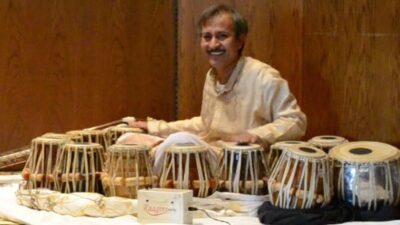
Overviewतबला तरंग हिंदुस्तानी संगीत का शायद सबसे अकेला वाद्य यंत्र है — साधारण तबला दायों की एक शृंखला, अर्ध-वृत्त में सजी, हर एक अलग सुर में बंधी, जिसे बजाकर एक कलाकार अपने दो ही हाथों से लय और राग दोनों बुनता है। एक शिक्षण-कक्ष के उपकरण से उदय शंकर के मंच तक, और वहाँ से जॉर्ज हैरिसन के दौरों तक — फिर भी आज इसे जीवंत रखने वाले हाथ उंगलियों पर गिने जा सकते हैं।
अंग्रेज़ी में पढ़ें · Read in English
The tabla tarang is perhaps Hindustani music's loneliest instrument — a row of ordinary tabla dayan drums, arranged in a semicircle, each bound to a different note, letting a soloist weave both rhythm and raga together with just two hands. From a classroom teaching aid to Uday Shankar's stage, and from there to George Harrison's touring party — yet today the hands still keeping it alive can be counted on one's fingers.
वर्गीकरण
ClassificationNatya Shastra Category
अवनद्ध (Avanaddha - चर्म-आच्छादित वाद्य यंत्र)
अवनद्ध वर्ग में तबला तरंग तबले के 'दायें' (उच्च स्वर वाले ढोल) की एक श्रृंखला है, जिसे विभिन्न स्वरों में बांधकर हाथों की थाप से बजाया जाता है।
In the Avanaddha (covered/membranophone) category of Natya Shastra, tabla tarang is a row of tabla 'dayan' (treble drums) tuned to different pitches and struck by hand to produce melody rather than pure rhythm.
Western Category
Tuned membranophone / melodic percussion set
Western Family
Drum-chime (a tuned set of skin-headed drums functioning like a melodic 'keyboard' of percussion — organologically closer to a row of tuned kettledrums than to bar-instruments like the xylophone, though it fills a similar melodic role; a distant skin-drum cousin of the water-tuned jal tarang, both named for 'tarang' — waves)
Sub Classification
बनावट
PhysicalDescription Hindi
तबला तरंग साधारण तबले के 'दायें' (उच्च स्वर के ढोल) की एक शृंखला है — सामान्यतः 10 से 16 तक, प्रत्येक एक भिन्न स्वर में बंधा हुआ — जिन्हें वादक के चारों ओर अर्ध-वृत्त में इस प्रकार सजाया जाता है कि हाथ आसानी से हर ढोल तक पहुँच सकें। यह वाद्य यंत्र किसी एक राग विशेष के स्वरों में बजाने से पहले प्रत्येक बार नए सिरे से सुर में बांधा जाता है।
Description English
The tabla tarang is a row of ordinary tabla 'dayan' (treble drums) — typically ten to sixteen of them, each tuned to a different pitch — arranged in a semicircle around the seated player so that both hands can reach every drum. Before each performance, the relevant drums are freshly tuned to the specific swaras (notes) required by the raga about to be played.
Body
Each unit is a standard dayan: a shallow, tapering, barrel-like shell
प्रत्येक इकाई एक मानक दायां है — छिछला, संकुचित, पीपा-सदृश खोल
Hollowed wood (commonly sheesham/Indian rosewood or mango wood); clay-bodied or brass/copper-bodied dayans also exist in some regional traditions
खोखली लकड़ी (सामान्यतः शीशम या आम की लकड़ी); कुछ क्षेत्रीय परंपराओं में मिट्टी या पीतल/तांबे के खोल वाले दायें भी प्रयुक्त होते हैं
Individual shell diameter roughly 12-20 cm, sized to the assigned pitch — smaller, tauter shells for higher swaras, larger shells for lower swaras
Each dayan resonates independently — there is no shared soundbox; the 'instrument' is really an ensemble of single drums played as one
Drums
10-16 (occasionally more in elaborate concert sets; exact upper limit not independently verified)
A full set of individually tuned dayan drums, together spanning roughly one octave (plus alternate komal/tivra swaras) of whichever raga is being performed that day
व्यक्तिगत रूप से सुर में बंधे दायों का एक पूरा सेट, जो मिलकर उस दिन बजाए जाने वाले राग के लगभग एक सप्तक (और आवश्यक कोमल/तीव्र स्वरों) को कवर करता है
Semicircle around the seated player, positioned so a rapid lateral sweep of the hands can move across the full melodic range
बैठे हुए वादक के चारों ओर अर्ध-वृत्त में, इस प्रकार व्यवस्थित कि हाथों की तीव्र गति पूरी सुर-सीमा में सहजता से घूम सके
Heads
पुड़ी
Puri
Two-layer goatskin membrane stretched over each shell, identical in construction to a standard tabla dayan head
प्रत्येक खोल पर फैली दो-परत बकरी की खाल की झिल्ली, एक सामान्य तबला दायें के सिर के समान
Syahi
स्याही
Syahi
A permanent black tuning paste of iron filings mixed with dough/rice-paste, applied off-centre to each head; it loads the membrane so that the drum rings a clear, defined pitch rather than an indistinct thud — the feature that makes melodic tuning possible at all
प्रत्येक सिर पर केंद्र से हटकर लगाई गई लौह-चूर्ण और आटे/चावल के लेप से बनी स्थायी काली स्याही, जो झिल्ली पर भार डालकर ढोल को एक स्पष्ट, निश्चित स्वर देती है — यही विशेषता इस वाद्य यंत्र को सुर में बांधना संभव बनाती है
Tuning Mechanism
गजरा, गत्ता और हथौड़ी
Gajara, Gatta and Hathauri
Each drum is tuned like a solo tabla: a braided leather tuning collar (gajara) and wooden dowels (gatta) run around the rim, and a small hammer (hathauri) is used to tap the dowels — striking the gajara raises pitch, striking between the dowels (the gatta) fine-tunes it down — until the drum matches its assigned swara for that raga
प्रत्येक ढोल को एकल तबले की तरह सुर में बांधा जाता है — किनारे पर एक गुंथा हुआ चमड़े का गजरा और लकड़ी के गत्ते लगे होते हैं, और एक छोटी हथौड़ी से इन्हें थपथपाकर स्वर ऊँचा या नीचा किया जाता है, जब तक ढोल उस राग के लिए निर्धारित स्वर से पूरी तरह न मिल जाए
Because every raga uses a different set of swaras, a significant part of a tabla tarang performance's preparation is the laborious re-tuning of some or all drums beforehand — a defining practical burden of the instrument
क्योंकि हर राग के लिए स्वरों का समुच्चय अलग होता है, प्रदर्शन से पहले कुछ या सभी ढोलों को पुनः सुर में बांधना एक श्रमसाध्य कार्य है — यही इस वाद्य यंत्र की एक बड़ी व्यावहारिक चुनौती भी है
Frets
तबला तरंग में परदे या फ्रेट की कोई अवधारणा नहीं है — प्रत्येक ढोल स्वयं में एक स्थिर स्वर है; सुर परिवर्तन के लिए वादक अलग ढोल पर प्रहार करता है, न कि एक ही तार/सतह पर उंगली सरकाता है।
There is no concept of frets — each drum is itself one fixed pitch. To change note, the player strikes a different drum rather than sliding a finger along a single surface.
ध्वनि-चरित्र
SoundTonal Character Hindi
तबला तरंग की ध्वनि तबले की परिचित थाप जैसी ही है, किंतु हर थाप एक निश्चित स्वर में बंधी होती है — इसलिए इसकी बनावट गर्म, मंद्र (dampened) और कुछ हद तक तपस्वी (austere) मानी जाती है, सारंगी या सितार की गूंजती, सतत ध्वनि की तुलना में अधिक 'नपी-तुली' और लयबद्ध।
Tonal Character English
The tabla tarang sounds like familiar tabla strokes, except each stroke rings at a fixed, chosen pitch — giving it a warm, muted, comparatively austere texture, more clipped and rhythmic in character than the sustained, ringing tone of instruments like sarangi or sitar.
Timbre
Dry, resonant thump layered with the syahi's characteristic overtone shimmer — essentially the timbre of a solo tabla dayan, but deployed across a full melodic scale
Range
Typically about one octave of the chosen raga's swaras (core notes plus relevant komal/tivra alternates); the exact range is re-tuned and re-defined for every raga rather than being fixed
Dynamic Range
Moderate — comparable to ordinary tabla playing, from soft closed strokes to sharp open accents; each note has a percussive attack-and-decay envelope with no sustain, unlike bowed or plucked strings
Techniques
सुनने का मार्गदर्शन
The Listening Guideतबला तरंग का रस लेना हो, तो पहले सामान्य तबले की थाप को पहचानिए, फिर कल्पना कीजिए कि वही थाप कई सुरों में बंट गई है। कमलेश मैत्र के 'राग दीन तोड़ी' से शुरुआत कीजिए और देखिए कैसे ताल और राग एक ही प्रहार में साथ उभरते हैं। यह एक ऐसा वाद्य यंत्र है जो लय और धुन की सीमा को मिटा देता है।
अंग्रेज़ी में पढ़ें · Read in English
To appreciate the tabla tarang, first listen closely to an ordinary tabla's strokes, then imagine that same stroke-vocabulary split across many different pitches. Start with Kamalesh Maitra's 'Raag Deen Todi' — notice how rhythm and melody emerge together in a single stroke. Watch how each change of note means the player's hand reaching a different drum, not sliding along one surface. It is an instrument that dissolves the usual boundary between taal (rhythm) and raga (melody).
श्रवण-कक्ष · The Listening Room
देखें-सुनें
Pandit Kamalesh Maitra: Raga Deen Todi · 9:20
Tabla Tarang (Part 1) by Milind Tulankar · 7:11
Tabla Tarang by Sanjeev Kanitkar · 2:42
परिचय
Identity- Year Of Origin
- 1880
अन्य विवरण
More DetailsTimbre
Dry, resonant thump layered with the syahi's characteristic overtone shimmer — essentially the timbre of a solo tabla dayan, but deployed across a full melodic scale
रोचक तथ्य
Margin Notesएक शिक्षण उपकरण से मंचीय कला तक — तबला तरंग की शुरुआत एक साधारण शिक्षण उपकरण के रूप में हुई थी — पंडित विष्णु दिगंबर पलुस्कर गायन के विद्यार्थियों को स्वर पहचानने के लिए अलग-अलग सुर में बंधे तबलों का प्रयोग करते थे। यह उदय शंकर की नृत्य-मंडली में शामिल होने के बाद ही, 1930 के दशक में, एक पूर्ण मंचीय वाद्य यंत्र बना।
Tabla tarang began life as a simple teaching aid — Pandit Vishnu Digambar Paluskar reportedly used differently-tuned tablas to help vocal students recognize pitch. It only became a full concert instrument in the 1930s, after entering Uday Shankar's dance troupe.
'अंतिम गुरु' का बोझ और आशीर्वाद — कमलेश मैत्र (1928-2005) को व्यापक रूप से तबला तरंग का 'अंतिम गुरु' माना जाता है। उनके निधन के बाद, Songlines पत्रिका के अनुसार, यह वाद्य यंत्र गहरे पतन में चला गया — पूर्णकालिक विशेषज्ञ अब गिनती के ही बचे हैं।
Kamalesh Maitra (1928-2005) is widely regarded as tabla tarang's 'last master.' After his death, according to Songlines magazine, the instrument entered a steep decline — only a handful of full-time specialists remain today.
जॉर्ज हैरिसन के मंच पर — 1974 में, रवि शंकर के निमंत्रण पर कमलेश मैत्र ने जॉर्ज हैरिसन द्वारा प्रायोजित 'Music Festival from India' दौरे में प्रदर्शन किया और बाद में हैरिसन के उत्तर अमेरिकी दौरे में जैज़ संगीतकार एमिल रिचर्ड्स तथा टॉम स्कॉट के साथ सहयोग किया — तबला तरंग को पश्चिमी जैज़ मंच पर लाने वाला एक दुर्लभ क्षण।
In 1974, at Ravi Shankar's invitation, Kamalesh Maitra performed in the George Harrison-sponsored 'Music Festival from India' revue, later collaborating with jazz musicians Emil Richards and Tom Scott during Harrison's North American tour — a rare moment that brought tabla tarang onto a Western jazz stage.
दो हाथ, दो स्वर की सीमा — चूँकि एक वादक के पास केवल दो हाथ होते हैं और प्रत्येक हाथ एक समय पर केवल एक ढोल पर प्रहार कर सकता है, तबला तरंग पर अधिकतम दो स्वर ही एक साथ बज सकते हैं — यह भौतिक सीमा वाद्य यंत्र की संगीत रचना शैली को स्वाभाविक रूप से प्रभावित करती है।
Because a player has only two hands and each hand can strike only one drum at a time, at most two notes can sound simultaneously on a tabla tarang — a physical constraint that naturally shapes the instrument's compositional style.
सवाल-जवाब
Questions & Answersतबला तरंग क्या है?
तबला तरंग तबले के 10 से 16 (कभी-कभी अधिक) 'दायों' (उच्च स्वर वाले ढोल) की एक शृंखला है, जिनमें से प्रत्येक को एक भिन्न स्वर में बांधा जाता है और अर्ध-वृत्त में सजाकर हाथों से बजाया जाता है ताकि एक पूरी धुन बजाई जा सके।
तबला तरंग सामान्य तबले से कैसे भिन्न है?
सामान्य तबला ताल (लय) के लिए दो ढोलों (दायां व बायां) की एक जोड़ी है। तबला तरंग में केवल दायें (उच्च स्वर वाले ढोल) की कई प्रतियाँ होती हैं, प्रत्येक अलग सुर में बंधी होती है, जिससे यह एक शुद्ध रूप से मेलोडिक (धुन बजाने वाला) वाद्य यंत्र बन जाता है।
तबला तरंग को 'अंतिम गुरु' किसे कहा जाता है?
पंडित कमलेश मैत्र (1928-2005) को व्यापक रूप से तबला तरंग का अंतिम महान गुरु माना जाता है। वे इस वाद्य यंत्र पर पूर्ण राग-संगीत सभा प्रस्तुत करने वाले पहले कलाकार थे और 1974 में जॉर्ज हैरिसन के दौरे में भी प्रदर्शन किया।
क्या तबला तरंग आज भी बजाया जाता है?
हाँ, किंतु यह अत्यंत दुर्लभ है। कमलेश मैत्र के 2005 में निधन के बाद, संदीप बर्मन, मिलिंद तुळंकर और संजीव कानिटकर जैसे गिने-चुने कलाकार ही इस परंपरा को आगे बढ़ा रहे हैं।
क्या तबला तरंग हिंदी फ़िल्म संगीत में प्रयोग हुआ है?
इसका प्रयोग सीमित रहा है। संजीव कानिटकर जैसे कलाकारों को सिने म्यूज़िशियन एसोसिएशन द्वारा मान्यता प्राप्त है और उन्होंने कई बॉलीवुड फ़िल्मों के लिए तबला तरंग बजाया है, किंतु यह वाद्य यंत्र मुख्यधारा फ़िल्मी वाद्यवृंद का हिस्सा कभी नहीं बना।
नमूना-पट्टी
The Specimen Table| नाम | तबला तरंग · Tabla Tarang |
|---|---|
| अन्य नाम | तरंग तबला (शब्द-क्रम भिन्नता) · Tarang Tabla (word-order variant) · 'Melody on Drums' (descriptive English subtitle used by Smithsonian Folkways for Kamalesh Maitra's 1996 album) |
| उद्गम | 1880 |
| प्रकार | वाद्य · Instruments |
साझा कीजिए · Share this Plate