शास्त्र विंग · वाद्य-पट्टिका · Instrument Plate
खंजनी
Khanjani
अन्य नामखांजनी (वर्तनी भेद) · Khajani / Khajni (कॉमन्स फ़ाइलों व स्थानीय ओड़िया प्रयोग में मिलने वाली वर्तनी) · खंजनी बाजा / खंजनी बाद्य — Khanjani Baja / Khanjani Badya · Khanjari (निकट-नाम — बंगाल के कुछ वैष्णव कीर्तन स्रोतों में एक भिन्न रचना वाले काष्ठ-क्लैपर वाद्य के लिए भी प्रयुक्त; इस लेख की झिल्ली-वाली खंजनी से भ्रमित न करें)
परिचय
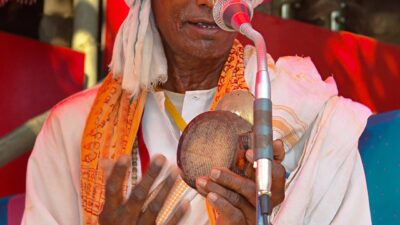
Overviewखंजनी पश्चिम बंगाल और ओडिशा का एक छोटा, हाथ में पकड़ा जाने वाला फ्रेम-ड्रम है — कटहल की लकड़ी के गोलाकार ढाँचे पर मढ़ी चमड़े की झिल्ली, और किनारे पर जड़ी धातु की चक्तियाँ, जो हर हिलाव पर झनझनाती हैं। यह वैष्णव कीर्तन, ओडिशा की महिमा धर्म भजन-परंपरा, और गाँव-गाँव घूमने वाली 'खंजनी पार्टी' टोलियों की संगत का अभिन्न हिस्सा रही है।
अंग्रेज़ी में पढ़ें · Read in English
The khanjani is a small, hand-held frame drum of West Bengal and Odisha — a skin membrane stretched over a circular jackfruit-wood ring, with metal discs set into the rim that jangle with every shake. It has long been integral to Vaishnava kirtan, Odisha's Mahima Dharma bhajan tradition, and the accompaniment of village-touring 'Khanjani Paty' troupes.
वर्गीकरण
ClassificationNatya Shastra Category
अवनद्ध (Avanaddha - चर्म-मढ़ा ताल वाद्य)
नाट्यशास्त्र के अवनद्ध वर्ग में खंजनी आती है — एक हाथ से पकड़ा जाने वाला छोटा फ्रेम-ड्रम, जिसके एक मुख पर चमड़े की झिल्ली मढ़ी होती है, जबकि दूसरा मुख खुला रहता है। फ्रेम की परिधि में जड़ी छोटी धातु-चक्तियाँ इसे शुद्ध अवनद्ध वाद्यों से थोड़ा आगे — घन-अवनद्ध के मिश्रण की ओर — ले जाती हैं।
In the Avanaddha (membranophone) category of the Natya Shastra, khanjani is a small hand-held frame drum with a skin membrane stretched over one face, the other face left open. Small metal discs set into the wooden rim push it slightly toward a membranophone-idiophone hybrid, similar to a tambourine.
Western Category
Membranophone with attached idiophone jingles (frame drum / tambourine-type)
Western Family
Frame drum family — related to the daf and dafli, but smaller, single-headed, and regionally rooted in Bengal-Odisha folk and devotional practice rather than Sufi or pan-Indian bhajan use
Sub Classification
बनावट
PhysicalDescription Hindi
खंजनी एक छोटा, हल्का फ्रेम-ड्रम है — एक गोलाकार लकड़ी के ढाँचे पर एक ओर चमड़े की झिल्ली मढ़ी जाती है, जबकि दूसरा मुख खुला छोड़ दिया जाता है। फ्रेम की परिधि में छोटी-छोटी धातु चक्तियाँ (जिंगल) जड़ी होती हैं, जो हिलाने या थाप देने पर आपस में टकराकर झनझनाहट पैदा करती हैं। इसे एक हाथ में पकड़कर दूसरे हाथ की हथेली व उँगलियों से बजाया जाता है।
Description English
The khanjani is a small, lightweight frame drum — a circular wooden ring with a skin membrane stretched over one face, the other face left open. Small metal discs (jingles) are set into slots cut around the rim, clashing together into a jangling shimmer when the frame is shaken or struck. It is held in one hand and played with the palm and fingers of the other.
Body
Circular ring/hoop frame, single-headed
गोलाकार चूड़ीनुमा ढाँचा, एक ही ओर मढ़ा हुआ
Traditionally carved from jackfruit-tree wood (kanthal kaath); modern examples may use other locally available woods
परंपरागत रूप से कटहल की लकड़ी (कांठाल काठ) से बना; आधुनिक उदाहरणों में अन्य स्थानीय लकड़ियाँ भी प्रयुक्त होती हैं
व्यास लगभग 18-23 सेमी (7-9 इंच), गहराई लगभग 5-10 सेमी (2-4 इंच) — Diameter roughly 18-23 cm (7-9 in), depth roughly 5-10 cm (2-4 in)
The open, shallow wooden ring itself, with the single stretched skin head as the sounding membrane — no separate enclosed resonance chamber as in barrel- or pot-shaped drums
Strings
Not applicable — Khanjani is a membranophone with attached jingles, not a stringed instrument. It has no melody strings.
None. The membrane's tension and the rim jingles — not sympathetic strings — govern its tone and shimmer.
None.
Bow
लागू नहीं (हाथ से बजाया जाता है)
N/A — played with bare hands
No bow or stick is used; struck with the palm and fingertips of one hand while the other hand holds the frame near the rim
N/A
One hand supports the frame near the rim while the fingers and palm of the other hand strike the membrane and/or shake the frame to ring the rim jingles
Tuning Pegs
स्थिर बंधन (कोई खूंटी नहीं)
Fixed tensioning (no tuning pegs)
The skin head is typically glued or nailed directly to the wooden rim rather than laced with adjustable cords. Players commonly warm the head briefly near a flame or in sunlight before performance to tighten the skin and brighten the tone — a widespread practice for small skin-headed folk frame drums across India.
Bridge
लागू नहीं
N/A
Not applicable to a membranophone with no strings
N/A
Frets
फ्रेट का प्रश्न ही नहीं उठता — यह एक चर्म-ड्रम है। ध्वनि-रंग हाथ की स्थिति (मध्य बनाम किनारा आघात), आघात-बल, और चक्तियों की झनझनाहट की मात्रा से बदलता है।
Frets are not applicable — it is a skin drum. Tonal colour is shaped by hand position (centre vs. rim strike), striking force, and how much the rim jingles are allowed to ring.
Head
मढ़ी (चमड़े का मुख)
Drumhead (membrane)
परंपरागत रूप से गोह/मॉनिटर छिपकली की खाल का उल्लेख मिलता है। भारत के वन्यजीव (संरक्षण) अधिनियम, 1972 के अंतर्गत मॉनिटर छिपकली अनुसूची-I में संरक्षित प्रजाति है, इसलिए इसकी खाल का प्रयोग अब क़ानूनन निषिद्ध है — गोवा के घुमट वाद्य पर लागू इसी क़ानून के अनुरूप। आधुनिक खंजनी में बकरी की खाल या सिंथेटिक झिल्ली का प्रयोग होता है।
Traditionally described in regional sources as monitor-lizard (goh/godhi) skin. Because monitor lizards are a Schedule-I protected species under India's Wildlife (Protection) Act, 1972, use of their skin is now legally prohibited — the same law that has forced Goa's ghumot drum to switch materials. Modern khanjani heads use goat skin or synthetic membranes instead.
Jingles
धातु चक्तियाँ (जिंगल)
Metal jingles (discs)
Several small metal discs set into slots cut around the wooden rim
Brass or other metal alloy
फ्रेम को हिलाने या थाप देने पर ये चक्तियाँ आपस में टकराकर एक झनझनाती लय जोड़ती हैं — खंजनी की सबसे पहचानी जाने वाली ध्वनि विशेषता, जो इसे शुद्ध चर्म-ड्रम से अलग करती है।
When the frame is shaken or struck, these discs clash together adding a jangling rhythmic shimmer — the khanjani's most recognisable sonic signature, distinguishing it from a plain skin drum.
ध्वनि-चरित्र
SoundTonal Character Hindi
खंजनी की ध्वनि में दो परतें एक साथ सुनाई देती हैं — झिल्ली की गोल, गर्म थाप और चक्तियों की चमकीली झनझनाहट। यह मेल इसे भक्ति गीतों और सामूहिक कीर्तन में एक जीवंत, उत्सवी लय-रंग देता है।
Tonal Character English
The khanjani's sound layers two textures at once — the round, warm thump of the skin head and the bright jangle of its metal discs. This combination gives it a lively, festive rhythmic colour well suited to devotional singing and communal kirtan.
Timbre
Warm skin-thump layered with a bright metallic jingle-shimmer
Range
Percussive/unpitched — a single resonant fundamental plus the indefinite-pitched jingle shimmer, rather than a melodic range
Dynamic Range
Moderate to lively — soft accompaniment behind solo devotional singing, building to energetic, driving rhythm in massed 'Khanjani Paty' group performance
Techniques
सुनने का मार्गदर्शन
The Listening Guideखंजनी को उसके प्राकृतिक संदर्भ में सुनिए — किसी भजन-मंडली या 'खंजनी पार्टी' की सामूहिक प्रस्तुति में। झिल्ली की गहरी थाप और किनारे की झनझनाहट को अलग-अलग परत में पहचानिए, फिर देखिए कि सामूहिक वादन में गति कैसे चढ़ती जाती है।
अंग्रेज़ी में पढ़ें · Read in English
Listen to the khanjani in its natural setting — a bhajan gathering or a 'Khanjani Paty' massed performance. Notice how the deep thump of the head and the jangle of the rim discs sound together yet as distinct layers. Follow its steady accompaniment groove under slow devotional lines, then watch how the tempo lifts in group performance.
श्रवण-कक्ष · The Listening Room
देखें-सुनें
HOW TO PLAY KANNA, KANJIRA (ODIA KHANJANI) // CREATED BY HEMANT HASTI // HEMANTA HASTI MUSIC CLASS · 4:36
Khanjani Paty ! Ghuchepali Khanjani Paty ! bheluapadar Khanjani Paty ! At - Telmahul ! · 14:43
Khanjani baja (Alekh mahima baba) · 2:08
अन्य विवरण
More DetailsTimbre
Warm skin-thump layered with a bright metallic jingle-shimmer
रोचक तथ्य
Margin Notesएक नाम, कई वाद्य — भ्रम से सावधान — 'खंजनी' नाम पूर्वी भारत के इस झिल्ली-वाले फ्रेम-ड्रम के अलावा दक्षिण भारत के 'खंजीरा' (कर्नाटक शास्त्रीय संगीत का वाद्य, समान निर्माण-सिद्धांत पर आधारित पर पूर्णतः भिन्न सांस्कृतिक संदर्भ वाला) के लिए भी प्रयुक्त होता है, और बंगाल के कुछ स्रोतों में एक भिन्न काष्ठ-क्लैपर वाद्य के लिए भी। HindiGeet पर यह लेख विशेष रूप से पश्चिम बंगाल-ओडिशा की झिल्ली-वाली, जिंगल-युक्त खंजनी को दर्शाता है।
Beyond this membrane frame drum of eastern India, the name 'khanjani' is also used for South India's 'khanjira' (a Carnatic classical instrument, built on a similar principle but with an entirely different cultural context), and in some Bengal sources for a differently-built wooden clapper instrument. This HindiGeet entry specifically covers the jingled membrane khanjani of West Bengal and Odisha.
गोह की खाल से बकरी की खाल तक — परंपरागत खंजनी की मढ़ी गोह (मॉनिटर छिपकली) की खाल से बनाई जाती थी। भारत के वन्यजीव (संरक्षण) अधिनियम, 1972 के अंतर्गत यह प्रजाति अनुसूची-I में संरक्षित है, इसलिए इसका प्रयोग अब निषिद्ध है — ठीक उसी क़ानून के तहत जिसने गोवा के घुमट वाद्य को बकरी-चर्म/सिंथेटिक झिल्ली अपनाने पर मजबूर किया।
The traditional khanjani head was made from monitor-lizard (godhi) skin. Under India's Wildlife (Protection) Act, 1972, the species is Schedule-I protected, so this practice is now prohibited — the same law that forced Goa's ghumot drum to adopt goat-skin/synthetic heads.
खंजनी पार्टी — आज भी जीवंत गाँव-परंपरा — ओडिशा के गाँवों में संगठित 'खंजनी पार्टी' टोलियाँ भक्ति-गीत गाते हुए गाँव-गाँव घूमती हैं। इस परंपरा के वीडियो ऑनलाइन लाखों बार देखे गए हैं, जो दर्शाता है कि खंजनी किसी संग्रहालय-वस्तु के बजाय एक सक्रिय, लोकप्रिय ग्रामीण भक्ति-मनोरंजन रूप बना हुआ है।
In Odisha's villages, organised 'Khanjani Paty' troupes travel from village to village singing devotional songs. Videos of this tradition have drawn millions of views online, showing that the khanjani remains an active, popular form of rural devotional entertainment rather than a museum piece.
रुकुण रथ यात्रा में खंजनी — भुवनेश्वर के लिंगराज मंदिर की रुकुण रथ यात्रा के दौरान खंजनी बजाने वाले वादकों की तस्वीरें दर्ज़ हैं — यह दर्शाता है कि यह वाद्य ओडिशा के प्रमुख मंदिर-उत्सवों की जीवंत संगत का हिस्सा है।
Photographs document khanjani players performing during the Rukuna Ratha Jatra of the Lingaraja Temple, Bhubaneswar — showing the instrument as a living part of the accompaniment at Odisha's major temple festivals.
सवाल-जवाब
Questions & Answersखंजनी क्या है?
खंजनी पश्चिम बंगाल और ओडिशा का एक छोटा, हाथ में पकड़ा जाने वाला फ्रेम-ड्रम है, जिसकी परिधि में धातु की चक्तियाँ (जिंगल) जड़ी होती हैं। यह डफ परिवार का सदस्य है और मुख्यतः भक्ति-गायन व लोक-उत्सवों में बजाया जाता है।
खंजनी किस चीज़ से बनती है?
इसका ढाँचा परंपरागत रूप से कटहल की लकड़ी का बना होता है, जिस पर चमड़े की झिल्ली मढ़ी जाती है (परंपरागत रूप से गोह/मॉनिटर छिपकली की खाल, जो अब क़ानूनन निषिद्ध होने से बकरी की खाल या सिंथेटिक सामग्री से बदल दी गई है), और किनारे पर धातु की चक्तियाँ जड़ी होती हैं।
खंजनी और दक्षिण भारत की खंजीरा में क्या अंतर है?
खंजनी पश्चिम बंगाल-ओडिशा का एक ग्रामीण/भक्ति लोक-वाद्य है, जबकि खंजीरा दक्षिण भारत (तमिलनाडु, कर्नाटक, आंध्र प्रदेश) का एक कर्नाटक शास्त्रीय संगीत-सभा वाद्य है। निर्माण-सिद्धांत में समानता के बावजूद, दोनों की सांस्कृतिक भूमिका, क्षेत्र और नामकरण-परंपरा भिन्न हैं — इन्हें एक-दूसरे से भ्रमित नहीं करना चाहिए।
आज खंजनी कहाँ और कैसे बजाई जाती है?
यह बंगाल की वैष्णव कीर्तन-मंडलियों, ओडिशा की महिमा धर्म भजन-गायकी, मंदिर-उत्सवों (जैसे रुकुण रथ यात्रा), और गाँव-गाँव घूमने वाली संगठित 'खंजनी पार्टी' टोलियों में आज भी सक्रिय रूप से बजाई जाती है।
क्या खंजनी में अब भी मॉनिटर छिपकली की खाल का प्रयोग होता है?
नहीं। मॉनिटर छिपकली भारत के वन्यजीव (संरक्षण) अधिनियम, 1972 के अंतर्गत अनुसूची-I में संरक्षित प्रजाति है, इसलिए इसकी खाल का प्रयोग अब क़ानूनन निषिद्ध है। आधुनिक खंजनी में बकरी की खाल या सिंथेटिक झिल्ली का प्रयोग होता है।
नमूना-पट्टी
The Specimen Table| नाम | खंजनी · Khanjani |
|---|---|
| अन्य नाम | खांजनी (वर्तनी भेद) · Khajani / Khajni (कॉमन्स फ़ाइलों व स्थानीय ओड़िया प्रयोग में मिलने वाली वर्तनी) · खंजनी बाजा / खंजनी बाद्य — Khanjani Baja / Khanjani Badya · Khanjari (निकट-नाम — बंगाल के कुछ वैष्णव कीर्तन स्रोतों में एक भिन्न रचना वाले काष्ठ-क्लैपर वाद्य के लिए भी प्रयुक्त; इस लेख की झिल्ली-वाली खंजनी से भ्रमित न करें) |
| प्रकार | वाद्य · Instruments |
साझा कीजिए · Share this Plate