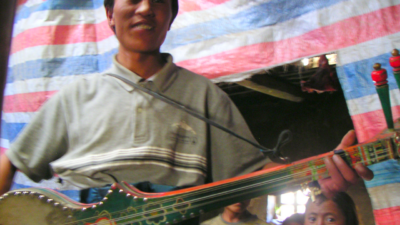
शास्त्र विंग · वाद्य-पट्टिका · Instrument Plate
द्रम्यिन
Dramyin
अन्य नामद्रन्येन (Dranyen — तिब्बती-भूटानी वर्तनी) · दमन्येन / दमन्यान — लद्दाखी नाम (Damnyen / Damnyan — Ladakhi name) · द्रम्नियेन — जोंखा वर्तनी (Dramnyen — Dzongkha spelling) · ज़मुन्ये — चीनी उच्चारण (Zhamunie / 扎木聂 — Chinese rendering)
परिचय
Overviewद्रम्यिन (द्रन्येन) हिमालय की खामोशी में गूँजता एक मधुर, अकेला स्वर है — विलो की एक लकड़ी से तराशा गया लंबी-गर्दन का तंत्री-वाद्य, जिसका पेगबॉक्स घोड़े या पौराणिक जल-जंतु के सिर से सजा होता है। लद्दाख के चांगथांग चरवाहों के एकल गीतों से लेकर सिक्किम के भूटिया उत्सव-नृत्यों तक, यह भारत के हिमालयी बौद्ध समुदायों की लोक-आत्मा है।
अंग्रेज़ी में पढ़ें · Read in English
The dramyin (dranyen) is a sweet, solitary voice echoing through Himalayan silence — a long-necked lute carved from a single piece of willow, its pegbox crowned with a horse's or mythical sea-monster's head. From the solo songs of Ladakh's Changthang herders to the festival circle-dances of Sikkim's Bhutia community, it is the folk soul of India's Himalayan Buddhist communities.
वर्गीकरण
ClassificationNatya Shastra Category
तत (Tata — तंत्री/तार-वाद्य)
भरत के नाट्यशास्त्र के चतुर्विध वर्गीकरण में द्रम्यिन 'तत वाद्य' (तार वाद्य) की श्रेणी में आता है — यद्यपि यह वर्गीकरण मूलतः शास्त्रीय भारतीय संगीत के लिए विकसित हुआ था और तिब्बती-हिमालयी लोक-परंपरा इससे स्वतंत्र रूप से विकसित हुई, संरचनात्मक दृष्टि से द्रम्यिन एक बजाया जाने वाला (न कि धनुष से बजाया जाने वाला) तंत्री-वाद्य है।
Under Bharata's four-fold Natya Shastra classification, the dramyin falls within 'Tata vadya' (stringed instruments) — though that taxonomy was developed for classical Indian music and the Tibetan-Himalayan folk tradition evolved independently of it. Structurally, the dramyin is a plucked (not bowed) chordophone.
Western Category
Long-necked plucked lute (chordophone)
Western Family
Central-Asian/Himalayan long-necked lute family — a cousin lineage to the rubab, tanbur and other Silk-Road lutes, distinct from the short-necked oud/sitar branch
Sub Classification
बनावट
PhysicalDescription Hindi
द्रम्यिन एक लंबी गर्दन वाला, दोहरी-कमर (अष्टाकार-सदृश) और फ्रेट-रहित तंत्री-वाद्य है, जो प्रायः लकड़ी के एक ही टुकड़े को तराश-खोखलाकर बनाया जाता है। इसका पेगबॉक्स प्रायः किसी पौराणिक जल-जंतु ('चुसिंग') या — लद्दाख में विशेष रूप से — घोड़े के सिर के आकार में तराशा जाता है, जिससे यह वाद्य दूर से ही पहचाना जा सकता है।
Description English
The dramyin is a long-necked, double-waisted (figure-eight-like) and entirely fretless lute, most often carved and hollowed from a single block of wood. Its pegbox is typically carved into the shape of a mythical sea-monster ('chusing') or — distinctively in Ladakh — a horse's head, making the instrument recognisable at a glance.
Body
Long-necked, double-waisted (figure-eight-like), boat-shaped resonating chamber
लंबी गर्दन, दोहरी-कमर (अष्टाकार-सदृश), नाव-सदृश गुंजन-काय
Hollowed from a single block of wood; willow is the preferred timber in Ladakh (master maker Tsering Angchuk notes thicker willow wood gives better tone), with other regions using locally available hardwoods
लकड़ी के एक ही टुकड़े को खोखला करके बनाया गया — लद्दाख में विलो (बेद) की लकड़ी प्राथमिक पसंद (मास्टर कारीगर त्सेरिंग अंगचुक के अनुसार मोटी विलो लकड़ी बेहतर स्वर देती है); अन्य क्षेत्रों में स्थानीय उपलब्ध कठोर काष्ठ
60-120 (Ladakhi/Tibetan forms); Bhutanese form typically about 90-120 cm (roughly 3-4 feet) with a body diameter of 15-30 cm
Single hollowed wooden chamber, topped with a wooden soundboard (some regional forms use a stretched-skin membrane) pierced with rosette-shaped sound holes rather than round guitar-style f-holes
Strings
Melody strings played in courses (paired or tripled strings tuned in unison/octaves)
The dramyin, unlike the sarangi or sitar, carries no sympathetic resonating strings — its shimmer comes instead from a buzzing bridge, not sympathetic drone strings
Plectrum
त्रिकोणीय मिज़राब (पिक)
Triangular plectrum
Traditionally carved animal bone or horn; now commonly plastic or wood
Held between thumb and forefinger; strings are struck in alternating down-and-up strokes for melodic passages, or swept across the courses for rhythmic strumming — many players also pluck or finger-pick bare-handed
Tuning Pegs
खूँटी
Tuning pegs
Wooden friction pegs set into the carved pegbox — six pegs for the classic six-string form, arranged around the sculpted chusing (sea-monster), horse-head (Ladakh) or dragon-head (Amdo, north-eastern Tibetan Plateau) carving
Bridge
पुल
Bridge
A single bridge on the soundboard in most Ladakhi/Sikkimese forms; some Bhutanese instruments add a second, lighter bridge near the neck that lightly buzzes against the belly, giving the tone its characteristic jangling edge
Wood, occasionally with a bone or horn insert
Frets
द्रम्यिन पूर्णतः फ्रेट-रहित है — वादक उँगलियों से सीधे गर्दन पर तार दबाता है, जिससे सूक्ष्म सर्पण-स्वर (ग्लाइड) और लोक-धुनों की स्वाभाविक झुकाव-शैली संभव होती है, यद्यपि यह भारतीय शास्त्रीय राग-प्रणाली से स्वतंत्र एक मौलिक, धुन-प्रधान वादन-शैली है।
The dramyin is entirely fretless — the player presses the strings directly against the neck with the fingers, allowing subtle sliding tones and the natural bending style of folk melody, even though its idiom is a self-contained, tune-driven one independent of the Indian classical raga system.
ध्वनि-चरित्र
SoundTonal Character Hindi
द्रम्यिन की ध्वनि गर्म, थोड़ी झनझनाती (बज़-युक्त) और खुले पहाड़ी वातावरण या पत्थर के मठ-प्रांगण में दूर तक गूँजने वाली होती है। यह मुख्यतः एक समय में एक ही स्वर-रेखा बजाने वाला, हार्मनी-रहित, धुन-प्रधान वाद्य है — गायन और नृत्य के साथ चलने के लिए बना।
Tonal Character English
The dramyin's voice is warm, faintly buzzing (from its bridge), and carries well through open mountain air or a stone monastery courtyard. It is primarily a single-line, non-harmonic, melody-driven instrument — built to walk alongside singing and dance rather than to stand in solo virtuoso display.
Timbre
Warm and woody with a light buzzing edge from the bridge; softer and less sustained than a bowed instrument
Range
Modest — roughly two octaves, tuned to sit comfortably beneath a singer's voice rather than to cover a wide instrumental range
Dynamic Range
Moderate — designed for close, unamplified accompaniment of singing and circle-dancing rather than large-hall projection
Techniques
सुनने का मार्गदर्शन
The Listening Guideद्रम्यिन को पहले किसी एकल वादक की धुन में सुनिए, फिर किसी सामूहिक नृत्य-रिकॉर्डिंग में जहाँ यह पिवांग, ग्युमांग या बाँसुरी के साथ मिलकर उत्सवी लय गढ़ता है। यह सारंगी जैसा भावुक विलाप नहीं, बल्कि यायावर मन का साधारण, आत्मीय साथी-स्वर है।
अंग्रेज़ी में पढ़ें · Read in English
To appreciate the dramyin, first listen to a single player alone — perhaps a herder's tune or a craftsman's demonstration — and notice how each plucked note floats in the air, building not a fixed raga structure but a flowing, conversational melody. Then move to a communal dance recording, where it joins piwang, gyumang or flute to build a festive groove. It is neither the emotional lament of a sarangi nor the raga-elaboration of a sitar — it is the plain, intimate voice of a travelling companion.
श्रवण-कक्ष · The Listening Room
देखें-सुनें
Dramyin or Dranyen, a Ladakhi lute - The Himalayan folk music instrument resembling a guitar · 3:26
Kopong / Dranyen melody Ladakh · 2:42
Bhutia folk song melody in Danyen. · 0:59
अन्य विवरण
More DetailsTimbre
Warm and woody with a light buzzing edge from the bridge; softer and less sustained than a bowed instrument
रोचक तथ्य
Margin Notesत्सेरिंग अंगचुक — द्रम्यिन के आधुनिक रक्षक — जांगथांग खारनाक (लेह से 100+ किमी दूर) में बड़े हुए त्सेरिंग अंगचुक हर वर्ष विलो लकड़ी से 40-50 द्रम्यिन बनाते हैं, हर एक को बनाने में 3-4 दिन लगते हैं। उन्होंने लेह आकाशवाणी पर प्रदर्शन किया है और राजस्थान-मध्य प्रदेश तक अपनी कला ले गए हैं, और दिसंबर 2024 में मुंबई के सेरेंडिपिटी आर्ट्स फ़ेस्टिवल में स्कल्ज़ांग तुंडुप के साथ एक व्याख्यान-प्रदर्शन दिया।
Growing up in Jangthang Kharnak (over 100 km from Leh), Tsering Angchuk crafts 40-50 willow-wood dramyins a year, each taking 3-4 days to make. He has performed on All India Radio's Leh station, carried his craft to states like Rajasthan and Madhya Pradesh, and in December 2024 gave a lecture-demonstration with Skalzang Tundup at Mumbai's Serendipity Arts Festival.
क्षेत्र के अनुसार बदलता सिर — द्रम्यिन के पेगबॉक्स की नक़्क़ाशी क्षेत्र पहचानती है — तिब्बत-भूटान में प्रायः पौराणिक जल-जंतु 'चुसिंग' का सिर, लद्दाख में विशिष्ट रूप से घोड़े का सिर, और आम्दो (उत्तर-पूर्वी तिब्बती पठार) में ड्रैगन का सिर तराशा जाता है।
The carving of the dramyin's pegbox identifies its region — in Tibet-Bhutan it is typically the mythical sea-monster 'chusing', in Ladakh distinctively a horse's head, and in Amdo (north-eastern Tibetan Plateau) a dragon's head.
अकेले चरवाहे का साथी — लद्दाख के चांगथांग के घुमंतू चरवाहे परंपरागत रूप से भेड़-बकरियाँ चराते समय अकेले द्रम्यिन बजाकर गाते थे — यह वाद्य का सबसे पुराना और सबसे निजी उपयोग है, किसी मंच या समारोह से पहले का।
Nomadic Changthang herders of Ladakh traditionally played and sang to the dramyin alone while tending their flocks — the instrument's oldest and most private use, predating any stage or festival setting.
मठ के भीतर बजने वाला दुर्लभ तंत्री-वाद्य — द्रुक्पा बौद्ध परंपरा में द्रम्यिन को सामान्यतः एक लौकिक (धार्मिक-इतर) वाद्य माना जाता है, फिर भी 'द्रम्यिन छम' नृत्य के दौरान इसे मठ या द्ज़ोंग के भीतर बजाने की अनुमति है — तिब्बती बौद्ध संगीत में तार-वाद्यों को यह विशेषाधिकार बहुत कम मिलता है।
In Drukpa Buddhist tradition the dramyin is generally regarded as a secular instrument, yet during the 'Dramyin Cham' dance it is permitted to be played inside a monastery or dzong — a privilege very rarely extended to stringed instruments in Tibetan Buddhist music.
सवाल-जवाब
Questions & Answersद्रम्यिन क्या है?
द्रम्यिन (द्रन्येन) एक लंबी गर्दन वाला, फ्रेट-रहित तंत्री-वाद्य है जो हिमालयी बौद्ध लोक-संगीत में गायन और नृत्य की संगत के लिए बजाया जाता है। भारत में यह मुख्यतः लद्दाख, सिक्किम और हिमालयी पश्चिम बंगाल में मिलता है।
द्रम्यिन में कितने तार होते हैं?
क्लासिक रूप में 6 तार (तीन युग्म) होते हैं; कुछ भूटानी रूपों में 7 तार होते हैं, और आधुनिक 'रिगसार द्रन्येन' में 15 तक तार होते हैं।
लद्दाख में द्रम्यिन को किसने पुनर्जीवित किया?
मास्टर कारीगर त्सेरिंग अंगचुक, जो जांगथांग खारनाक (चांगथांग) में बड़े हुए, हर वर्ष 40-50 विलो-लकड़ी के द्रम्यिन बनाते हैं और लेह आकाशवाणी सहित कई मंचों पर प्रदर्शन कर चुके हैं, इस लगभग-लुप्त परंपरा को पुनर्जीवित करने का श्रेय पाते हैं।
क्या द्रम्यिन हिंदुस्तानी शास्त्रीय संगीत का हिस्सा है?
नहीं। द्रम्यिन तिब्बती-हिमालयी बौद्ध लोक-परंपरा का वाद्य है, जो भारतीय राग-प्रणाली से स्वतंत्र रूप से विकसित हुआ। यह गायन और नृत्य की संगत के लिए बना एक धुन-प्रधान वाद्य है।
द्रम्यिन का धार्मिक महत्व क्या है?
द्रुक्पा बौद्ध परंपरा में द्रम्यिन 'द्रम्यिन छम' अनुष्ठान-नृत्य के दौरान बजता है, जो 'द्रम्यिन छोएशे' धार्मिक गायन के साथ होता है। यह उन गिने-चुने तंत्री-वाद्यों में से है जिन्हें मठ के भीतर बजाने की अनुमति है।
नमूना-पट्टी
The Specimen Table| नाम | द्रम्यिन · Dramyin |
|---|---|
| अन्य नाम | द्रन्येन (Dranyen — तिब्बती-भूटानी वर्तनी) · दमन्येन / दमन्यान — लद्दाखी नाम (Damnyen / Damnyan — Ladakhi name) · द्रम्नियेन — जोंखा वर्तनी (Dramnyen — Dzongkha spelling) · ज़मुन्ये — चीनी उच्चारण (Zhamunie / 扎木聂 — Chinese rendering) · Damyan / Tungana (broader Himalayan 'folk rabab' family names, per Indian organology references) |
| प्रकार | वाद्य · Instruments |
साझा कीजिए · Share this Plate