शास्त्र विंग · वाद्य-पट्टिका · Instrument Plate
शंख
Shankh
अन्य नामशंख · शङ्ख (Sanskrit) · Shankha · Conch / Conch-shell trumpet
परिचय
Overviewशंख भारत का सबसे पुराना और सबसे पवित्र नाद-वाद्य है — मनुष्य-रचित नहीं, समुद्र का दिया हुआ कवच, जिसकी चोटी घिसकर उसमें साँस भरी गई। यह न राग गाता है न ताल थामता है; इसका एक ही लम्बा, गूँजता नाद केवल यह कहता है — 'यह क्षण मंगलमय है।' पाञ्चजन्य से लेकर घर की आरती तक, विष्णु के हाथ से लेकर बंगाल की शंखध्वनि तक, शंख भारतीय जीवन में शुभ का उद्घोषक है और 'ॐ' के आदिनाद का प्रतीक।
अंग्रेज़ी में पढ़ें · Read in English
The shankh is India's oldest and most sacred sounding instrument — not man-made but a gift of the sea, a shell whose tip was ground away so breath could fill it. It sings no raga and keeps no tala; its one long, resonant blast says only, 'this moment is auspicious.' From the Panchajanya to the household aarti, from Vishnu's hand to Bengal's shankhadhwani, the shankh is the herald of the auspicious in Indian life and a symbol of the primordial sound 'Om'.
वर्गीकरण
ClassificationNatya Shastra Category
सुषिर (Sushira - wind instruments)
नाट्यशास्त्र के चार वाद्य-वर्गों (तत, सुषिर, अवनद्ध, घन) में शंख 'सुषिर' अर्थात् वायु-वाद्य की श्रेणी में आता है। ध्वनि खोखले शंख के छिद्र में होंठों के कम्पन (फूँक) से उत्पन्न होती है — किसी तार, ताँत या झिल्ली से नहीं।
Among the four instrument classes of the Natya Shastra (Tata, Sushira, Avanaddha, Ghana), the shankh belongs to 'Sushira' — the wind/hollow class. Sound is produced by lip-vibration (a buzzing embouchure) blown into a hole at the shell's apex, not by strings or a membrane.
Western Category
Natural shell trumpet — lip-reed (lip-vibrated) aerophone
Western Family
Conch horn / shell trumpet family; acoustically kin to the natural trumpet and horn (a single-note lip aerophone with no valves, holes or slide)
Sub Classification
बनावट
PhysicalDescription Hindi
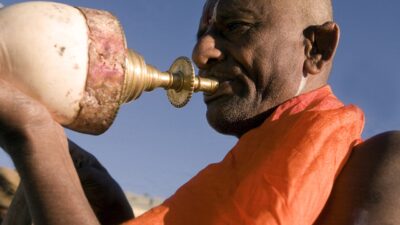
शंख कोई गढ़ा हुआ वाद्य नहीं, बल्कि समुद्री घोंघे (पवित्र शंख — Turbinella pyrum) का प्राकृतिक कवच है, जिसकी नुकीली चोटी (शिखर) को घिसकर एक छोटा छिद्र बना दिया जाता है। इसी छिद्र पर होंठ सटाकर फूँक मारने से पूरा सर्पिल कोष एक गूँजती हुई नाद में गूँज उठता है। प्रत्येक शंख अद्वितीय होता है — दो शंख कभी एक-से नहीं होते।
Description English
The shankh is not a crafted instrument but the natural shell of a sea snail (the sacred chank, Turbinella pyrum), whose pointed apex (spire) is ground down to form a small blow-hole. Pressing the lips to this hole and buzzing sets the whole spiral cavity ringing in a resonant blast. Every shankh is unique — no two are alike.
Body
Spiral (helical) calcareous shell tapering from a wide aperture to a pointed apex
सर्पिलाकार, चूनेदार कठोर कोष — चौड़े मुख से नुकीले शिखर तक
Natural calcium-carbonate shell of Turbinella pyrum; cream to porcelain-white, sometimes with a pink or orange aperture; larger specimens often mounted in silver, brass or gold and carved with deities
Turbinella pyrum का प्राकृतिक कैल्शियम-कार्बोनेट कोष; क्रीम से चीनी-सफ़ेद रंग, कभी-कभी मुख गुलाबी या नारंगी; बड़े शंख प्रायः चाँदी, पीतल या सोने में जड़े और देवमूर्तियों से उकेरे जाते हैं
10-25 (सामान्य अनुष्ठानिक शंख); विशाल मंदिर-शंख इससे भी बड़े
The entire coiled internal cavity acts as the resonating air column; the wide aperture serves as the flaring 'bell' that projects the tone
Strings
The shankh has no strings — it is a lip-reed aerophone. The vibrating element is the player's own lips buzzing at the apex hole; the shell is the resonator and amplifier.
None — the shankh produces no sympathetic resonance from strings; its 'shimmer' comes from the spiral cavity's natural overtones.
The shankh itself is essentially a single-note drone instrument — one deep, sustained, penetrating tone likened to the primordial 'Om'.
Bow
कोई गज़ नहीं
No bow
N/A — the shankh is blown, not bowed or struck
N/A
Sound is generated purely by the buzzing lips (embouchure) at the apex blow-hole
Tuning Pegs
कोई खूँटी नहीं
No pegs
Being a natural single-note aerophone, the shankh has no tuning mechanism
Bridge
कोई पुल नहीं
No bridge
N/A
N/A
Frets
शंख में न फ्रेट होते हैं न छिद्र — यह मूलतः एक ही स्वर देता है। कुशल वादक फूँक की तीव्रता और होंठों के कसाव से नाद को हल्का ऊपर-नीचे 'उठा' सकते हैं, किंतु यह कोई सुरीला/रागात्मक वाद्य नहीं है।
The shankh has neither frets nor finger-holes — it essentially sounds a single note. A skilled blower can make the tone swell slightly up or down by varying breath pressure and lip tension, but it is not a melodic/raga instrument.
Coiling Types
शंख दो प्रकार के होते हैं: 'वामावर्ती' (बाईं ओर घूमता हुआ, सामान्य) और 'दक्षिणावर्ती' (दाईं ओर घूमता हुआ, अत्यन्त दुर्लभ)। दक्षिणावर्ती शंख को लक्ष्मी का प्रतीक और सर्वाधिक शुभ माना जाता है।
Shankhs are of two kinds: 'Vamavarti' (left-turning, common) and 'Dakshinavarti' (right-turning, extremely rare). The Dakshinavarti conch is regarded as a symbol of Lakshmi and the most auspicious of all.
ध्वनि-चरित्र
SoundTonal Character Hindi
शंख की ध्वनि गहरी, गूँजती और भेदक होती है — एक लम्बा, सधा हुआ नाद जो वातावरण को भर देता है और दूर तक पहुँचता है। इसे 'ॐ' के आदिनाद के समान माना जाता है; यही कारण है कि यह हर पूजा और आरती का आरम्भ और अन्त दोनों करता है।
Tonal Character English
The shankh's sound is deep, resonant and piercing — a long, steady blast that fills a space and carries far. It is likened to the primordial sound 'Om'; this is why it both opens and closes every puja and aarti.
Timbre
Warm, hollow, booming with a faint roaring buzz; rich in low overtones
Range
Essentially a single fundamental pitch (with harmonics) determined by shell size — larger shells sound lower, smaller ones higher; not a chromatic/melodic range
Dynamic Range
From a soft sustained hum to a very loud, far-carrying blast — traditionally audible across a whole temple courtyard or riverside ghat without amplification
Techniques
सुनने का मार्गदर्शन
The Listening Guideशंख का रस लेना हो तो किसी मंदिर की सन्ध्या-आरती में बैठिए। देखिए कैसे नाद पहले धीमे उभरता है, फिर पूरे प्रांगण को भर देता है। कुशल वादक बिना साँस तोड़े एक-दो मिनट तक नाद थामे रखता है — यही परिपत्र श्वसन की कला है। यह किसी धुन को नहीं, एक भाव को सुनने का अनुभव है; और गूँज जब थमती है, तब जो मौन बचता है, वही शंख की असली प्रतिध्वनि है।
अंग्रेज़ी में पढ़ें · Read in English
To understand the shankh, attend an evening aarti at a temple. Notice how the blast begins — soft, then swelling, then filling the whole courtyard. Hear how a skilled blower holds the note unbroken for a minute or more (circular breathing). This is listening not for a tune but for a feeling — the silence left when the resonance fades is the shankh's truest music.
श्रवण-कक्ष · The Listening Room
देखें-सुनें
Priests blow conch shell 'Shankh' before Ganga aarti at Banaras · 0:53
Incredible! Over 2 minute non-stop 'Shankhnaad' by this Yogi impresses PM Modi · 2:54
How to Blow Conch Shell? Play Shankh (ISKCON) · 4:20
परिचय
IdentityYear Of Origin
प्राचीन काल — सिंधु घाटी सभ्यता (लगभग 2500 ईसा पूर्व) से शंख-शिल्प के प्रमाण; वैदिक व महाभारत काल में रण-तूर्य एवं अनुष्ठान-वाद्य के रूप में प्रतिष्ठित
अन्य विवरण
More DetailsTimbre
Warm, hollow, booming with a faint roaring buzz; rich in low overtones
रोचक तथ्य
Margin Notesपाँच नामधारी शंख — कुरुक्षेत्र के महाशंख — महाभारत में पाण्डवों के शंखों के अपने-अपने नाम थे: कृष्ण का 'पाञ्चजन्य', अर्जुन का 'देवदत्त', भीम का 'पौण्ड्र', युधिष्ठिर का 'अनन्तविजय', तथा नकुल-सहदेव के 'सुघोष' व 'मणिपुष्पक'। यह संसार का सम्भवतः सबसे प्रसिद्ध शंख-वर्णन है।
In the Mahabharata each of the Pandavas' conches had its own name: Krishna's 'Panchajanya', Arjuna's 'Devadatta', Bhima's 'Paundra', Yudhishthira's 'Anantavijaya', and Nakula's and Sahadeva's 'Sughosha' and 'Manipushpaka'. It is perhaps the most famous conch-passage in the world.
मणिपुर का 'मोइबुंग' — मणिपुर की मैतेई संस्कृति में शंख को 'मोइबुंग' कहते हैं। यह लाई-हराओबा जैसे प्राचीन उत्सवों, अनुष्ठानों तथा राज्य-समारोहों में फूँका जाता है — जो दर्शाता है कि शंख-नाद उत्तर-पूर्व से लेकर सुदूर दक्षिण तक एक साझा भारतीय ध्वनि-विरासत है।
In Manipur's Meitei culture the conch is called the 'Moibung'. It is sounded at ancient festivals such as the Lai Haraoba, at rites and at state ceremonies — showing that the conch-blast is a shared Indian sonic heritage stretching from the Northeast to the far South.
एक कवच से तीन जीवन — एक ही पवित्र शंख (Turbinella pyrum) से तीन वस्तुएँ बनती हैं: फूँकने का नाद-वाद्य, पूजा में जल छिड़कने का पात्र (जिससे देवता को अभिषेक होता है), और घिसकर बनी शंख-चूड़ियाँ। परम्परा में बजाने वाले और जल-वाले शंख को अलग रखा जाता है।
From a single sacred chank (Turbinella pyrum) come three things: the sounding trumpet, the vessel for sprinkling holy water in worship (used to anoint the deity), and ground conch bangles. By tradition the blowing-conch and the water-conch are kept separate.
आकार ही स्वर तय करता है — शंख में न छिद्र होते हैं न कोई ट्यूनिंग — इसका स्वर पूरी तरह कोष के आकार से तय होता है। बड़ा शंख गहरी, दूर तक पहुँचने वाली गम्भीर ध्वनि देता है; छोटा शंख अपेक्षाकृत ऊँची व तीखी। इसीलिए मंदिर के प्रधान शंख प्रायः बड़े चुने जाते हैं।
The shankh has no finger-holes and no tuning — its pitch is set entirely by the shell's size. A large conch gives a deep, far-carrying tone; a small one a higher, sharper cry. This is why temples' principal conches are usually chosen large.
सवाल-जवाब
Questions & Answersशंख क्या है?
शंख एक समुद्री घोंघे (पवित्र शंख — Turbinella pyrum) का प्राकृतिक कवच है जिसकी चोटी घिसकर छिद्र बनाया जाता है और होंठों से फूँककर बजाया जाता है। यह 'सुषिर' (वायु) वर्ग का वाद्य है और पूजा, आरती व शुभ अवसरों पर बजाया जाता है।
शंख कैसे बजाया जाता है?
शंख के नुकीले शिखर पर बने छोटे छिद्र पर होंठ सटाकर फूँक मारी जाती है; होंठों के कम्पन (एम्बशुर) से सर्पिल कोष एक लम्बे, गूँजते नाद में गूँज उठता है। कुशल वादक परिपत्र श्वसन से एक-दो मिनट तक अखण्ड नाद थाम सकते हैं।
शंख के कितने प्रकार होते हैं?
मुख्यतः दो: 'वामावर्ती' (बाईं ओर घूमता, सामान्य) और 'दक्षिणावर्ती' (दाईं ओर घूमता, अत्यन्त दुर्लभ)। दक्षिणावर्ती शंख को लक्ष्मी का प्रतीक और सर्वाधिक शुभ माना जाता है।
पाञ्चजन्य शंख किसका था?
'पाञ्चजन्य' श्रीकृष्ण का शंख था। भगवद्गीता (1.15) के अनुसार कुरुक्षेत्र-युद्ध से पूर्व कृष्ण ने पाञ्चजन्य और अर्जुन ने देवदत्त शंख फूँका। यह विष्णु-कृष्ण की मूर्ति का स्थायी आयुध भी है।
क्या शंख शास्त्रीय राग बजाता है?
नहीं। शंख में न सुर होते हैं न छिद्र — यह मूलतः एक ही स्वर देता है और कोई राग या ताल नहीं बजाता। इसकी भूमिका अनुष्ठान का उद्घोष करना और 'ॐ' के आदिनाद के रूप में शुभ का संकेत देना है। यह मणिपुर में 'मोइबुंग' नाम से जाना जाता है।
नमूना-पट्टी
The Specimen Table| नाम | शंख · Shankh |
|---|---|
| अन्य नाम | शंख · शङ्ख (Sanskrit) · Shankha · Conch / Conch-shell trumpet · मोइबुंग (Moibung — मणिपुरी समकक्ष) · दुङ्ग-दकर (Dung-dkar — तिब्बती बौद्ध शंख) |
| प्रकार | वाद्य · Instruments |
इस वाद्य के गीत
Songs of this Instruments
साझा कीजिए · Share this Plate